



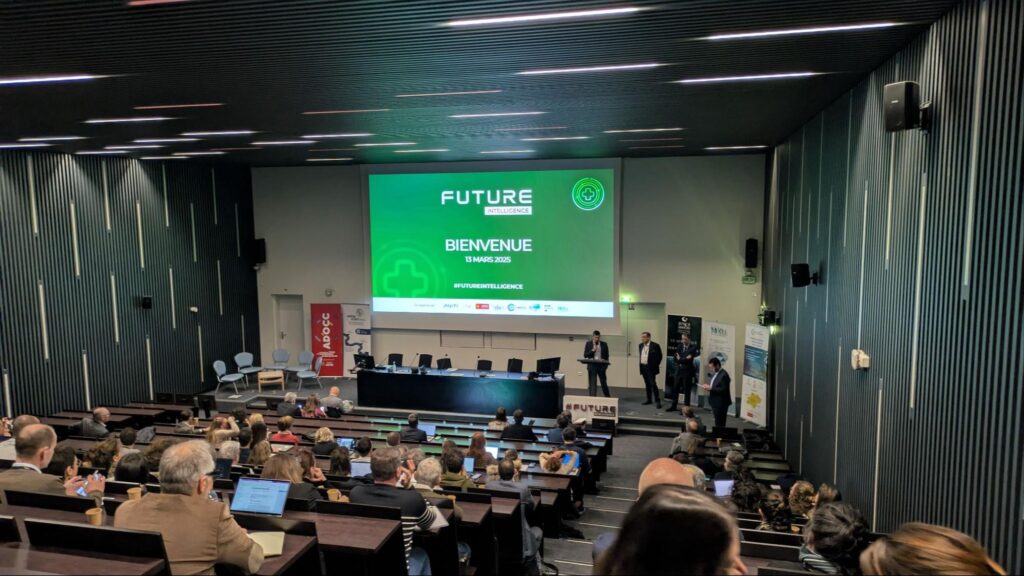
On March 13, the Purpan hospital in Toulouse hosted a new edition of Future Intelligence. This event brought together the Artificial Intelligence and Medical Intelligence communities for a session on trusted AI useful in the service of Health.
The day featured discussions on advances in AI applied to research, healthcare, ethics, and digital twins (Discover more on digital twins in this article). The discussions highlighted concrete solutions for trustworthy, ethical, and patient-centred AI. The networking also created new synergies between researchers, healthcare professionals, businesses, and institutions.
Concrete Cases and Anticipation
Dr. Jean-Louis Fraysse recalled the importance of being “at the beginning of something”. He evoked the origins of the third cholera pandemic, drawn from statistical archives, as proof that medicine has always relied on data analysis to anticipate crises.
This historical reminder highlighted the need to move from a curative model, which intervenes once the pathology has been declared, to a predictive and preventive model. Anticipating the worst makes it possible to consider measures today that minimise the impact of future health emergencies. Therefore, integrating AI as an essential ally in decision support and strengthening the role of caregivers.
Ethics and Data Governance: Laying the Foundations for Trusted AI
The conference’s first theme was the ethical and technical challenges associated with the use of healthcare data. Audrey Kauffmann of Pierre Fabre Medical Care highlighted the critical role of input data quality in algorithm performance, stating the principle “Garbage-in / Garbage-out.”
In this context, Aymeric Perchant recalled the importance of maintaining strict control over the decision-making tree. So, that artificial intelligence remains an assistance tool and not a substitute for medical judgment.
Dr. Nicolas Delaporte of the Toulouse University Hospital, for his part, spoke of the urgent need to establish interoperability standards. He cited the FHIR standard in particular, while emphasising that complete automation was inconceivable without the intervention of a human in the loop.
The discussions also addressed the environmental dimension and the need to adopt frugal models. Finally, the patients’ perspective, highlighted by Arthur Dauphin, emphasised that transparency regarding data use is essential to establishing a climate of lasting trust.
Medical Research: Accelerating Innovation through AI
The session dedicated to medical research demonstrated how artificial intelligence can accelerate innovation and transform the clinical research landscape. Vincent Diebolt presented in silico techniques that enable the dematerialisation and decentralisation of clinical trials. Thus, ensuring rigor equivalent to traditional methods while simplifying their implementation.
Dr. Laure Rouch then outlined the perspectives opened up by the identification of biomarkers and the use of biological clocks to understand aging and, consequently, improve prevention.
Furthermore, the work of Lionel Colliandre of Evotec illustrated how Bayesian optimisation and active learning approaches facilitate the exploration of large chemical spaces. This is accelerating the development of promising molecules.
Finally, the contribution of Stéphanie Allassonnière and Marketa Saint-Aroman highlighted the use of artificial data to overcome the limitations of traditional clinical datasets. This guarantees increased robustness to the models developed.
Optimising Care Pathways: AI at the Service of the Patient
In the session devoted to healthcare, the focus was on the concrete improvement of care pathways through digital technologies. Digital solutions, through, for example, the use of digital twins and telehealth platforms, provide personalised and continuous monitoring. This allows interventions to be better tailored to the specific needs of each patient.
David Gruson illustrated the promise of early home screening. This allows to guide patients toward appropriate care based on the level of risk detected. Dr. Fabrice Ferré expanded on these remarks by presenting intelligent solutions, such as medical chatbots. These chatbots are capable of maintaining a constant connection with the patient throughout all stages of care, from the preoperative period to postoperative follow-up.
Concrete examples, such as the X-Pressure solution for detecting hydrocephalus or Christophe Hurter’s approach to identifying biomarkers of epileptic seizures, have illustrated how AI, integrated into hospital practices, strengthens the effectiveness of care while remaining complementary to the doctor’s central role.
Digital Twins: Simulate for Better Prevention
The final part of the conference opened a resolutely forward-looking dimension by addressing digital twins in the medical sector.
Presentations by Dr. Jean-Louis Fraysse and Stanley Durrleman brought to light the idea of creating virtual replicas. Replicas, whether of patients or organs, help to simulate interventions and predict the progression of complex diseases like Alzheimer’s. They can also help optimise the predictive maintenance of medical devices. Thierry Garaix and Yann Maël Le Douanin expanded on this thinking by discussing the optimisation of hospital processes. In this area, simulation enables better flow management in emergency situations and real-time adjustment of care protocols.
These applications concretely demonstrate that digital twins are not limited to theoretical modelling. They offer a real opportunity to anticipate and prevent, by complementing the work of practitioners in the field.
Building Tomorrow’s Health Together
The future of healthcare rests on the convergence of technological innovations and strong ethical principles. Unlike some industries still in the early stages of artificial intelligence, the healthcare sector has long benefited from proven machine learning and analytical AI solutions: from early disease detection through supervised learning to decision support systems based on big data analysis. The advent of generative AI is therefore not a sudden revolution. It’s a further step—a refinement of existing tools to enrich predictive and personalised medicine.
Each presentation, from the powerful opening keynote address to the explorations of digital twins, demonstrates a shared commitment between researchers, clinicians, industry, and regulators. The goal, more than ever, is to transform medicine from essentially curative to predictive, personalised, and, above all, human. Future Intelligence reminds us that AI should not be seen as an end in itself, but as a tool that, under the watchful and enlightened gaze of humans, will improve quality of life, strengthen trust, and ensure personalised and responsible care.
The path is clear: with our technological maturity and our advancement in the use of AI, the health of tomorrow is being built together, starting today.
For a foundational overview of the technologies currently being deployed, read our guide to AI in Healthcare. Interested in how AI is changing research? Read our analysis From Antiquity to Artificial Intelligence.
Over 80% of AI projects fail. Yours don’t have to.
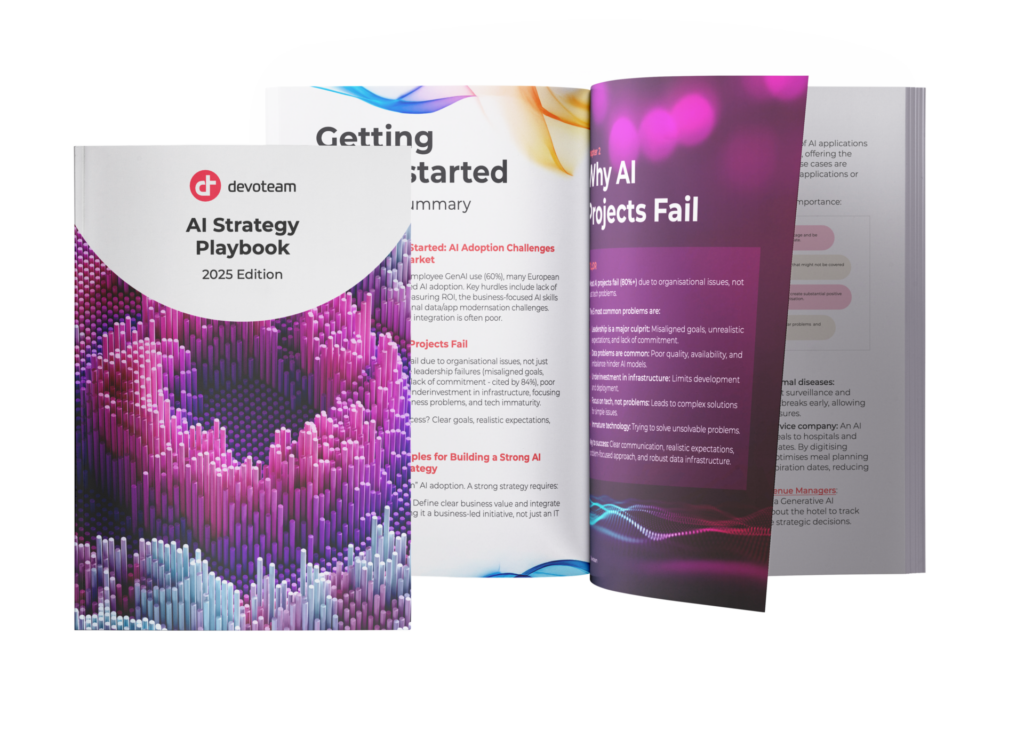
Download our AI Strategy Playbook:
- Learn why AI projects often fail (and how to avoid it).
- Follow 10 clear steps for a strong AI plan.
- Focus on solving business problems (not just using AI).
- Find the best AI uses for your business (includes 100+ examples).
- Learn how to measure AI results (GenAI projects average ~3.7x return).
- Get your tech foundations ready (Cloud, Data, and AI Security).
- Help your team adapt to AI (and see how we train our staff).
- Use AI responsibly (covering fairness, bias, and environmental thoughts).