




What if your entire marketing campaign could be planned, executed, and optimised by a team of AI agents working together, without human intervention?
AWS is executing a clear strategy to make this reality. They build the infrastructure, provide the tools, and own the orchestration layer. Rather than simply offering components for building chatbots, Amazon Web Services has constructed an ecosystem designed to automate entire business processes through intelligent, collaborative AI agents.
The company’s approach is deliberately layered. It goes from fully managed services like Agents for Amazon Bedrock that abstract away complexity, to open-source frameworks like Strands and Agent Squad that offer granular control. This multi-tiered strategy ensures AWS captures workloads regardless of developer preferences or organisational maturity levels.
This article dissects AWS agentic AI ecosystem. We’ll examine the architectural foundations that power these systems, the frameworks that guide their development, and the recent strategic announcements that signal a shift toward multi-agent business process automation. We’ll explore how AWS is positioning itself not just as a cloud provider, but as the foundational platform for the next generation of enterprise automation.
In this article you’ll read:
Defining the AI Agent in the AWS Context
Within the AWS agentic AI ecosystem, an agent is a rational, autonomous software program. It is engineered to interact with its environment and perceive data. An agent can perform self-determined tasks to achieve predefined goals without continuous human intervention. These are not merely bots. They are intelligent systems that make rational decisions based on their perceptions to produce optimal outcomes. For example, a contact center agent can independently ask a customer clarifying questions. The agent can also search internal knowledge bases, and formulate a solution, all while adapting to the flow of the conversation.
Architectural Deep-Dive into Agents for Amazon Bedrock
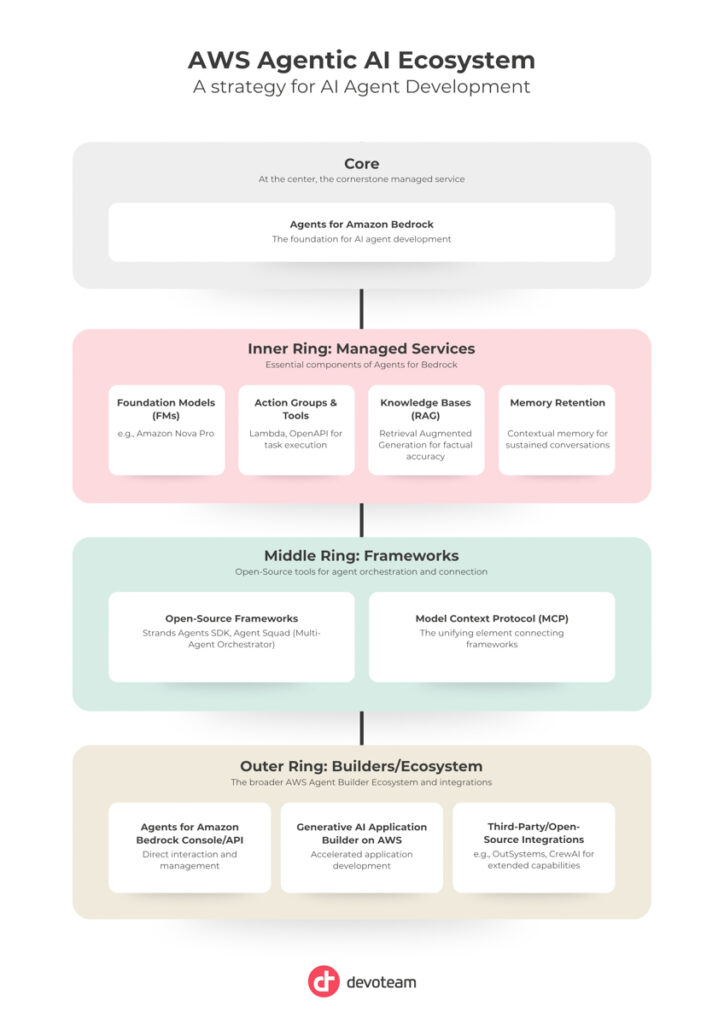
Agents for Amazon Bedrock is the cornerstone of AWS agentic AI ecosystem. It is a fully managed, serverless service designed to simplify the creation, deployment, and scaling of generative AI agents. The service orchestrates the fundamental components of an agentic system. It abstracts away the underlying complexity and allowing developers to focus on business logic rather than the mechanics of AI. Several distinct but interconnected layers compose the architecture.
The Reasoning Engine: Foundation Models (FMs)
At the core of every agent is a foundation model that serves as its reasoning engine or “brain.” This model is responsible for interpreting user requests, breaking down complex tasks into logical steps (planning), and generating coherent responses. Amazon Bedrock provides access to an extensive and diverse selection of high-performing FMs from leading AI companies. It includes Anthropic, Cohere, Meta, Mistral AI, AI21 Labs, and Stability AI. And, of course, Amazon’s own model families, all accessible through a single, unified API.
This model-agnostic approach is a key strategic advantage. It gives developers the flexibility to choose the best FM for their specific use case, balancing considerations of performance, cost, and specialised capabilities.
A critical recent development is the introduction of the Amazon Nova family of foundation models. This suite includes Amazon Nova Pro. It is a highly capable model specifically optimised for the kind of complex reasoning and instruction following that is essential for sophisticated agentic tasks and multi-agent orchestration.
The Action Layer: Action Groups and Tools
For an agent to be useful, it must be able to interact with the world beyond its own context. The Action Layer provides this capability. It allows the agent to execute tasks by calling APIs, interacting with applications, and querying databases. In Agents for Bedrock, Action Groups implement this.
An Action Group is a collection of specific, concrete actions that an agent is permitted to perform. Each action is defined using two key components:
- An OpenAPI Schema: This schema, written in JSON or YAML, serves as a formal contract. It describes the API’s endpoints, parameters, and expected responses. The agent’s foundation model uses this schema to understand what a tool does, what inputs it requires, and what outputs to expect. This allows the model to intelligently decide when and how to call the tool.
- An AWS Lambda Function: The function encapsulates the actual business logic for the action. When the agent decides to invoke an action, it triggers this function. The function executes the necessary code. It can be querying a database, calling an internal enterprise API, or interacting with a third-party service.
This architectural pattern provides a standardised, secure, and scalable way to expose virtually any digital capability to an AI agent. Developers can leverage the vast ecosystem of AWS services and their existing enterprise systems by simply wrapping them in a Lambda function and describing them with an OpenAPI schema.
The Knowledge Layer: Knowledge Bases for Retrieval-Augmented Generation (RAG)
Agents for Bedrock can securely connect to an organisation’s private data sources, such as documents in Amazon S3, to create a Knowledge Base. When a user asks a question, the agent first searches this Knowledge Base for relevant information. It then “augments” the original prompt by injecting this retrieved context before sending it to the foundation model.
The Context Layer: Memory Retention
Effective conversational agents require the ability to remember past interactions to provide a coherent and personalised experience. Agents for Bedrock incorporate built-in memory capabilities to manage conversational context. This includes:
- Short-Term Memory: The agent maintains the context of the current conversation session. This allows users to ask follow-up questions without having to restate previous information.
- Long-Term Memory: The service also supports the retention of memory across multiple interactions and sessions. This enables the agent to recall historical context. It improves the accuracy of multi-step tasks and offering more personalised recommendations over time.
Amazon Bedrock manages the complexities of session handling and memory summarisation, freeing developers from building this state management logic themselves.
The Execution Layer: Orchestration and Code Interpretation
The Execution Layer is where all the components come together. Agents for Bedrock automate the core agentic loop, often referred to as a ReAct (Reason, Act) loop. When a user submits a request, the service orchestrates the following sequence:
- Reason: The agent uses the FM’s reasoning abilities to analyze the request. The agent breaks it down into a logical sequence of steps or a plan.
- Act: The agent determines which tools (Action Groups) or knowledge bases are needed to execute the plan. It automatically calls the necessary APIs or queries data sources to gather information or perform transactions.
- Observe & Iterate: The agent observes the results of its actions and determines if the task is complete or if more information is needed from the user or other tools. It continues this loop until the user’s request is fulfilled.
The AWS Agentic Frameworks
Every organization faces a crucial question when adopting new technology: What frameworks actually drive its design? For AI agents on AWS, the answer is not a single, monolithic framework. It is a sophisticated, multi-layered ecosystem of conceptual models, managed services, and open-source tools.
This section deconstructs these layers to provide a clear picture of the options available to developers, from high-level architectural guidance to specific, code-level SDKs and the pivotal role of the Model Context Protocol (MCP).
The Conceptual Framework: A Mental Model for Agentic AI on AWS
Before writing a single line of code, architects need a mental model to structure their thinking. AWS provides a high-level conceptual framework for designing agentic AI systems, breaking them down into six key modules. This model serves as a design pattern. It helps teams to think systematically about the components of a robust and intelligent agent.
The six modules are:
- Perception Module: How the agent senses its environment (e.g., through user input, sensor data, or API streams).
- Cognitive Module: This is the agent’s “brain,” responsible for reasoning, planning, and decision-making. It is where services like Amazon Bedrock and its foundation models reside.
- Action Module: How the agent acts upon its environment. This is enabled by services like AWS Lambda, which execute tool calls defined in Bedrock Agents.
- Learning Module: The mechanism for continuous improvement and feedback. This can be supported by services like Amazon SageMaker for model retraining or Knowledge Bases for RAG.
- Collaboration Module: How the agent communicates and works with other agents or humans. This is directly addressed by new capabilities like multi-agent collaboration in Bedrock.
- Security Module: The layer responsible for safety, privacy, and governance. This is where services like Amazon Bedrock Guardrails and AWS Identity and Access Management (IAM) are critical.
This conceptual framework provides a structured vocabulary and a set of design principles, allowing architects to map the vast portfolio of AWS services to the specific functional requirements of an agentic system.
The Managed Framework: Agents for Bedrock
For most enterprises, the primary and most direct way to build agents on AWS is through the fully managed service, Agents for Amazon Bedrock. This service is AWS’s principal framework. It provides a prescribed architecture and a streamlined development path that prioritises ease of use, security, and tight integration with the broader AWS ecosystem.
By choosing this managed framework, developers trade some level of granular control for significant benefits in speed and operational simplicity. The service handles the complex orchestration of the agentic loop, memory management, and automatic prompt engineering, allowing teams to focus on defining the agent’s purpose and tools rather than its internal mechanics.
The Open-Source Frameworks: Flexibility and Control
As a one-size-fits-all approach does not suit the diverse needs of the AI development community, AWS actively develops and supports a portfolio of open-source frameworks. These frameworks offer greater flexibility, control, and interoperability for developers who need to build more customised or complex agentic systems.
Strands Agents SDK
Strands Agents is a powerful, open-source Software Development Kit (SDK) that represents a model-driven philosophy for building AI agents. This is a significant offering because it contrasts with more workflow-centric frameworks (like LangChain’s original chain-based approach) by placing greater trust in the reasoning capabilities of modern foundation models.
The core concepts of Strands are elegant in their simplicity. An agent is defined in just a few lines of code by three components:
- A Model: Strands is model-agnostic, supporting models from Amazon Bedrock, Anthropic, Llama, OpenAI (via LiteLLM), and local models via Ollama. It can also define custom providers.
- A Set of Tools: A tool can be any Python function or, critically, any published Model Context Protocol (MCP) server.
- A Prompt: A natural language instruction that defines the agent’s task.
Instead of requiring a developer to explicitly define a rigid chain of thought or a graph of execution, Strands leverages the advanced reasoning of the underlying FM to dynamically plan its own steps and select the appropriate tools in a loop until the task is complete.
Strands is not just an experimental project.
It is used in production by internal AWS teams for core services like Amazon Q Developer, AWS Glue, and VPC Reachability Analyzer. This internal adoption is a strong signal of its robustness, scalability, and strategic importance to AWS’s own development efforts.
“Strands distinguishes itself from other frameworks through its model-driven architecture, which facilitates the development of AI agents with minimal complexity. By requiring only the definition of a prompt and a collection of available tools within a concise code implementation, the framework enables the underlying model to autonomously determine the appropriate actions for the agent based on the provided tool set.
Strands’ primary advantage is its integration with the AWS services ecosystem, making it particularly well-suited for development teams with existing AWS expertise and infrastructure. Nevertheless, the framework may exhibit limitations in scenarios that demand granular control over the agent’s operational workflow and decision-making processes.”
Reyan Leifa, AWS Solution Architect, Devoteam
Agent Squad (formerly Multi-Agent Orchestrator)
Strands is focused on building individual agents. Agent Squad is an open-source framework for orchestrating multiple AI agents to handle complex, multi-turn conversations and workflows.
The architecture of Agent Squad is built for sophisticated coordination:
- Classifier: An intelligent routing component that analyses a user’s query and directs it to the most suitable agent in the “squad” based on the agent’s defined characteristics and the conversation history.
- SupervisorAgent: This component enables advanced team coordination using an “agent-as-tools” pattern. A lead agent can coordinate a team of specialised agents, invoking them in parallel to work on different facets of a complex problem while maintaining a shared context.
Agent Squad is explicitly designed for a multi-platform world. It provides native support for models from AWS, Anthropic, and OpenAI and is implemented in both Python and TypeScript.
The Unifying Protocol: Model Context Protocol (MCP)
Model Context Protocol (MCP) is an open standard. We could describe as the “USB-C for AI applications,” aiming to standardise tool integration. In other words, this protocol connects the conversational abilities of large language models (LLMs) with actionable systems like APIs and databases.
AWS heavily invests in MCP, indicating a strategic focus on an open, interoperable tool ecosystem:
- Official MCP Servers: AWS is releasing official, open-source MCP servers for its own core services, including AWS Lambda, Amazon ECS, Amazon EKS, AWS CDK, and Terraform. This allows any MCP-compliant AI assistant to interact with these AWS services using a standardised, best-practice approach.
- Integration into AWS Products: MCP support is being built directly into flagship AWS products. Amazon Q Developer, for example, can now connect to external MCP servers, allowing it to use tools from third parties like Atlassian (for Jira) and Figma, expanding its capabilities beyond the AWS ecosystem.
- Framework-Level Support: MCP is a foundational element of the Strands Agents SDK, which is designed to consume any MCP server as a native tool.
The biggest bottleneck to agent adoption is the difficulty of integrating with the thousands of tools and APIs that enterprises rely on. By championing a standard that simplifies this integration, AWS helps foster a rich ecosystem of third-party tools. If MCP becomes the industry standard, a vast library of MCP servers will emerge.
For a technical deepdive on MCP: Deploy a secure MCP Server to manage EKS clusters using natural language
The AWS-Specific Agent Builder Ecosystem
While frameworks provide the architectural blueprints, developers need concrete tools to bring their agents to life. AWS offers a layered ecosystem of builders, from its primary managed service interface to solution accelerators and deep integrations with third-party tools. This approach aims to maximise adoption by catering to different developer skill sets, organisational maturities, and project requirements.
The Primary Builder: The Agents for Amazon Bedrock Console and API
The central hub for creating, managing, and deploying agents on AWS is the Agents for Amazon Bedrock console. This is the primary, AWS-native builder interface, complemented by a full-featured API for programmatic control. It provides developers with a granular set of controls over every aspect of the agent’s lifecycle.
The builder experience is multifaceted:
- Guided and Manual Creation: For those new to the service, a “conversational builder” offers a guided, step-by-step workflow to configure an agent. For more advanced users, the service allows for manual configuration of every parameter, providing maximum control within the managed environment.
- Dynamic Configuration: For highly dynamic use cases, agents can even be configured “inline” at runtime. This allows an application to define an agent’s instructions, tools, and knowledge bases on-the-fly for a specific task, without needing to pre-configure it in the console.
- Comprehensive Control Panel: The builder serves as a central control panel for all agent components. Developers can select foundation models, write detailed instructions, define Action Groups with their OpenAPI schemas, associate Knowledge Bases for RAG, configure memory retention policies, and enable features like Code Interpretation.
- Advanced Prompt Engineering: Recognising that the prompt is the heart of the agent, the builder provides tools for advanced prompt templating. Developers can inspect and refine the automatically generated prompt templates used at various stages of the orchestration process (e.g., pre-processing, orchestration, post-processing) to fine-tune the agent’s behaviour and enhance the user experience.
- Essential Observability: A critical feature for any complex system is the ability to observe its internal state. The builder includes a trace feature that allows developers to see the agent’s step-by-step reasoning process. This trace reveals the orchestration plan generated by the model, the sequence of API calls made, the data returned, and the final response generation. This level of transparency is indispensable for debugging, troubleshooting, and optimising agent performance.
The Accelerator: Generative AI Application Builder on AWS
For organisations that want to move even faster, AWS provides the Generative AI Application Builder on AWS. This is not a builder in the traditional sense, but an AWS Solution Implementation. It’s a pre-packaged, production-ready architecture that can be deployed into a customer’s account with a single AWS CloudFormation template.
The primary purpose of this solution is to “remove the heavy lifting” associated with deploying a complete generative AI application stack. It provides a no-code deployment wizard that allows users to rapidly stand up and experiment with various use cases, including:
- Conversational search and AI-generated chatbots.
- Text generation and summarisation.
- Complex workflows powered by Amazon Bedrock Agents.
The architecture follows AWS Well-Architected principles, ensuring it is secure, scalable, and highly available. It comes pre-integrated with Amazon Bedrock, its foundation models, Knowledge Bases for RAG, and Guardrails for safety. By bundling all these components into a turnkey solution, the Generative AI Application Builder acts as a powerful accelerator or quick-start kit, enabling teams to go from idea to a functioning, agent-powered application without requiring deep expertise in cloud infrastructure or AI.
The Extended Ecosystem: Third-Party and Open-Source Builders
AWS’s strategy extends beyond its own native tools. This strategy is actively fostering an ecosystem of third-party and open-source builders that leverage Amazon Bedrock as a foundational service. This approach recognises that many developers and organisations have existing investments in other platforms and tools.
Low-Code/No-Code Platform Integration
An example of this strategy is the integration with platforms like the OutSystems AI Agent Builder. OutSystems is a leading low-code development platform. Its AI Agent Builder allows its users to easily incorporate powerful AI capabilities into their applications. The integration enables them to add Amazon Bedrock models as available endpoints within the OutSystems environment, effectively bringing AWS’s powerful FMs to the low-code world.
Open-Source Framework Collaboration
The partnership with CrewAI, a popular open-source framework for orchestrating autonomous AI agents, is particularly significant. Instead of viewing such frameworks as competitors, AWS is actively collaborating with them. This partnership involves AWS publishing official reference blueprints and open-sourcing example systems that demonstrate how to effectively use CrewAI’s “flows-and-crews” architecture with Amazon Bedrock models, memory, and guardrails. The collaboration provides a secure, modular, and vendor-neutral foundation for enterprises looking to build large-scale agentic systems using familiar open-source tools. The reported results from early pilots are compelling, with a large-scale code-modernisation project running approximately 70% faster and a consumer-packaged goods (CPG) back-office automation flow cutting processing time by 90%.
This multi-layered builder ecosystem reveals a deliberate and pragmatic strategy. AWS is ensuring that no matter the developer’s skill set or preferred toolchain, there is a clear and supported path to building on its AI infrastructure.
- At the lowest level, the Bedrock API provides full programmatic control for expert developers.
- The Bedrock Agent Builder console offers a user-friendly UI for application and DevOps teams.
- The Generative AI Application Builder provides a turnkey solution for organisations prioritising speed to market.
- Finally, by enabling deep integrations with third-party platforms like OutSystems and open-source leaders like CrewAI, AWS is executing a sophisticated “embrace and extend” strategy. This approach allows AWS to capture the underlying compute and model-access workloads even if it doesn’t own the top-level application framework. It pragmatically acknowledges the diversity of the developer landscape and aims to make Amazon Bedrock a ubiquitous, foundational service for any and all agent builders.
AWS AI Agentic Ecosystem: Recent Announcements (re:Invent 2024)
The announcements from AWS re:Invent 2024 represent an inflexion point in the company’s AI strategy. The focus has clearly shifted from providing the components for building individual, task-oriented agents to delivering a managed platform for orchestrating complex, enterprise-scale agentic systems. This forward-looking analysis examines the key announcements. AWS’ strategy aims at automating entire business processes and hardening them for production deployment.
The Headline Announcement: Multi-Agent Collaboration in Amazon Bedrock
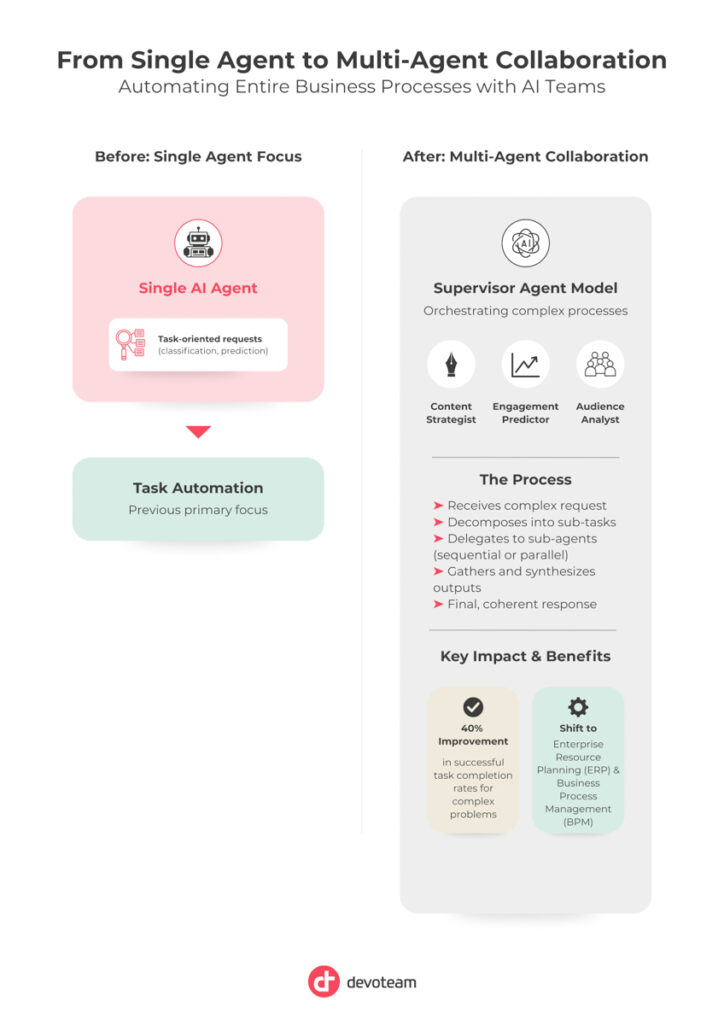
The most groundbreaking announcement was the introduction of multi-agent collaboration as a new capability within Amazon Bedrock. Now available in preview, this feature allows developers to build, deploy, and manage teams of specialised AI agents. These agents work together to tackle complex, multi-step business workflows that would be beyond the scope of any single agent.
The architecture of this system is hierarchical and employs a supervisor-agent model:
- A central “supervisor” agent acts as an orchestrator or project manager. It receives a high-level, complex request from a user.
- The supervisor agent uses its advanced reasoning capabilities to analyse the request and decompose it into a series of smaller, more manageable sub-tasks.
- It then delegates these sub-tasks to a team of specialized “sub-agents”. Each of which has a specific skill or domain expertise. The supervisor can orchestrate these sub-agents to work in sequence or in parallel, depending on the nature of the task.
- Finally, the supervisor agent gathers the outputs from all the sub-agents and consolidates them. It then synthesises a final, coherent response for the user.
AWS illustrates this with a practical example.
A team of agents could automate a complex social media campaign:
- A content-strategist agent could generate creative post ideas
- An engagement-predictor agent could forecast performance
- An audience-analyst agent could provide demographic insights
- A supervisor agent would coordinate all three, ensuring a cohesive and effective campaign execution from start to finish.

This move up the value chain from single-task automation to multi-step process automation is a clear indication of AWS’s ambition. The goal is no longer just to build a better chatbot, but to create a new engine for enterprise resource planning (ERP) and business process management (BPM). AWS’s internal benchmarks underscore the significance of this approach, claiming that multi-agent collaboration can improve successful task completion rates by 40% compared to popular single-agent solutions when dealing with complex problems.
The Enabling Technology: The Amazon Nova Model Family
Amazon’s launch of multi-agent collaboration intrinsically links to another major announcement: the new Amazon Nova family of foundation models. These next-generation models, which Amazon offers exclusively through Amazon Bedrock, provide state-of-the-art intelligence with industry-leading price-performance.
The Nova family is not monolithic; it consists of several models tailored for different needs:
- Amazon Nova Micro and Lite: optimised for efficiency, offering lower cost and latency for simpler or high-volume tasks.
- Amazon Nova Pro: A highly capable, frontier model specifically designed for the kind of complex reasoning and sophisticated instruction-following required by the “supervisor” agents in a multi-agent system.
Furthermore, the Nova models are inherently multimodal. They have advanced capabilities to understand and process not just text, but also visual data like images, charts, and diagrams, and even to generate video content. This paves the way for future multi-agent systems that can automate workflows involving a rich mix of data types, moving beyond purely text-based interactions. The development of a powerful, in-house model like Nova Pro gives AWS a finely tuned engine to power its most advanced agentic capabilities.
The Enterprise-Hardening Features
Deploying powerful, autonomous multi-agent systems to run critical business processes requires an unprecedented level of trust and reliability. Recognising this, AWS announced a suite of enterprise-hardening features in parallel, designed to build customer confidence and make these systems safe for production.
Guardrails with Automated Reasoning
Perhaps the most scientifically significant of these features is the addition of Automated Reasoning checks to Amazon Bedrock Guardrails. This is a first-of-its-kind generative AI safeguard that goes beyond simple content filtering. It uses techniques from formal methods to validate the factual accuracy of an LLM’s output. By encoding domain-specific rules and business logic into verifiable policies, this feature can help prevent factual errors and reduce hallucinations with a degree of logical rigor previously unavailable in the industry.
The parallel launch of a more powerful agentic engine (Multi-Agent Collaboration) and a more powerful safety system (Automated Reasoning) is not a coincidence. As agent systems become more powerful and autonomous, the potential “blast radius” of an error increases. Enterprises will not hand over the keys to critical business processes without extremely strong guarantees of reliability. Automated Reasoning provides a crucial mechanism to build that trust, making it a necessary prerequisite for the widespread adoption of complex multi-agent systems.
Enhanced Amazon Q Developer
Amazon Q is becoming a powerful, real-world demonstration of the agentic patterns AWS is pioneering. New capabilities announced for Amazon Q Developer include agentic features that can automatically generate documentation, perform code reviews for security and quality, and even assist with large-scale application transformation projects, such as modernising a legacy.NET application or migrating from VMware. By embedding these advanced agentic workflows directly into its core developer tool, AWS is not only showcasing the power of its technology but also accelerating its customers’ own development and modernisation efforts.
Collectively, the re:Invent 2024 announcements paint a clear picture of AWS’s strategic direction. The company is moving decisively beyond providing agent components and is now offering a managed platform for agentic business process automation, complete with the state-of-the-art models needed to power it and the enterprise-grade guardrails required to run it safely in production.
Amazon Bedrock AgentCore
Amazon launched Amazon Bedrock AgentCore in July 2025 as a managed service to help organizations deploy AI agent prototypes into secure, scalable production environments.
The platform eliminates infrastructure complexity by providing enterprise-grade services for runtime, identity, memory, and observability, allowing teams to focus on business logic rather than operational requirements. AgentCore’s framework-agnostic design supports popular open-source frameworks like CrewAI, LangGraph, and LlamaIndex while working with any foundation model, preventing vendor lock-in. Key benefits include accelerated time-to-value, built-in security with complete session isolation, and automatic scaling through serverless architecture.
While still in preview, early testing shows promising capabilities for fast deployment, though areas like cost control and observability dashboards need refinement before reaching general availability.
Read our full article:
Amazon Bedrock AgentCore: The Infrastructure Layer for Enterprise AI Agents
Conclusion
AWS has laid the groundwork for a fundamental shift in how enterprises approach automation. By combining managed services that lower barriers to entry with sophisticated multi-agent orchestration capabilities, the company is positioning itself at the center of what could become the largest transformation in business process management since the advent of ERP systems.
The strategic elements are now in place: the Nova models provide the reasoning power, the multi-agent collaboration framework enables complex workflow automation, and enterprise-grade guardrails with automated reasoning offer the safety net required for production deployment. The question is no longer whether AI agents will transform enterprise operations, but how quickly organisations can adapt to leverage this new paradigm.
Over 80% of AI projects fail. Yours don’t have to.
Download our AI Strategy Playbook:
- Learn why AI projects often fail (and how to avoid it).
- Follow 10 clear steps for a strong AI plan.
- Focus on solving business problems (not just using AI).
- Find the best AI uses for your business (includes 100+ examples).
- Learn how to measure AI results (GenAI projects average ~3.7x return).
- Get your tech foundations ready (Cloud, Data, and AI Security).
- Help your team adapt to AI (and see how we train our staff).
- Use AI responsibly (covering fairness, bias, and environmental thoughts).