



Estimated reading time: 10 minutes
Written as part of our AI Upskilling Program
This article was created as part of the Global Devoteam AI Upskilling Program, where employees share their knowledge to accelerate their learning. The program’s key objective is to provide a foundation in AI for every employee and apply these new skills in our work. Do you want to work with us? Check out our career opportunities.
The conversation around AI is often polarised, between a vision of a personalised educational utopia and fears of job replacement and bias. The truth lies somewhere in the middle. The goal isn’t to replace the human connection in teaching but to augment it. By handling repetitive work, AI frees educators to focus on inspiring and mentoring students. At the same time, we need to be aware of the ethical and practical considerations.
In this article we explore the critical challenges education sector is currently facing and the opportunities AI is presenting. You will also get practical steps for implementing AI in classrooms and an overview on ethical considerations.
Current Challenges in Education
Before we jump into AI’s promise, let’s start with some current challenges in the education sector
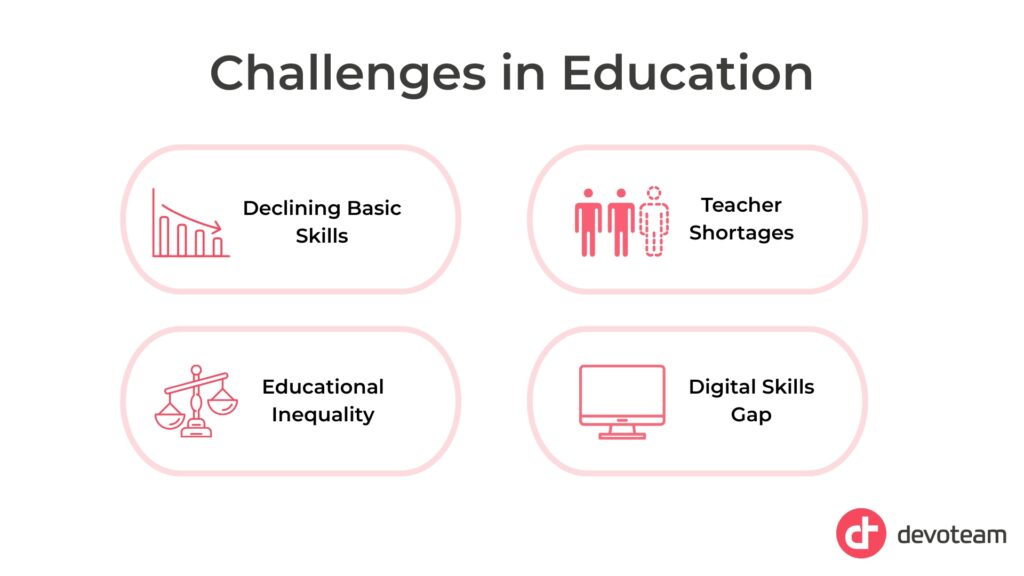
- Declining Basic Skills: According to the 2022 PISA report, nearly 30% of EU students lack basic proficiency in mathematics.
- Teacher Shortages: Europe is projected to have a shortfall of 3.1 million secondary school teachers by 2030, according to UNESCO. The shortage is mostly due to teachers leaving profession.
- Educational Inequality: Students from disadvantaged socio-economic backgrounds are more likely to underperform, creating a significant equity gap. Based on 2018 PISA report, disadvantaged students are 2.7 times more likely not to achieve the minimum level of proficiency in reading.
- Digital Skills Gap: The digital transformation has also exposed a substantial digital skills gap. While technology is increasingly integrated into daily life and the economy, many young people and adults lack the necessary digital competencies.
How Can AI Improve Education?
How can AI address the challenges we just discussed? Let’s start with a quick overview:
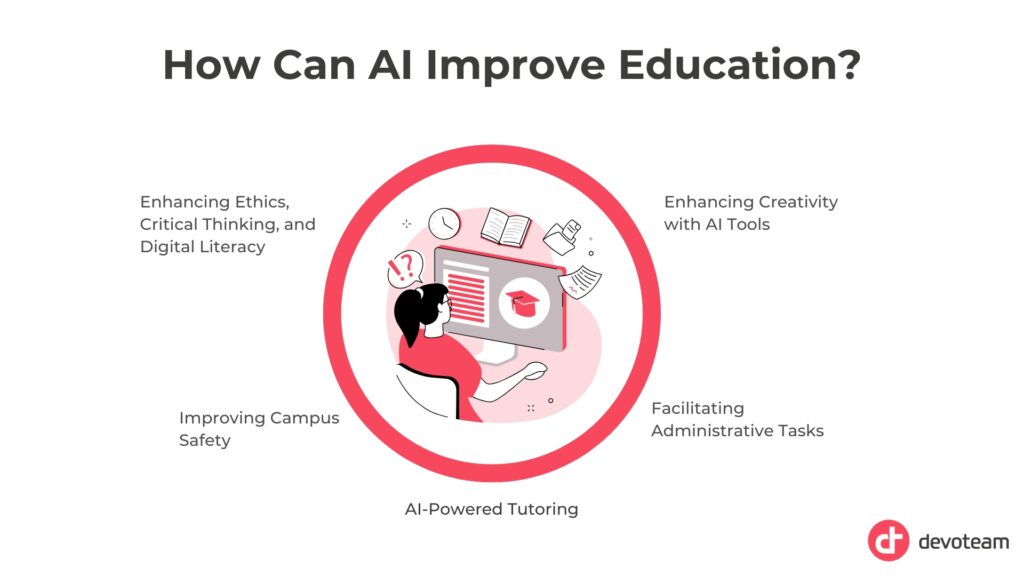
Let’s dive deeper and see some real-world examples.
1. AI-Powered Tutoring
AI can function as a 24/7 tutor for students. With AI chatbots or virtual assistants, students can ask questions and get immediate feedback on homework or concepts they might be struggling with. Tools like these can help students when teachers are not available, whether at night or over the weekend. AI-driven tutoring systems not only help students grasp concepts but also allow teachers to monitor progress and identify areas where students need additional support.
Examples: platforms like Khan Academy and Duolingo use AI to provide interactive exercises and quizzes that track progress and adjust the difficulty level based on the learner’s responses.
2. Enhancing Creativity with AI Tools
Artificial intelligence can encourage students’ creativity and assist them in art, music, and writing. AI-powered tools are excellent for encouraging experimentation and innovation, enabling students to see the potential of AI in creating original content. AI can also enhance storytelling abilities, allowing young learners to develop their narratives by suggesting plot twists, characters, or dialogue based on their input. This helps students realise that technology and creativity can work hand-in-hand, making the learning process fun and engaging.
Examples: Programs such as DeepArt and Runway ML allow students to create digital artwork using AI, while tools like AIVA help students compose original music by analysing their preferences and style. In writing, AI tools like Grammarly and Slick Write provide instant feedback on grammar, sentence structure, and style, helping students become more proficient in their writing skills.
3. Facilitating Administrative Tasks
Teachers can benefit from AI in ways that go beyond student interaction. AI can help automate administrative tasks such as grading, attendance tracking, and even curriculum development. Tools that can assess student essays or multiple-choice quizzes can help reduce the time teachers spend on grading, allowing them to focus more on student interaction and lesson planning.
Moreover, AI-based systems can analyse data from various student assessments and highlight trends, enabling educators to identify which students may need extra help. By streamlining administrative tasks, AI allows teachers to allocate more time to personalised teaching and creating meaningful learning experiences.
Example: Tools like MagicSchool.ai, Microsoft Copilot or Google Gemini can be used, for example, to create a 60-minute lesson plan on specific topics. Additionally, Copilot and Gemini can be used within communication and productivity tools like Microsoft 365 or Google Workspace to summarise emails, draft responses, or analyse information.
4. Enhancing Ethics, Critical Thinking, and Digital Literacy
Incorporating AI into education doesn’t just mean using tools for personalised learning or administrative efficiency. It also provides a valuable opportunity for students to learn about the ethical implications of artificial intelligence and how it works. Understanding AI’s capabilities, limitations, and ethical concerns is crucial for the next generation, as they will be living in a world heavily influenced by this technology.
AI in the classroom can foster critical thinking skills by prompting students to ask questions about data privacy, the impact of AI on jobs, and the potential for bias in AI algorithms. Schools can teach students how to use AI responsibly, make informed decisions, and develop the skills needed for future careers that may revolve around AI.
Example: Devoteam participated in the UNECE Civil Society Forum in Geneva, where they designed and led an innovative workshop on using artificial intelligence to advance gender equality. The project focused on two key areas: providing quality education on AI and ensuring equal access to emerging technologies for women and girls. Read more about the project.
5. Improving Campus Safety
AI-driven surveillance systems can analyse video feeds in real time to detect unauthorised access, forbidden objects or unusual activity, alerting security to potential threats before they escalate and helping to allocate security resources more effectively.
Example: The University of Illinois Chicago (UIC) uses AI-powered video surveillance. The system addressed different security concerns. such as weapon detection to parking lot monitoring.
Ethical Considerations
AI in Education has a lot of potential, but we can’t turn a blind eye to the potential problems. Let’s explore some aspects to consider:
- The Danger of Algorithmic Bias: This is a critical ethical challenge. AI models learn from historical data, and if that data reflects societal biases, the AI will amplify them. For instance, an AI could recommend fewer advanced science courses to girls or fewer resources to students from low-income neighbourhoods, creating a high-tech system that reinforces old inequities.
- The Rise of the Surveillance School: Personalisation requires extensive data, raising profound questions about student privacy and data security. We must avoid creating a “panopticon campus” where every student’s action is monitored. Building trust requires absolute transparency about what data is collected, why, and how it is protected.
- The “Hallucination” Problem: AI models can “hallucinate,” generating information that sounds authoritative but is completely false. In an educational context, this is a disaster. An AI tutor that teaches incorrect facts or invents fake sources undermines the very purpose of education.
Considering these risks, the path forward requires a conversation that includes all of us. We call on educators to become critical evaluators of these tools. Administrators should prioritise ethical procurement and develop education-specific guardrails. We encourage parents and students to ask questions and participate in shaping how this technology is woven into our schools. Together, we can ensure that AI is used not to replace our humanity, but to amplify it, fostering a future where technology serves the timeless goals of education: curiosity, creativity, and human potential.
How to Implement AI in Schools
To successfully integrate AI into education for young people, schools need to take several things into account:

Introduce AI Education:
Start by teaching students about AI and its potential. Offer courses or workshops that explain how AI works, its applications, and its ethical considerations.

Use AI Tools in the Classroom:
Adopt AI-driven learning platforms, tutoring systems, and content creation tools to personalise learning and provide additional resources.

Train Educators:
Teachers should be trained in how to use AI tools effectively in their classrooms. Professional development sessions should cover both the technical aspects of AI and its integration into pedagogy.

Encourage Creativity:
Use AI to promote creative projects and problem-solving activities. This encourages students to see AI not just as a tool for efficiency but as a medium for innovation.

Promote Collaboration:
Encourage students to work together on AI-related projects, fostering teamwork and collective learning. Group activities can help them explore different AI applications in real-world scenarios.

Emphasise Humans in the Loop:
Technology should be a tool, not an oracle. Teachers and students must retain the power to question and override AI recommendations. This is especially for high-stakes decisions like grading or admissions. Read more about the human-in-the-loop approach.
Conclusions
Artificial intelligence holds the potential for a more personalised, engaging, and equitable future for education. It can empower teachers and open new worlds for students, but it also carries risks that could deepen inequality if we are not careful. When implemented effectively, AI can help students develop the skills and knowledge they need to thrive in a digital world.
Ultimately, the goal is not to automate education but to augment it. AI’s true value lies in its capacity to handle repetitive tasks, freeing human educators to focus on the most important aspects of their role: mentorship, inspiration, and fostering critical thinking. The path forward demands a collaborative effort. We should encourage educators to be critical evaluators, hold administrators accountable for ethical implementation, and invite students and parents into the conversation.

Devoteam helps you lead the (gen)AI revolution
Partner with Devoteam to access experienced AI consultants and the best AI technologies for tailored solutions that maximise your return on investment. With over 1,000 certified AI Consultants and over 300 successful AI projects, we have the expertise to meet your unique needs.