


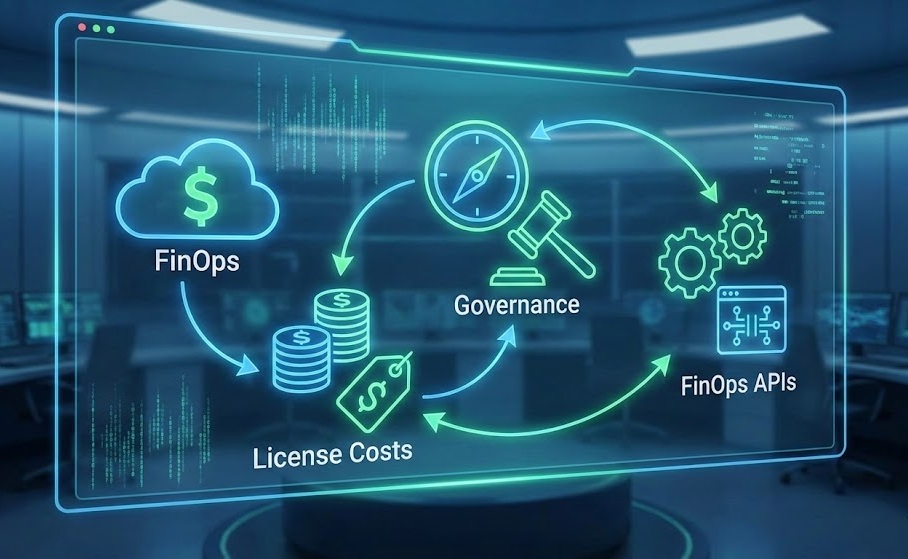
Most SaaS leaders associate FinOps with cloud infrastructure optimisation, right-sizing compute, negotiating commitments, or reducing data egress. Those levers matter, but they are not where many SaaS businesses lose the most money month after month.
In practice, a significant share of SaaS “cost waste” sits in commercial and operational blind spots: customers buying the wrong licenses for the wrong people, PoC licenses left active long after pilots end, and renewal terms that roll over without anyone realising better options were available. These issues do not just reduce a customer’s ROI; they also erode the provider’s margin, increase churn risk, and create distrust in renewals.
FinOps for SaaS should be treated as an operating model that connects consumption + licensing + commercial terms to outcomes, so customers can spend confidently and providers can scale profitably.
Why SaaS FinOps is different
SaaS unit economics are shaped by a mix of:
- Product decisions (features, reliability tiers, data retention, regions)
- Commercial models (seat-based vs usage-based vs hybrid)
- Customer operations (how well customers manage identity, entitlements, and renewals)
- Provider operations (how well the SaaS vendor exposes cost/usage/licensing data)
In other words: SaaS FinOps is not just about reducing spend, it is about reducing margin leakage and the gap between what is paid and what is used, what is contracted and what is needed, and what is available and what is realised.
Three real-world FinOps use cases that show up constantly
1) Customers buy the same license for everyone, even when roles and needs differ
What happens
A customer purchases a premium license for all employees, “to keep it simple”, even though only a small subset uses advanced features. Many users log in rarely, only consume basic functionality, or need read-only access.
Why does this become a FinOps problem
- The customer’s perceived waste increases every month.
- At renewal, procurement arrives with a blunt conclusion: “We’re overpaying.”
- The vendor is pressured into discounting rather than expanding value.
SaaS FinOps response (provider + customer)
- Offer role-aligned tiers (e.g., Viewer / Contributor / Admin).
- Surface usage signals that support rightsizing:
- active in the last 30/60/90 days
- feature-level adoption (who uses premium features)
- API usage, storage consumption, or workflow volume
- Provide a guided recommendation: “Move 120 users to Viewer, keep 25 on Pro, maintain 8 Admin.”
Business outcome
Customers retain confidence in the product’s value, renewals become fact-based, and expansion becomes targeted (“upgrade the teams that actually benefit”), rather than across-the-board.
2) PoC licenses are created and forgotten for months
What happens
Licenses get provisioned for a pilot project, a trial team, or an internal evaluation. The PoC ends (successfully or quietly), but the licenses remain active and billable because no one owns deprovisioning, and there is no expiration mechanism.
Why does this become a FinOps problem
- Waste persists invisibly and compounds.
- Adoption metrics become misleading: “We have 500 seats” becomes “We have 500 assigned seats,” not “500 active users.”
- Finance and IT lose trust in billing accuracy.
SaaS FinOps response
- Make PoC licensing time-bound by default (e.g., 30 or 60 days).
- Require an explicit PoC owner and a success criterion.
- Notify before expiry: “PoC ends in 7 days, convert, downgrade, or deactivate.”
- Provide a monthly “inactive license sweep” report with actions.
Business outcome
Customers reduce waste without friction, and vendors reduce renewal pushback caused by unnoticed shelfware.
3) Renewals are unmanaged, and contract enhancements are missed due to a lack of knowledge
What happens
Renewals occur under time pressure or through auto-renewal clauses. Entitlements are forgotten, better plan options are not assessed, and negotiated improvements from past cycles are not tracked. Many organisations simply do not have a single place where license terms, renewal dates, and commercial levers are documented.
Why does this become a FinOps problem
- Customers overpay or fail to capture negotiated value.
- Vendors face reactive negotiations and last-minute escalations.
- Both sides miss opportunities for a better-fit commercial model (e.g., switching some users to a lower tier, or shifting certain workloads to usage-based pricing).
SaaS FinOps response
- Maintain a renewal calendar with owners and lead times (90–120 days).
- Keep a simple “contract factsheet”:
- SKUs and tiers
- unit pricing basis
- minimum commitments / true-ups
- entitlements (support level, add-ons, training credits)
- renewal notice periods and clauses
- Use a renewal playbook:
- 120 days: usage and shelfware analysis
- 90 days: rightsizing proposal and commercial options
- 60 days: negotiation and approvals
Business outcome
Renewals become predictable and data-driven, with fewer surprises and fewer missed entitlements.
The missing piece: SaaS providers must enable FinOps with endpoints and standardised data
Even when customers want to run strong FinOps practices, many cannot because they cannot reliably extract licensing and consumption data from the SaaS product into their FinOps tooling. This is a product gap.
If you are a SaaS provider, think of FinOps-grade telemetry as part of your enterprise readiness, just like SSO, audit logs, and RBAC.
What “FinOps-ready” looks like
1) Provide clear APIs/endpoints (not just admin screens)
At a minimum, expose endpoints for:
- License inventory
- assigned vs unassigned
- license tier/SKU
- assignment date and last activity date
- cost basis (seat price, bundle, discount reference if applicable)
- Usage telemetry
- active users by time window
- feature usage (premium features, exports, analytics, workflows)
- consumption units (API calls, jobs, GB stored, GB egress, compute minutes, depending on your model)
- Commercial and renewal context
- contract start/end, renewal date
- true-up rules
- entitlements and add-ons
- plan constraints (limits, fair-use policies)
Customers should not need custom scraping or manual exports to manage spend.
2) Standardise your data model, so integrations are repeatable
The goal is to make ingestion consistent across customers and tools. Standardise dimensions such as:
- Tenant/customer identifiers (stable, unique)
- User identity (or anonymised identifier) and role
- SKU/plan identifiers and tier hierarchy
- Usage units and definitions (what exactly counts as an “active user”?)
- Time windows and aggregation rules
- Allocation dimensions (environment, region, product line, cost center)
If these definitions change, version them and publish the versioning approach. FinOps fails quickly when basic definitions drift.
3) Offer data exports aligned to the FOCUS format where possible
Many organisations are adopting standardised cost and usage models to reduce bespoke ETL. If you can provide exports aligned (fully or partially) to FOCUS (FinOps Open Cost and Usage Specification), you make it materially easier for customers to ingest your data into FinOps platforms, data lakes, and reporting.
You do not need perfection on day one. The initial objective is: consistent line items, consistent dimensions, and unambiguous unit definitions.
Minimal operating model to make this work (customer side)
Customers do not need a complex program to start. They need three fundamentals:
- Visibility
Active vs inactive seats, PoC expiration, usage by tier/feature, renewal dates.
- Ownership
A named owner for license pools and renewals, with decision rights to downgrade/deactivate.
- Cadence
- Monthly: inactive and PoC cleanup
- Quarterly: tiering/packaging review for top accounts
- Renewal windows: weekly pipeline review and negotiation preparation
When providers supply clean data, customers can run these routines with minimal overhead, and both sides benefit.
Conclusion
SaaS FinOps is ultimately about aligning spend to outcomes. The most common sources of waste are not exotic infrastructure problems; they are everyday operational issues: mis-tiered users, forgotten PoCs, and unmanaged renewals.
Providers that deliver FinOps-ready APIs, standardised data models, and (where possible) FOCUS-aligned exports reduce friction for customers, improve renewal trust, and turn cost transparency into a competitive differentiator. Customers gain control and confidence. Providers gain margin predictability and healthier expansions.
FinOps is most effective when it becomes a durable capability rather than a one-off cost exercise. Devoteam partners with clients to build FinOps operating models that deliver measurable outcomes: improved gross margin, predictable cloud and SaaS spend, and better commercial decisions at renewal. We bring a pragmatic approach that combines governance, engineering optimisation, and data integration so that teams can act on cost and usage insights quickly. If your objective is to scale efficiently while maintaining customer outcomes, Devoteam can help you design the roadmap and deliver the execution.