




Introduction
There might be some level of scepticism about using AI in healthcare, but what is much more scary is the shortage of approximately 1.2 million doctors, nurses, and midwives across the European Union as of 2022. This is a challenge that demands every solution we have, and digital tools are part of the answer. The new generation of Agentic AI tools shows promising capabilities for building more efficient, intelligent, and resilient healthcare services.
In this article, we will explore how Gemini Enterprise can help you create a smarter foundation for the future of care. Read on to learn how this powerful technology can assist you in solving specific challenges within the healthcare industry.
Challenges in Healthcare
Healthcare systems are under immense pressure. From stretched budgets and staff shortages to fragmented data, the challenges are often interconnected. Let’s break down the key hurdles for which new technology can offer genuine support.
1. Workforce and Labour Issues
The World Health Organisation (WHO) forecasts a shortfall of at least 15 million healthcare workers by 2030. This isn’t just a number; it translates to reduced access to care and a lower quality of life for millions.
The staff we do have are facing burnout, reported by 70% of health workers. Nurses, for example, are often swamped with administrative tasks, spending more time with a keyboard than with a patient. This creates a vicious cycle where overload drives people away, increasing the pressure on those who remain. At the same time, medical specialities are becoming ever more niche, making it difficult to find the right expert for specific conditions.
2. Financial and Operational Strains
High inflation, sluggish economic growth, and competing public priorities are putting immense pressure on national healthcare budgets. Healthcare systems are being asked to do more with less, and this squeeze makes it incredibly difficult to innovate and provide the best possible care. The fact that the population in Europe is ageing constantly increases the demand. At the same time, patients now expect a seamless experience. In fact, 78% of people say they have left a provider simply because the system was too difficult to navigate, quoting inadequate digital solutions as one of the difficulties.
3. Data Silos and Interoperability Issues
Healthcare data is often siloed. Information is locked away in different systems that don’t communicate. In the USA, this problem costs the system an estimated $30 billion every year. This lack of interoperability leads to manual workarounds and frustrating bottlenecks.
For decades, doctors have had to wrestle with fragmented systems just to get a single, complete view of a patient. Huge volumes of vital information remain stuck in separate silos, making access a headache for everyone. Many hospitals still depend on outdated legacy systems, which makes accessing and using data incredibly difficult.
The challenge is growing as we add new data sources, from medical scanners to wearable devices like Fitbit or Pixel Watch. Integrating this flood of information is complex, especially for remote patient monitoring. Critical concerns around data governance, privacy, and security underpin it all, with cybersecurity attacks on hospitals becoming all too common.
4. The AI Adoption
According to the European Health Commission, Artificial intelligence holds the key to solving many of these problems, yet organisations are struggling to adopt it. The very data issues we’ve discussed are holding back the AI revolution in healthcare.
For AI to be effective, it needs to understand the unique language of medicine. Models must be trained to recognise clinical context, from common acronyms (like “ABX” for antibiotics) to complex drug classifications and even handwritten notes.
From GenAI to Agentic AI: A New Toolkit for Healthcare
Google Cloud is not new to supporting healthcare professionals with the latest technology. It has existing GenAI solutions designed specifically for the healthcare industry, and now it has added a powerful Agentic AI platform called Gemini Enterprise.
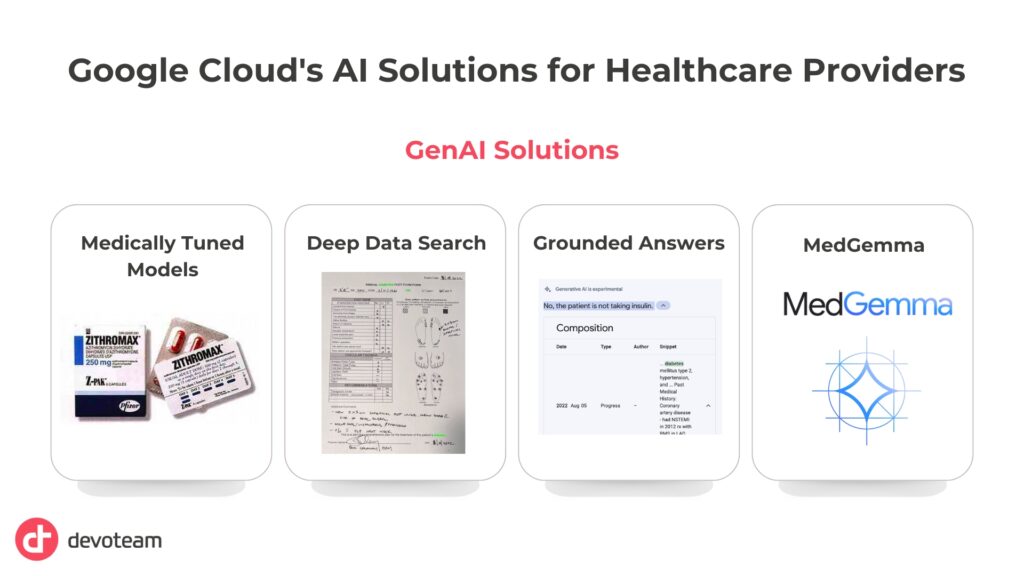
GenAI Solutions
Gemini Enterprise
Let’s explore how these tools work together, starting with the foundation.
1. GenAI for Healthcare
Google Cloud’s GenAI is tuned for the unique needs of healthcare, ensuring it understands the critical context of medical data. Key features include:
- Medically Tuned Models: Trained on clinical knowledge graphs, these models understand medical jargon, acronyms (like “Abx” for azithromycin), and drug types.
- Deep Data Search: The AI can search across all your data, whether it’s neatly structured in a database or unstructured in a scanned document, thanks to built-in character recognition.
- Grounded Answers: It provides answers in plain language, based on specific patient data, not generic information from the internet.
- MedGemma: This family of open models can understand both medical text and images (multimodal AI), supporting tasks like generating radiology reports, summarising patient records, and assisting with triage.
2. Gemini Enterprise The Agentic Platform
Gemini Enterprise is a platform that changes how work gets done. It seamlessly combines search, chat, and AI agents across all of an organisation’s data, allowing users to create multi-step workflows across various applications for agents to automatically complete. It functions as a self-hosted service, giving you control over integrations and securely connecting to tools like Google Calendar, Confluence, Jira, and many more.
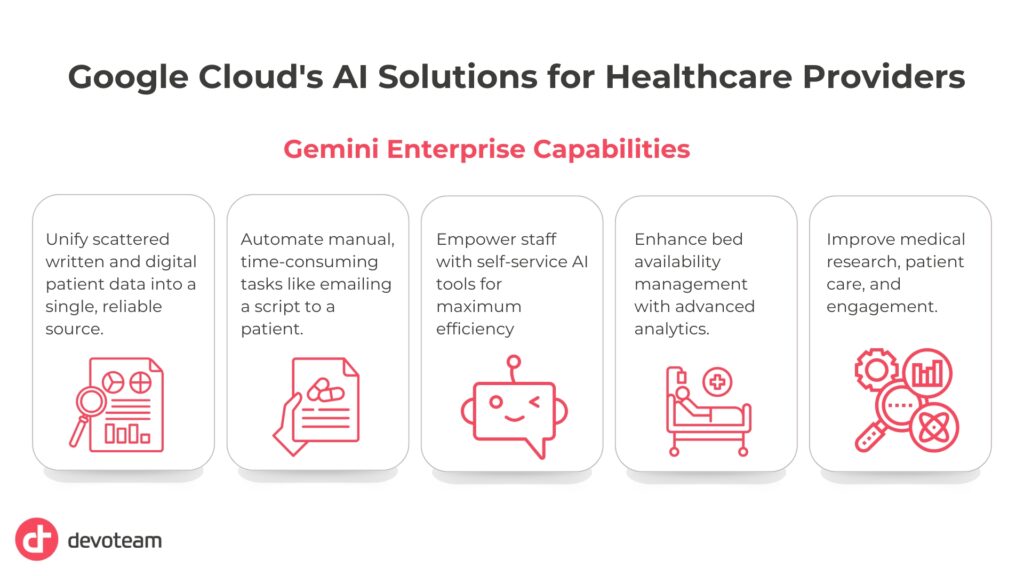
For healthcare organisations, Gemini Enterprise makes it possible to:
- Unify scattered written and digital patient data into a single, reliable source.
- Automate manual, time-consuming tasks like emailing a script to a patient.
- Empower staff with self-service AI tools for maximum efficiency
- Enhance bed availability management with advanced analytics.
- Improve medical research, patient care, and engagement.
How Gemini Enterprise Addresses the Healthcare Industry’s Challenges
Let’s look at how this works in practice.
1. Workforce and Labour Issues
| Challenge | How Gemini Enterprise Solves It |
| Global Worker Shortage | Agents can act as digital watchtowers, monitoring data from EHRs and patient vitals to automatically spot needs and streamline processes, like bed turnover. Agents can also autonomously perform tasks in other systems, like alerting nurses based on analysed data, allowing true process automation. |
| Burnout & Admin Burden | Agents automatically pull key information from faxes, PDFs, and clinical notes. Staff can find information buried in a patient’s chart in seconds or get immediate answers from a 120-page medical history. Agents can also draft emails and create tickets, freeing clinicians from routine communication. |
| Specialist Shortage | The platform uses medically-tuned AI that understands specific clinical context, acronyms (like ABX for antibiotics), and drug classifications, acting as a knowledge repository. Custom agents can provide an executive summary and critical warnings for a patient, ensuring comprehensive information for anyone covering patient care, even without prior specialist knowledge of the case. |
2. Financial and Operational Constraints
| Challenge | How Gemini Enterprise Solves It |
| Cost Increases & Consolidation | Gemini Enterprise reduces costs by automating repetitive, manual workflows like authorisation or claims appeals. Its predictive analytics can also help improve resource management, such as optimising bed or staff allocation. |
| Consumerisation | When clinicians can find information in seconds, patient care becomes faster, more effective, and less frustrating. This directly improves the clinician and patient experience. |
3. Data and Interoperability
| Challenge | How Gemini Enterprise Solves It |
| Lack of Interoperability, Fragmented Systems & Siloed Data | Gemini Enterprise unifies fragmented patient data into a single source of truth. It can standardise data to the FHIR format for full interoperability and connect to any system, even custom ones, to overcome integration hurdles. |
| Data Integration Complexity | The platform is designed to handle the volume, complexity, and sensitivity of healthcare data. Agents process and understand diverse data sources, including text, audio and images from remote monitoring feeds. |
| Data Governance, Privacy & Security | Built on Google’s enterprise-grade platform, Gemini Enterprise automatically respects your existing security permissions. This ensures that sensitive or confidential data is only accessed by authorised personnel, providing peace of mind and meeting compliance requirements |
4. AI Adoption
| Challenge | How Gemini Enterprise Solves It |
| Struggle to Adopt AI & Analytics | With Gemini Enterprise, you can put self-service AI tools directly into the hands of clinicians, researchers, and administrators. They can summarise charts, answer clinical questions, and explore operational data using natural language. |
| Data Constraints for AI | Gemini Enterprise solves this by creating a unified data foundation. It brings together structured EHR data with unstructured patient notes and images, making all your clinical, health, and imaging data interoperable and ready for Agentic AI. |
Want to see it in action? Watch the expert-led webinar Drive Your Healthcare Operations Forward with Gemini Enterprise.
How to Start with Gemini Enterprise for Healthcare
Seeing what Gemini Enterprise can do is one thing. Making it work for your Healthcare organisation is the next step. Here’s a strategic plan to get you started.
1. Join a Discovery Workshop
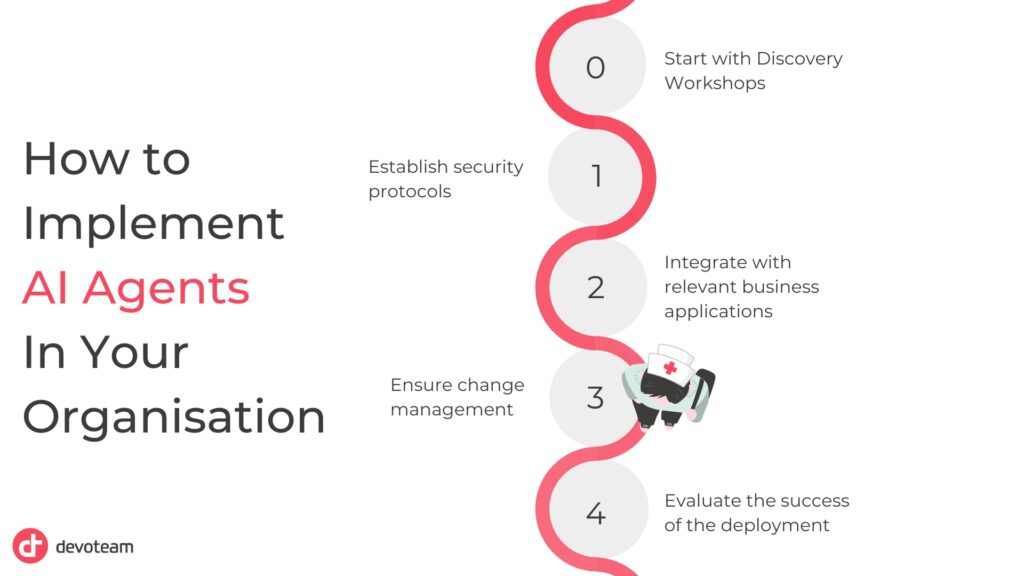
The first step is to take part in Devoteam’s ’Gemini Enterprise Case Discovery Workshop’. This collaborative session will help you uncover the best ways to apply Gemini Enterprise to your specific business needs and overcome core challenges. Get in touch with us to schedule your session.
2. Follow Our Four-Phase Plan
After the workshop, it’s time to roll out Gemini Enterprise using a proven four-phase plan. This ensures a smooth and successful deployment launch from start to finish.
- Secure: Security comes first, so you need to start with strong privacy, governance, and compliance measures from the very beginning. This gives you complete peace of mind that your solution is secure by design.
- Integrate: Next, it’s time for the technical setup. Devoteam’s AI specialists connect Gemini Enterprise to the tools your team relies on every day and configure the right access for everyone.
- Adopt: For Gemini Enterprise to make a real difference, your team needs to feel confident using it. Our change management specialists provide practical, role-specific training to help everyone get the most out of this Agentic solution.
- Embed: In this phase, we measure the impact on your business and demonstrate the return on investment.
Conclusion
The healthcare industry is currently burdened by interconnected challenges of workforce shortages, financial pressures, and fragmented data. By unifying disparate data sources, automating time-consuming administrative workflows, and placing powerful, medically-tuned AI tools directly into the hands of healthcare workers, Gemini Enterprise is the tool to address and resolve these issues.
Ultimately, integrating agentic AI across daily workflows is about building a more resilient and responsive healthcare system, freeing professionals to focus on their primary mission: delivering exceptional patient care.

Unify data, enhance clinician efficiency & deliver exceptional patient care
Gemini Enterprise provides the toolset, Devoteam’s experts help you to achieve results. Transform your Healthcare operations today by scheduling a personalised Discovery Workshop.