


For the 3rd edition of the GreenIO conference in Paris, I had the opportunity to attend one of the event’s three days. The international dimension, both of speakers and participants, allowed us to move beyond a France-centric framework. It places us in a broader perspective, where digital sustainability asserts itself as a global rather than local issue. Awareness must be collective. The community’s work shows that it is gaining maturity. We find increasingly relevant metrics and concrete solutions to implement. Here are some takeaways.
The Assessment
Gaël Duez (listen to his GreenIO podcast) aptly introduces the subject of digital sustainability. Echoing the emergence of the Middle Ages, Gaël Duez asserts that the barbarians of tech are at our gates. Not that they have weapons and want to set fire to our datacenters, computers, and other smartphones. But it is time to act concretely against tech individualism for more responsible digital technology.
Indeed, this did not escape anyone’s notice: the world we knew no longer exists. We must now deal with the powers’ withdrawal into themselves, the end of multilateralism, which directly impacts access to resources necessary for building digital technology. And, of course, climate disruption. The impact of digital technology is exploding with AI. Should we encourage its adoption across the board? Or conversely, concentrate its deployment on major issues where its contribution would be decisive? Should tech be a power factor in this new world? Or remind us that it is possible to build sustainable projects on a global scale?
Gaël Duez ends with a quote from french philosopher Descartes:
“Judge a man by his questions, rather than by his answers”
All presentations are available online at greenio.tech.
Breaking the rules
In the spirit of transforming our approach to responsible digital technology and to digital technology in general, the day began with an original session. Recognised sector actors took turns playing the role of defender of the status quo or that of change.
This gave rise to some comical moments where people like Sasha Luccioni from Hugging Face, Théo Alvez Da Costa from Data for Good, or Boris Gamazaychikov from Salesforce mockingly defended ideas such as putting a datacenter in space!
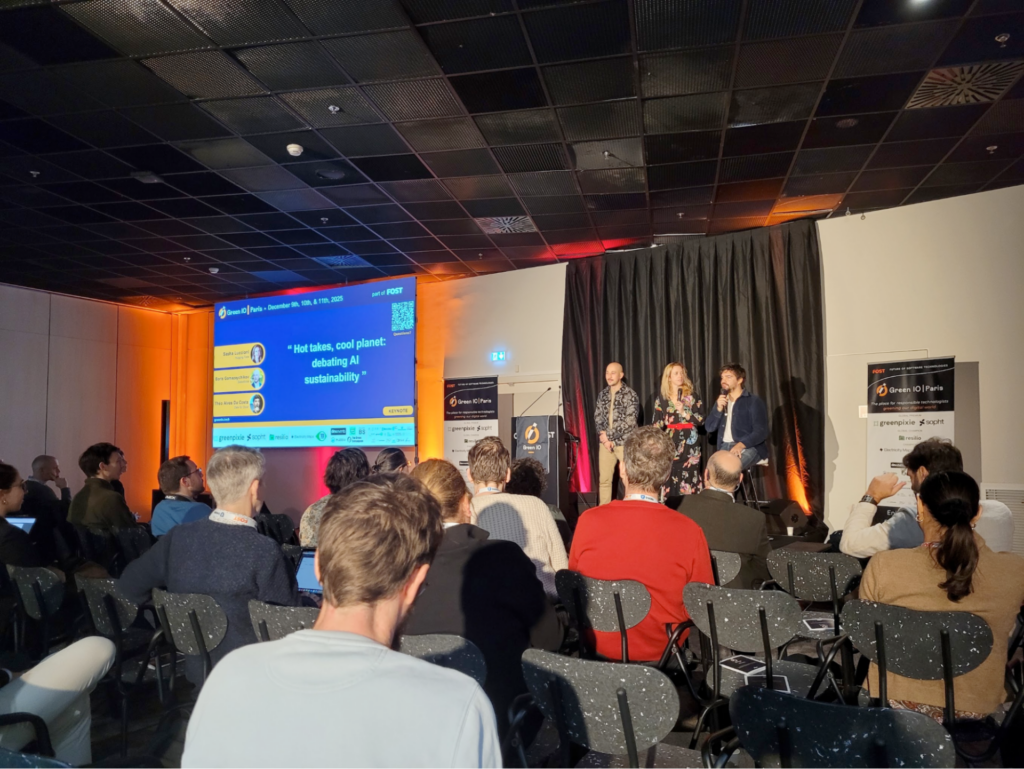
Among the questions raised:
- Is AI the solution to fundamental environmental problems?
- Is it necessary to have raw data, or are proxies sufficient?
- What is the real impact of datacenters supposedly virtuous for the local economy?
- How can we combine innovation with energy demand control?
The role-playing is interesting. Indeed, unsurprisingly, everyone in the room more or less leaned toward the same answers. This is not the case for all decision-makers, and defending their position helps build the argument. On the use of AI, there is no debate. It remains a powerful tool and, as such, can give rise to a great virtuous revolution. Or conversely, rush us toward highly polarised digital technology. Impossible to give a clear-cut answer, because it is currently illusory to limit AI uses.
Measuring, Comparing
If everyone makes estimates of their impacts in their corner while carefully guarding their data, we’re heading straight for obscurantism. We must therefore continue to develop standards so that impacts are measurable and comparable. Regarding the local impact of datacenters, beyond their inevitable environmental footprint despite optimisations, a finding is now evident. Local economic benefits are quite meagre. Unlike a factory that generates thousands, even tens of thousands of jobs relative to the investments made, a datacenter only creates a few hundred positions.
The debate on energy use is an interesting case, particularly with the project to develop SMRs to power datacenters. Especially in a context where even Ireland implemented a moratorium in 2021 on installing new datacenters. These already consume more than 20% of the country’s energy while globally we’re around 1%. This situation has moreover led to the regulation recently put in place.
In conclusion of this original roundtable, it is important not to forget anyone on the path to responsible digital technology. And especially not the big tech companies. AI’s disproportionate growth in recent years shows us that they advance at any cost to position themselves well in this new market.
Change is always possible, with more public debate or more prioritisation at the state level on resource allocation. This will not be sufficient, but it is an essential step. Vincent Poncet reminds us that it is important to have strong sponsorship within companies. It is indeed the VPs on the datacenters’ client side who speak to the VPs who own the datacenters.
A Far from Virtual Grip of Digital Technology
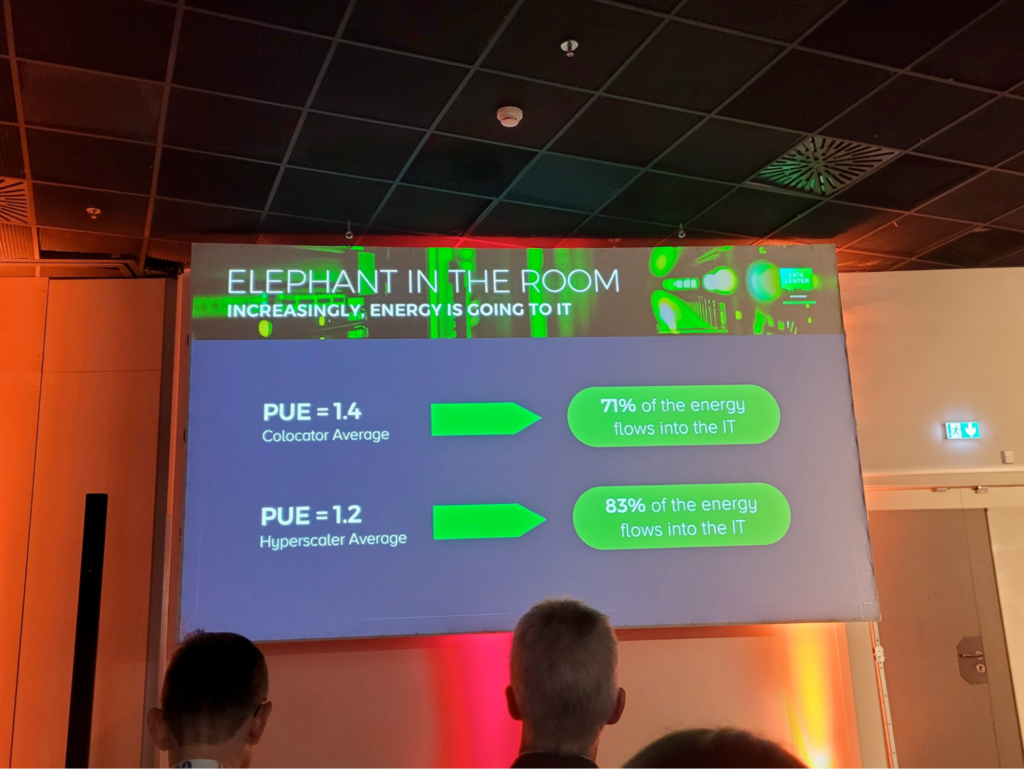
On the datacenter side, PUE is the main indicator put forward. It allows knowing what energy was used to execute any type of digital code. The larger a datacenter is, the more it can optimise. Thus, hyperscalers achieve the best results, which allows them to rent resources at lower prices.
But, as Babak Falsafi points out, their responsibility stops there. Indeed, there is no question of knowing whether the code that was executed is efficient or not.
Richard Kenny presented a study on resource management in a datacenter. The race for the latest generation for more performance is generally the rule there. First, he demonstrates that the combination of the right hardware (CPU/GPU/RAM) is crucial for good performance. Then, he presents a use case where equipment renewal is less profitable than extending existing equipment because of energy savings that are too small relative to the investment required (£60k in electricity savings vs £2M investment over 4 years).
Location of Consumption and Carbon Footprint
Another perspective is interested in the relocation of consumption, either in time or in space, through the example of Portugal. At the local scale, the approach seems interesting: performing intensive calculations during datacenter off-peak hours, or locating them in low-carbon regions. Ismael Velasco reminds us that this only works in the short term because the actors doing it today are in the minority. As soon as the practice becomes common, then off-peak hours will be saturated in turn. And low-carbon regions will eventually become carbon-intensive again (restarting coal plants, using fuel, etc.) because we cannot command the sun or the wind. What’s important is the global vision and knowing whether demand is sustainable or not.
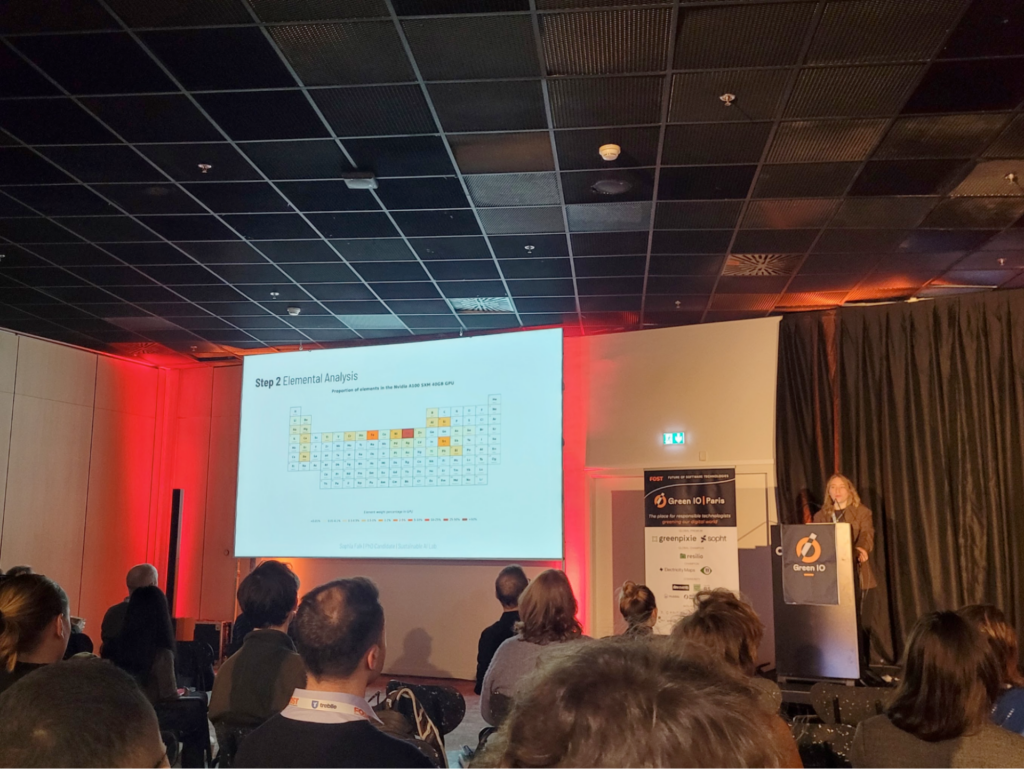
Sophia Falk, for her part, participated in dissecting an Nvidia GPU card to perform a complete LCA. More than 30 elements from the periodic table are present in a GPU (25% of all elements!). If the use of these GPU cards is necessary for AI, their impact goes well beyond the carbon emission figures that communications focus on.
Can We Still Be “AI Vegan”?
Website or application, can we still escape AI? Anaëlle Beignon wonders. UX sometimes even borders on ridiculous, with the same functionality available via several buttons visible simultaneously. The goal is, of course, to make us dependent on AI as we already are on our smartphones. Once habits are established, it will be very difficult for us to disconnect.
James Martin questions frugal AI by demystifying 10 preconceived ideas. Some are findings of failure, such as the current impossibility of measuring AI’s real impact. Others are more engaging. For example, choosing your region well at your hyperscaler, or choosing the model to use according to your needs, to adapt its size, or if open source can respond. He even goes so far as to remind us of AI usage hygiene:
- Don’t provide entire data sources for analyses on specific data
- Ensure personal data protection
- Take into account AI usage sovereignty.
To the question “Are you AI vegan?”, James Martin proposes an excellent answer. He is “AI flexitarian” because it is difficult today to ignore this aspect of digital technology.
Théophile Lenoir concludes this session by presenting figures that confirm AI’s role as an accelerator of digital technology’s environmental impact. While his conclusion is that we must standardise measurements, clarify responsibilities, and establish the cost of quantification, we can remember the image of a refuge at 2,883 meters where AI allows optimising energy use, more rationed up there. AI remains a tool, and innovation is often the fruit of constraint.
Conclusion
A finding emerges from the sessions. Although it is gaining maturity, responsible digital technology remains the exception and AI encourages overconsumption while its large-scale utility remains to be proven. The solution? Return to digital fundamentals and ask the right questions: “What do I need?” then “Is it worth it?”. This is where the concepts of “AI vegan” and “AI flexitarian” are born, while the current trend is toward AI binge eating.
Finally, Ismael Velasco presented the work of 21 European NGOs initiating unprecedented synergy at the scale of our continent for coordinated, responsible digital technology. An unexpected stage performance for such an event, with gestures rich in emotions illustrating the journey of different digital actors in today’s world. He concludes with “There is hope, you’re not alone”.
His performance must be an inspiration for us: what if we changed our point of view and our way of doing things? It’s up to us, IT professionals, to decide what digital technology we want to build in tomorrow’s uncertain world.
Hyperscalers publish their environmental commitments (increasingly regional indicators including PUE and WUE) and other metrics
More information on PUE:
- Ecologist calculator to evaluate the impact of GenAI models
- The environmental commitments of d’AWS, Azure and GCP
On this topic, also read: