

Estimated reading time: 10 minutes
Introduction
Artificial Intelligence promises transformative potential, from personalising experiences to optimising complex systems. However, unleashing this power responsibly requires careful management. Effective AI governance is not merely a regulatory hurdle or a cost centre; it is a fundamental business imperative that builds trust and mitigates significant risks like bias and security breaches. AI governance ensures legal and regulatory compliance, protects brand reputation, and ultimately empowers the successful and ethical delivery of AI solutions. Without robust governance, organisations risk deploying AI that is unfair, unsafe or operates opaquely, undermining the very benefits it aims to deliver. This article brings the frameworks, tools, and strategies necessary for implementing responsible AI governance. Keep on reading and see that true AI governance is not just about avoiding fines but about empowering AI delivery.
Also read: Operationalising AI Governance and Risk Through Existing Enterprise Structures
Understanding and Establishing AI Governance
What is AI Governance?
Think of AI Governance as the comprehensive envelope for your entire AI lifecycle, from initial concept to decommissioning. It encompasses the processes, standards, and controls designed to ensure AI systems are developed and operate safely, ethically, fairly, transparently, and securely.
Key pillars of AI Governance include:
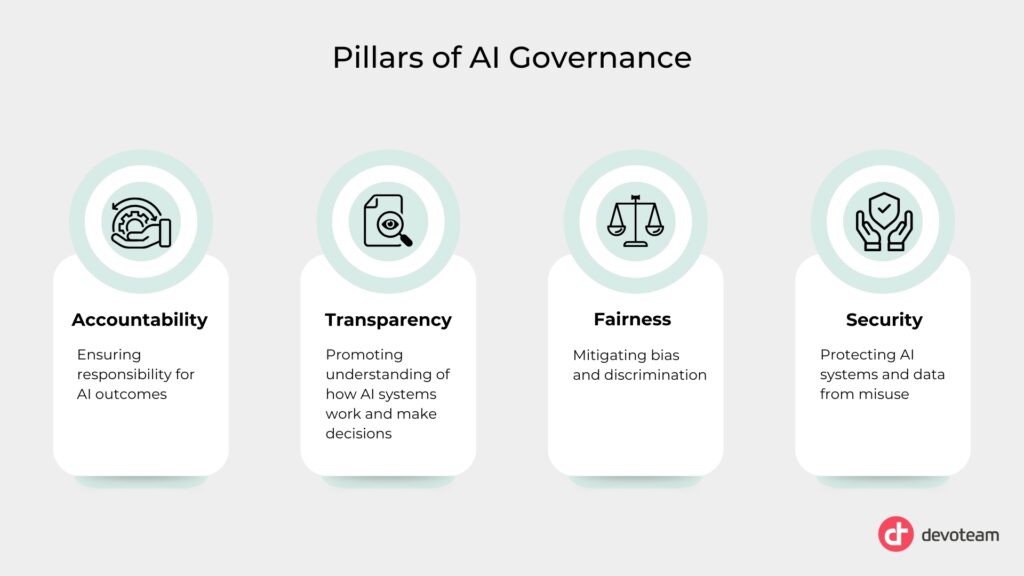
- Accountability: Ensuring clear responsibility for AI outcomes.
- Transparency: Promoting understanding of how AI systems function and arrive at decisions.
- Fairness: Actively identifying and mitigating bias and discrimination.
- Security: Protecting AI systems and the data they use from misuse or attack.
While related to general IT governance, AI governance addresses the unique challenges posed by AI’s learning capabilities, potential autonomy, and the ‘black box’ nature of some complex models.
Why is it Crucial?
The need for AI governance stems from several critical factors:
- Regulatory Compliance: A growing number of regulations worldwide mandate responsible AI practices. Examples include the EU AI Act (with its risk-based approach), data protection laws like GDPR, US guidelines like SR-11-7 for banking and the White House Executive Order on AI, and Canada’s proposed AIDA. Governance frameworks provide the structure to meet these requirements.
- Risk Mitigation: AI carries inherent risks, including algorithmic bias leading to unfair outcomes, security vulnerabilities exploitable by adversaries, and unforeseen ethical dilemmas. Governance provides the means to systematically identify, assess, and mitigate these potential harms. Read more about AI Governance and Security in our whitepaper.
- Building Trust: Transparency, explainability, and demonstrated fairness are essential for building confidence among customers, employees, and the public regarding AI systems’ reliability and ethical operation.
- Protecting Reputation: AI failures or ethical lapses can cause significant reputational damage. Strong governance demonstrates a commitment to responsible practices, safeguarding the organisation’s image.
- Enhancing Governance Itself: AI can also be a tool within governance, improving efficiency in public services, enhancing decision-making, detecting fraud, and bolstering cybersecurity. However, using AI in governance also requires oversight.
Pathway to Implementing AI Governance
Establishing effective AI governance is a strategic journey requiring a structured, cross-functional approach. Before we dive into each step, let’s start with an overview of the steps to AI Governance:
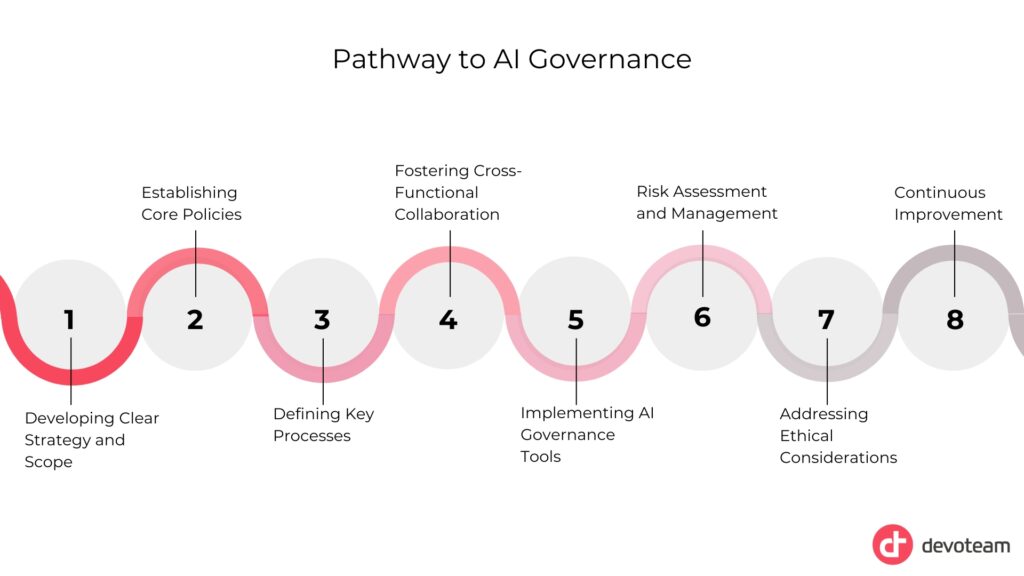
Let’s dive deeper into each step!
1. Develop a Clear Strategy
Define governance objectives aligned with business goals, identify the scope (which AI systems are covered), and establish core ethical principles (fairness, transparency, accountability).
2. Establish Policies and Processes
Create clear policies for the entire AI lifecycle, covering data governance (collection, storage, quality, privacy), model development, deployment, monitoring, risk management, incident response, and stakeholder engagement.
3. Implement Frameworks
Leverage established frameworks as guides, adapting them to your organisation’s context. Notable frameworks include:
- NIST AI Risk Management Framework: Focuses on identifying, assessing, managing, and monitoring AI risks with an emphasis on trustworthiness.
- OECD AI Principles: Promotes responsible stewardship of trustworthy AI based on human-centric values.
- European Commission’s Ethics Guidelines: Outlines requirements for lawful, ethical, and robust AI.
- Council of Europe Framework Convention on AI: An international treaty focused on human rights, democracy, and the rule of law in AI.
Often, a tailored approach combining elements from different frameworks is most effective.
4. Define Roles and Foster Collaboration
Assign clear responsibilities for governance oversight and implementation. Engage stakeholders across legal, compliance, risk, IT, data science, and business units. Consider forming an AI ethics board for guidance. Strong leadership commitment is crucial for enterprise-wide adoption.
5. Leverage AI Governance Tools
Utilise specialised tools and platforms to support practical implementation. Key categories include:
- Comprehensive Platforms: Manage the AI lifecycle, risk, bias, explainability, monitoring, and compliance (e.g., Holistic AI, Credo AI, IBM watsonx.governance™, 2021.AI GRACE).
- Bias & Fairness Tools: Detect and mitigate bias (often integrated into platforms or standalone like Sigma Red AI, Solas AI).
- Explainability Tools: Provide insights into model decisions (often platform features).
- Risk Management Tools: Assess and mitigate AI risks (often platform features or specialised ones like Anch.AI).
- Model Monitoring Tools: Track performance and detect drift (e.g., Aporia AI, Fiddler AI, Why Labs).
- Data Governance Platforms: Ensure data quality, privacy, and compliance (e.g., Databricks, Snowflake, IBM Cloud Pak for Data). Learn why data governance is key to AI transformation from our CTO.
The choice of tools depends on specific needs, system complexity, and existing infrastructure. - Emerging Standards like the Model Context Protocol (MCP): Simplify AI integration in a standardised way for LLMs to interact with external tools and data sources, akin to a ‘USB-C port’ for AI.
6. Conduct Rigorous Risk Assessment
Systematically identify potential risks (bias, security, ethics, compliance) throughout the AI lifecycle using methods like impact assessments. Develop and implement mitigation strategies (e.g., bias mitigation techniques and security controls).
7. Address Ethical Considerations
Actively work to ensure fairness, promote transparency and explainability, protect privacy, maintain appropriate human oversight, and build robust, safe systems.
8. Ensure Continuous Improvement
AI governance is not static. Regularly review and update frameworks, policies, and tools based on evolving regulations, technology, and lessons learned. Establish processes for continuous monitoring and adaptation.
AI Governance Solutions from Industry Leaders
Devoteam partners with leading cloud and platform providers to offer tailored AI governance assistance, helping you integrate governance seamlessly within your existing infrastructure.
Here is an overview of our partners’ solutions:
AWS
by Sergio Winter, AI Lead consultant at Devoteam, AWS business unit
Solution/feature: SageMaker Unified Studio, SageMaker Catalog and DataZone, SageMaker Role Manager, Model Cards, Model Dashboard, Clarify & Model Monitor
Description: AWS has developed a comprehensive, modular, and integrated ecosystem to enable organisations to implement robust, scalable, and compliant AI governance. At Devoteam, we support clients in navigating this complexity, ensuring that AI governance is not a constraint but a catalyst for successful AI delivery. Through Amazon SageMaker and its integrated components, AWS offers a sovereign platform to orchestrate the entire AI project lifecycle, from raw data to generative AI applications. The whole ecosystem empowers organisations to scale and secure their AI initiatives in alignment with ethical and regulatory requirements.
Google Cloud
by Cyril Maréchal, Lead Machine Learning Engineer at Devoteam, Google Cloud business unit
Solution/feature: Vertex AI product suite, Google Monitoring, BigQuery, Terraform
Description: Devoteam’s Google Cloud business unit has developed the AI Foundations framework, which aids in the adoption of best practices concerning compliance, security and governance. The framework ensures your AI projects comply with the EU AI Act, utilising Google’s Vertex AI product suite. For operational performance quality, we use Google Monitoring and BigQuery, while employing infrastructure-as-code (Terraform), which enhances security.
Microsoft Azure
by Hardik Patel, GenAI Application Architect at Devoteam, Microsoft business unit
Solution/feature: Microsoft Purview Compliance Manager, Azure API Management, Azure Policy, Microsoft Purview.
Description: Devoteam helps organisations establish AI Governance on Microsoft Azure with the Cloud Enabler for AI Foundations framework. The steps towards AI governance depend on companies’ AI maturity and readiness level. During the assessment, we identify the company’s current position and the desired state, helping them to build a comprehensive AI roadmap that includes AI governance. The solutions we propose are aligned with Microsoft’s best practices. We use Azure tools like Microsoft Purview Compliance Manager and Azure API Management for risk identification and mitigation. For policy enforcement, we use Azure Policy and Microsoft Purview.
ServiceNow
by Peter Skovgaard, Lead consultant and ServiceNow AI SME, Devoteam, ServiceNow business unit
Solution/feature: IRM, Now Assist Guardian, Now Assist Data Kit, Now Assist Analytics, Data Privacy for Now Assist, Sensitive Data Handle
Description: Devoteam ServiceNow business unit helps organisations to deploy AI responsibly, transparently, and securely across the Now Platform. It leverages the governance tools provided by ServiceNow, including Integrated Risk Management for centralised oversight, Now Assist Guardian for GenAI usage control, Now Assist Data Kit for improved AI accuracy and Now Assist Analytics for performance tracking. To ensure real-time anonymisation, we use Data Privacy for Now Assist, while Sensitive Data Handler for PII masking guarantees secure, transparent, and compliant AI implementations.
Working with AI Governance Consulting
Working with an AI governance consulting company can provide valuable expertise and support in establishing and implementing effective AI governance frameworks. Specialists guide companies through complex legal landscapes and technological possibilities, ensuring that the AI Governance solutions align with the organisation’s AI maturity and aspirations.
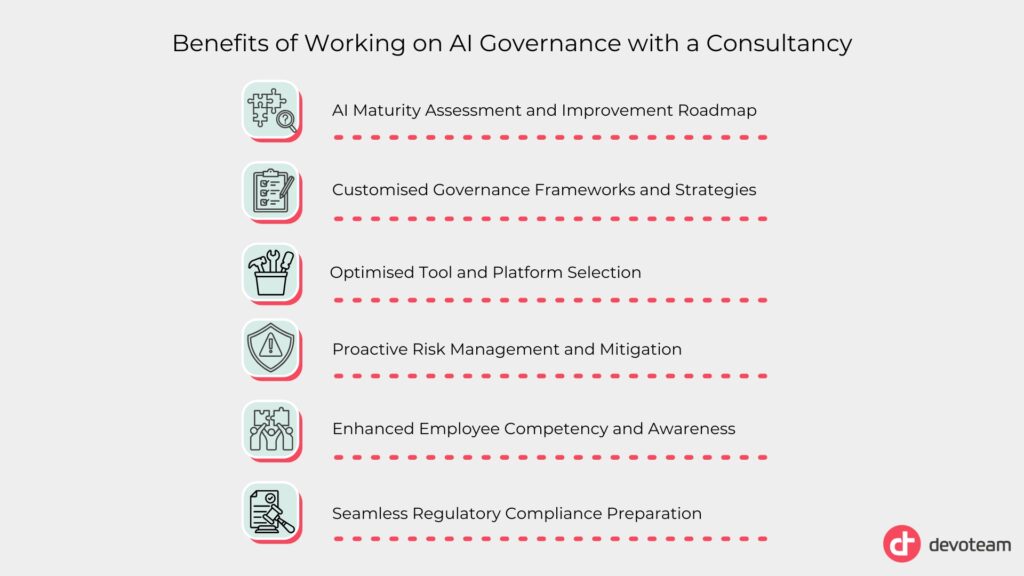
Consultants can help organisations:
- Assess their AI governance maturity and identify areas for improvement.
- Develop tailored governance strategies, policies, and frameworks.
- Select and implement appropriate tools and platforms.
- Conduct risk assessments and develop mitigation strategies.
- Provide training and awareness programs for employees.
- Prepare for compliance with AI regulations such as the EU AI Act.
AI Governance with Devoteam
Devoteam helps clients navigate the complexities of responsible AI deployment. As presented before, the partnerships with vendors and leading platform providers allow us to implement the best possible governance solutions.
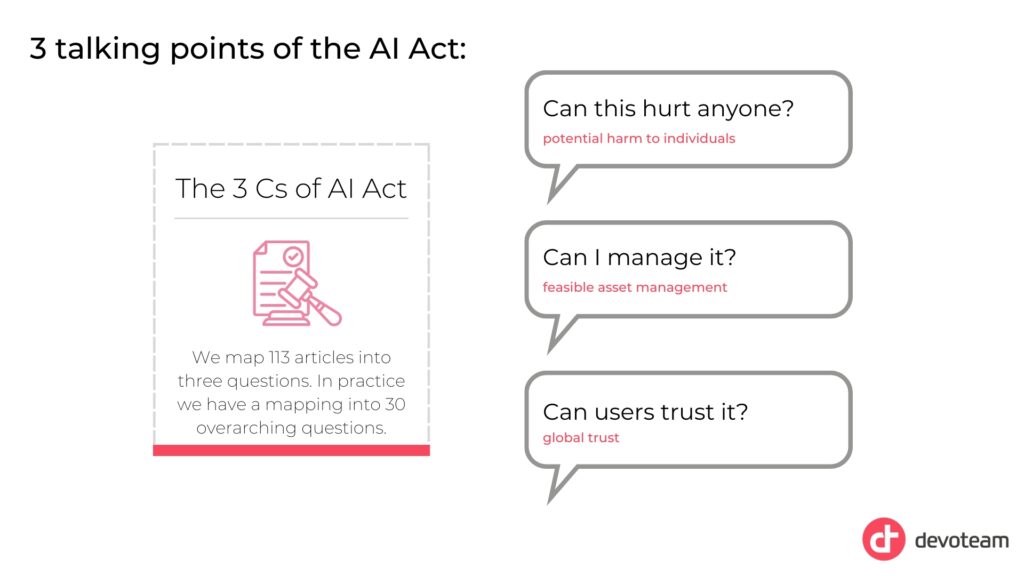
We work from the simple mantra: “AI Governance empowers AI delivery.” The EU AI Act contains 131 articles, and while that is a daunting corpus, we have reduced the issue to three talking points: potential harm to individuals, feasible asset management, and global trust. We believe that asking clients these three questions is the simplest way to engage them prior to introducing the whole offering.
Devoteam provides comprehensive AI governance services aimed at ensuring secure, responsible, and ethical AI adoption.
Devoteam’s offer includes:
- Enable Responsible AI: Devoteam helps organizations harness AI’s power safely by embedding governance throughout the AI lifecycle.
- Custom Frameworks: We establish tailored AI governance policies and frameworks aligned with your business and ethical goals. For a practical framework to guide your organisation, download The Ethical AI Playbook.
- Risk & Compliance Management: Our solutions mitigate AI-specific risks and ensure compliance with evolving regulations like the EU AI Act.
- Third-Party Oversight: We implement structured models to manage risks associated with third-party AI components and vendors.
- AI-Specific Data Governance: Devoteam implements robust data governance focused on enhancing the reliability and integrity of AI systems.
- Data Quality & Ethics: We ensure high standards for data architecture, quality, and ethical considerations crucial for trustworthy AI.
- Operational Governance (MLOps): We integrate MLOps and change management to scale AI effectively while maintaining governance standards.
- Platform-Specific Solutions: Devoteam offers tailored governance implementations for Google Cloud, AWS, Microsoft Azure, and ServiceNow platforms.
- Automated & Efficient: We provide cost-effective, automated governance approaches aligned with modern cloud-native strategies.
- Empower AI Delivery: Ultimately, our offerings aim to build trust and empower the confident, ethical, and successful delivery of AI solutions.
Devoteam’s expertise spans AI strategy, cybersecurity, and regulatory compliance, helping organisations navigate AI adoption securely.
Conclusion
Robust AI governance is non-negotiable. It is the bedrock upon which organisations can confidently scale their AI initiatives. By proactively establishing clear strategies, implementing comprehensive frameworks and tools, and nurturing a culture of responsibility, businesses can unlock the immense potential of AI while effectively mitigating risks, building essential stakeholder trust, and ensuring deployment is both ethical and compliant. A continuous, adaptive approach to AI governance is paramount for driving sustainable innovation and ensuring that AI ultimately benefits society. Remember, effective AI Governance empowers AI delivery.

Don’t let your next AI project become the next ethical minefield
Contact us to build AI that empowers! With over 1,000 certified AI Consultants and over 300 successful AI projects, we have the expertise to guide you.