


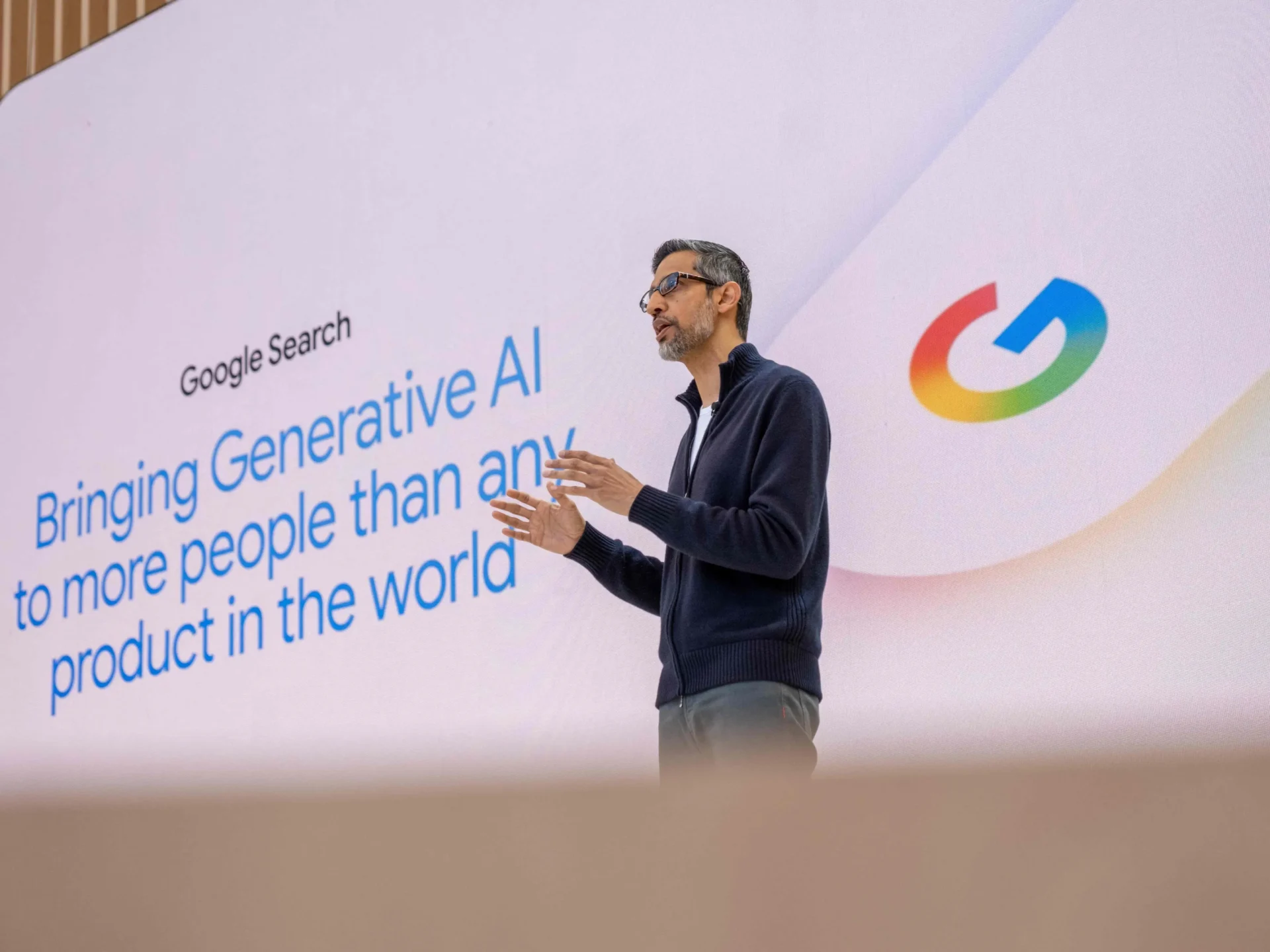
Google I/O has always been a highlight event in the tech calendar, but this year’s edition felt particularly momentous. This Google I/O 2025 recap shows the high volume and impact of announcements, showing that Google is accelerating its AI strategy. The announcement touch nearly every aspect of its ecosystem. At Devoteam, we’ve been closely watching these developments, and here are our top 11 takeaways from what was arguably one of the most impactful I/O events in recent memory.
The 11 takeaways from Google I/O
- 1. The Future of Software Development: Accelerated Code Generation
- 2. Breaking Down Barriers: Real-time Translation in Google Meet
- 3. Generative Video Takes Centre Stage with Veo and Flow
- 4. Gemini Elevates: State-of-the-Art LLM with Deeper Reasoning
- 5. AI-Driven UI/UX Design: The Stitch Acquisition Comes to Life
- 6. Revolutionising E-commerce: Hyper-Realistic Virtual Try-Ons
- 7. Introducing Jules: The AI Software Engineering Assistant
- 8. Imagen 4: Pushing the Boundaries of Image Generation Speed and Quality
- 9. The End of Ten Blue Links? AI Overviews Transform Google Search
- 10. The Immense Scale of Gemini: Fueling Google’s AI Ambitions
- 11. Google’s Agile Response in a Competitive AI Landscape
1. The Future of Software Development: Accelerated Code Generation
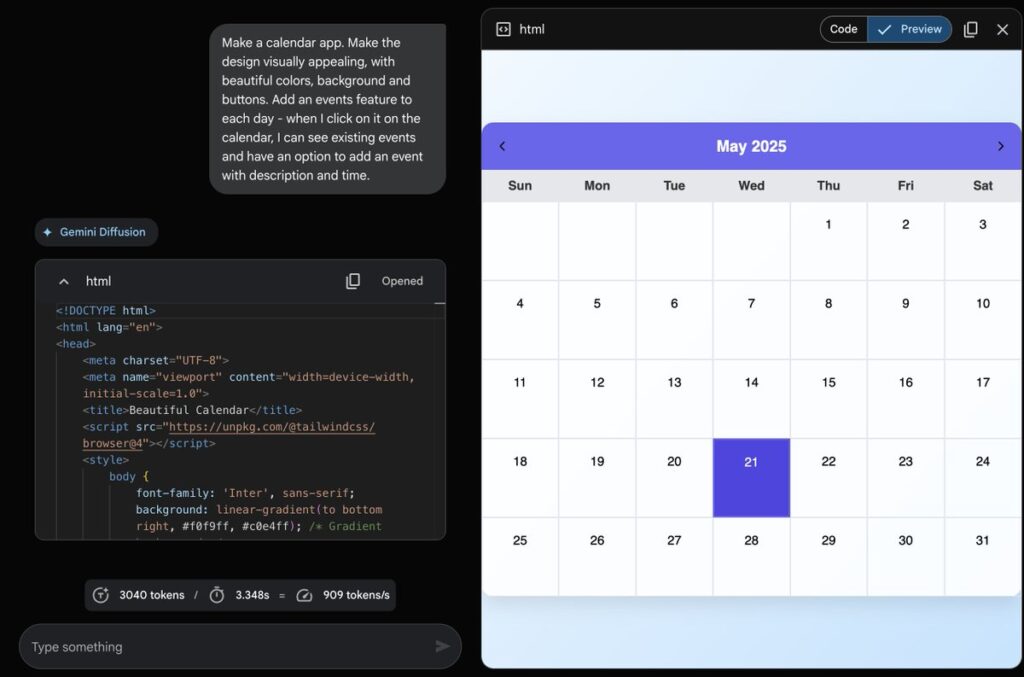
Large Language Models (LLMs) have shown promise in code generation, but speed has often been a bottleneck. Google introduced Gemini Diffusion, a novel approach that utilizes diffusion models (historically prominent in image generation) for coding. This method is reportedly 10-15x faster than traditional autoregressive models. Following models like Mercury Small, this signals a significant leap in making AI-assisted software development more efficient and responsive.
2. Breaking Down Barriers: Real-time Translation in Google Meet
Imagine a world with no language barriers in virtual meetings. Google is making this a reality by integrating powerful multimodal AI for real-time translation into Google Meet. This feature promises to foster truly global collaboration, making international business and diverse team interactions more seamless than ever before.
3. Generative Video Takes Centre Stage with Veo and Flow
Generative video saw a monumental update with Veo. This model is designed to create photorealistic video content. Coupled with Flow, a sophisticated filmmaking tool, users can add sound effects and maintain character consistency across scenes. While bold claims about disrupting Hollywood or gaming studios abound, the potential for content creators, marketers, and training industries is undeniably transformative.
4. Gemini Elevates: State-of-the-Art LLM with Deeper Reasoning
Google continues to refine its flagship LLM, Gemini. The latest iteration boasts a deeper reasoning mode, allowing the model to explore multiple hypotheses before arriving at a conclusion. This has resulted in state-of-the-art performance on complex benchmarks like MMMU (multimodal understanding), LiveCodeBench (coding proficiency), and an impressive performance on USAMO 2025 (mathematics Olympiad problems), reportedly doubling the score of the next best model.
5. AI-Driven UI/UX Design: The Stitch Acquisition Comes to Life
Google’s strategic acquisition of Stitch is now bearing fruit, introducing an AI-first approach to UI/UX design. This technology allows designers and developers to iteratively create user interfaces from textual prompts. It even allows to export these designs directly into Figma. This could dramatically accelerate prototyping and streamline the design-to-development workflow.
6. Revolutionising E-commerce: Hyper-Realistic Virtual Try-Ons
The online shopping experience is about to get another significant upgrade. Google showcased an AI-powered virtual try-on feature that requires just a full-body picture of the user. The technology renders clothing on the user’s image with unprecedented quality and realism, aiming to reduce returns and increase conversion rates for online apparel retailers. Read more about how to use AI in Retail.
7. Introducing Jules: The AI Software Engineering Assistant
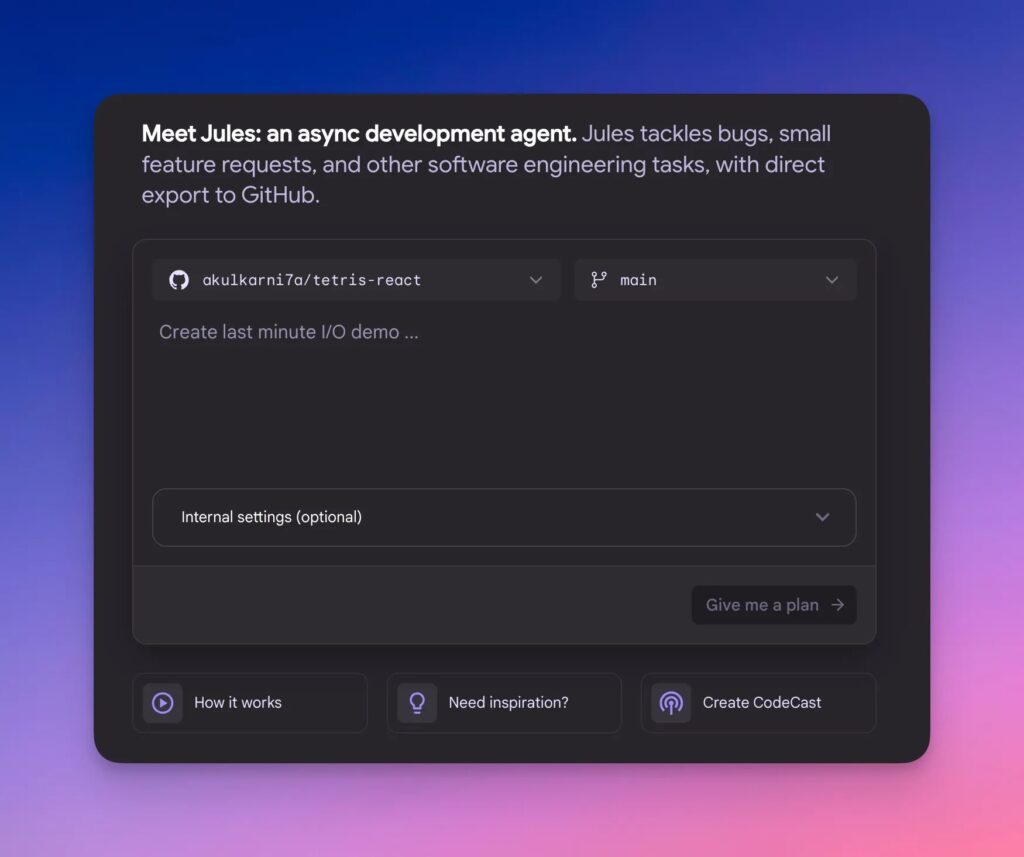
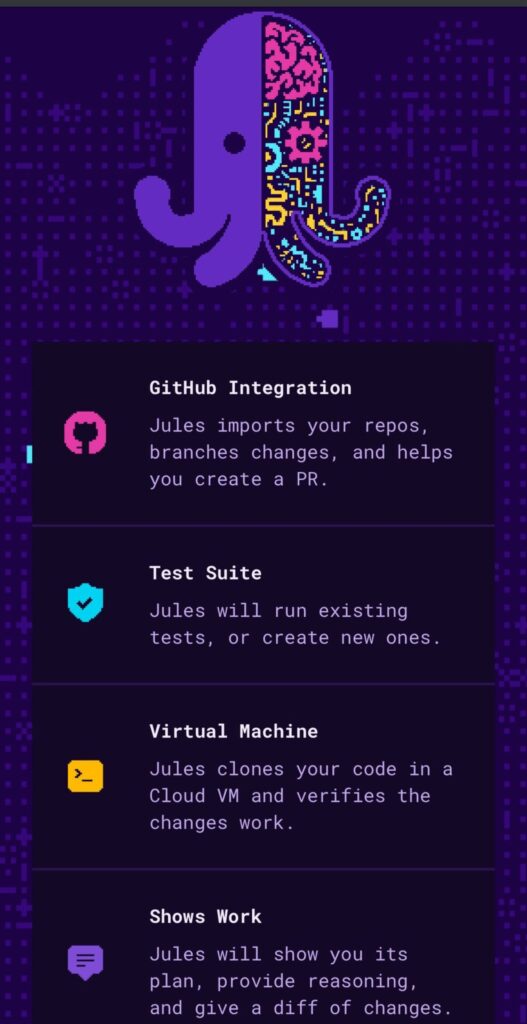
The concept of an AI software engineer is taking a tangible form with Jules. This application empowers developers to make changes to their GitHub repositories using simple English prompts, without needing to clone the repository locally. Jules offers a streamlined UI to interact with codebases, potentially lowering the barrier to entry for certain development tasks and boosting productivity for experienced coders.
8. Imagen 4: Pushing the Boundaries of Image Generation Speed and Quality
Google unveiled Imagen 4 (implied, based on typical I/O image model updates and quality descriptions), its next-generation image model. It stands out not only for its speed but also for its remarkable ability to render accurate typography within images—a common challenge for many models. While benchmarks (like Elo scores) place it among the top contenders for overall quality, its speed-to-quality ratio could make it a go-to for many practical applications.




9. The End of Ten Blue Links? AI Overviews Transform Google Search
Google Search is undergoing one of its most significant transformations. The AI Overviews feature is rolling out widely. It provides direct, comprehensive, GPT/Perplexity-style answers at the top of search results. This marks a pivotal shift from the traditional “ten blue links,” fundamentally changing how users access information and how businesses approach SEO and content strategy.
10. The Immense Scale of Gemini: Fueling Google’s AI Ambitions
To underscore the pervasive integration of its AI, Google shared some staggering figures for Gemini: it now has over 400 million monthly active users and processes an astounding 480 trillion tokens per month. These numbers illustrate the massive infrastructure and user adoption driving Google’s AI ecosystem forward
11. Google’s Agile Response in a Competitive AI Landscape
Back in 2023, a well-known quote from Microsoft CEO Satya Nadella expressed a desire to “make Google dance.” This year’s I/O demonstrates that Google, even at 26 years old, is not only dancing but is often leading the choreography. The flurry of innovations showcases a company that is agile, deeply invested in AI, and ready to shape its future.
What This Means for Your Business
The announcements from Google I/O 2025 are more than just exciting technological advancements; they represent tangible opportunities for businesses to innovate, optimize, and grow. From leveraging generative AI for content creation and software development to transforming customer experiences with new search and interaction paradigms, the potential is immense.
At Devoteam, we are dedicated to helping you navigate this rapidly evolving landscape. Our experts are ready to partner with you to understand how these cutting-edge Google technologies can be strategically applied to your specific business challenges and goals.