


Estimated reading time: 5 minutes
The sophisticated algorithms driving today’s artificial intelligence are often described as “black boxes” — their decision-making processes opaque and potentially containing hidden biases or security flaws. What if we could illuminate these black boxes, ensuring fairness, reliability, and robust protection against malicious actors? In this article, I explore one solution that addresses these concerns – the AI TRISM framework. Let’s look at what it is, how it works and how it can help you to ensure that your AI models are trustworthy, fair, dependable, and secure.
To better understand how robust AI security measures are crucial, read our article “AI Without Security: A Car Without Brakes?“
What is AI TRiSM?
The AI TRISM framework aims to mitigate AI risks, focusing on trust, privacy, and security. It provides organisations with strategies to use AI responsibly, promoting accountability while protecting sensitive data and infrastructure to ensure legal and secure use.
Worldwide, the adoption of this framework is expanding rapidly. According to Gartner, organisations see a 50% increase in AI adoption rates due to improved model accuracy. This approach supports businesses in achieving their objectives while safeguarding customers, employees, and data.
Source : Gartner
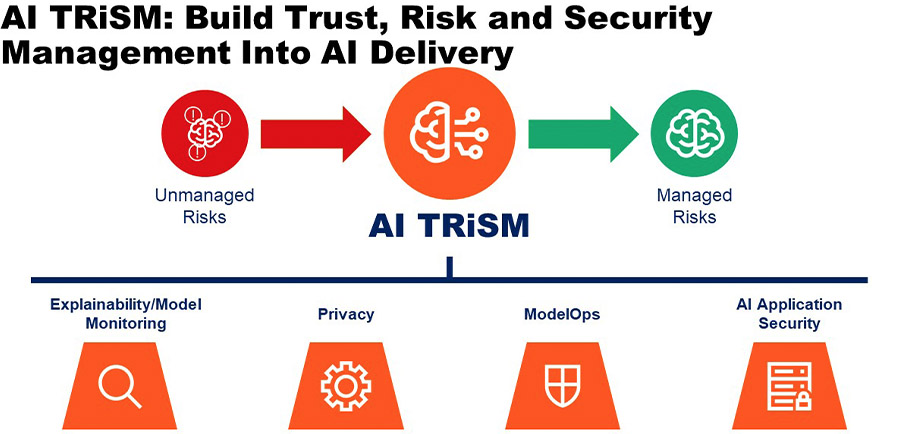
Four Fundamental Pillars of AI TRiSM
The AI Trust, Risk, and Security Management paradigm is supported by four fundamental pillars:

Explainability in AI
Explainability tracks and evaluates AI models, ensuring they meet their goals. It improves model performance, efficiency, and outcomes.

ModelOps
ModelOps focuses on the upkeep and management of any AI model’s whole lifespan, including models based on analytics, knowledge graphs, decision-making, and so on.

Securing AI applications
Application security is crucial due to AI’s handling of sensitive data. TRiSM helps create policies that prevent unauthorised access and cyberattacks.

Privacy
Safeguards data privacy, ensuring proper collection, storage, and usage of data while respecting individual privacy rights.
Applications
The AI TRISM framework finds applications across various industries. Here are some examples:
- In healthcare, it enhances trust, reduces risks, and protects patient data
- In financial services, it helps detect fraud, manage credit risks, and safeguard consumer information.
- In the automotive industry, it ensures security and trust in autonomous vehicle development.
- In manufacturing, it safeguards sensitive industrial data in AI-powered systems (production, quality, maintenance) and manages risks in highly automated environments.
The use cases are extensive. By applying this approach, businesses can secure infrastructure, maximise data insights, and ensure ethical AI practices across industries.
Key advantages of AI TRiSM
Let’s look deeper into the key advantages of AI TRISM framework. Here is how organisations can benefit when applying AI TRISM in their AI models:
- Building Trust: AI TRiSM validates AI decisions, helping consumers and stakeholders trust an organisation’s use of AI.
- Detecting and Mitigating Risks: It aids in the early detection and mitigation of data privacy and algorithmic bias concerns.
- Enhancing Security: AI model governance helps protect infrastructure, preserve data integrity, and prevent AI from becoming an attack vector.
- Facilitating Regulatory Compliance: TRiSM tools help organisations cope with emerging AI rules and best practices more effectively.
- Protecting Against AI Vulnerabilities: It addresses the vulnerability of AI models to hackers and the potential for AI to be used in attacks.
- Establishing a Solid Foundation: TRiSM’s architecture includes strategies for creating a robust base for AI models.
- Ensuring Result Accuracy: Features like data encryption, secure data storage, and multi-factor authentication ensure AI models produce correct results.
- Enabling Focus on Core Competencies: By providing a secure AI platform, TRiSM allows companies to concentrate on their primary business activities.
Conclusion
In conclusion, AI TRiSM enables secure, trustworthy AI implementation. By adopting this framework, organisations can manage risks, enhance transparency, and ensure ethical AI use. Transparent decision-making and robust security measures build trust in AI systems, safeguarding them from attacks while ensuring accurate and ethical outcomes.
Secure AI, Sustainable Value: Your CISO’s Guide to AI Risk Management

Get your free Whitepaper if you want to:
- Learn to identify and manage unique AI security challenges
- Implement Devoteam’s AI Cyber Trust Cube – our framework for trusted and secure AI deployments
- Align AI with your organisation’s sustainability goals
- Gain insights from Devoteam’s leading AI security experts.