



Estimated reading time: 18 minutes
What you’ll learn from the article
- The New Era of Personalisation
- What is Hyper-Personalisation?
- 3 Main Benefits of Hyper-Personalisation
- How to Implement Hyper-Personalisation in Your Business
- Real-World Examples Across 5 Industries
- Implementing Hyper-Personalisation
- Emerging Approach: GraphRAG (Graph Retrieval-Augmented Generation)
- Conclusion & Recommendations
The New Era of Personalisation
71% of consumers expect interactions tailored precisely to their unique needs and preferences. To meet this demand, service providers are seeking more effective and impactful ways to connect with their audiences. While machine learning has paved the way for powerful recommendation systems, the desire for truly bespoke experiences remains unmet. But the solution might be closer than you think.
Hyper-personalisation is a game-changing approach that uses generative AI to create content that is as individual as your customers themselves. Building upon the foundation of recommender systems, this technique promises a new level of targeted delivery for your products and services. In this guide to hyper-personalisation, you will find definitions, use cases, and a step-by-step overview of the implementation process. Furthermore, we will cover useful tools and an emerging GraphRAG method. Keep on reading and get ready for a crucial shift in consumer expectations!
What is Hyper-Personalisation?
AI-enabled hyper-personalisation is the most advanced form of customer personalisation, using generative AI and your own unique proprietary dataset. It aims to create highly contextualised user experiences, with dynamic content and adaptable offerings in real time. Unlike traditional personalisation (which might segment customers into broad groups for marketing campaigns), hyper-personalisation leverages AI to drill down to the individual level. This involves analysing data gathered on a specific customer, such as browsing patterns, past purchases, demographic data, current app or website behaviour, sensor/IoT data, and others. It then instantaneously customises what customers see or the service they receive.
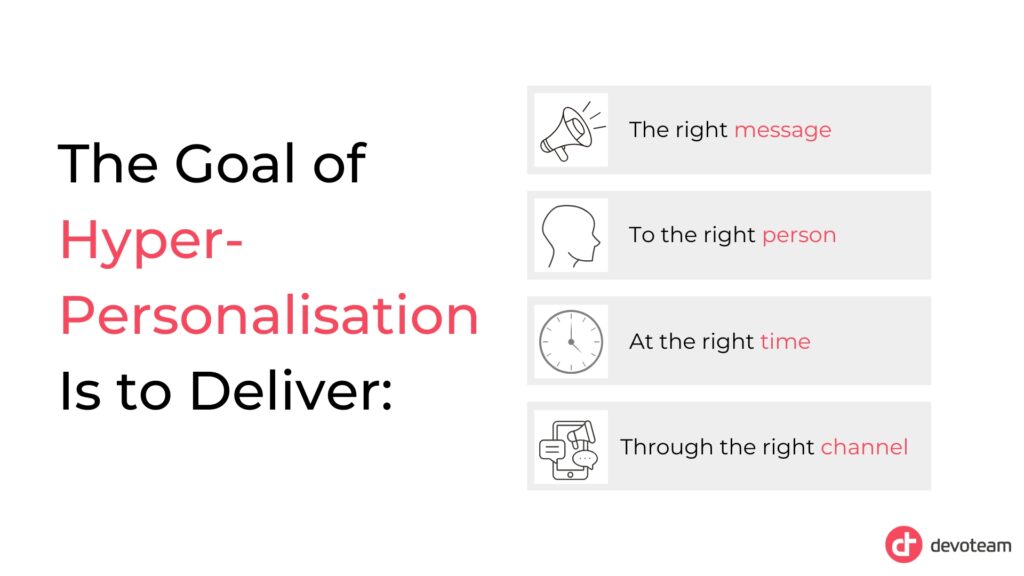
Under the hood, technologies like machine learning, predictive analytics, natural language processing, and real-time data processing make this possible. These AI systems process immense amounts of customer data to find patterns and predict what each customer will respond to. Crucially, hyper-personalisation goes beyond rule-based segmentation, it instead treats each customer as unique and aims to achieve true customer intimacy at scale.
3 Main Benefits of Hyper-Personalisation
What are the benefits of the hyper-personalisation technique? And why are companies investing heavily in the architecture that could support this? If done correctly, hyper-personalisation can unlock a variety of positive aspects for your business.
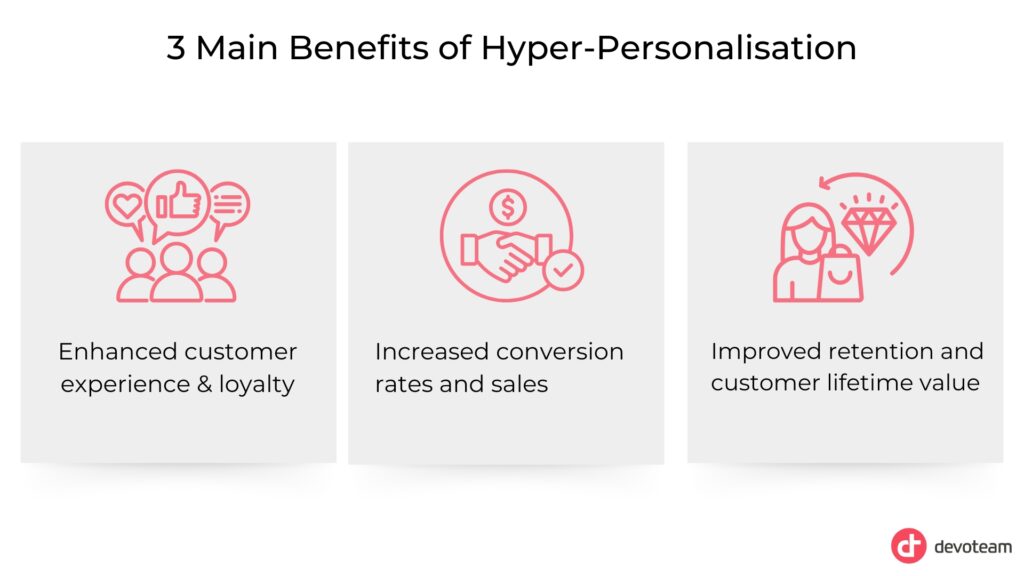
Let’s take a closer look at each benefit:
- Enhanced customer experience & loyalty: Hyper-personalisation makes customers feel seen and valued. By delivering relevant content and recommendations, brands can delight users and increase satisfaction. In fact, a report by McKinsey has shown that 72% of consumers expect the businesses they buy from to recognise them as individuals and understand their interests. And when companies meet this bar, customers reward them – 78% of consumers say that personalised content from brands increases their likelihood to repurchase. Over time, this builds loyalty and trust.
- Increased conversion rates and sales: Hyper-personalisation boosts conversion rates and sales by showing each customer the product or offer most likely to appeal to them. On average, personalised web experiences have been shown to lift sales conversions by around 20% compared to generic experiences, according to the ever-growing e-commerce company Monetate. In another report, it was stated that companies that master personalisation see 5–15% revenue increases as a result.
- Improved retention and customer lifetime value: Building customer relationships doesn’t rest on one-off sales, but on building long-term relationships. By using your proprietary data, you are the one who truly understands your customer and their journey. A study by BCG in the banking industry found that personalisation initiatives can lower customer churn rates and drive annual revenue uplifts of ~10% for banks. More broadly, 56% of consumers in one survey by Twilio said a personalised experience would encourage them to become repeat buyers. Hyper-personalisation creates a virtuous cycle: the more a customer engages, the more data the brand gathers. This allows even more relevant targeting, further increasing the customer’s value and likelihood to stay. Many loyalty programs now use AI to personalise rewards and communications. The payoff is seen in retention, repeat purchase rate, and higher share-of-wallet metrics.
How to Implement Hyper-Personalisation in Your Business
Implementing hyper-personalisation is a multidisciplinary effort that involves data strategy, technical infrastructure, AI modelling and some organisational oversight. There are also some important things to consider, like privacy and ethical concerns. These steps give a rough technical overview of what is needed for a successful implementation. Of course there are other aspects that should be considered as well, like what the true business need for hyper-personalisation is.
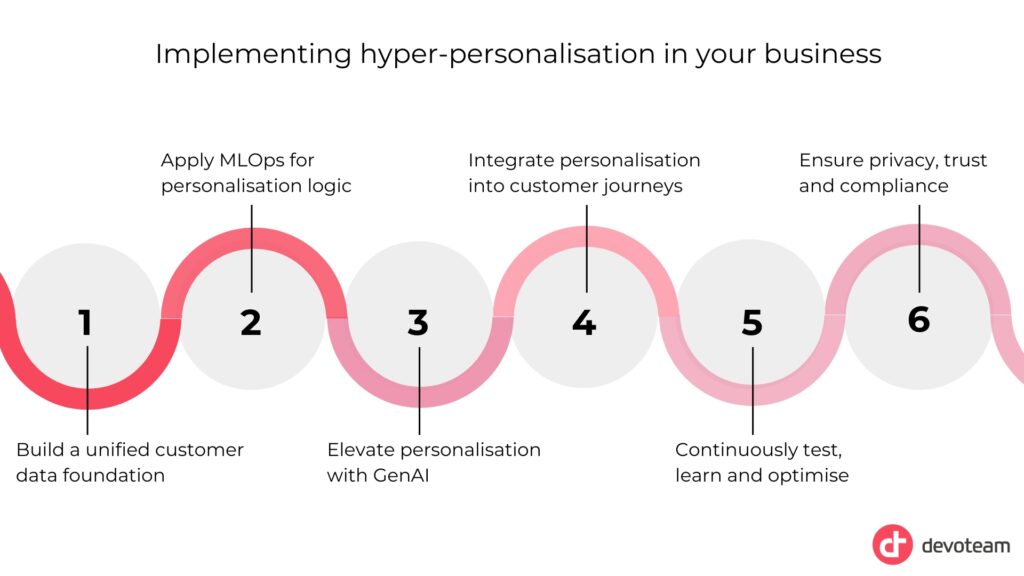
1. Build a unified customer data foundation
We start with the most fundamental part of implementing hyper-personalisation, namely, data. The first step is to build a unified customer data foundation, this is sometimes referred to as a customer 360° profile. This includes transaction history, website/app clickstream data, mobile app usage, email responses, loyalty program activity, customer service interactions, social media data, and more. Modern companies often employ a Customer Data Platform (CDP) or data lake/warehouse to aggregate this information. It’s crucial to ensure data quality and to unify identities. Real-time data collection is also essential; streaming events (such as a customer browsing a product or adding to a cart) should be captured as they happen. A strong data foundation might involve cloud data warehouses, ETL pipelines, and adherence to privacy regulations (like GDPR) to manage consent and data governance from the outset.
2. Apply MLOps for personalisation logic
With the customer data in place, the next step is to develop, deploy, and manage the AI models that power hyper-personalisation. The best way to achieve this is to implement several MLOps best practices that take care of your entire model lifecycle, from development to production. If you are curious about implementing MLOps for your business, see the following link, or reach out to one of us.
Below are some more approaches to achieve the desired personalised insights that eventually will feed into the GenAI component
2.1 Recommendation Engines: These suggest products, content, or actions to users based on their profile and behaviour. Collaborative filtering, matrix factorisation, and deep learning methods (such as neural collaborative filtering or transformers) can be used to power recommendations (“Customers like you also liked…”). For this to scale up, one must consider balancing complex models with simple, intuitive ones, depending on the use case.
2.2 Segmentation to One-to-One: AI can micro-segment or even individualise marketing. Clustering algorithms might group similar customers into very fine segments, or reinforcement learning might dynamically decide the best content for each individual.
2.3 Real-Time Decision Engines: These are systems that can decide, in milliseconds, what content to show to a user. For example, when a user visits a homepage, an AI decision engine might choose which banner, which products, and what message to display uniquely for that session. This essentially combines the powers of 2.1 and 2.2 into one powerful engine.
With any of these, it is important to keep the client at the centre of attention. Therefore, A/B testing during this phase is essential – you’ll want to compare AI-driven personalised experiences against control versions to ensure the model is truly driving improvements and you are not just experiencing a fad.
3. Elevate personalisation with GenAI
Integrating GenAI into your hyper-personalisation strategy significantly enhances your creative capabilities. The key lies in clearly defining your use case and choosing the most suitable AI modality, whether it’s text, image, audio, or video. Text models are excellent for natural language tasks, while image-based models efficiently generate personalised visuals. Audio models can deliver high-quality personalised voice experiences. Video modalities, though currently less widespread, offer powerful potential for engaging customer interactions.
Selecting the right AI solution involves balancing performance needs with cost-effectiveness. Smaller, task-specific models are typically more budget-friendly and better suited for high-volume or real-time applications. In contrast, larger multimodal models offer broader capabilities but come at higher computational and financial costs.
Finally, integrating these AI solutions into your existing customer experience pipeline is crucial. Doing so allows each modality to scale independently, with ongoing performance, cost, and quality monitoring. This ensures that your hyper-personalisation strategy continuously delivers measurable business value.
4. Integrate personalisation into customer journeys
Hyper-personalisation creates the most outstanding value when integrated across multiple customer touchpoints. However, approaching this iteratively is often best, beginning with key channels or interactions where you can quickly demonstrate value. Embedding AI-driven insights gradually into your customer journeys allows you to learn, refine, and scale effectively, ultimately creating a cohesive, personalised experience across all your customer interactions. To understand more about how artificial intelligence is reshaping this key business area, explore the full impact of AI on customer service.

Website and Mobile App: Implement dynamic content placement. For instance, a homepage that rearranges featured items per user, or a news app whose home feed is curated by AI.

Email and Messaging: Use AI to send triggered communications based on individual behaviour (abandoned cart emails tailored with the exact items left behind, follow-up offers related to products viewed, etc.). Even newsletter content can be dynamically assembled per recipient. For example, Spotify’s personalised “Weekly Digest” emails highlight songs or artists that each user might specifically like, rather than a generic newsletter.

Customer Service/Contact Centres: Feed your AI insights to customer service. When a customer calls, the agent (or AI chatbot/voice assistant) should know who the customer is, and their history, and even predict the reason for contact. For example, if the data shows this customer recently experienced a service issue, the system can prompt the agent with a tailored retention offer.
5. Continuously test, learn and optimise
Hyper-personalisation is not a “set and forget” project; it requires ongoing tuning. Businesses should establish a culture of experimentation and continuous improvement. E.g., test personalised versus default content through A/B and multivariate testing to validate impact. Key metrics like conversion rates, churn, customer lifetime value, and satisfaction scores should be tracked, ideally segmented by those receiving personalisation versus those who don’t. Feedback loops are essential; if certain recommendations are being ignored or opted out of, that insight should inform model updates. AI models must also be retrained regularly to keep up with evolving customer preferences, seasonal shifts, and new trends. Finally, start with a few high-impact use cases, and once validated, scale personalisation across more channels, domains, or even into new areas like pricing and product configurations.
6. Ensure privacy, trust and compliance
Given that hyper-personalisation uses extensive personal data, companies must implement it responsibly. Ensure compliance with privacy laws, e.g., obtain consent for data collection/use, provide transparency to users, and allow opt-outs for personalised profiling. It’s wise to have human oversight on how algorithms are using data, especially sensitive categories. For example, an AI might inadvertently target offers based on proxies for ethnicity or health status; one should guard against sensitive attribute targeting that could be unethical or non-compliant. Maintaining customer trust is paramount; hyper-personalisation should feel helpful, not invasive.
Real-World Examples Across 5 Industries
Hyper-personalisation is being applied across a wide range of industries, revolutionising how companies interact with their customers. Let’s look at some real-world examples and use cases in different sectors and perhaps you can find yourself a use case that you would like to try out.
1. E‑Commerce & Retail
Online retailers are leveraging GenAI to go far beyond static recommendations. By analysing browsing history and purchase patterns, platforms can dynamically generate unique landing pages that reflect a user’s preferences, including personalised product arrangements, messaging, and visuals. This same approach powers tailored marketing content, such as emails with subject lines and offers curated specifically for each individual’s shopping habits.
GenAI also enables dynamic pricing strategies. Machine learning models assess real-time demand, user behaviour, and competitor pricing to create personalised price points or offers. For example, a customer who regularly purchases high-end electronics might be shown premium product bundles, while a bargain-focused shopper could receive limited-time discounts aimed at triggering a quick conversion.
2. Banking & Financial Services
Banks are turning to GenAI to generate tailored financial advice in real-time. Mobile banking apps use machine learning to analyse transactions and spending habits. With GenAI, the application can generate bespoke messages: “Based on your recent cash flow, consider increasing your savings account contributions this month,” complete with personalised graphics and even dynamically generated emails summarising your financial health and steps to improve it.
GenAI enhances conventional AI-powered fraud detection by also creating personalised alerts. For instance, if an unusual transaction occurs, the system can automatically generate and send a detailed message explaining the anomaly and providing next steps. This approach not only improves security but also builds trust by offering clear, bespoke communication. Curious how AI is changing the banking and financial sector? Read our expert view!
3. Healthcare
In healthcare, every patient is unique and so should their care. GenAI is being used to generate personalised treatment plans and patient communications. For example, a patient using a digital health app might receive tailored health tips and medication reminders that not only account for their medical history but also adapt in tone and content based on recent activity.
Beyond day-to-day support, GenAI can also assist clinicians by generating personalised diagnostic summaries. When a doctor enters a patient’s symptoms and background, the AI can produce a concise report with possible diagnoses, recommended tests, and care options, helping medical professionals quickly grasp the full context and make well-informed decisions.
4. Hospitality & Travel
Hotels and airlines are leveraging GenAI to provide not only dynamic content, such as personalised suggestions and itineraries but also unique messages tailored to each guest. For example, a hotel’s mobile app might dynamically generate a welcome note mentioning the guest’s previous stays and suggesting services that match their interests—be it spa recommendations or a specific type of cuisine in the hotel restaurant.
Using a combination of real-time data and GenAI, hospitality companies can craft custom offers. An airline, for instance, might generate a personalised travel itinerary complete with custom‑branded advice and offers (“Based on your past trips, you might enjoy a lounge upgrade today!”) that dynamically adapts to current travel data.
5. Contact Centers & Customer Service
AI chatbots and voice assistants are now enhanced by generative AI. When a customer contacts support, the GenAI‑powered system not only retrieves historical context but also generates a unique, friendly greeting and real‑time responses that adapt as the conversation unfolds. This level of personalisation reduces handling times and improves satisfaction by providing a conversation that feels both intuitive and tailor‑made. Want to discover other ways AI is used in Customer Service? Read our comprehensive guide!
Download Now: Free AI Strategy Playbook
[New 2025]
Implementing Hyper-Personalisation
We covered the benefits of hyper-personalisation and the general implementation steps, but how do you actually implement it with specific technologies? Naturally, this will depend on your current infrastructure and use case. Devoteam partners with leading cloud platforms like AWS, Google Cloud, Microsoft and ServiceNow, which gives us expertise on implementing AI solutions in different environments. Let’s look at a couple of examples of hyper-personalisation with different cloud platforms.
Hyper-personalisation with AWS
By Yannick Caillaud, Senior Data Engineer at Devoteam, AWS business unit
At the heart of any hyper-personalisation engine lies the ability to collect, store, and process vast amounts of customer data. Amazon Simple Storage Service (Amazon S3) provides a scalable and cost-effective data lake foundation, capable of storing structured, semi-structured, and unstructured data from diverse sources.
To organise and govern this data lake, AWS Lake Formation simplifies the process of building, securing, and managing data lakes. It allows for centralised data governance and fine-grained access control and is compliant with customer requirements and GDPR regulations. AWS Glue, a serverless data integration service, facilitates the ETL (extraction, transformation, and loading) of data into the data lake, preparing it for analysis and machine learning.
To extract meaningful insights and build predictive models for hyper-personalisation, Amazon SageMaker provides a comprehensive machine learning service that enables data scientists and developers to build, train, and deploy machine learning models at scale.
Amazon Personalize, a fully managed service within the AWS ecosystem, offers a dedicated solution for building hyper-personalised recommendation systems. It leverages sophisticated machine learning algorithms to generate real-time personalised recommendations for users based on their interactions, preferences, and item metadata. Amazon Personalize can address common challenges like cold starts for new users or items and adapt to evolving user behaviour.
For post-deployment monitoring and continuous improvement, the data in Amazon S3 can be analysed using services like Amazon Athena and Amazon QuickSight. Amazon Athena enables serverless interactive querying, while Amazon QuickSight allows you to create insightful visualisations and dashboards.
Hyper-personalisation with Google Cloud
By Joshua Vink, Senior AI & ML Consultant, Devoteam, Google Cloud business unit
Google Cloud Platform (GCP) provides a range of services for hyper-personalisation, from data intake and storage to machine learning model training and real-time recommendation delivery.
BigQuery acts as a central data hub, ideal for large-scale customer data integration. Its speed and SQL capabilities allow for a complete customer view and even initial model exploration. The serverless nature lets you focus on analysis, not database management. GCP also offers Cloud Storage for unstructured data and Dataproc/Dataplex for big data processing. Security and governance tools ensure data is well-managed.
Vertex AI offers tools for developing, training, and deploying ML models at scale. This includes recommendation systems and customer lifetime value predictors. Features like Vertex AI Pipelines aid MLOps, and Vertex AI Endpoints allow for easy model deployment and real-time prediction delivery. Vertex AI handles autoscaling and provides Vertex Feature Store for managing key customer data. Vertex AI Matching Engine enables high-speed similarity searches for recommendation systems.
Post-deployment, BigQuery and Looker help monitor personalisation performance. Vertex AI tracks model performance, and Google Cloud’s Operations suite monitors infrastructure. The integrated GCP services allow for a continuous improvement feedback loop.
Hyper-personalisation with ServiceNow
ServiceNow empowers organisations to move beyond generic interactions and create hyper-personalised experiences that build customer trust, enhance satisfaction, and drive loyalty.
Here is how it is done:
- Unified Platform and Data Foundation: ServiceNow brings together data from various touchpoints and systems across an organisation. This provides a 360-degree view of each customer or employee, capturing their interactions, preferences, history, and context. Such a unified data foundation is crucial for delivering hyper-personalised experiences.
- Advanced Analytics and AI Capabilities: By analysing vast amounts of data with AI and ML, ServiceNow is able to identify patterns, predict needs, automate interactions and workflows and generate personalised insights.
- Dynamic Content and Offers: ServiceNow facilitates the creation of dynamic and personalised content within self-service portals, agent workspaces, and other interfaces.
- Workflow Automation with Personalisation: ServiceNow’s workflow automation capabilities can be infused with personalisation logic. This means that processes adapt based on individual user characteristics and needs.
Devoteam works with organisations to leverage ServiceNow’s capabilities and design and implement truly personalised customer experiences.
Emerging Approach: GraphRAG (Graph Retrieval-Augmented Generation)
As hyper-personalisation continues to evolve, one promising method gaining attention is GraphRAG, a new approach that combines generative AI with knowledge graphs to generate highly contextualised and intelligent outputs. Unlike traditional RAG (Retrieval-Augmented Generation), which pulls from unstructured text, GraphRAG retrieves information from structured graphs that represent relationships between entities, like customers, products, and behaviours.
This added layer of structure helps the AI understand how data points are interconnected, allowing for more precise and relevant personalisation. For example, instead of just knowing a customer bought running shoes, the AI can also infer they’re training for a marathon and suggest related products accordingly. While still in the early stages, GraphRAG is being explored for use cases in healthcare, marketing, and B2B sales and is likely to shape the next frontier of AI-driven personalisation. More about this can be found in this paper.
Conclusion & Recommendations
Hyper-personalisation has emerged as a game-changer for businesses across industries. It leverages data and intelligence to create customer experiences that feel tailor-made, driving substantial improvements in engagement, conversion, and loyalty. As we’ve seen, companies that get it right are reaping the rewards in revenue and customer satisfaction, while those that lag risk losing business. Implementing hyper-personalisation can be complex, but the journey can be managed with a clear strategy and the right tools.
To conclude, here are some actionable recommendations for organisations looking to harness hyper-personalisation:
- Invest in Data Infrastructure: Begin by breaking down data silos and consolidating your customer data into a unified platform. Ensure you have robust data collection (including real-time events) and a single customer view. Without high-quality, accessible data, even the best AI will falter.
- Start Small with High-Impact Use Cases: Identify a pilot use case that can showcase quick wins, for example, product recommendations on your homepage or a personalised email campaign. Implement, test, and measure results. Use early successes to build momentum and justify further investment.
- Leverage Scalable AI Tools: You don’t have to build everything from scratch. Use cloud-based AI services (like GCP’s Vertex AI) to accelerate development. These tools incorporate best-in-class algorithms and can save you time. Ensure your solution can scale to your customer base and activity levels.
- Embed Personalisation Across Channels: Don’t let personalisation be a one-channel experiment. Aim for consistency across web, mobile app, email, and offline touchpoints. Omni-channel coordination will amplify the impact (for example, a personalised offer is more effective if the customer sees it in an email and on the website and hears it from a sales rep, rather than in just one place).
- Maintain Customer Trust (Privacy & Relevance): Personalisation should be done with the customer’s interests in mind. Be transparent about data usage and make it easy for customers to control their preferences. Focus on genuinely helpful personalisation rather than gimmicks. Always ask, “Is this adding value to the customer’s experience?” Avoid the “creepy” factor of over-personalisation by using data thoughtfully. Earning and keeping trust will ensure customers welcome your personalised touches.

Exceed your customers’ expectations with hyper-personalisation!
Talk to our experts or explore our success stories and learn how we’ve helped companies like yours achieve tangible results.