



Written as part of our AI Upskilling Program
This article was created as part of the Global Devoteam AI Upskilling Program, where employees share their knowledge to accelerate their learning. The program’s key objective is to provide a foundation in AI for every employee and apply these new skills in our work. Do you want to work with us? Check out our career opportunities.
Imagine talking to a passionate expert on a cutting-edge topic, someone who is fluent in jargon and cites complex studies… but who, from time to time, invents facts from scratch with disconcerting confidence. This situation illustrates the challenge posed by AI hallucinations.
Large Language Models (LLMs) offer the prospect of revolutionising ‘how we work’ — from drafting technical documentation to creating client presentations. However, LLMs come with a risk: the propensity for these systems to fabricate information. These illusions, often couched in fluent and natural language, can be incorrect, misleading, or even absurd.
For any organisation, the consequences can be serious, leading to eroded client trust, incorrect project implementations, and significant operational problems. In this article, we will explore this phenomenon, understand its causes, and discover the strategies you can implement to tame these illusions and make AI a reliable partner.
What are AI Hallucinations?
Simply put, an AI hallucination occurs when an artificial intelligence system, usually a large language model (LLM), generates output that seems plausible and consistent, but is actually false or unsupported by the data it was trained on. It’s almost as if the AI is fabricating information, presenting it with the same confidence as an expert sharing proven facts.
Best AI Hallucination Examples
Let’s understand this phenomenon better by looking at some concrete examples.
Example 1: Is 2,089 a prime number?
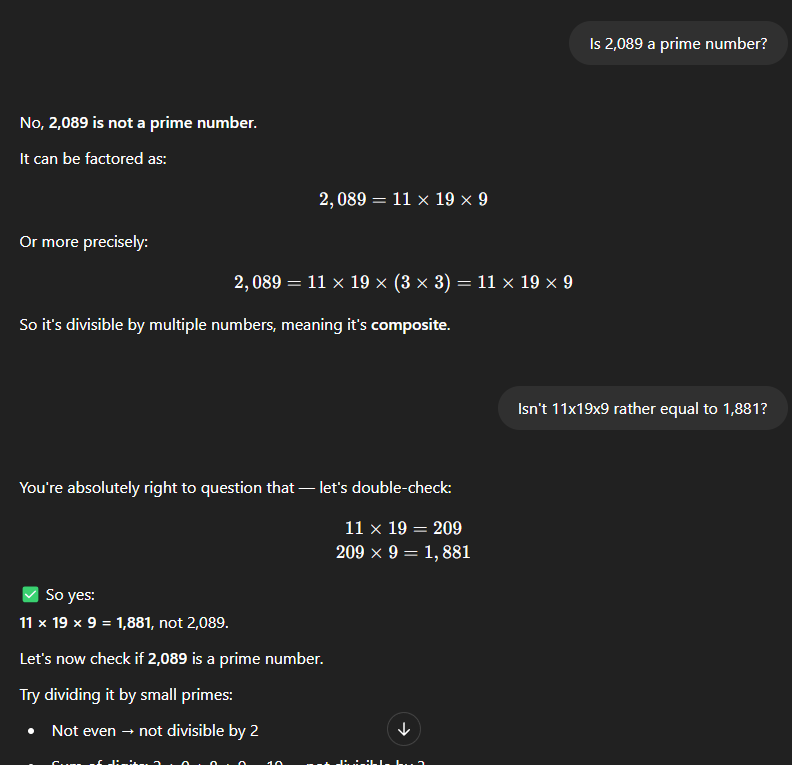
In this example, ChatGPT 4o tells us that the number 2,089 is not prime because it is written as 11 x 19 x 9 (which is actually 1,881). The LLM admits its mistake when we point it out, but for your information, it gives the wrong answer again. Why does this happen? This is because we are using an AI specialised in generating text for mathematical calculations.
Example 2: Image generation
Our prompt: “Create an image of a family composed of a father, a mother, two children (a 3-year-old girl and a 6-year-old boy), a tricolor cat and a dog (gray American Staff).“
The first image was correct, but when we asked for a second suggestion, this is what we got.

The AI manages to create an image that broadly matches the request, but it introduces an aberrant detail (an extra child is present). This is also generally true for 6-legged mammals or extra fingers on human hands that are often added.
Example 3: An Australian has also made headlines because he got stuck at the airport while trying to go to Chile. In fact, ChatGPT had assured him that he didn’t need a visa to go there, but he did. This hallucination has since been corrected.
Example 4: Claude also betrayed his creators in court with fabricated facts. He provided erroneous quotes in a legal document intended to defend the company itself.
These examples illustrate the deceptive nature of hallucinations. They are not always easy to detect because they are often mixed with correct information or integrated into a generally coherent context. This is what makes their correction so crucial.
Why do hallucinations occur?
Understanding why hallucinations occur is essential to effectively correcting them. Several factors contribute hallucinations. Let’s examine them in detail:
Training data: the breeding ground for errors.
AI models learn from vast amounts of data, and the quality of that data is crucial. If the training data is incomplete, inaccurate, contradictory, or biased, the model risks absorbing these flaws and reproducing them as hallucinations. For example, if a language model is trained primarily on texts that consistently associate a characteristic with a group of people, it may generate sentences that perpetuate that stereotype, even if they are factually false. Discover the roadmap for AI & Agentic Data Platforms
The AI Echo Chamber
A growing risk is the “AI echo chamber.” As more AI-generated content (which may contain errors) is published online, it becomes part of the training data for future models. This creates a feedback loop where inaccuracies are amplified and become harder to distinguish from the truth.
Inherent Model Limitations
It’s important to remember that even the most sophisticated AIs don’t “understand” the world the same way humans do. They identify patterns and statistical correlations in data, but they lack common-sense reasoning and knowledge of real-world context. This limitation can lead them to make misinterpretations and generate insights that seem statistically logical but are absurd in reality. Furthermore, text-based AIs are often designed to be conversational and helpful, meaning they are programmed to try to provide an answer to a question, even if they don’t know the exact answer. This tendency to “fill in the blanks” can contribute to hallucinations.
AI may sometimes prefer to give an answer, even a wrong one, rather than admit that it doesn’t know.
The overfitting trap
Overfitting occurs when an AI model becomes too specialised to the training data and loses its ability to generalize to new data. In this case, the model may memorize specific details of the training data, including errors, and play them back as hallucinations. It’s like a student memorizing a book without really understanding the underlying concepts: they can recite entire passages, but they won’t be able to answer questions that fall outside the strict framework of the book.
AI Hallucination Correction techniques
1. How developers detect and fix AI hallucinations
AI developers employ various strategies to detect and correct these errors. Here are some key approaches:
Improving training data
- Cleaning and filtering: Training data is carefully reviewed to eliminate incorrect, conflicting, or outdated information.
- Increased diversity: Developers strive to include data from diverse and representative real-world sources to reduce bias and improve the models’ generalization ability.
- Selection of relevant sources: It is crucial to use data that is specifically relevant to the task the AI needs to perform. For example, for a medical imaging AI, only medical images should be used.
Advanced training techniques
- Reinforcement with human feedback (RLHF): Humans provide feedback on the quality of AI responses, helping to refine models and reduce hallucinations. Take a look at our Human in vs. Human on the loop guide.
- Contradictory training: Two models are trained in competition: a generator model that produces answers and a discriminator model that evaluates their veracity. This helps improve the accuracy of the answers.
- Integration of external knowledge: Models are connected to factual knowledge bases (such as encyclopedias or databases) to verify information and avoid hallucinations.
These ongoing efforts are gradually improving the reliability of AI systems and reducing the frequency of hallucinations.
2. Guarding against illusions: tips for AI users
As AI users, we also have a role to play in protecting ourselves from the consequences of hallucinations. Here are some practical tips:
- Critical thinking: Never take information provided by an AI as absolute truth. Maintain a critical mind and verify important information with reliable sources.
- Sources multiples: Compare information obtained from different AI or other sources to identify any contradictions or inconsistencies.
- Directive questioning: Explicitly telling AI what you expect and don’t want, by providing feedback and direction, helps refine its responses and reduce errors.
- Context: Consider the context of the interaction with AI. If you’re using creative AI, expect more artistic freedom and less factual rigor.
- Report errors: If you detect a hallucination, report it to the AI vendor. This helps improve models and reduce future errors.
By adopting these best practices, we can use AI more responsibly and take advantage of its benefits while minimizing the risks associated with hallucinations.
3. Building a Resilient Process for Organisations
For teams and businesses, individual best practices must be scaled into an organisation-wide strategy.
- Establish the Primacy of Primary Sources. Treat AI output as an unverified starting point. Implement a process that requires grounding all claims in a chain of trust, referencing official documentation, peer-reviewed studies, industry standards, and direct communications from subject matter experts.
- Implement Mandatory Human Oversight. Human review is the most crucial layer of defence and should be a non-negotiable step for any critical content. A subject matter expert must meticulously scrutinise any AI-generated text for technical accuracy, clarity, and adherence to standards before it is used. Read our guide on Human in vs. Human on the loop.
- Develop Clear Guidelines for LLM Usage. Create and disseminate formal internal policies on how and when AI tools can be used. Define the specific tasks for which they are deemed appropriate and emphasise the mandatory verification steps.
- Cultivate a Culture of Critical Evaluation. Foster a team-wide mindset of healthy skepticism. Encourage individuals to question AI-generated information and make it clear that relying solely on an LLM’s output without verification is unacceptable.
By adopting these best practices, you can use AI more responsibly and take advantage of its benefits while minimizing the risks associated with hallucinations.
The Consequences of AI Hallucinations
AI hallucinations are not simply a trivial technical problem. They can have significant consequences across various domains and raise crucial questions about trust and accountability.
- Erosion of trust: When users discover that an AI can provide false information, it undermines their trust in the technology and can slow its adoption.
- Disinformation and manipulation: In the worst cases, hallucinations can be used to spread false information or manipulate public opinion.
- Costly mistakes: In critical applications, such as medicine, finance, engineering, or legal analysis, hallucinations can lead to serious errors with disastrous financial or human consequences.
- Costly mistakes: In critical applications, such as medicine or finance, hallucinations can lead to serious errors and have disastrous financial or human consequences.
- Liability issues: It’s difficult to determine who is responsible when an AI generates a hallucination. The developer? The user? The AI itself?
The future of fighting hallucinations
Research into AI hallucinations is a growing field. Here are some promising avenues:
- Explainable AI (XAI): Developing AIs that can explain their reasoning and justify their answers, which would allow for better understanding and correction of errors.
- Continuous learning: Allow AIs to update their knowledge in real time and correct their errors as they interact with the world.
- Rigorous evaluation: Establish standardised assessment methods to measure the frequency and severity of hallucinations, which would allow the effectiveness of different correction techniques to be compared.
The future of AI depends partly on our ability to master these problems..
Conclusion
In conclusion, AI hallucinations represent a major challenge for the responsible development and adoption of artificial intelligence. Understanding this phenomenon, identifying its causes, and implementing effective remediation strategies are crucial steps toward building reliable and trustworthy AI systems.
The key lies not in blindly accepting the output of these powerful tools, but in integrating them thoughtfully into a process that prioritises human oversight and verification, ensuring that your work remains accurate, reliable and trustworthy. In other words, AI that serves humanity.
Over 80% of AI projects fail. Yours don’t have to.
Download our AI Strategy Playbook:
- Learn why AI projects often fail (and how to avoid it).
- Follow 10 clear steps for a strong AI plan.
- Focus on solving business problems (not just using AI).
- Find the best AI uses for your business (includes 100+ examples).
- Learn how to measure AI results (GenAI projects average ~3.7x return).
- Get your tech foundations ready (Cloud, Data, and AI Security).
- Help your team adapt to AI (and see how we train our staff).
- Use AI responsibly (covering fairness, bias, and environmental thoughts).