


The 2026 Banking Efficiency Gap
As we start 2026, the global banking industry is facing what is called a “Great Transition.” The era of easy margins is over. Banks are now operating in a “toxic revenue-cost squeeze”: while revenue growth has slowed to 2-4% annually, operating costs are ballooning due to a surge in non-discretionary spending.
The primary driver of this cost spike is “Regulatory Tech Debt.” New mandates like the Digital Operational Resilience Act (DORA) and tightened AML/KYC standards are no longer just compliance checkboxes; they are major operational burdens consuming up to 15-20% of total IT spend. In this climate, “optimisation” is not a choice, but the only way to fund innovation.
In this article, I explore how to convert regulatory burdens into innovation opportunities. You will learn to use the “Value Navigator” framework to map unit costs and simulate ROI, ensuring every euro spent moves the needle from legacy maintenance to profitable modernisation.
The New Threat: Digital Innovators and the “AI-First” Advantage
Traditional banks are no longer just competing with each other; they are being outpaced by “Fast Players”, digital-only neobanks like Nubank, Revolut, and Chime. These players don’t just have better apps; they have a fundamental cost advantage.
- The CI Ratio Gap: While traditional banks struggle with Cost-to-Income (CI) ratios of 50-60%, digital innovators are operating at 20-30%.
- AI-First Unit Economics: These challengers leverage “AI-First” architectures. Instead of mapping costs once a year, they use AI to monitor unit economics in real-time. If a specific customer segment or product becomes unprofitable due to rising cloud costs or fraud rates, their AI models flag it, allowing for strategic adjustments.
For traditional banks, the “Cost Maze”, a legacy web where true costs are hidden, is the single biggest barrier to matching this agility.
The Solution: AI Scenario Modelling as a “Value Navigator”
To close this gap, banks must move from static spreadsheets to AI Scenario Modelling. This technology creates a “Digital Twin“ of the bank’s operational cost structure. Unlike traditional tools that merely report spend, a “Value Navigator” builds a dynamic relationship between raw IT expenses and business outcomes through a sophisticated four-stage process:
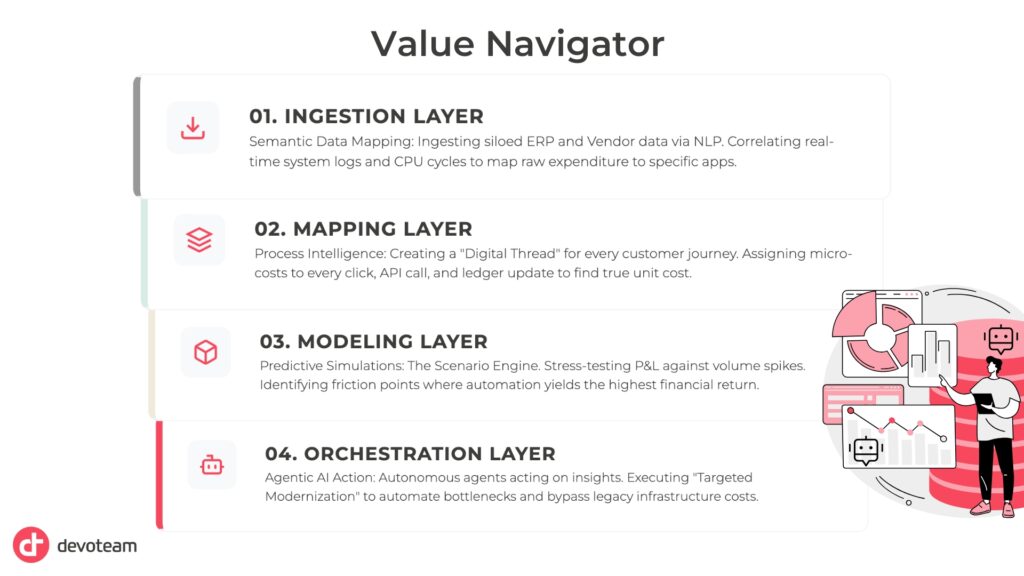
Let’s dive deeper into each layer!
1. The Ingestion Layer: Semantic Data Mapping
The system uses Semantic Data Layers to ingest data from siloed environments without requiring a massive data migration.
- It pulls Financial Data from ERP systems and Vendor Contracts, using NLP to interpret complex license terms.
- It correlates this with Operational Data—real-time system logs and mainframe CPU cycles (MIPS)—to understand exactly which applications are consuming the most resources and when.
2. The Mapping Layer: Process Intelligence
The AI uses Process Mining to track the “Digital Footprint” of every customer journey.
- When a customer clicks “Apply for Loan,” the AI follows that request through the entire stack, from the mobile API to the middleware and the back-end ledger.
- It creates a Digital Thread, assigning a precise “micro-cost” to every step. The result is a shift from asking “What is our IT budget?” to “What is the true unit cost of this specific business process?”
3. The Modelling Layer: Predictive Simulations
With the data mapped, the AI acts as a Scenario Engine.
- It allows leaders to change variables (e.g., volume spikes or system changes) to see the ripple effect on the bank’s P&L.
- Banks using this approach have identified high-friction workflows that, once automated, have led to up to a 40% decrease in onboarding costs.
4. The Orchestration Layer: Agentic AI Action
Finally, the system leverages Agentic AI, autonomous agents that can act on the insights. Instead of just highlighting an expensive manual step, these agents can be deployed to orchestrate the “Targeted Modernisation” identified in the scenarios, such as automating a specific document verification step to bypass legacy bottlenecks.
The Framework: The Modernisation Value Matrix
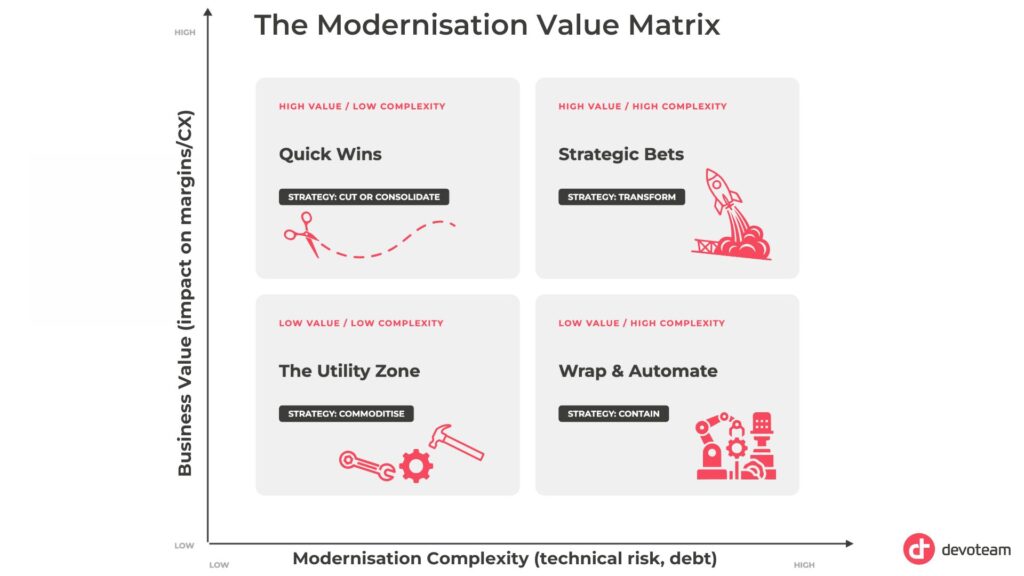
Once the AI reveals the true cost/value mapping, leaders need a framework to act. We use the Modernisation Value Matrix to categorise initiatives based on their Business Value and Modernisation Complexity.
- Quick Wins (High Value / Low Complexity)
- Strategy: Cut or Consolidate.
- The AI identifies “zombie” SaaS licenses and redundant data storage. Simplifying these undifferentiated products can free up 50-80% of costs in specific areas to fund transformation elsewhere.
- Strategic Bets (High Value / High Complexity)
- Strategy: Transform.
- These are core systems (e.g., Core Banking) that block innovation. The AI provides the hard ROI data needed to justify a multi-year cloud-native migration.
- The “Wrap & Automate” Zone (Low Value / High Complexity)
- Strategy: Contain.
- Old back-office systems are stable but expensive. AI data proves that “ripping and replacing” has a negative ROI. Instead, banks use “Agentic AI” layers to automate around the legacy core.
- The Utility Zone (Low Value / Low Complexity)
- Strategy: Commoditise.
- Standard IT functions like email or basic maintenance. These are standardised or outsourced to keep the “Run the Bank” budget lean.
The Process: Running the “What-If” Scenarios
The ultimate value of this engine is the ability to simulate “What-If” scenarios before committing capital, a critical safeguard given that around 48% of banking AI projects are abandoned before production due to lack of clear ROI.
Example Case: The Loan Processing Crisis
A bank’s “Time to Cash” is 9 days, while digital innovators do it in 24 hours.
- Scenario A (The Band-Aid): Hire 50 more staff.
- AI Prediction: Unit cost per loan rises 15%; speed improves only slightly.
- Verdict: ROI Negative.
- Scenario B (The Big Bang): Replace the entire legacy mainframe core.
- AI Prediction: 3-year timeline; 70% probability of project failure due to 5,000+ undocumented dependencies.
- Verdict: Too High Risk.
- Scenario C (Targeted Modernisation): The AI identifies that 80% of the friction is in “Income Verification.” The bank deploys a targeted AI Agent for just this step.
- AI Prediction: 40% reduction in unit cost; 6-month payback.
- Verdict: Optimal Strategy.
Conclusion
The 2026 banking winner will not be the one with the biggest IT budget, but the one with the highest “AI-to-Value” ratio. By moving away from fragmented pilot projects and adopting a holistic, AI-driven cost strategy, banks can finally shift their spending from “Running the Bank” to “Reinventing the Bank.”
The technology is no longer an IT project; it is the Value Navigator that determines which institutions will thrive in the AI age and which will be left behind in the maze.
Want to read more about AI in banking? Read our expert view on AI banking trends.

Is Your Legacy Tech Draining 20% of Your Budget?
Do not let “Regulatory Tech Debt” dictate your 2026 margins. Contact our experts to see how you can innovate your way out of the Cost Maze.