


Estimated reading time: 7 minutes
Written as part of our AI Upskilling Program
This article was created as part of the Global Devoteam AI Upskilling Program, where employees share their knowledge to accelerate their learning. The program’s key objective is to provide a foundation in AI for every employee and apply these new skills in our work. Do you want to work with us? Check out our career opportunities.
Introduction
The right architecture, good data and realistic ambitions – that’s how you succeed with AI in practice.
AI has taken over the strategy debate. The board is asking. The management is asking. And in many companies, a kind of “AI pressure” is emerging – a need to show that we are also doing something with AI. That’s understandable. The potential is enormous, the technology is suddenly available to everyone, and there is a fear that we will be left behind.
But this pressure must not lead to hasty projects without clear goals or system support. It is important to start with AI – but you have to start with the right use cases. It should be use cases that provide real value, and that can actually be implemented with today’s data, processes and system architecture.
From this article you will learn why traditional ERP systems often act as an anchor, holding back innovation, and how a modern, composable architecture is the key to unlocking genuine, scalable value from artificial intelligence.
Why Your Old ERP System Is an AI Blocker
Many businesses still rely on traditional ERP (Enterprise Resource Planning) solutions – solid, but often inflexible. Here are some reasons why the old ERPs make it harder to unlock the potential of AI:
- The data is not accessible or structured
- The processes are manual and not standardised
- The integrations are expensive and complicated – typically point-to-point between legacy systems written in custom code
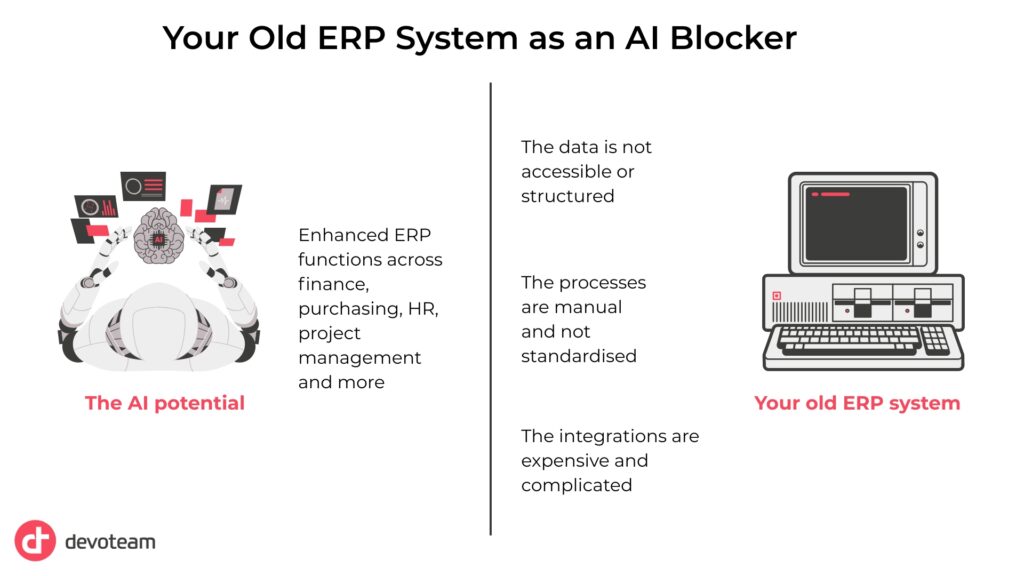
It is simply difficult to put AI to work when the underlying infrastructure does not support it.
The Solution? Build with Bricks, Not Cement
Composable ERP is a term referring to building the system landscape modularly – like building blocks that can be connected and adjusted over time. Composable ERP is typically cloud-based.
This is what you get with Composable ERP:
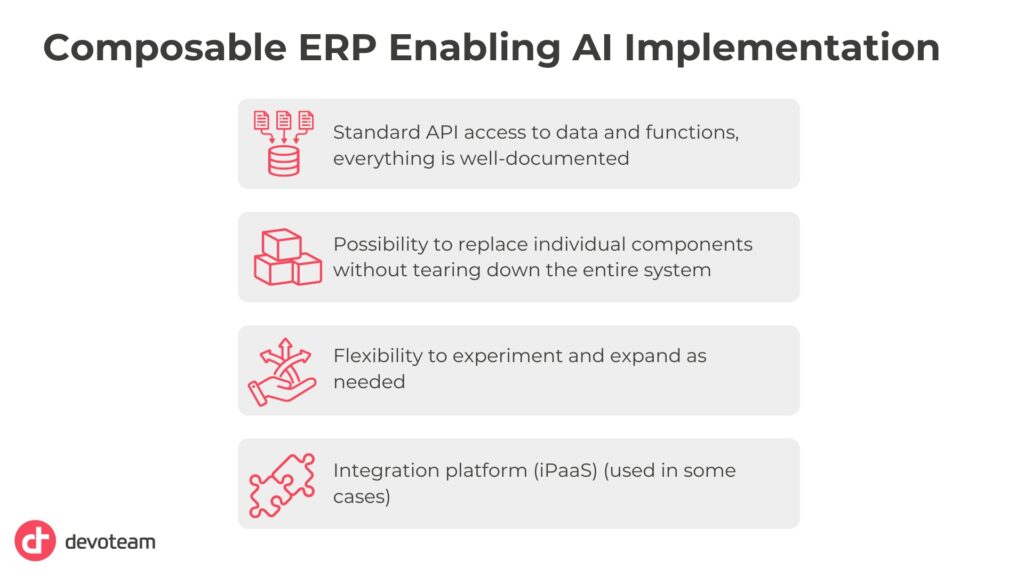
The result? A foundation where you can actually connect to AI – smart, efficient and scalable.
How Can AI Be Used In an ERP Context?
AI in ERP is no longer science fiction, but I think examples of practical use are still very limited. Some have difficulty seeing the obvious opportunities AI can provide. The major ERP vendors also see that customers need help getting started and therefore try to inspire by providing examples and partially building ready-made solutions.
Let’s look at some of the examples of solutions for AI in ERP:
- Oracle Fusion Cloud ERP has built-in AI that predicts cash flow, suggests project participants for tasks, generates project plans and alerts about risks in the supply chain – all through intelligent assistants. For inspiration, Oracle has collected a number of examples of the use of AI here.
- SAP has developed “Joule”, an AI-based copilot that helps users automate tasks, interpret numbers and gain insights in real time. This will also be connected to Microsoft’s Copilot for further efficiency and value. SAP has collected a number of examples and inspiration for customers here.
- Microsoft Dynamics 365 combines AI from Azure and Copilot with ERP functionality – e.g. intelligent purchasing support, sales forecasts and document analysis. Microsoft has also seen the need to inspire the use of the solutions through examples and customer stories. See more here.
- Infor has worked well with AI and is trying to show how different sectors/industries and micro-verticals can utilise their AI functionality. An example is for fashion with AI-assisted product development (variant suggestions, data enrichment of product cards), price and campaign optimsation, deviation detection in production/supplier data and recommended actions. Read more here.
- IFS does a bit of the same as Infor. They also have industry-specific solutions for, for example, the power industry, where they deliver smart forecasting and simulation for plant activities, route planning, deviation detection on components and lines that can automatically trigger purchase and work orders, etc. See more here:
As the examples show – AI can already today enhance ERP functions across finance, purchasing, HR and project management, etc. But only if the systems facilitate it.
Size of the Supplier Determines Approach
The largest ERP players – SAP, Oracle, Microsoft – develop their own AI solutions and incorporate them directly into their products. They often own the entire technology stack and have their own language models, data centers and AI teams. But even though they develop their own solutions, they are also open and can use third-party solutions as part of the product.
The smaller and medium-sized ERP suppliers, which are often strong in niches and industries, rarely have the resources to build their own AI engines. For these players, it is crucial that the solutions are:
- Composable, so that external services such as OpenAI GPT-4, Google Gemini, or Microsoft Copilot can be connected
- Accessible via modern APIs and data access, so that AI can work with the company’s real process and business data
A recent analysis from Third Stage Consulting ranks SAP, Microsoft, Oracle and Workday among the leading AI players in the ERP market – and points out that smaller vendors will have to rely on open architectures and integrations to keep up.
So – if you don’t choose a solution from one of the big ones that has its own AI built in (which there may be many reasons not to), you need to choose one of the smaller ones carefully – they need to have a smart and flexible platform.
Get Started – But Do It Right
As I mentioned in the beginning of the article, many feel pressure to get started with AI. My message is simple: The pressure is there for a reason and yes, most people should try to get started with AI. But start in a way that provides real value and don’t construct problems that don’t actually exist just to solve something with AI.
Some things to keep in mind:

Choose the right cases first – with clear benefit and feasibility

Make sure your systems are ready – flexible, accessible and integrable

Think continuous improvement, not a one-off project – AI solutions need to be managed and further developed, just like other parts of the business
Many AI initiatives in ERP fail because the business lacks data quality, structured processes and anchoring. Therefore, AI should be seen as an improvement practice, not a stunt. If you want to know why most AI projects fail in general, check our expert view.
Conclusion
AI is not magic – but an aid when things are in place for its use. On the other hand, it is also not just an “amplifier” of existing structure and order.
With the right approach and technology, AI can actually simplify the complex, clean up unstructured information, and automate tasks that previously required manual effort. It can help you take action where you currently struggle with fragmented processes, long lead times, or poor data quality.
But to do that, you need an architecture that allows for it: Composable ERP provides just that flexibility – to connect AI where it adds value, pull data across, and make improvements piecemeal and pragmatically.
The path to AI success doesn’t start with a complex AI project. It starts with ensuring your foundation is ready. A flexible, composable ERP system is no longer a ‘nice-to-have’ – it’s a prerequisite for competing. AI and composable ERP are not an end in themselves – but a tool for continuous improvement. And that’s what smart businesses are investing in now.
Ready to take the first step?
At Devoteam, we help you assess your current system landscape and identify the cases that provide real value – quickly. Get in touch, and we’ll build the bridge from hype to action together.