


Written as part of our AI Upskilling Program
This article was created as part of the Global Devoteam AI Upskilling Program, where employees share their knowledge to accelerate their learning. The program’s key objective is to provide a foundation in AI for every employee and apply these new skills in our work. Do you want to work with us? Check out our career opportunities.
Artificial intelligence is becoming autonomous. We are moving from simple chatbots to AI ‘agents’ that can independently perform tasks: managing projects, booking travel, or interacting with customers. While this brings efficiency, it also introduces serious risks. An autonomous agent acting without direct oversight could make costly errors, expose sensitive data in breach of regulations like GDPR, or act in a way that damages a company’s reputation.
To manage this, you need AI guardrails. These safety systems define the boundaries within which an AI agent can operate safely and ethically. As we delegate more responsibility to AI, how can we ensure these powerful tools remain firmly under our control?
What Are AI Guardrails?
AI guardrails are protective measures that you implement at various stages of AI processing to maintain outputs within acceptable boundaries. They act as a crucial layer of protection, constantly monitoring the input and output of AI systems to ensure responsible and safe behaviour. Essentially, they are algorithms that take LLM inputs or outputs and determine if, and how, enforcement actions should occur to reduce embedded risks. For example, if an input to an LLM is related to child exploitation, the AI guardrail will react. It may stop the input processing or adapt the output to make it harmless.
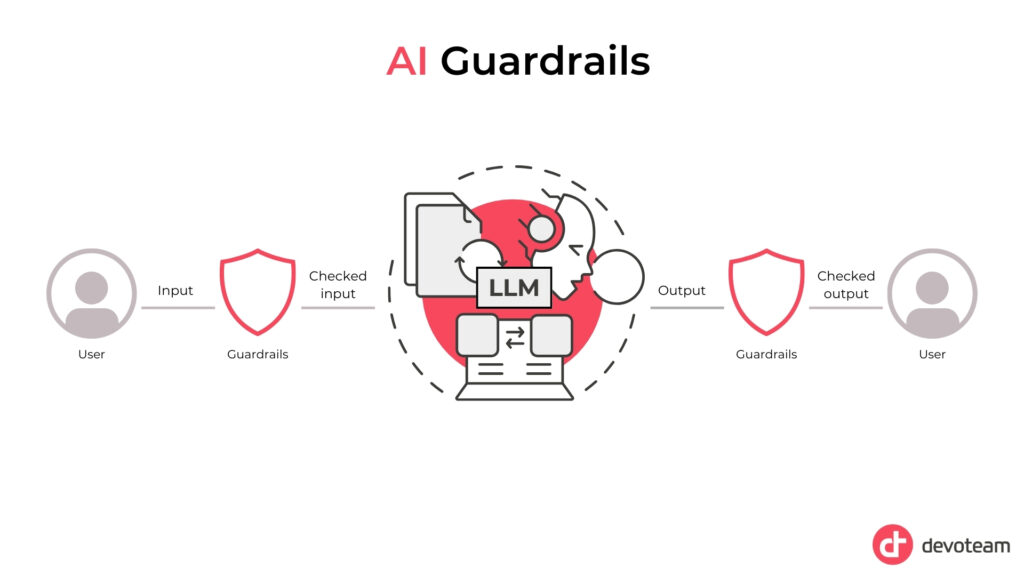
These systems rely on predefined rules and algorithms to detect potentially problematic content or behaviour, allowing for immediate intervention. The complexity of LLMs, with their intricate networks and numerous parameters, demands different strategies compared to the pre-LLM era. This has led the community towards employing black-box, post-hoc strategies like guardrails, which monitor and filter trained LLMs.
The Essential Types of AI Guardrails
AI Guardrail Types
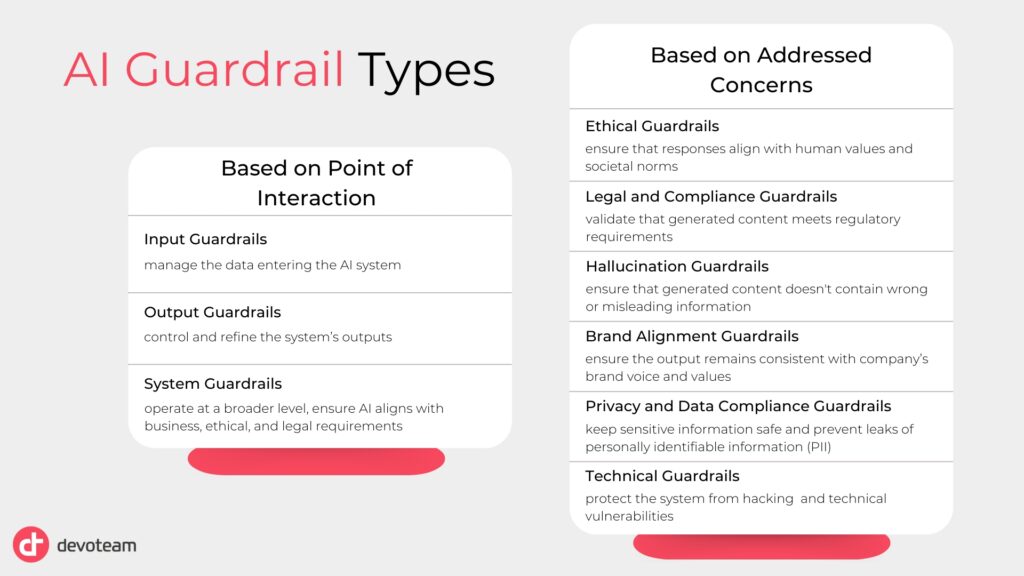
You can categorise AI guardrails based on their purpose and the risks they address. From a functional perspective, they typically operate across various points of interaction within an AI system:
- Input Guardrails These mechanisms manage the data entering the AI system. They curate data to ensure training datasets are free from biases, protect personal information by anonymising it, and validate inputs to prevent malicious or nonsensical data from being processed by the AI. An example includes filtering user inputs to prevent harmful or inappropriate queries from reaching the AI model.
- Output Guardrails: Focusing on the content generated by the AI, these guardrails control and refine the system’s outputs. They moderate content to prevent offensive or harmful material, provide explanations for AI decisions, and create feedback loops for continuous improvement. This layer evaluates and potentially modifies the AI-generated content before finalising the output.
- System Guardrails Operating at a broader level, these ensure AI aligns with business, ethical, and legal requirements. This can involve human-in-the-loop” solutions for critical decision-making or monitoring systems to protect against attacks and ensure expected performance.
Other types of AI guardrails
Beyond these functional categories, other types of AI guardrails address specific concerns:
- Ethical Guardrails: These ensure AI system responses align with human values and societal norms, preventing biases and discrimination. They check for toxic, harmful, or stereotypical content and filter it out before it reaches customers.
- Legal and Regulatory-Compliance Guardrails: Designed to validate that generated content meets regulatory requirements, these guardrails ensure the AI remains compliant with laws, particularly regarding personal data handling. The EU’s AI Act, for instance, requires companies developing high-risk AI systems to implement mitigation plans for various risks, including data governance.
- Hallucination Guardrails: These are crucial for ensuring that AI-generated content does not contain information that is factually wrong or misleading. Hallucinations, where LLMs generate contents that deviate from facts, significantly hamper reliability.
- Brand Alignment Guardrails: These ensure the AI’s output remains consistent with a company’s brand voice and values, preventing content from drifting away from its main purpose.
- Privacy and Data Compliance Guardrail:s These strictly follow data protection regulations, keeping sensitive information safe and preventing leaks of personally identifiable information (PII).
- Technical Guardrails: These protect the system from hacking attempts and safeguard against AI hallucinations and other technical vulnerabilities. They also include access and permission controls, defining who can interact with a model and how.
The Indispensable Value of AI Guardrails
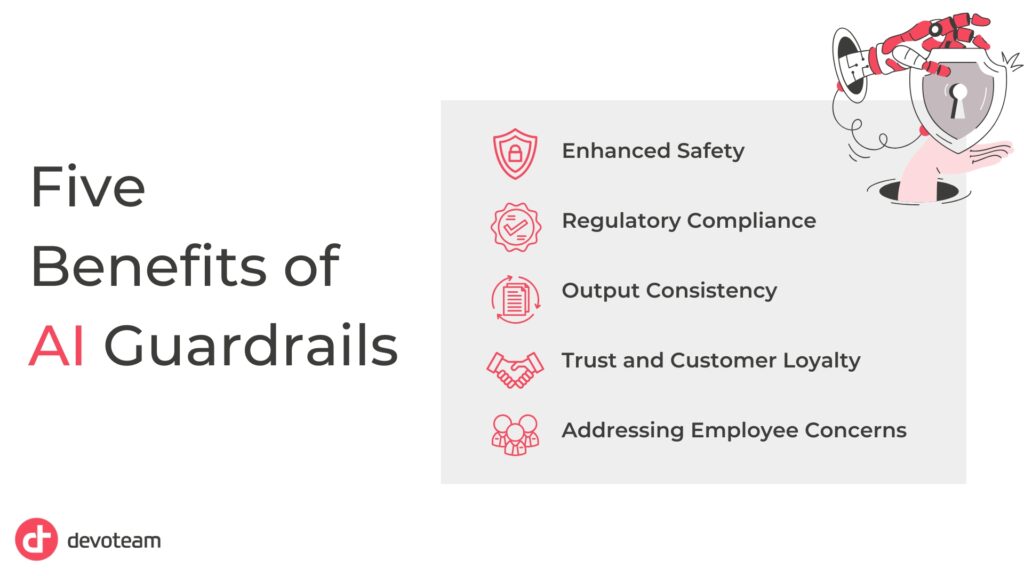
Implementing robust AI guardrails is not merely a compliance exercise; it is a strategic imperative that offers numerous benefits to organisations.
First and foremost, AI guardrails enhance safety by preventing the dissemination of harmful or inappropriate content. They protect organisations and customers from malicious attacks that exploit AI vulnerabilities. Second, they ensure regulatory compliance, helping AI outputs adhere to legal and ethical standards. With increasing government scrutiny and emerging laws like the EU AI Act, guardrails mitigate the risk of substantial legal penalties and liabilities.
Third, guardrails provide consistency in managing AI interactions across different models and applications. They help align AI-generated content with user expectations and maintain brand consistency. Fourth, and critically, guardrails build and maintain trust with customers and the broader public. By continuously monitoring and reviewing AI-generated outputs, they reduce the risk of releasing errant content. This fosters enduring customer loyalty and transforms a compliance cost into a revenue-enabling investment, as verifiably safe AI becomes a powerful brand differentiator.
Finally, guardrails address employee concerns about AI risks, combating the rise of “Shadow AI” by providing sanctioned, secure, and guardrail-equipped AI tools, which is crucial for preventing data and security vulnerabilities.
How AI Guardrails Operate
You can build AI guardrails using various techniques, from rule-based systems to LLMs themselves. Generally, they function through a multi-layered architecture.
Their operation can be conceptualised through three core layers:
- Pre-training constraints begin with the training data itself. While developers attempt to filter datasets, the sheer scale often means some harmful patterns can still be learned, making downstream guardrails critical. Data curation techniques remove toxic, biased, or irrelevant content from training sets.
- In-model alignment techniques are applied during and after training. Techniques like reinforcement learning from human feedback (RLHF) teach models to respond appropriately, shaping AI behaviour to stay on track.
- Post-processing filters and access controls are deployed after the AI system is live. Rule-based filters, red teaming, and ongoing content moderation detect and block problematic outputs in real time. Access controls and role-based permissions ensure only authorised users interact with sensitive AI features.
A foundational architectural model for guardrails includes four interrelated components:
- The Checker scans AI-generated content to detect errors and flag issues, acting as the first line of defence.
- The Corrector refines, corrects, or improves the AI’s output once an issue is identified by the checker, iteratively working until the content meets required standards.
- The Rail manages the interaction between the checker and corrector, running checks and triggering corrections as needed, also logging processes for analysis.
- The Guard acts as the master controller, interacting with all other components, initiating checks and corrections, coordinating rails, aggregating results, and delivering the final validated message.
Existing open-source solutions like Llama Guard (Meta), Nvidia NeMo, and Guardrails AI provide basic infrastructure for these functions. Llama Guard, for instance, is a fine-tuned model that classifies LLM inputs and outputs for safety. Nvidia NeMo acts as an intermediary layer, enhancing control and safety by using LLMs throughout the guardrail process and employing executable programming languages like Colang to set constraints. Guardrails AI allows users to add structure, type, and quality guarantees to LLM outputs. They can do so by defining “RAIL” specifications in XML format and automatically generating corrective prompts when the system detects errors.
Challenges and a Systematic Approach to Implementation
Challenge 1: Conflicting Requirements
Despite their importance, building effective AI guardrails presents several complexities. One significant challenge is managing conflicting requirements, such as the tension between safety and intelligence or creativity. For example, studies have shown that overly conservative guardrails can lead to LLMs providing shorter, less detailed, or even abstaining from responses to sensitive queries, raising questions about maintaining exploratory depth. The difficulty also lies in precisely defining requirements, as regulations can differ across countries or contexts, and certain issues like fairness and toxicity are inherently complex to quantify.
Challenge 2: Inherent Model Risks like Hallucinations, Biases
Furthermore, AI models are not perfect . They can generate confident but inaccurate responses (hallucinations) and often underperform in reasoning tasks without proper guidance, highlighting inherent limitations. The data used to train AI models reflects societal imperfections, inadvertently emulating historical biases Bias related to race, gender, and stereotypes. Users can also deliberately misuse AI systems through “jailbreaking” or prompt injection attacks, requiring continuous defence mechanisms.
Systematic Approach to Solve these Challenges
To effectively mitigate these complex challenges, I advocate for a systematic approach to constructing guardrails for LLMs.
A multidisciplinary approach is essential, involving diverse stakeholders, including legal teams, ethicists, and experts from various backgrounds. This socio-technical method ensures comprehensive consideration of human and societal values, such as fairness and ethics, and helps define precise technical requirements for specific contexts.
Implementing AI guardrails also demands a rigorous engineering process, akin to safety-critical software development. This includes careful specification, design, implementation , integration, verification , validation, and production release. Rigorous verification and testing, including techniques like statistical certification and multi-objective optimisation (e.g., Pareto front-based evaluation), are crucial to ensure the quality and robustness of the final product. Continuous monitoring and refinement of guardrail configurations based on real-world performance are vital, as the threat landscape is constantly evolving.
Organisations should also explore advanced neural-symbolic implementations for guardrails, combining learning agents (for frequently seen cases) with symbolic agents (for rare or complex corner cases) to enhance capability and explainability. This allows for more deeply coupled systems that can manage the tension between effective learning and sound reasoning.
Finally, staying ahead of an evolving regulatory landscape is crucial. Existing and emerging legal frameworks, such as the EU AI Act can serve as “goals” for guardrails, with companies measuring their models’ performance against these standards. Companies need to proactively adapt their AI guardrails to ensure compliance and leverage it as a competitive advantage.
Conclusion
As AI continues to integrate into our daily lives, AI guardrails are no longer just a technical control but a fundamental pillar of modern business strategy and a critical component for responsible AI deployment. They are indispensable in mitigating the multifaceted risks associated with LLMs, from unintended responses and biases to privacy breaches and hallucinations.
By building robust and adaptable AI guardrails through systematic processes, multidisciplinary collaboration, and continuous evaluation , organisations can harness the full potential of AI safely, ethically , and in alignment with their values and regulatory obligations. This approach fosters trust, ensures compliance, and ultimately drives innovation with confidence in the ever-evolving AI landscape.
Are you ready to ensure your AI initiatives are safe, ethical, and aligned with your business goals? Contact our experts today ? to discuss how robust AI guardrails can protect your organisation and build lasting trust.
Over 80% of AI projects fail. Yours don’t have to.
Download our AI Strategy Playbook:
- Learn why AI projects often fail (and how to avoid it).
- Follow 10 clear steps for a strong AI plan.
- Focus on solving business problems (not just using AI).
- Find the best AI uses for your business (includes 100+ examples).
- Learn how to measure AI results (GenAI projects average ~3.7x return).
- Get your tech foundations ready (Cloud, Data, and AI Security).
- Help your team adapt to AI (and see how we train our staff).
- Use AI responsibly (covering fairness, bias, and environmental thoughts).