


Artificial intelligence is rapidly transforming the retail industry. 75% of retail executives considering generative AI crucial for revenue growth and 72% planning to use it to reinvent their operations (Accenture).
Forrester projects the global retail market to exceed $28 trillion by 2028, with AI emerging as a key investment priority alongside retail media and mobile commerce. Retailers are implementing AI across multiple channels, from Instacart’s recipe-driven shopping experience to Bricorama’s AI paint assistant. This technique enhances customer experiences, improves product recommendations, and increases brand loyalty through personalised interactions.
Download Now: Free AI Strategy Playbook
[New 2025]
Why do you need AI in the retail industry?
According to Forrester’s analysis, AI transforms retail operations across several key domains. In back-office operations, AI technologies streamline processes and improve efficiency, reducing manual workload and operational costs. Machine learning and deep learning algorithms, deployed in retail for several years, serve dual purposes. They strengthen fraud detection mechanisms in commercial transactions while enhancing marketing automation and customer personalisation efforts.
The emergence of generative AI has introduced new capabilities for retailers. These tools now enable businesses to automatically summarise large volumes of unstructured text data, and develop and train sophisticated chatbots for customer service. They generate detailed product descriptions at scale, and significantly enhance search result accuracy for online shoppers.
In the field of natural language processing, major retailers, including Foot Locker and Kroger, are leveraging this technology to analyse and synthesise customer feedback and extract actionable insights from extensive customer databases.
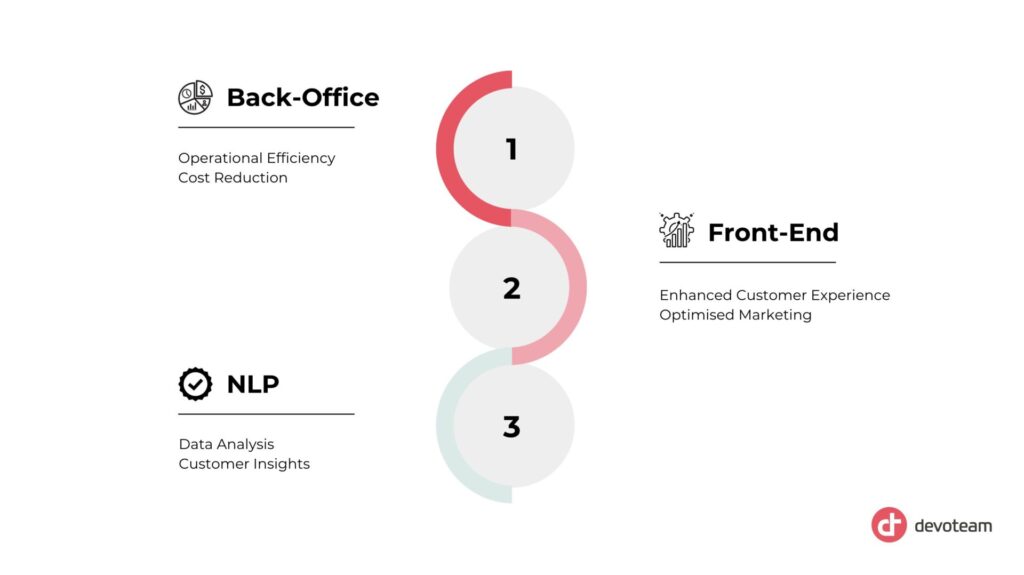
AI Use Cases in Retail
These theoretical applications of AI in retail are now evolving into concrete business solutions. Several implementations by Devoteam’s customers demonstrate how AI is delivering tangible value across various retail operations:
- Product Sheet Enrichment: Generative AI helps to create a database of brand product visuals for Optical Character Recognition (OCR) via Google’s Vision AI API. This enables the extraction of the necessary information to generate marketing descriptions using ChatGPT 3.5 Turbo and prompt engineering techniques. The process is automated via parallelisation of OpenAI API calls for large-scale enrichment. This solution improves the quality of product pages, lowers enrichment costs, and provides communication benefits.
- Optimisation of Sales Forecasting: We use AI to digitalise sales forecasting using external data, develop machine learning models, and train department managers to use these models. This works through the integration of data using various APIs, and the deployment of machine learning models with Python and Alteryx. This approach reduces the time spent on sales forecasting and optimises costs.
- Virtual Assistant for Wine Recommendations: A virtual assistant Sommelier uses Google Cloud Platform, leveraging machine learning and natural language processing (NLP), to provide personalised wine recommendations to customers. This enhances customer service and engagement.
- Overhaul of Inactivity Detection Models: AI overhauls inactivity detection models in the beverages/retail sector. This involves testing various features, implementing data preparation algorithms, and comparing various machine learning algorithms. The result is improved marketing performance, customer retention, and simplified maintenance.
- Enhancing Employee Experience: For a luxury retailer, we are using AI to raise employee awareness of the key concepts of generative AI. AI helps to develop use cases and support employees in learning to use internal generative AI solutions. This involves training and support to help employees integrate the technology into their daily work.
- AI-enhanced Customer Data Platform: Devoteam has established a data-centric organisation and AI tools for Vert Baudet to deliver ultra-personalised customer journeys. Cédric Packowski, Head of Data Intelligence Factory at Vertbaudet, explains:

We are still realising on a daily basis the spectacular progress we have made in terms of customer activation, and all thanks to the hyper-personalisation of our paths. Several hundred targets per day, based on 20,000 customer qualifiers, some of which are built using monitored AI. None of this would have been possible without the pragmatic, efficient and seamless collaboration with Devoteam.
Cédric Packowski
Head of Data Intelligence Factory at Vertbaudet
Databricks and Snowflake use cases
Additionally, Databricks and Snowflake develop specific AI technologies for retail:
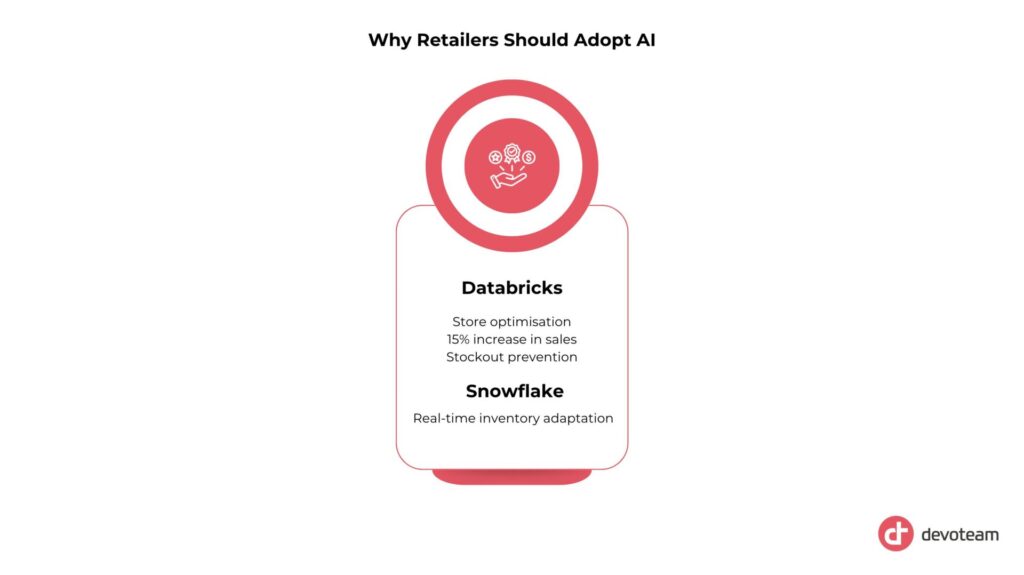
- Store Optimisation with Databricks: A retail chain achieved significant results by implementing AI-driven shelf optimisation. Their system analysed customer traffic patterns and sales data to identify ineffective product placements. This intelligence allowed them to strategically reorganise shelves, more effectively positioning high-demand items and complementary products. This resulted in a 15% increase in sales for key product categories and improved customer satisfaction. Furthermore, their AI-powered inventory monitoring system prevented stockouts while reducing unnecessary replenishment activities, generating cost savings (source).
- Stock Optimisation with Snowflake: Snowflake collaborated with a major cloud service company to assist a well-known clothing retailer in implementing generative AI technology. This partnership enabled the retailer to gain real-time visibility into its inventory levels, allowing it to adapt more quickly and effectively to changing consumer preferences and demands (source).
How AI is changing the retail industry
AI technologies are set to transform the future of retail. AI algorithms optimise supply chain management in daily operations by generating optimal route plans and reducing human error. Robotics are revolutionising warehouse operations, particularly in picking and packing processes, while predictive analytics are helping reduce return rates by analysing transaction histories, search patterns, and environmental factors.
Customer experience is evolving through AI-powered solutions, from automated checkouts to mood-tracking systems, ensuring comprehensive customer support at every touchpoint. The technology also enables levels of personalisation by bridging online and offline shopping experiences. Retailers can now leverage customer data from email marketing and loyalty programs to predict behaviour and deliver targeted offers across channels.
AI is also transforming physical retail spaces through sophisticated space and inventory optimisation. These systems consider multiple variables, including consumer preferences, product placement, seasonal factors, and expiration dates, to create intuitive store layouts that maximise sales potential.
Additionally, they enhance data security measures by providing real-time detection of unusual system activity, protecting the vast amounts of customer and operational data that modern retailers maintain.
The Future of AI in Retail
Retail technology trends for 2025 will focus on more sophisticated AI applications. According to Google, multimodal AI systems will become prevalent, mimicking human learning by simultaneously processing and integrating multiple data types – from images and videos to audio and text content.
The retail landscape will shift from traditional chatbots to more complex multi-agent systems, enabling more nuanced and comprehensive customer interactions. Search technology will significantly advance through AI integration, making product discovery more intuitive and accurate.
Perhaps most significantly, AI-powered customer experiences are expected to become nearly invisible, seamlessly integrating into the shopping journey. This evolution marks a departure from obvious AI interventions toward subtle, behind-the-scenes optimisations that enhance the customer experience without drawing attention to the technology itself.
Challenges and Opportunities of AI in Retail
According to recent studies by Accenture and EHI, AI presents significant opportunities and challenges for the retail industry. Accenture’s research reveals that generative AI could transform 50% of all working hours in retail. 36% of retail functional roles in the United States are susceptible to automation and 28% having potential for augmentation.
To successfully integrate AI, retail leaders must address five key imperatives:
- First, developing an AI-enabled, secure digital core through strategic technology investments.
- Second, reinventing talent management and work processes to prepare for an AI-driven environment.
- Third, implementing responsible AI practices that balance value creation with risk mitigation.
- Fourth, fostering a culture of continuous reinvention and adaptability.
- Fifth, business capabilities should be prioritised across the entire value chain rather than focusing on isolated use cases.
The EHI study reinforces these findings. 63.9% of respondents acknowledging AI’s impact across the entire value chain and 55.4% believing it will permanently transform retail.
While the industry recognises AI’s potential benefits, successful implementation requires careful consideration of data privacy, security concerns, and ethical implications. The emphasis is on strategic integration that addresses these challenges while maximising the technology’s transformative potential.
Conclusion
The integration of AI in retail represents a shift in how the industry operates, serves customers, and plans for the future. From back-office operations to customer-facing services, AI is proving to be a transformative force, reshaping every aspect of the retail value chain.
The impact of AI in retail can be measured both in current implementations and future potential. Today, retailers are successfully using AI to automate product documentation, optimise sales forecasting, provide personalised recommendations, and enhance employee capabilities. Looking ahead to 2025, the industry is moving toward more sophisticated applications. This will include multimodal AI systems, advanced search capabilities, and seamlessly integrated customer experiences.
However, this transformation comes with both opportunities and challenges. While AI can potentially transform 50% of retail working hours and significantly boost revenue growth, successful implementation requires careful attention to data security, workforce adaptation, and ethical considerations.
To understand the broader impact and revolutionary potential of AI in the retail sector, download our whitepaper, ‘How Artificial Intelligence is Revolutionising the Retail Industry‘.
As the retail industry continues to evolve, those who can successfully balance these factors while focusing on strategic integration and continuous innovation will be best positioned to thrive in this AI-driven future.
Over 80% of AI projects fail. Yours don’t have to.
Download our AI Strategy Playbook:
- Learn why AI projects often fail (and how to avoid it).
- Follow 10 clear steps for a strong AI plan.
- Focus on solving business problems (not just using AI).
- Find the best AI uses for your business (includes 100+ examples).
- Learn how to measure AI results (GenAI projects average ~3.7x return).
- Get your tech foundations ready (Cloud, Data, and AI Security).
- Help your team adapt to AI (and see how we train our staff).
- Use AI responsibly (covering fairness, bias, and environmental thoughts).