


Introduction
Businesses are increasingly seeking ways to harness artificial intelligence for competitive advantage. Microsoft Azure stands at the forefront of this revolution. It offers a comprehensive ecosystem where cloud computing and AI converge to drive unprecedented innovation. Whether you’re a startup looking to disrupt markets or an enterprise focused on digital transformation, Azure’s AI capabilities provide the tools and infrastructure to turn ambitious ideas into reality.
In this article, I’ll explore how Microsoft’s intelligent cloud is fundamentally transforming the way organisations innovate. I’ll focus on the latest advancements, including Copilot, Microsoft Fabric, and AI Agents—technologies that are reshaping what’s possible in the enterprise space.
Table of contents
- Microsoft’s AI Vision and Strategy
- What is Microsoft Azure AI?
- 6 Ways Azure AI Drives Transformation
- 6 Key Technologies Driving the Azure AI Revolution
- Advanced Implementations: Beyond Basic AI
- The Azure AI Innovation Cycle
- Azure AI Use Cases: Real-World Innovation with Microsoft AI
- Ready to transform your business with Azure AI technologies?
Microsoft’s AI Vision and Strategy
Microsoft has articulated a clear and ambitious AI strategy centred around democratising artificial intelligence while ensuring responsible development. At Ignite 2024, the company revealed that nearly 70% of Fortune 500 companies now use Microsoft 365 Copilot—a testament to Microsoft’s success in making AI accessible and valuable across organisations of all sizes.
The strategy revolves around three key pillars:
- AI Copilots: Intelligent assistants that work alongside users to enhance productivity and creativity
- AI Infrastructure: Scalable, secure foundation for building and deploying AI solutions
- Advanced AI Models: Including both Microsoft-developed models and partner solutions through Azure OpenAI Service
This cohesive approach ensures that organisations can implement AI in ways that drive meaningful innovation while addressing practical business challenges.

What is Microsoft Azure AI?
Microsoft Azure AI encompasses a comprehensive suite of services, models, and tools integrated within the Azure cloud platform. This ecosystem enables organisations to build, train, and deploy AI-powered applications that can transform operations and customer experiences.
What distinguishes Azure AI is its seamless integration with Microsoft’s broader technology stack—from Microsoft 365 to Dynamics 365—creating an environment where AI capabilities enhance existing workflows rather than existing in isolation. The platform supports popular frameworks including PyTorch and TensorFlow, giving developers flexibility while maintaining enterprise-grade security and governance.
6 Ways Azure AI Drives Transformation
1. Accelerated Innovation Cycles
Azure AI dramatically compresses the time between concept and implementation. With pre-built cognitive services and automated machine learning capabilities, organisations can prototype and deploy AI solutions in days rather than months. This acceleration enables more experimentation, faster iteration, and ultimately more innovative outcomes.
2. Democratised AI Development
By providing no-code and low-code AI tools, Azure makes artificial intelligence accessible to a broader range of employees beyond data scientists. Business analysts, developers, and domain experts can now directly contribute to AI initiatives, bringing diverse perspectives that fuel innovation.
3. Enhanced Human Creativity
Through tools like Microsoft Copilot, Azure AI augments human capabilities rather than replacing them. This partnership between human ingenuity and machine intelligence creates a multiplier effect on creativity and problem-solving, leading to breakthroughs that would be unattainable by either alone.
4. Unparalleled Scalability
Azure’s global infrastructure enables AI solutions to scale seamlessly from proof-of-concept to worldwide deployment. This eliminates traditional barriers to innovation adoption, allowing organisations to rapidly capitalise on successful experiments without rebuilding for scale.
5. Cross-Domain Intelligence
Azure AI facilitates the combination of insights across previously siloed domains. By integrating data from operations, customer interactions, and market trends, organisations can identify non-obvious connections that spark innovation in products, services, and business models.
6. Responsible Innovation Framework
Microsoft’s approach to responsible AI provides governance guardrails that actually accelerate innovation by addressing ethical considerations early in the development process. This prevents costly redesigns and builds trust with customers and regulators.
6 Key Technologies Driving the Azure AI Revolution
1. Microsoft Copilot and Copilot Studio
At the centre of Microsoft’s AI strategy is Copilot—an AI assistant that works alongside users in Microsoft 365 applications, helping with everything from writing and coding to data analysis. Copilot enhances human productivity by handling routine tasks, generating creative content, and providing contextual insights.
For organisations seeking customised AI assistants, Copilot Studio enables the creation of specialised copilots for specific business domains without extensive coding. This democratisation of AI development accelerates innovation by putting powerful capabilities in the hands of business users.
See how Devoteam helped Cellnex, a large European telecommunications infrastructure company, to implement Microsoft 365 Copilot!
2. Microsoft Fabric
Fabric represents Microsoft’s integrated analytics platform that unifies data engineering, data science, and business intelligence. Unlike its predecessor Synapse, Fabric provides a cohesive experience across the entire data lifecycle with AI capabilities deeply embedded throughout.
Fabric’s AI features include:
- Native integration with Azure OpenAI Service
- Automated data preparation and cleansing
- AI-powered semantic models for business analytics
- Natural language querying of complex datasets
- Automated machine learning capabilities
This unified approach eliminates the friction between data preparation and AI implementation, significantly accelerating the journey from raw information to actionable intelligence.
3. Azure OpenAI Service
Azure OpenAI Service provides enterprise-grade access to advanced language models like GPT-4 and DALL-E, enabling organisations to implement generative AI capabilities while maintaining security, privacy, and compliance standards.
This service has transformed how businesses approach content creation, code generation, customer service, and knowledge management—opening new frontiers for innovation while addressing the governance concerns that often accompany powerful AI technologies.
4. AI Agents
As Gartner identified in their 2025 technology trends, AI agents represent the next evolution in artificial intelligence—autonomous systems that can perform complex tasks with minimal human supervision. Microsoft has embraced this trend with several technologies:
- Azure AI Studio: A unified environment for creating autonomous agents that can reason, plan, and execute complex workflows
- Semantic Kernel: An open-source framework for building AI agents that integrate with existing systems
- Autonomous Systems: Tools for creating self-improving AI systems in industrial and business contexts
These agent technologies are particularly transformative when it comes to process automation, customer engagement, and decision support scenarios.
5. Azure Cognitive Services and Azure ML
Azure Cognitive Services provides ready-to-use APIs for capabilities like computer vision, speech recognition, and natural language processing, while Azure Machine Learning offers comprehensive tools for custom model development.
These foundational services enable organisations to implement AI capabilities quickly, focusing innovation efforts on unique business applications rather than underlying infrastructure.
6. Microsoft AI Foundry
Microsoft AI Foundry represents the company’s comprehensive platform for enterprise-grade generative AI deployment. It provides the infrastructure, tools, and expertise necessary for organisations to build and scale custom AI solutions that align with their specific business needs.
Foundry addresses critical aspects of enterprise AI implementation including:
- Model customisation and fine-tuning
- Deployment at scale across complex environments
- Governance and responsible AI implementation
- Integration with existing business systems and workflows
This end-to-end approach ensures that organisations can move beyond experimental AI to production-ready solutions that deliver measurable business impact.
Advanced Implementations: Beyond Basic AI
Advanced RAG (Retrieval-Augmented Generation)
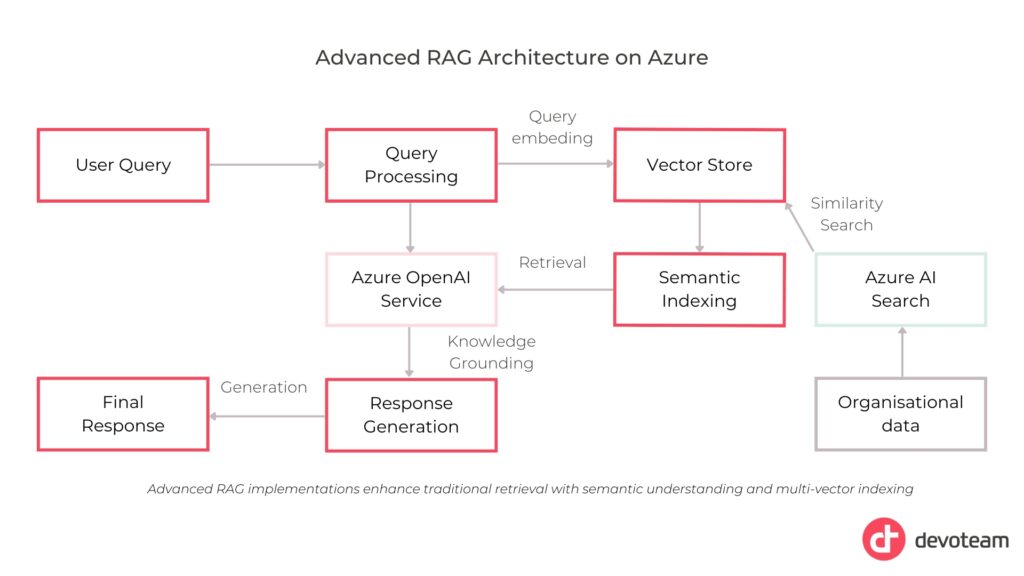
One of the most exciting developments in Azure’s AI capabilities is the evolution of Retrieval-Augmented Generation (RAG) architectures. Advanced RAG approaches combine the power of large language models with an organisation’s proprietary information, enabling:
- Contextually relevant responses grounded in company knowledge
- Reduced hallucinations and more accurate outputs
- Dynamic knowledge integration without retraining models
- Multi-vector retrieval for improved relevance
Microsoft’s implementation of Advanced RAG through Azure AI Search and Azure OpenAI Service provides enterprise-grade capabilities that transform how organisations leverage their institutional knowledge.
Multi-Modal AI Applications
Azure’s support for multi-modal AI—combining text, vision, audio, and other data types—opens new frontiers for innovation. Organisations are using these capabilities to:
- Extract insights from unstructured data across formats
- Create more natural and accessible human-computer interfaces
- Develop richer customer experiences that span multiple senses
- Automate complex processes requiring diverse data interpretation
These multi-modal capabilities are particularly valuable in sectors like healthcare, manufacturing, and retail where different data types must be integrated for comprehensive understanding.
The Azure AI Innovation Cycle
Successfully implementing AI within organisations follows a continuous innovation cycle, where each phase builds upon the previous and contributes to ongoing value creation.
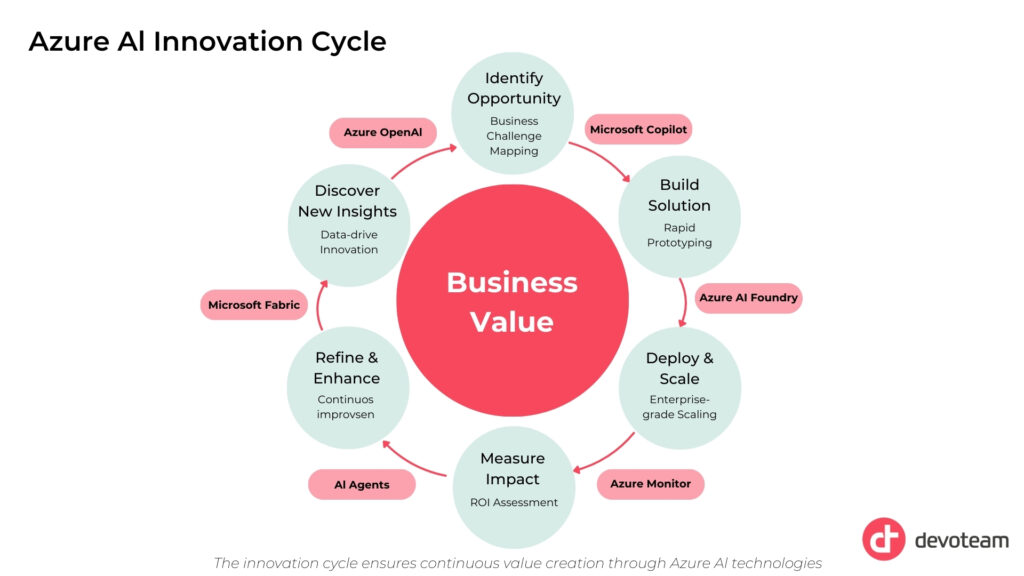
As the diagram illustrates, the Azure AI Innovation Cycle connects business value with specific technologies at each phase:
- Identify Opportunity: Begin by identifying specific business challenges or opportunities where AI can deliver tangible value, using tools like Microsoft Copilot to explore possibilities.
- Build Solution: Leverage Azure’s development tools and services to rapidly prototype and develop AI-powered solutions that address the identified opportunities.
- Deploy & Scale: Utilise Azure AI Foundry and other deployment tools to seamlessly transition from experimentation to production at enterprise scale.
- Measure Impact: Implement comprehensive monitoring and analytics to quantify business impact and return on investment.
- Refine & Enhance: Apply insights from AI Agents and user feedback to continuously improve solution performance and capabilities.
- Discover New Insights: Use Azure OpenAI and Microsoft Fabric to uncover additional opportunities and insights that feed back into the cycle.
This cyclical approach ensures continuous improvement and innovation, maximising the long-term value generated from AI investments.
Azure AI Use Cases: Real-World Innovation with Microsoft AI
1. Healthcare
Healthcare organisations are using Azure AI to drive innovation in:
- Precision medicine through patient-specific treatment recommendations
- Drug discovery acceleration using AI to identify promising compounds
- AI-enhanced medical imaging for earlier and more accurate diagnoses
- Predictive analytics to optimise hospital operations and improve patient outcomes
For example, a leading hospital network reduced patient readmissions by 28% by implementing an Azure-based predictive model that identifies at-risk patients and recommends personalised intervention strategies.
2. Retail
Retailers are transforming customer experiences and operations through:
- Hyper-personalised shopping experiences powered by Azure AI
- Intelligent supply chain optimisation that anticipates market trends
- Mixed reality shopping environments combining physical and digital elements
- Automated visual merchandising analysis for store layout optimisation
A global retailer implemented Microsoft Fabric and Copilot to create a unified view of customer data, enabling store associates to provide recommendations that increased average transaction value by 23%.
3. Financial Services
Financial institutions are innovating with Azure AI through:
- AI agents that proactively manage financial wellness for customers
- Advanced fraud detection systems that adapt to emerging threats
- Automated regulatory compliance checking with continuous monitoring
- Personalised financial advice delivered through conversational interfaces
One major bank reduced loan processing time from days to minutes while improving accuracy by implementing an Azure AI solution that automates document processing and risk assessment.
4. Manufacturing
Manufacturers are revolutionising production through:
- Predictive maintenance systems that virtually eliminate unplanned downtime
- Quality assurance powered by computer vision and anomaly detection
- Digital twins that enable scenario planning and process optimisation
- Autonomous systems for hazardous environment operations
A leading automotive manufacturer used Azure AI agents to optimise production scheduling, reducing energy consumption by 18% while increasing throughput by 12%.
Getting Started with Azure AI Innovation
1. Align AI with Business Objectives
Start by identifying specific business challenges where AI could deliver measurable impact. Focus on areas where even incremental improvements would create significant value.
2. Assess Your Data Readiness
Evaluate your organisation’s data landscape to determine what information is available to fuel AI initiatives. Microsoft Fabric provides tools to help organise and prepare this data.
3. Choose the Right Entry Point
For organisations new to AI, Microsoft Copilot offers an accessible starting point with immediate productivity benefits. For more specific needs, Azure Cognitive Services or custom solutions via Azure Machine Learning may be more appropriate.
4. Build Skills and Culture
Successful AI innovation requires both technical expertise and organisational readiness. Invest in upskilling teams while fostering a culture that embraces AI-augmented work.
5. Implement Responsible AI Practices
Embed ethical considerations and governance throughout your AI journey using Microsoft’s Responsible AI tools and frameworks.
Conclusion
Microsoft Azure’s AI ecosystem represents a powerful platform for innovation, enabling organisations to reimagine processes, products, and customer experiences. By leveraging technologies like Copilot, Fabric, AI Agents, and advanced RAG implementations, businesses can accelerate their transformation journey while maintaining security and governance.
As AI continues to evolve, Microsoft’s integrated approach—combining infrastructure, models, and development tools—positions organisations to not just adopt artificial intelligence but harness it as a catalyst for continuous innovation.
For more on how our capabilities in this area are recognised, discover how Devoteam Obtains AI Platform Specialisation in Microsoft Azure.

Ready to transform your business with Azure AI technologies?
Partner with Devoteam to access experienced AI consultants and the best AI technologies. Maximise your return on investment with over 1,000 certified AI specialists. With over 300 successful AI projects, we have the expertise to meet your unique needs.