



Research is the engine of human progress. It has been central to every major advancement in civilisation. From the philosophical inquiries of ancient thinkers to the data-driven breakthroughs in contemporary Artificial Intelligence, the pursuit of understanding has indeed defined human history.
Today, with the establishment of Devoteam’s Research and Innovation department focusing on AI, we stand on the shoulders of centuries of inquiry and exploration. For that very reason, understanding the lineage of research provides both context and inspiration as we build the technologies of tomorrow.
Antiquity: Curiosity and Observation
The impulse to question the world is ancient. In early civilisations, such as Mesopotamia, Egypt, the Indus Valley, and China, observations of the natural world laid the groundwork for systematic thinking. Early astronomers tracked celestial movements to create calendars; engineers in Egypt constructed pyramids using principles of geometry long before formal mathematical frameworks existed. However, these efforts were often practical in aim, in agriculture, construction, and medicine. Indeed, they show the roots of empirical observation.
Ancient Greece formalised the practice of inquiry. Thinkers such as Thales and Anaximander proposed natural explanations for phenomena traditionally attributed to the divine. Socrates emphasised dialectical reasoning. Plato wrote extensively on knowledge and perception, while Aristotle systematised logic and biology. Their work introduced methods of classification, hypothesis, and deduction that resonate in modern scientific methods.
In India, scholars compiled extensive works on astronomy, linguistics, and mathematics. Aryabhata’s 5th-century treatises demonstrated early understandings of planetary motion and introduced concepts foundational to trigonometry. The development of zero and decimal systems here would eventually reshape global mathematics.
China’s scholarly tradition, especially during the Han dynasty, produced rich records in astronomy, pharmacology, and engineering. The invention of paper and printing technology enabled knowledge transmission that would influence intellectual life across Asia and, much later, Europe.
Knowledge Centers of the Medieval World
Contrary to popular stereotypes of intellectual stagnation during the Middle Ages, this era was vibrant with scientific development, particularly in Western Asia. Baghdad’s House of Wisdom, established in the 9th century, became a hub of translation, debate, and experimentation. Scholars translated Greek, Persian, and Indian texts into Arabic, effectively preserving and expanding upon them.
Mathematicians like Al-Khwarizmi, whose name gave rise to the term “algorithm”, formalised algebraic methods and contributed to astronomical models used for navigation and calendar systems. Physicians such as Al-Razi (Rhazes) and Ibn Sina (Avicenna) compiled encyclopedic texts on medicine that would be used in European universities for centuries.
In medieval Europe, cathedral schools and later universities emerged, modelled after monastic centers of learning. While heavily influenced by religious doctrine, these institutions fostered debate and the study of natural philosophy. The Scholastic method, exemplified by thinkers like Thomas Aquinas, emphasised dialectical reasoning and sought harmony between faith and rational inquiry.
Meanwhile, knowledge also flourished in the universities of Timbuktu and the Buddhist monastic universities in Nalanda and Vikramashila. These sites, often left out of commonplace narratives, played essential roles in developing and transmitting scientific and philosophical knowledge across continents.
Renaissance and Enlightenment: Shifts in Perspective
Beginning in the 14th century, the Renaissance reignited interest in classical texts and placed human observation at the center of inquiry. This shift encouraged empirical approaches and led to a flowering of discovery across the arts and sciences. Figures like Copernicus and Vesalius challenged prevailing doctrines, proposing heliocentric models and revising anatomical knowledge through dissection.
Gutenberg’s invention of the printing press in the mid-15th century revolutionised knowledge dissemination, enabling ideas to spread widely and rapidly. This technological change was as important to research culture as any intellectual advance.
The 17th and 18th centuries, often referred to as the Scientific Revolution and the Enlightenment, saw the institutionalisation of science. Galileo’s telescopic observations refuted geocentric cosmology. Newton’s laws described a universe governed by measurable forces. The Royal Society in England and the Académie des Sciences in France formalised scientific exchange, introducing peer review and shared experimental methods.
During this period, naturalists embarked on global expeditions to catalogue flora and fauna. The classification systems developed by Linnaeus and others laid the groundwork for evolutionary biology. This growing culture of documentation and replication marked a departure from reliance on authority toward evidence-based knowledge.
The Rise of Industrial and Institutional Research
The Industrial Revolution ushered in an age where research moved from the periphery of society into the heart of economic and political strategy. Discoveries in chemistry, mechanics, and thermodynamics fueled new industries and altered daily life. Institutions such as the École Polytechnique in France and the German research universities combined theoretical training with applied science, producing engineers and scientists who shaped modern infrastructure.
In the 19th and early 20th centuries, physics and biology experienced profound shifts. Darwin’s theory of evolution by natural selection offered a unifying explanation for the diversity of life. In physics, Maxwell’s equations linked electricity and magnetism, setting the stage for the later revolutions of quantum mechanics and relativity.
Research became increasingly collaborative. The founding of laboratories like the Cavendish Laboratory in Cambridge and Bell Labs in the United States demonstrated how structured environments could facilitate innovation. These institutions pioneered not just technologies, like the transistor, but also organisational models for scientific productivity.
Twentieth Century: Scaling Complexity
The 20th century was defined by the intersection of research and geopolitics. The two World Wars drove unprecedented investment in scientific development. Radar, rocketry, nuclear energy, and antibiotics were all products of wartime research. After the wars, government-funded research became the norm in many countries.
During the Cold War, the Space Race between the United States and the Soviet Union pushed physics, materials science, and computing into new frontiers. NASA and its Soviet counterpart invested heavily in research, producing technologies that later found civilian applications, from satellite communications to microprocessors.
Simultaneously, academic disciplines became more specialised. Fields like molecular biology and computer science emerged, each with its own methodologies and tools. Yet this specialisation did not preclude interdisciplinary work. Indeed, some of the century’s most significant advances, such as the structure of DNA and the development of the internet, emerged from cross-disciplinary collaboration.
By the 1980s and 1990s, the digital revolution transformed how research was conducted. Simulations replaced some physical experiments; databases enabled new forms of data analysis. The rise of the internet facilitated global collaboration, accelerating the pace of discovery.
AI and the New Frontier of Inquiry
Today, AI represents the latest stage in research evolution. Unlike earlier tools that extended human physical capacities, AI extends cognitive capacities. Machine learning algorithms can process and find patterns in vast datasets to uncover insights that would take humans years to identify, or might never be found at all.
In fields like genomics, AI accelerates the identification of disease markers. It refines predictive models in climatology. In industry, it enhances process optimisation, quality control, and resource management. Yet the use of AI in research is not merely about speed; it also changes the questions we can ask.
Our R&I department aims to explore these new frontiers with a commitment to transparency, rigour, and collaboration. By grounding our projects in sound methodology and drawing on diverse expertise, from data science to ethics, we aim to contribute meaningfully to the global research ecosystem.
Research is not merely an academic exercise. It informs public policy, drives economic development, and shapes cultural narratives. Moreover, research cultivates critical thinking. It teaches us to question assumptions, test hypotheses, and remain open to revision. These skills are vital not only for scientists but for any society navigating complex challenges.
We recognise that innovation does not occur in a vacuum. It depends on a culture of inquiry and a willingness to support long-term thinking. Research and Innovation reflects a commitment to building such a culture.
Looking Forward
The story of research is not one of linear progress but of expanding horizons. Each era redefines what it means to understand the world and our place within it. The tools may change (from papyrus scrolls to quantum processors), but the underlying spirit of curiosity endures.
As we develop AI technologies, we inherit both the achievements and responsibilities of this long tradition. It is a task that demands intellectual humility, technical skill, and ethical reflection. The future will not be built solely on answers, but on the ability to ask better questions.
Over 80% of AI projects fail. Yours don’t have to.
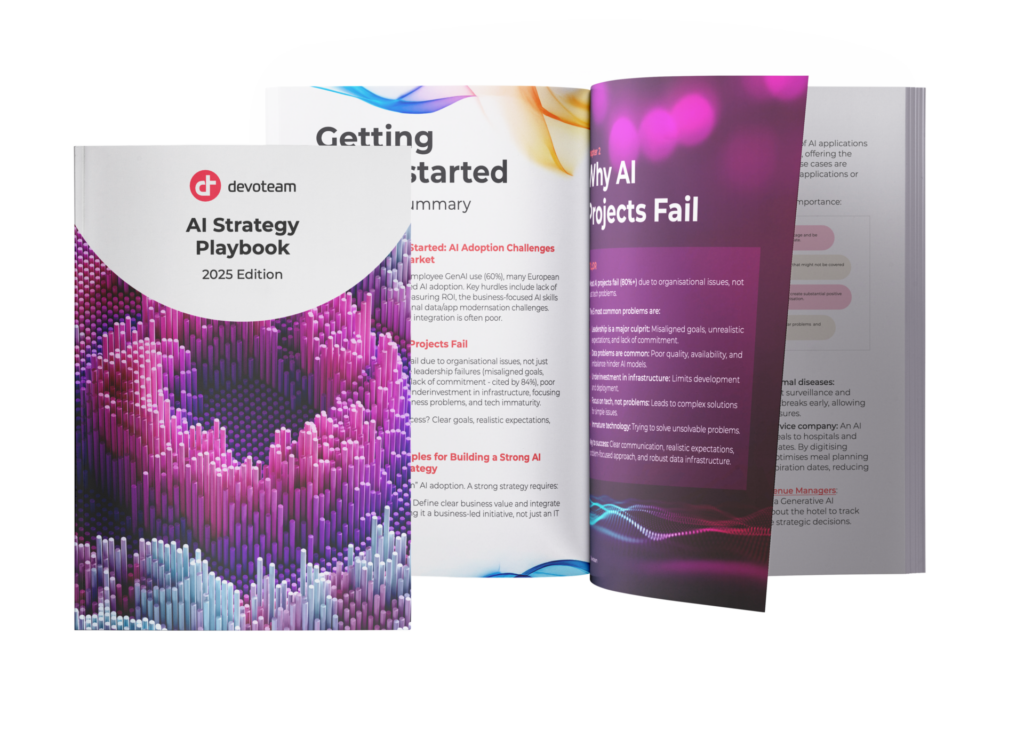
Download our AI Strategy Playbook:
- Learn why AI projects often fail (and how to avoid it).
- Follow 10 clear steps for a strong AI plan.
- Focus on solving business problems (not just using AI).
- Find the best AI uses for your business (includes 100+ examples).
- Learn how to measure AI results (GenAI projects average ~3.7x return).
- Get your tech foundations ready (Cloud, Data, and AI Security).
- Help your team adapt to AI (and see how we train our staff).
- Use AI responsibly (covering fairness, bias, and environmental thoughts).