

Written as part of our AI Upskilling Program
This article was created as part of the Global Devoteam AI Upskilling Program, where employees share their knowledge to accelerate their learning. The program’s key objective is to provide a foundation in AI for every employee and apply these new skills in our work. Do you want to work with us? Check out our career opportunities.
Most AI initiatives do not fail because the model is weak. They fail because no one truly understands how the data underneath is created.
That realisation came early while rebuilding a legacy data platform that had evolved over more than 15 years. Before any AI could be trusted, every single datapoint had to be traced, from raw input to final “gold” output, through hundreds of files, scripts and manual steps.
Only then did one thing become clear: the organisation was not struggling with AI. It was struggling with AI readiness.
What you’ll read in this article:
- When data becomes a black box, AI becomes untrustworthy
- Why legacy pipelines quietly kill AI initiatives
- Rebuilding for AI readiness: what actually changed
- The turning point: when trust returned
- How to recognise real AI readiness
- What to do if AI feels stuck
- Three Final Thought s
- Learn more about building AI-ready data platforms and architectures with Devoteam.
When data becomes a black box, AI becomes untrustworthy
On paper, the existing system worked. Dashboards loaded. Numbers were delivered. Decisions were made. But the moment AI entered the conversation, confidence collapsed.
The data pipeline had grown organically over years. Logic was deeply nested inside spreadsheets, scripts and undocumented transformations. Understanding how a single metric was calculated meant following a trail across countless files and handovers.
As a result:
- No one could confidently explain how figures were derived
- AI outputs could not be validated against the “golden” data
- Analysts and leaders doubted conclusions, even when models behaved correctly

At some point, scepticism turned into resignation.
“This is just how it is. Improving it probably isn’t possible.”
That belief, not technology, was the biggest blocker to AI readiness.

Nassiem Lahmidi
Senior Consultant at Devoteam Netherlands
Why legacy pipelines quietly kill AI initiatives
AI exposes weaknesses that traditional reporting can hide. During the rebuild, four recurring issues stood out:
Issue 1. Understanding the pipeline is harder than rebuilding it
The hardest part was not writing new code. It was understanding the old one.
Years of incremental changes had created a system no single person fully understood. Every datapoint required detective work. Without clarity, AI outputs remained a black box on top of another black box.
Issue 2. Trust disappears before performance does
AI models produced outputs, but without traceability, no one trusted them.
If teams cannot compare AI-driven insights with explainable, auditable numbers, confidence erodes fast. Accuracy alone is not enough.
Issue 3. AI pressure comes from multiple directions
In this case, expectations came from both leadership and analysts:
- Leadership wanted future-facing AI capabilities
- Analysts needed reliable, explainable numbers
Without AI readiness, those expectations collided instead of reinforcing each other.
Issue 4. Governance cannot be retrofitted
Security, privacy and auditability were not optional. Yet the existing pipeline made compliance almost impossible to demonstrate.
AI simply made that risk visible.
Rebuilding for AI readiness: what actually changed
Once the legacy pipeline was fully understood, something unexpected happened. Rebuilding it properly was far smoother than anticipated. Clear structure replaced tribal knowledge. Manual steps gave way to automated, reproducible pipelines. Every transformation became traceable from raw to gold.
Key changes included:
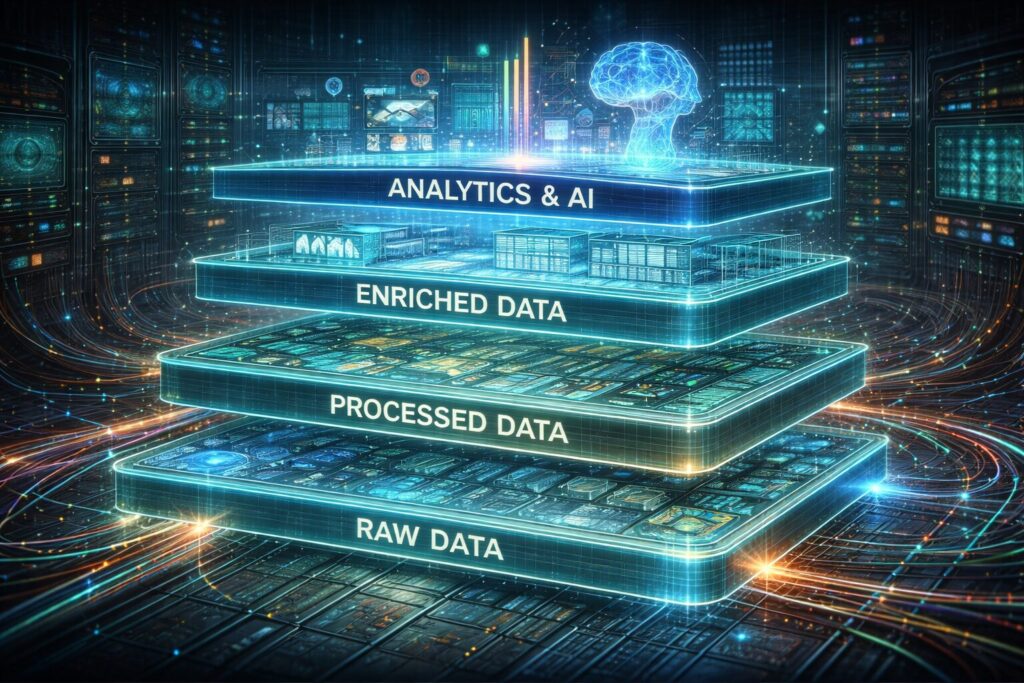
- A clearly layered data architecture
- Automated, auditable transformations
- Explicit ownership of data products
- Separation between experimentation and production
- Governance embedded by design
AI was no longer asked to “figure things out”. It consumed trusted, explainable data.
“Once the data became transparent, AI stopped being scary and started being useful.”
Nassiem Lahmidi
Senior Consultant at Devoteam Netherlands
The turning point: when trust returned
The real breakthrough was not technical. It was cultural.
When the first fully auditable outputs became available, the mood shifted almost immediately. Analysts could validate results. Leadership could understand assumptions. AI conclusions could finally be compared with known figures.
At one point, a senior leader summed it up perfectly: “Imagine what we can do now. The possibilities are endless.”
That moment marked true AI readiness, not because AI suddenly improved, but because trust was restored.
How to recognise real AI readiness
Before investing further in AI, it helps to pause and ask a different set of questions:
- Can every key metric be traced from raw data to output?
- Can results be reproduced next month?
- Can an analyst explain the logic without opening ten spreadsheets?
- Can AI outputs be audited, challenged and improved?
- Can the platform scale without adding manual work?
If not, AI will struggle, no matter how advanced the model. AI readiness is built before AI delivers value.
What to do if AI feels stuck
If AI initiatives feel slow, fragile or disappointing, the solution is rarely “more AI”.
A better next step is to focus on three foundations:
- Data clarity – transparency, lineage and ownership
- Platform structure – automation, modularity and scalability
- Governance by design – security, compliance and auditability
Fixing these unlocks AI naturally, without forcing it.
Three Final Thoughts
- AI does not fail because organisations lack ambition. It fails because ambition outpaces structure.
- AI readiness is not glamorous. But it turns scepticism into confidence, and experiments into impact.
- Want to understand how AI-ready your organisation really is? Start with the foundations before scaling the next AI initiative.
Learn more about building AI-ready data platforms and architectures with Devoteam.

Learn more about building AI-ready data platforms and architectures with Devoteam.
Devoteam is a trusted partner for your data transformation:
- Measurable Results: Our focus is on delivering business value
- Proven Expertise: Our team of 1,000+ data consultants boasts 960+ certifications across leading cloud platforms like AWS, Google Cloud, Microsoft Azure, Snowflake and Databricks.
- End-to-End Solutions: We’ve successfully delivered data transformation projects, spanning data strategy, governance, platform implementation, advanced analytics, and AI integration.