


Effective cloud cost management remains a persistent challenge for organisations of all sizes. It is often rooted in complexities that extend well beyond the technical intricacies of the infrastructure itself. The core issue is frequently not the technology. It is the organisational and systemic structures that need to evolve alongside the dynamic nature of Cloud environments.
Understanding variable Cloud spend presents a significant hurdle for many organisations. Cloud bills can be challenging to interpret. This reflects the impressive scale and breadth of the AWS ecosystem, which comprises over 200 distinct services, each with its own sophisticated and dynamic pricing model. This granularity offers tremendous flexibility and value. But it also introduces complexity through variable charges based on hourly usage, request counts, data transfer volumes, and regional pricing variations. These factors can make accurate cost forecasting a significant undertaking for finance and operations teams.
Without proper tools, processes, and governance frameworks, organisations may experience unexpected budget variances. These variances strain cash flow and complicate financial planning.
Devoteam is an AWS Premier Consulting Partner. We help you implement the visibility, controls, and strategic insights you need. This enables you to optimise your cloud investments and achieve predictable, efficient spending patterns.
In this article, you’ll read:
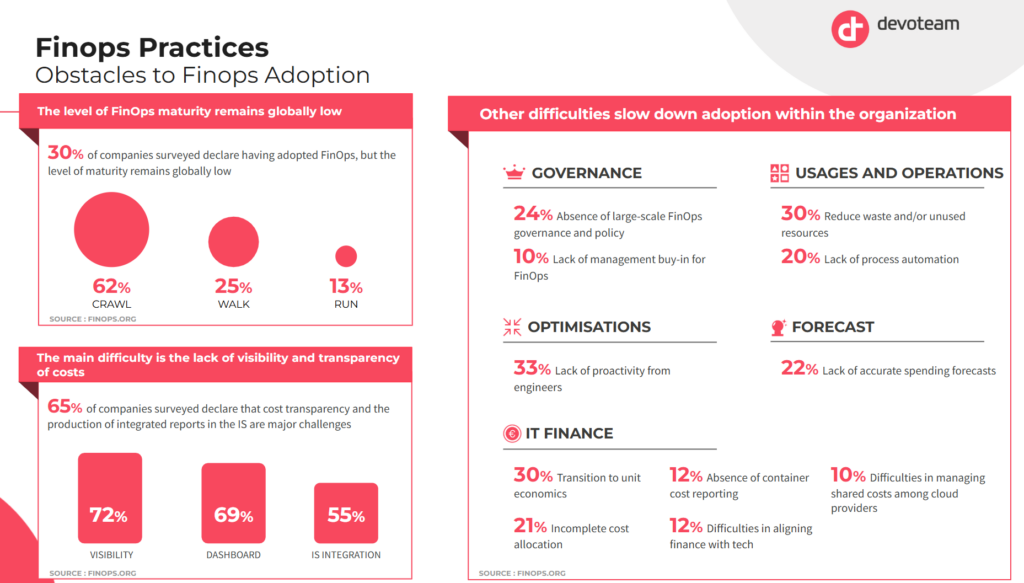
The Challenges of AWS FinOps
Organisational Silos
Beyond the bill itself, the fundamental problem often lies in organisational and cultural silos. These silos separate teams responsible for building cloud infrastructure from those managing budgets and finances. This disconnect creates a “reactive firefighting” mentality. Teams respond to cost spikes only after they occur and hit the monthly invoice.
Engineering teams lack the financial context to make cost-aware decisions at the point of creation. Finance teams lack the technical understanding to comprehend the underlying drivers of cloud expenses. This siloed, reactive approach is quantifiable and leads to higher costs and more frequent business disruptions.
Hidden Costs and Cloud Waste
Another significant drain on a company’s cloud budget is the proliferation of hidden costs and cloud waste. Over-provisioning, where organisations deploy more powerful resources than are necessary for a given workload, is a common source of inefficiency.
This is accompanied by the silent accumulation of costs from underutilised or “zombie” resources, idle virtual machines, unattached storage volumes, and databases that are left running long after they have served their purpose. These unnecessary expenses, along with fees for data transfer between different AWS regions or services, can account for a large percentage of an organisation’s total cloud bill.
Multi-Cloud Environments
The complexity is magnified in modern multi-cloud and hybrid environments. Each provider has its own unique pricing model, service taxonomy, and operational framework, making it nearly impossible to have a consolidated view of technology spend without specialised tools. This decentralised landscape, coupled with the fact that any team can independently spin up cloud resources, makes central control over costs an immense challenge.
Billing Complexity
The sheer complexity of Cloud billing is often cited as the primary cause of overspending, but a deeper analysis reveals this can be a “convenient distraction.” The real challenge is the fragmented visibility across an organisation’s entire technology portfolio, which includes multi-cloud, on-premises infrastructure, and SaaS costs. By fixating on the intricacies of the AWS bill, IT leaders may be addressing a symptom rather than the root cause, which is a lack of unified financial management and a systemic inability to connect technical spending to its corresponding business value.
Common Challenges in Cloud Cost Management
| Challenge | Description | Primary Impact |
| Lack of Visibility | Inability to track where and how cloud costs are incurred across the organisation. | Budget overruns, unexpected charges, and inefficient resource allocation. |
| Organizational Silos | Disconnect between engineering, finance, and business teams. | Reactive “firefighting” and a failure to align spending with business goals. |
| Cloud Waste | Paying for idle, underutilised, or forgotten resources. | Significant financial loss and poor return on investment (ROI). |
| Multi-Cloud Complexity | Managing multiple cloud providers with different pricing and services. | Inconsistent tracking, fragmented visibility, and difficulty in unified governance. |
| Lack of Forecasting | Inability to accurately predict future cloud spending. | Budget uncertainty and inability to plan for future growth. |
FinOps Discipline: A Cultural and Operational Framework
FinOps represents a cultural and operational shift that is transforming how businesses approach cloud economics. It is a collaborative framework that unites engineering, finance, and business teams to bring financial accountability to the variable spend model of the cloud.
The objective of FinOps is not simply to save money. It is to maximise the business value of every euro invested in the cloud. Thus, empowering teams to make informed trade-offs between speed, cost, and quality. This approach fundamentally repositions cloud infrastructure from a mere cost center to a strategic driver of business value.
FinOps Core Principles
The FinOps Foundation provides a structured framework built on six core principles:
- Collaboration: FinOps requires cross-functional teams to work together in near real-time, using cost as a shared efficiency metric.
- Accountability: Individuals and teams are expected to take ownership of their cloud usage. They are supported by a central group that provides best practices and tools. This ensures that teams are empowered to proactively cut waste at the source.
- Centralised Governance: While decision-making is distributed, a central team is responsible for setting policies, managing rate negotiations, and handling bulk commitments to secure significant discounts, such as Reserved Instances and Savings Plans.
- Data-Driven Decisions: The practice requires that cloud spending data be accessible, timely, and accurate. Teams need real-time feedback on their spending to make intelligent decisions before inefficiencies escalate.
- Business Value: Every cloud investment must be tied to a measurable business outcome, such as revenue growth, efficiency improvements, or customer impact.
- Variable Cost Model: FinOps helps organisations fully take advantage of the cloud’s variable, pay-as-you-go model to prevent cost spikes and align spending with business demand.
FinOps Cycle
The practice of FinOps is inherently iterative and is best understood as a continuous cycle of improvement. It is defined by three phases: Inform, Optimise, and Operate.
The Inform phase is foundational, focused on gaining full visibility into cloud costs and establishing accountability across teams. It is about understanding who is spending what and why.
With this visibility established, the Optimise phase focuses on actively improving cloud cost efficiency by identifying and implementing cost-saving opportunities, such as rightsizing resources, eliminating waste, and leveraging commitment-based discounts.
The Operate phase, the final and most mature stage, involves embedding FinOps practices into daily workflows through automation, established governance, and continuous improvement. This transition converts cost awareness into a continuous, automated process rather than a periodic, manual review.
Maturity States of FinOps
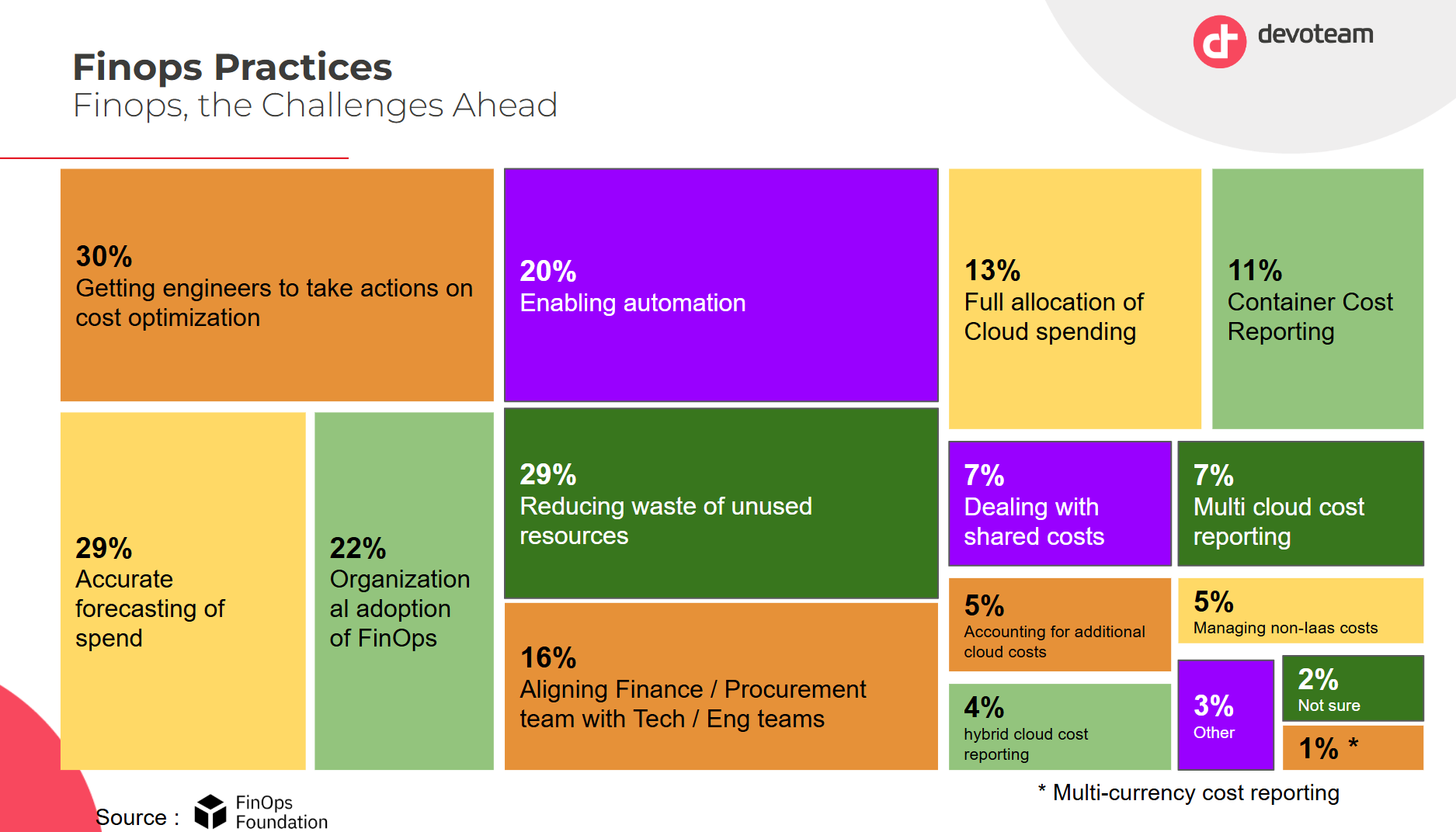
A common pitfall for organisations is attempting to implement a complex FinOps framework all at once. The FinOps Maturity Model, often described as a “Crawl, Walk, Run” progression, provides a pragmatic roadmap to prevent this. It is a direct response to the common implementation failure of trying to do too much too soon.
The Crawl phase focuses on gaining basic visibility and addressing low-hanging fruit. This includes enforcing a consistent tagging strategy and identifying untagged resources.
The Walk phase introduces accountability and cross-functional collaboration, where costs are organised by team or product.
The Run phase is the highest level of maturity. The practice becomes proactive and predictive. Advanced tools, automation, and unit economics enable this phase. This structured approach provides a clear path for organisations. They move from a reactive, crisis-driven state to a proactive, data-driven one. Progress happens one step at a time.
Managed AWS Billing: A Strategic Solution for Cloud Complexity
Managed AWS billing, often referred to as a “FinOps Managed Service,” is a strategic offering that Devoteam provides as an alternative to building a full internal FinOps practice from scratch. Our services go beyond simple invoice management by providing specialised expertise, tooling, and proven processes to help organisations manage, control, and optimise their cloud spend.
Our value proposition as an AWS Premier Consulting Partner is compelling, particularly for organisations grappling with the complexities of cloud costs. At Devoteam, we offer a wealth of specialised expertise, bringing a team of cloud technologists who have successfully delivered multi-year FinOps services across a wide range of industries and environments. Our services are underpinned by advanced tooling that provides deeper analytics, AI-based predictive forecasting, and automated optimisation capabilities that are not easily replicated by native tools alone. This allows organisations to accelerate their FinOps maturity journey. Ultimately, our managed service frees organisations to focus on their core business and innovation, while Devoteam handles the complex and time-consuming task of cloud financial management.
Why Should You Use AWS Managed Billing Services
AWS Managed Billing services are not a one-size-fits-all solution. They best suit specific organisational profiles and workload types. This model is ideal for enterprises that lack the internal resources, expertise, or time to build a dedicated FinOps team. It is also highly effective for companies with complex, multi-cloud environments or those that need to quickly scale their financial governance without a proportional increase in headcount. From a workload perspective, our managed services are particularly valuable for organisations with high-volume, dynamic, and unpredictable workloads, where costs can spiral out of control without continuous, expert management. They are also a good fit for businesses with subscription-based or usage-based business models, such as SaaS companies, where billing is a core component of the business itself.
The decision to use AWS Managed Billing services is a business strategy trade-off between speed, control, and cost. While building an internal FinOps team offers maximum control and deep integration with a company’s unique culture, it is a slow, expensive process that requires finding and retaining scarce talent. Opting for Devoteam’s managed service, however, provides an immediate injection of specialised expertise and advanced tooling, allowing for rapid progress in FinOps maturity.
Devoteam’s Cloud Managed Billing service helps AWS customers simplify billing and maximise cloud value. It’s a free, no-commitment service that delivers real results:
- Get a direct 2% discount on your monthly AWS consumption.
- Funding Access: Gain priority access to AWS funding, including specialized programs for GenAI PoCs.
- Expert Support: Continuous cost optimization guidance from our certified specialists.
Devoteam AWS FinOps Methodology

With AWS Cloud, cost is no longer just an annual budget line item; it becomes dynamic and manageable in real time. This paradigm shift requires business units, IT teams, and finance to rethink their role and collaborate closely so that every technical decision maximises business value.

Cédric Porte
AWS Cloud Consultant
Building a FinOps Vision
Objectives
The primary goal is to establish alignment by building a shared FinOps vision that brings together Business, IT, and Finance stakeholders. This approach emphasises accountability by empowering local teams while providing Group-level support and framework. The methodology focuses on sustainability by embedding FinOps into governance and daily practices, ensuring cost security through proactive identification of overruns and waste elimination. Ultimately, every initiative aims to create value, ensuring that every euro invested in the Cloud improves application performance and supports business strategy.
Implementation Framework
The FinOps management approach builds on four foundational pillars. Teams establish Golden Rules and translate them into specific compliance rules. Automation plays a critical role in collecting non-compliance data and generating consolidated reporting. Governance structures are implemented through regular central-to-business unit (BU) routines and process integration. Finally, organisations achieve acculturation through workshops and a structured maturity development program.
Framework and Rules
The foundation begins with defining a comprehensive set of Golden Rules covering Tagging, Waste Management, Workload Management, and Savings Plans. These principles are translated into technical compliance rules using tools like AWS Config, Policies, and compliance dashboards.
Technical controls are implemented through dashboards and configuration management to monitor adherence. All non-compliances are consolidated into central reporting, providing organisation-wide visibility and enabling proactive issue management.
Reporting and KPIs
A shared reporting framework accessible to both business units and Central teams tracks compliance rates for each rule. Technical KPIs measure operational efficiency. This includes the percentage of optimised instances, cost coverage by Savings Plans or Reserved Instances, and waste rates. Maturity KPIs derived from assessments help track the organisation’s FinOps journey progress and identify areas requiring additional focus or support.
Governance and Routines
Clear governance structures define interaction patterns between Central and business unit teams through monthly FinOps Committees and quarterly maturity reviews. Business units receive default routines via a Launch Pack that includes monthly cost and anomaly reviews, plus product-level FinOps committees. The methodology outlines a FinOps integration path, accompanied by onboarding materials and a “Build Your Own Journey Kit.” An acceleration path is available through the FinOps Accelerator Kit, incorporating operational and maturity assessments.
Workshops and Acculturation
A comprehensive workshop catalogue supports the cultural transformation required for FinOps success. The “Paradigm Shift” workshop introduces FinOps fundamentals, while company onboarding workshops define RACI matrices, KPIs, and routines. Technical “How-to” workshops provide hands-on guidance for dashboards, Savings Plans, waste management, and tagging strategies. The FinOps Accelerator program delivers account audits, maturity assessments, and customised action plans. It includes implementation support where the Central team guides rather than executes for business units.
FinOps Maturity Assessment
The Devoteam FinOps Maturity Assessment evaluates an organisation’s current position in its FinOps journey. It enables organisations to plan progress and develop their cloud financial management capabilities.
Sponsorship
Assesses executive commitment and strategic alignment for cloud operations, including:
- Level and type of executive sponsorship for cloud adoption
- Defined success criteria for cloud teams
- Alignment between business and IT leadership on FinOps strategy
- Key strategic drivers motivating FinOps adoption
Community
Evaluates collaboration and knowledge sharing practices:
- Utilisation of data and information assets for insights and decision-making
- Implementation of optimisation recommendations from Central FinOps teams
Governance and Controls
Examines accountability structures and performance tracking:
- Presence of a designated FinOps Champion within the organisation
- Measurement and reporting of annual savings from local FinOps initiatives
- Monitoring and reporting of compliance rates with Central FinOps standards
- Accuracy and compliance of tagging and cost allocation processes
- Review mechanisms for application cost performance
- Tracking and reporting systems for local optimisation savings
Global Pricing Strategy
Assesses alignment with enterprise-wide cost optimisation initiatives:
- Adoption and alignment of workloads with global pricing mechanisms (Reserved Instances, Savings Plans, Enterprise Discount Programs)
FinOps Management
Evaluates operational execution and tactical capabilities:
- Management of FinOps access profiles across business units and product teams
- Configuration and monitoring of budgets and alerts at the application level
- Execution of resource optimisation actions (right-sizing, start/stop scheduling, waste elimination)
- Detection and remediation of cost anomalies at the local level
AWS FinOps from Reactive to Proactive: Predictability and Optimisation
The evolution from a crisis-driven, reactive approach to a strategic, proactive one is a defining milestone in an organisation’s cloud journey. In a reactive posture, teams only address a cost problem after it has already occurred. This “fix it when it breaks” mentality is defined by unexpected budget overruns, manual reporting, and a scramble to understand why the bill spiked. This approach is fundamentally unsustainable and not scalable. It creates unpredictable costs, frequent business disruptions, and significantly drains valuable engineering time, forcing engineers to spend their time “firefighting” rather than innovating.
A Continuous Journey
The FinOps Maturity Model, outlined in the “Crawl, Walk, Run” framework, provides a clear blueprint for this transition. The journey is not an overnight switch but a continuous, iterative process of refinement.
In the Crawl phase, the goal is to gain basic visibility through simple, manual reports and the implementation of foundational practices, such as a standardised tagging strategy. This stage is about collecting data and making sense of it.
The Walk phase is a progression from visibility to accountability. In this stage, costs are organised and allocated to specific teams or products, and initial optimisation opportunities are identified.
Finally, the Run phase represents a proactive state of maturity, where organisations are not only optimising costs but actively predicting and managing them in real-time.
Proactive Activities
A proactive approach focuses on preventing issues before they occur. Key proactive activities include:
- Predictive Forecasting: This involves moving beyond simple manual reports to using historical data, machine learning, and business drivers to accurately predict future cloud spend and plan for growth.
- Automation: Implementing policies and tools to automatically scale down idle resources, enforce tagging, and trigger budget alerts. This reduces manual effort and can free up to 60% of engineering time for more strategic, value-added projects.
- Unit Economics: This represents the pinnacle of FinOps maturity, where cloud costs are linked directly to measurable business outcomes, such as cost-per-customer or cost-per-feature. This enables teams to assess whether an investment is generating value and to make informed, data-driven decisions on where to allocate resources to drive growth or where to scale back on underperforming initiatives.
The move from a reactive to a proactive model is an iterative journey of continuous improvement. A small, quick action, such as standardising a core tag set, is the starting point for gaining the necessary insights to progress to the next level. This ongoing process reframes FinOps from a daunting, one-time project into a sustainable, ongoing practice. This transition also directly enhances business agility by preventing issues before they arise, thereby reducing emergency interventions and lowering repair costs. This frees up engineering teams from the cycle of “firefighting” to focus on strategic, value-add projects, directly increasing productivity and enhancing business agility.
AWS FinOps Toolbox
AWS provides a suite of free or low-cost tools built directly into the platform, which are an ideal starting point for teams new to cloud financial management :
- AWS Cost Explorer: This is the primary tool for post-deployment cost analysis. It provides a graphical interface and an easy-to-use interface for visualising, understanding, and managing AWS costs and usage over time. It offers historical data for up to 13 months, granular breakdowns by service or tag, and built-in forecasting. The Cost Explorer API allows for programmatic querying of cost and usage data for building custom applications.
- AWS Pricing Calculator: A free, pre-deployment tool that helps teams estimate the costs of new workloads or changes to existing ones before deployment. It enables upfront budgeting and architecture planning by simulating potential costs based on specific configurations, allowing for the accounting of discounts and commitments.
- AWS Budgets: A foundational tool for financial discipline, AWS Budgets allows teams to set custom budgets for cost, usage, and even reserved instance and savings plan utilisation. It is a proactive mechanism that sends automated alerts when costs approach or exceed predefined thresholds.
- Supporting Tools: The AWS ecosystem also includes several complementary services that enhance the FinOps practice. AWS Compute Optimizer is a machine learning-based recommendations engine that suggests optimal configurations for compute resources to balance performance and cost.
- AWS Cost Anomaly Detection utilises machine learning to automatically identify and alert teams to unusual spending spikes, providing a critical early warning system to prevent budget overruns.
- AWS Trusted Advisor provides a holistic view of the cloud environment, offering recommendations across multiple pillars, including cost optimisation, by identifying opportunities like idle resources and underutilised instances.
Benefits of a Mature AWS FinOps Practice
The implementation of a mature AWS FinOps practice extends well beyond the singular goal of reducing costs. It delivers fundamental improvements in financial governance, operational efficiency, and business strategy, ultimately transforming cloud spend from a liability into a strategic asset.
A mature AWS FinOps practice provides a structured approach to controlling cloud spend through enhanced financial governance and transparency. The foundation of this governance is a consistent tagging strategy. By consistently applying tags for team, project, and environment, organisations can accurately allocate costs and gain a granular view of spending that moves beyond a monolithic monthly bill to a detailed, actionable report.
Once an organisation can track costs by team, it can implement a showback or chargeback model. A showback model simply displays a team’s cloud costs to foster awareness, while a more mature chargeback model formally allocates costs to departmental budgets, creating direct financial accountability and empowering teams to make better architectural and operational trade-offs. Effective financial governance is a prerequisite for accountability, and this accountability then becomes the engine of optimisation. Without the granular data provided by governance, accountability is impossible. This empowers and incentivises individual teams to manage their own costs, leading to more distributed and effective savings than a top-down mandate.
Predictable Cost Savings and Optimisation
A direct outcome of a mature AWS FinOps practice is achieving predictable cost savings and optimisation. The FinOps Foundation estimates that organisations practising FinOps save 20-30% on their cloud expenditure. Teams achieve this through two primary levers: unlocking discounts and eliminating waste. A key optimisation lever is the use of long-term commitment programs, such as AWS Savings Plans and Reserved Instances, which offer significant discounts for predictable workloads. Furthermore, FinOps focuses on continuously identifying and eliminating wasted spend from over-provisioned, underutilised, or idle resources. Tools like AWS Trusted Advisor and Compute Optimiser are instrumental in this process, providing recommendations to right-size instances and terminate unused assets.
Business Agility
The ultimate benefit of FinOps is its ability to foster business agility and innovation by turning cloud spend into a strategic asset. By systematically reducing waste and optimising spend, teams practicing FinOps free up capital to reinvest into strategic projects, new product launches, or team expansion. Moreover, by providing timely, accurate, and relevant financial data, FinOps empowers leaders to make data-driven decisions about whether cloud investments are truly delivering business value. This enables leaders to make informed decisions about where to invest more to drive growth and where to pull back on underperforming initiatives.
Conclusion
Building a successful FinOps culture requires more than implementing new tools. It demands a fundamental shift in how organisations approach cloud financial management. At its core, FinOps requires engineering, finance, and business teams to work together. Each team is taking ownership of cloud usage while working toward shared objectives. By progressing through the Crawl, Walk, Run maturity journey, organisations move from reactive cost firefighting to proactive financial governance, embedding cost awareness into daily workflows through automation, standardised tagging, and continuous optimisation.
As an AWS Premier Consulting Partner, Devoteam offers a compelling alternative to building internal FinOps capabilities from scratch. Through a structured methodology, we guide organisations through their entire FinOps journey, from establishing basic visibility to achieving predictive cost management and unit economics.
The path to cloud cost excellence is iterative, not instantaneous. By partnering with Devoteam, organisations gain immediate access to proven frameworks, specialised expertise, and enterprise-grade tooling, transforming cloud spend from an unpredictable cost centre into a strategic driver of business value. Whether you’re just beginning your FinOps journey or seeking to advance to higher maturity levels, Devoteam provides the guidance, tools, and support needed to achieve predictable, efficient cloud spending that aligns with your business goals.
Maximise Your Cloud Benefits with AWS
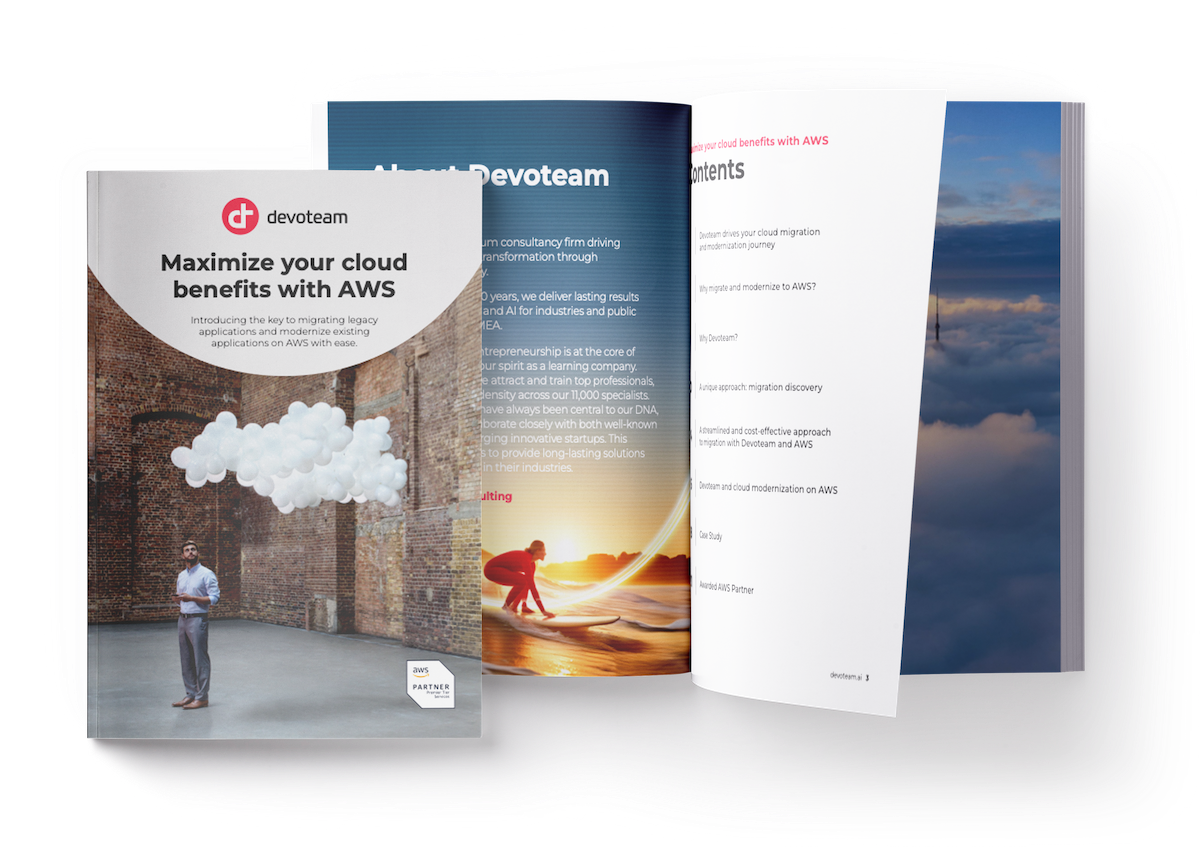
Ready to migrate to AWS but unsure where to start? Learn how to avoid common migration pitfalls and achieve real business transformation.
- Plan your migration properly, focusing on business value
- Connect cloud strategy to your business goals
- Prepare your organisation for successful transformation