


Estimated reading time: 10 minutes
Written as part of our AI Upskilling Program
This article was created as part of the Global Devoteam AI Upskilling Program, where employees share their knowledge to accelerate their learning. The program’s key objective is to provide a foundation in AI for every employee and apply these new skills in our work. Do you want to work with us? Check out our career opportunities.
Cyber threats become increasingly sophisticated and the volume of security alerts reaches overwhelming levels. Reports show that cyber attacks per organisation increased by 47% in 2025, with ransomware attacks rising by 126%. It’s no surprise that traditional Security Operations Centers (SOCs) are struggling to keep pace.
But there is good news as well – just as artificial intelligence is used for sophisticated attacks, it can also be used for advanced protection. From this article, you will learn how AI is transforming security operations and incident management. I will walk you through common challenges in SOC and the benefits of using AI in security operations.
Read on to enter a game-changing technology that’s not just enhancing SOC capabilities, but completely reimagining how organisations detect, respond to, and mitigate cyber threats.
What is a Security Operations Center (SOC)?
Firstly, let’s define the basics. A Security Operations Center (SOC) serves as the nerve center of an organisation’s cybersecurity defense strategy. SOC can be seen as the centralised unit encompassing the physical location, personnel, and tools dedicated to monitoring, detecting, responding to, and mitigating cybersecurity threats for an organisation.
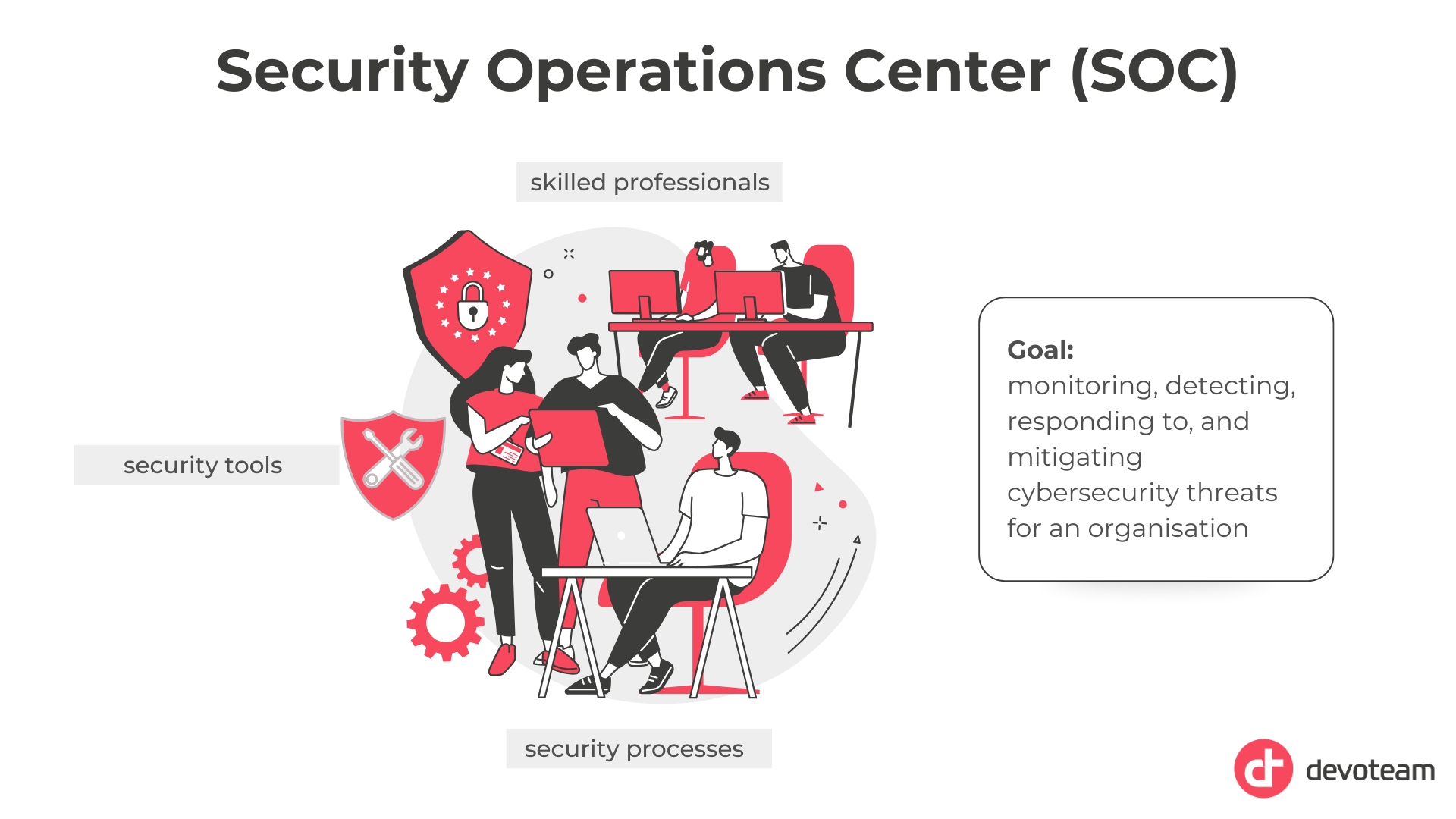
These command centers operate around the clock, with security analysts continuously monitoring network traffic, analysing security alerts, investigating potential incidents, and coordinating response efforts.
Traditional SOCs rely heavily on manual processes, with teams of analysts working in shifts to:
- Monitor security tools and dashboards
- Analyse thousands of daily alerts
- Investigate potential security incidents
- Coordinate incident response activities
- Generate reports and maintain compliance
However, the traditional SOC model is facing unprecedented challenges that are pushing these operations to their breaking point. Let’s look at some common issues.
Challenges in Traditional Security Operations Center
Before AI integration, SOC operations were characterised by several critical limitations that severely impacted their effectiveness:

I will briefly describe each challenge, showing relevant data.
1. Alert Overload and Analyst Fatigue
Studies indicate that teams receive an average of 4,000+ alerts daily, the vast majority of which are false positives or low-priority notifications. Security teams traditionally spend up to 90% of their time investigating false positives, leaving little room for proactive threat hunting and strategic security initiatives.
2. Slow Response Times
Manual investigation processes meant that using a traditional toolset of paid or free tools takes an analyst at least 30-60 minutes to classify and identify each new alert or threat. This delay provided attackers with critical windows of opportunity to advance their operations undetected.
3. Skills Gap and Resource Constraints
According to KPMG, about half of security leaders say they have “major issues” with retention and maintaining up-to-date knowledge, skills, and expertise to identify, analyse, and remediate emerging threats. The cybersecurity skills shortage meant that many organisations operated with understaffed SOCs, further exacerbating response time issues.
4. Limited Scalability
Traditional SOCs struggled to scale operations effectively. Adding more analysts is often expensive and time-consuming, while the complexity of modern IT environments continues to grow exponentially.
The AI Revolution: Transforming SOC Operations
The integration of artificial intelligence into SOC operations represents a paradigm shift from reactive, manual security operations to proactive, automated threat management. Two-thirds of the organisations studied in a survey now use security AI and automation in their security operations centres, which is a 10% increase from the previous year.
How AI Enhances SOC Capabilities
1. Intelligent Alert Triage and Prioritisation
AI-powered systems can automatically analyse incoming alerts, distinguishing between genuine threats and false positives with remarkable accuracy.
2. Automated Threat Detection and Analysis
Rather than disrupting established workflows, AI enhances what analysts do best. Machine learning algorithms continuously analyse network behaviour, identifying anomalies and potential threats that might escape human detection.
3. Predictive Threat Intelligence
AI-driven analytics enable SOCs to identify potential threats before they materialise. By analysing historical attack data, threat intelligence feeds, and user behaviours, AI models can predict vulnerabilities and preemptively strengthen security defences.
4. Automated Response and Orchestration
AI systems can execute predefined response actions automatically, from isolating compromised systems to blocking malicious IP addresses, significantly reducing the time between detection and containment.
Benefits of AI Integration in SOC
The implementation of AI in SOC operations delivers measurable benefits across multiple dimensions:

Cost Savings
The financial impact of AI integration is substantial and well-documented:
- Organisations that don’t use AI and automation in security operations have average breach costs of $5.72 million. In contrast, those that extensively use AI and automation averaged $3.84 million in costs, saving $1.88 million
- When AI solutions were used extensively across prevention workflows, organisations incurred an average $2.2 million less in breach costs, compared to those with no use in these workflows
- Organisations using AI and automation extensively throughout their security operations saved an average $1.9 million in breach costs

Resource Optimization
AI dramatically improves resource utilisation within SOC operations, as shown by Intezer:
- Teams using AI see alert triage time reduced by up to 90%
- With AI, teams spend on average 9% percent of their time on false positives, compared to the 90% that traditional teams waste
- There are reports of clients saving over 2,500 hours annually by using AI to triage alerts, allowing analysts to focus on the real threats

Incident Response Time Reduction
The speed improvements achieved through AI integration are remarkable, according to case studies:
- Case studies show that organisations using AI and automation in their security operations reduced the breach lifecycle by an average of 80 days
- A Forrester study found that organisations leveraging AIOps and advanced observability tools experienced a 50% reduction in mean time to repair (MTTR) and a 50% decrease in the number of severe incidents

Operational Efficiency Gains
The transformation in operational efficiency is equally impressive:
- Intezer shows that teams went from between 37-75% of time spent on thereat analysis to only 6% or less with AI automations
- IBM report shows organisations were able to identify and contain a breach within a mean time of 241 days, the lowest it’s been in nine years
Real-World Impact: The Global Context
The urgency for AI adoption in cybersecurity is directly link to the current threat landscape. Let’s look at some importand factors:
Breach Costs
In 2025 global data breach costs have declined for the very first time in 5 years. IBM’s newly released 2025 Cost of a Data Breach Report found that average global costs dropped to USD 4.44 million—down from USD 4.88 million, or 9%, in the year prior. It’s not an overreach to say that the reason for the decrease was faster breach containment driven by AI-powered defenses.
Market Growth
According to report by Markets&Markets AI in cybersecurity market is projected to grow from $8.8 billion in 2019 to $38.2 billion by 2026, at a compound annual growth rate (CAGR) of 23.3%, demonstrating the industry’s confidence in AI-driven security solutions.
Industry Adoption
Darktrace reports that 71% of security stakeholders are confident that AI-powered security solutions are better able to block AI-powered threats than traditional tools, while 69% of enterprise executives believe AI will be necessary to respond to cyberattacks.
The Future of AI-Powered SOCs
Looking ahead, the evolution of AI in SOC operations continues to accelerate:
AI-Driven SOC Co-pilots
According to Brian Linder, Cybersecurity Evangelist at Check Point: “AI-driven SOC co-pilots will make a significant impact in 2025, helping security teams prioritise threats and turn overwhelming amounts of data into actionable intelligence. It’s a game-changer for SOC efficiency.”
Autonomous Security Operations
The progression suggests a future where AI within SOCs operates independently, with no or minimal human intervention, representing the ultimate evolution toward fully autonomous security operations.
Proactive Defence Capabilities
In 2024, SOCs employ a proactive approach, leveraging the expertise of seasoned threat hunters and analysts to anticipate and neutralise potential risks before they materialise.
Implementation Considerations: Balancing Innovation with Governance
While the benefits of AI integration are compelling, organisations must address critical considerations:
AI Governance and Risk Management
Organisations must establish robust governance frameworks to manage AI deployment securely. IBM’s report shows that 63% of breached organisations either don’t have an AI governance policy or are still developing a policy. To learn more about AI governance, read our expert guide.
Skills Development
The integration of AI doesn’t eliminate the need for skilled analysts but rather transforms their roles. Human analysts bring strategic thinking, adaptability, and intuition that AI simply cannot replicate. Read our expert view about the role of humans in AI-powered SOCs.
Conclusion
The data is clear: AI integration in SOC operations is becoming a necessity for organisations serious about cybersecurity. With average cost savings of nearly $2 million per breach, response time reductions of up to 89%, and the ability to handle exponentially growing alert volumes, AI transforms SOCs from reactive centers into proactive security guardians.
The organisations that embrace AI-powered SOC operations today will be better positioned to defend against tomorrow’s threats. Those that delay adoption, risk being overwhelmed by the very challenges that AI is designed to address: alert fatigue, slow response times, resource constraints, and the ever-expanding threat landscape.
The key is for organisations to implement these transformative technologies while maintaining robust governance. It is also important to state clearly: the future of cybersecurity doesn’t lie in replacing human expertise with artificial intelligence. Creating powerful partnerships between human insight and machine efficiency can outpace even the most advanced cyber adversaries.
Secure AI, Sustainable Value: Your CISO’s Guide to AI Risk Management

Get your free Whitepaper if you want to:
- Learn to identify and manage unique AI security challenges
- Implement Devoteam’s AI Cyber Trust Cube – our framework for trusted and secure AI deployments
- Align AI with your organisation’s sustainability goals
- Gain insights from Devoteam’s leading AI security experts.