

Written as part of our AI Upskilling Program
This article was created as part of the Global Devoteam AI Upskilling Program, where employees share their knowledge to accelerate their learning. The program’s key objective is to provide a foundation in AI for every employee and apply these new skills in our work. Do you want to work with us? Check out our career opportunities.
The world of machine learning (ML) has grown exponentially, moving from a niche academic discipline to a powerful tool for businesses across every sector. From predicting market trends and optimising supply chains to creating hyper-realistic images and generating human-like text, ML is now a cornerstone of modern innovation. This article provides a comprehensive overview of the 2025 ML landscape, exploring the key components of the development pipeline, the tools and technologies available, and the exciting rise of generative AI.
The Machine Learning Pipeline
At its core, the machine learning pipeline is a structured process that data scientists and engineers follow to build, deploy, and maintain machine learning models. It’s a journey that begins with data and ends with a functional, deployed model. This process typically includes several stages: data collection and cleaning, feature engineering, model training and evaluation, and finally, deployment and monitoring.
However, the complexity and technical expertise required for this pipeline have historically been a barrier. This is where AutoML, or automated machine learning, comes into play. AutoML refers to the methods and processes that make the entire pipeline of creating machine learning systems easier for non-machine learning experts. By automating repetitive and complex tasks like algorithm selection and hyperparameter tuning, AutoML democratises ML, allowing a broader range of individuals and organisations to leverage its power without a deep understanding of the underlying theory. Read our full guide on AutoML.
Programming Languages and Frameworks for Machine Learning
The choice of programming language and framework is a critical decision in any ML project. While some languages are more dominant, several offer robust libraries and tools for machine learning development.
1. Python
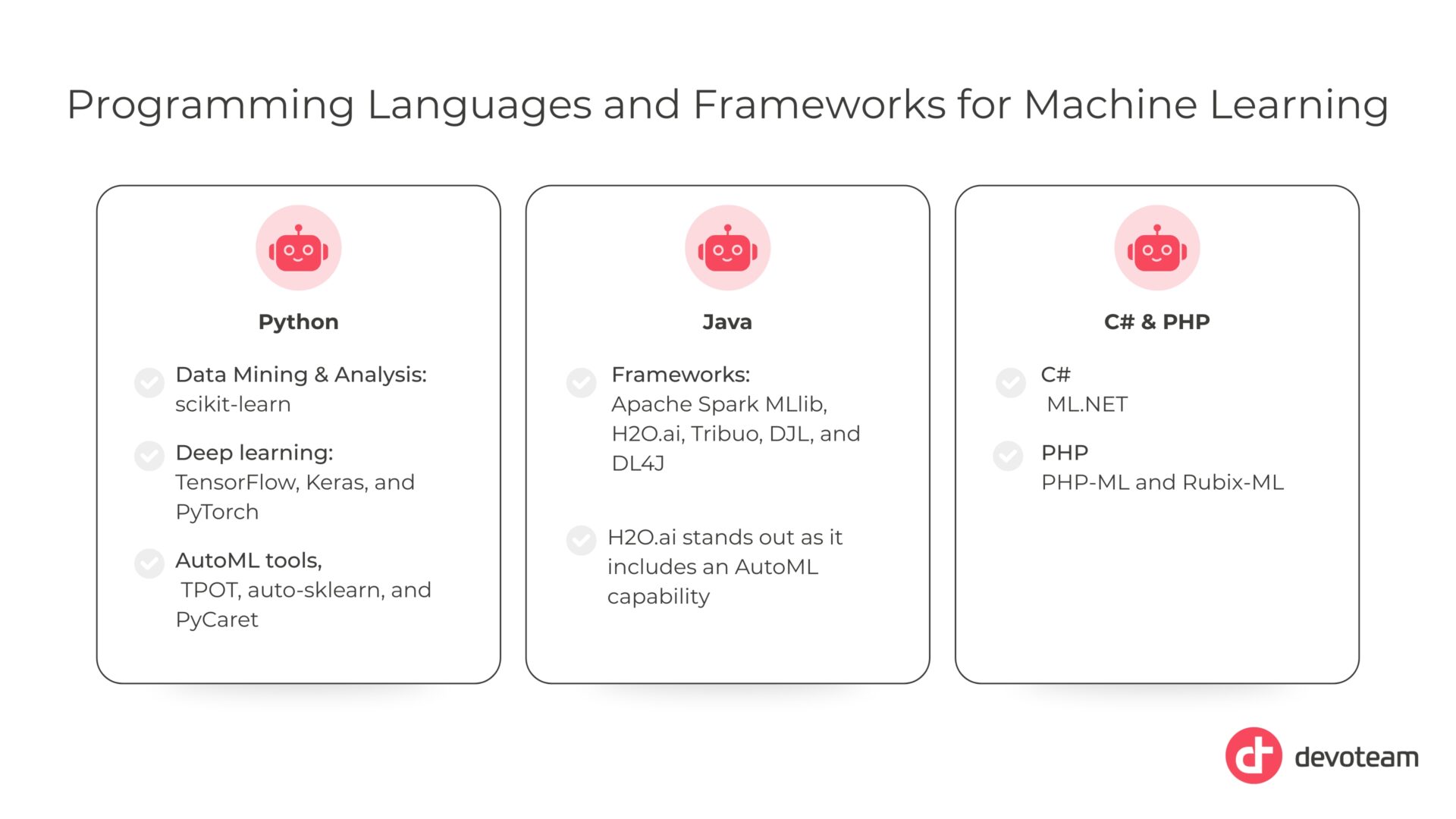
When it comes to the sheer volume of libraries and community support, Python remains the undisputed leader. Frameworks like scikit-learn provide a simple and efficient tool for data mining and data analysis. For deep learning, developers often turn to TensorFlow, Keras, and PyTorch. The Python ecosystem is also rich in AutoML tools, with options such as TPOT, auto-sklearn, and PyCaret providing automated solutions for building models.
2. Java
Java has been a reliable choice, especially in enterprise environments, and its ecosystem for machine learning provides some notable options. These include frameworks like Apache Spark MLlib, H2O.ai, Tribuo, DJL, and DL4J. H2O.ai, in particular, stands out as it includes an AutoML capability, making it a compelling option for those looking to simplify their workflow.
3. C#
C# is also making significant strides in the ML space. The primary tool here is ML.NET, a free, cross-platform, open-source machine learning framework that provides an AutoML feature. This allows .NET developers to integrate custom machine learning models into their applications without needing to be an expert in the field.
4. PHP
Even languages like PHP have found a place in the ML world. Libraries such as PHP-ML and Rubix-ML enable developers to implement machine learning algorithms directly within their web applications.
End-to-End ML Platforms
Building and deploying ML models at scale can be complex and resource-intensive. To address this, many companies now offer end-to-end platforms that streamline the entire MLOps (Machine Learning Operations) lifecycle. These platforms provide a complete suite of tools for data preparation, model building, deployment, and monitoring.
The competitive landscape of MLOps platforms is dominated by major cloud providers, such as Amazon SageMaker, which is a comprehensive service that allows developers and data scientists to build, train, and deploy machine learning models quickly. Similarly, Vertex AI from Google and AzureML from Microsoft provide integrated environments that unify the ML workflow, from data to production.
In addition to these commercial solutions, there are also powerful open-source platforms. Kubeflow is a project dedicated to making deployments of machine learning workflows on Kubernetes simple, portable, and scalable. Metaflow is another popular open-source framework designed to help data scientists and engineers build and manage real-life ML projects.
Cloud vs. On-Premise Solutions
Deciding between a cloud-based or on-premise solution is a fundamental choice for any organisation implementing MLOps. Each option comes with its own set of advantages and challenges.
Cloud-based solutions offer unparalleled flexibility and scalability. They operate on a pay-as-you-go model, meaning you only pay for the resources you use. This elasticity is perfect for handling fluctuating workloads and ensures you can scale up or down as needed. However, these solutions can raise concerns regarding sensitive data, as the data is stored and processed on third-party servers. They also require a stable and reliable internet connection, which can be a limitation in some scenarios.
In contrast, on-premise solutions provide greater data security and control. By keeping all hardware and data within the company’s own infrastructure, organisations can maintain full oversight and adhere to strict compliance regulations. The trade-off, however, is the high upfront costs for hardware and infrastructure. On-premise setups also require dedicated teams for maintenance and support, which can be both time-consuming and expensive.
The Generative AI Landscape
One of the most transformative developments in machine learning is the emergence of generative AI (GenAI). GenAI models are capable of creating new, original content, whether it’s text, images, voice, or video. This technology is rapidly reshaping industries and creating new possibilities for creativity and automation.
In the realm of language solutions, giants like Mistral AI, Gemini, Claude, Cohere, and OpenAI have released models that can generate coherent and contextually relevant text. Platforms such as Amazon Bedrock, Vertex AI, and Azure OpenAI make these powerful models accessible for business applications.
For image generation, services from OpenAI (DALL-E), Midjourney, Leonardo.AI, Stability.ai, and Amazon Bedrock (Amazon Titan & Canvas) are leading the way. These models can create photorealistic images from simple text descriptions.
The generation of voice and video has also seen significant advancements. Solutions like Amazon Polly, Azure AI Speech, IBM Watson Text to Speech, and ElevenLabs are revolutionising how we create audio content. For video, tools like Synthesia, Runway, Colossyan, and Sora are enabling the creation of dynamic, AI-generated videos with minimal effort.
To facilitate the integration of these powerful GenAI models into applications, a new set of frameworks has emerged. Spring AI and LangChain4j are popular choices for Java developers, while Python programmers often use LangChain, Semantic Kernel, AutoGPT, and LlamaIndex. For those working in C#, Semantic Kernel is a key framework, and in PHP, libraries like LLPhant and OpenAI PHP simplify the process of interacting with large language models.
Machine Learning in Action: Real-world Use Cases
The theoretical capabilities of machine learning only become truly impactful when applied to real-world problems. The list of use cases is endless and growing every day. Check out Devoteam’s success stories:







The Machine Learning Landscape Continues to Evolve Rapidly
The machine learning landscape is a dynamic and rapidly evolving field. From the foundational principles of the ML pipeline to the transformative power of generative AI, the tools and techniques available today are more powerful and accessible than ever before. As technology continues to advance, so too will our ability to harness the full potential of machine learning to solve complex problems and drive innovation.
Over 80% of AI projects fail. Yours don’t have to.
Download our AI Strategy Playbook:
- Learn why AI projects often fail (and how to avoid it).
- Follow 10 clear steps for a strong AI plan.
- Focus on solving business problems (not just using AI).
- Find the best AI uses for your business (includes 100+ examples).
- Learn how to measure AI results (GenAI projects average ~3.7x return).
- Get your tech foundations ready (Cloud, Data, and AI Security).
- Help your team adapt to AI (and see how we train our staff).
- Use AI responsibly (covering fairness, bias, and environmental thoughts).