



Benvenuti!
The SAFe Summit 2025 took place in Sorrento from April 7th to April 10th, gathering leaders, experts, SAFe Fellows and methodologists to delve into the latest developments, challenges, and opportunities within the SAFe framework.
The event provided a valuable platform for knowledge exchange, collaboration, and the promotion of innovation. Attendees participated in engaging discussions, keynote speeches, and workshops designed to tackle current industry issues.
I am trying, through this report, to highlight the main outcomes, insights, and recommendations from the summit, offering a comprehensive overview of the sessions and outlining the actionable steps to drive progress in Agile at Scale.
Keynote: Solving Real Business Problems with SAFe
First, let’s share the highlights of the keynote of Andrew Sales SAFe Chief Methodologist. He provided an in-depth look at the evolution and practical use of agile methodologies, focusing on the Scaled Agile Framework (SAFe). Andrew also introduced new competencies within SAFe that now directly address specific business challenges.
Agile is like the scientific method, with its core principles of observation, hypothesis testing, experimentation, and learning.
The primary aim of agile methodologies is to solve business problems. The speaker shared examples from industries like government, automotive, and space to demonstrate how agile practices effectively address real-world challenges.
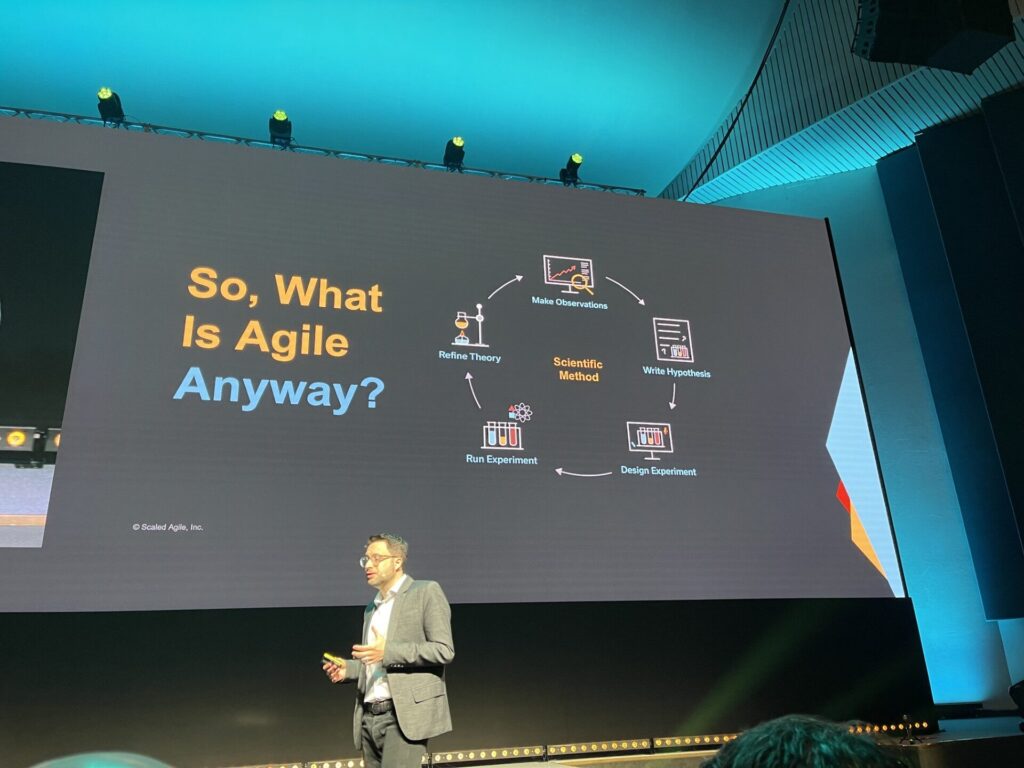
A significant portion of the speech focused on the current state of SAFe, highlighting a gap between its widespread adoption and mastery, particularly in areas like LPM. Users have expressed a desire for greater simplicity, flexibility, and an outcome-driven approach rather than a rigid process. In response to this feedback, SAFe has been restructured to offer a clearer, more intuitive framework.
The updated version of SAFe now revolves around five key disciplines:
- Lean Portfolio Management
- Large Solution Integration and Delivery
- Product Development Flow
- Team and Technical Agility
- Leadership and Culture
Each discipline is supported by both visual aids and narrative storylines to help organisations understand and implement the framework from start to finish.
Andrew also introduced new competencies within SAFe, which are now tailored to specific business challenges. These competencies focus on knowledge, application, and mastery, with examples such as lean-agile procurement and building AI-focused organisations.
Looking to the future, SAFe will prioritise continuous improvement, moving away from large batch releases in favour of monthly updates. An AI-powered tool, called SAFe Copilot, will be introduced to provide immediate, on-demand guidance. Future efforts will focus on helping organisations adapt SAFe to their unique contexts and integrate it with other methodologies.
In closing, the speaker emphasised the importance of focusing on solving business problems to ensure the continued success of SAFe. Efforts to make the framework more flexible, adaptable, and responsive to each organisation’s specific needs will shape its future direction.
Session: Product Innovation at Scale
One key topic covered at the Summit is Product Innovation at Scale.
The session is led by Luke Hohmann SAFe Fellow and CIO of Applied Frameworks and Marc Rix Methodologist and SAfe Fellow at Scaled Agile Inc. Product innovation plays a vital role in the success and longevity of companies, with 83% of organisations ranking it as a top priority.
Despite this high importance, only 3% feel adequately prepared to execute on it effectively. Successful product innovation relies on several key elements:
- Well-defined strategy and vision
- Continuous experimentation and learning
- Strong focus on customer experience
- The integration of emerging technologies and creative thinking
- Data-driven decision-making
- The courage to embrace risk
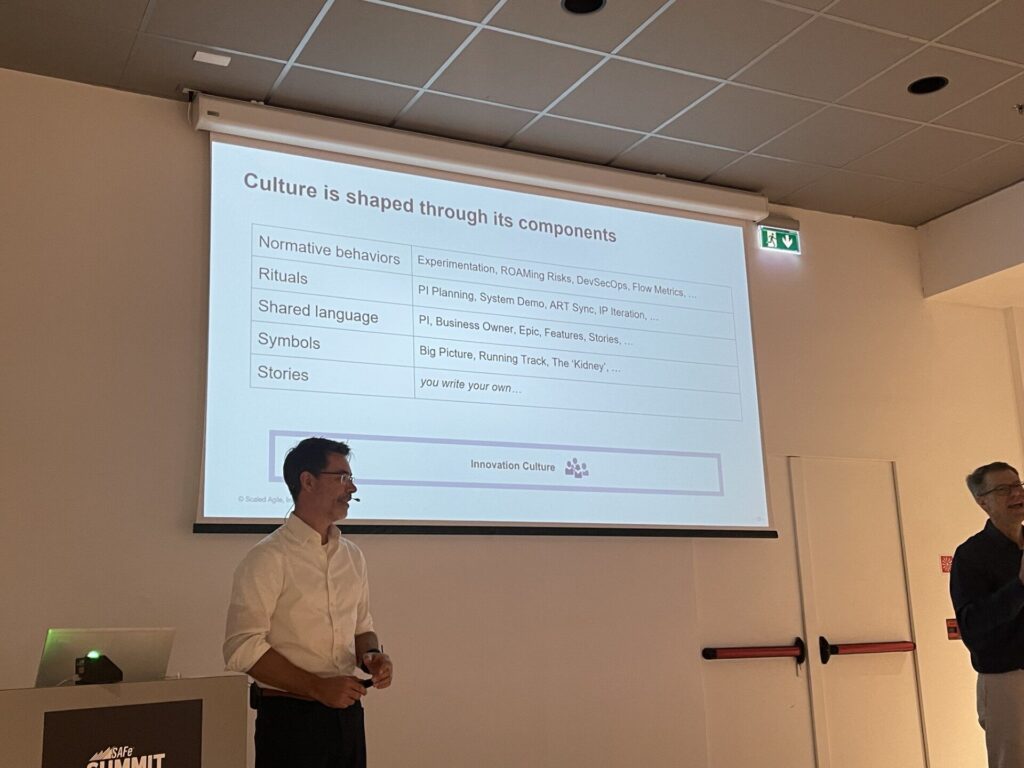
Scaling product innovation across an organisation requires more than ideas—it demands alignment, organisational buy-in, effective dependency management, coordination, and system-wide thinking. Adequate time, budget, and a supportive organisational culture are also critical.
SAFe provides a solid foundation for innovation at scale, emphasising principles such as customer centricity, continuous delivery, and agile methodologies. It also introduces a growing focus on product marketing to communicate innovations effectively.
The flow of product innovation typically follows a path from defining a clear vision and strategy to customer-centric design, continuous delivery, and strategic marketing. A culture that supports innovation is fundamental, with shared values and behaviours guiding the organisation. Leaders can shape this culture through consistent actions, shared language, rituals, and storytelling.
Panel: SAFe for Hardware
The panel is designed to address key questions about the effectiveness of SAFe for hardware. How can we leverage Lean and Agile practices to reduce lead times and improve outcomes for hardware-based and cyber-physical systems?
The panel is moderated by Harry Koehnemann, Methodologist and SAFe Fellow at Scaled Agile, Inc., and features insights from Ali Hajou SPCT, Wolfgang Brandhuber SPCT, and Julien Digoude Agile Coach.
During this panel, several key feedback points emerged from discussions on agile methodologies, specifically their application in hardware development. One of the main takeaways was the challenge of applying agile principles, such as incremental delivery, in hardware environments, where long development cycles and complex dependencies make frequent iterations difficult. Ali Hajou emphasised the importance of having stable teams and involving diverse engineering disciplines to better manage these challenges.
Another significant piece of feedback was the ongoing struggle to balance upfront planning with the flexibility required to adapt as projects progress. Julien discussed the value of early learning and modularity, allowing teams to adjust plans and accommodate changes later in the process.
There was also a consensus on the importance of starting the agile transition with editable roadmaps to bridge the gap between traditional waterfall methods and agile practices, as Wolfgang suggested. This approach can help ease the shift while also addressing the cultural challenges organisations face when introducing agile in hardware-focused industries. Panellists recommended using familiar terminology and initially focusing on smaller, manageable initiatives to build confidence and ensure successful adoption.
The discussion also highlighted the need for more agile-friendly approaches to verification and validation. The panel suggested breaking these activities into smaller, manageable tasks that fit into shorter development cycles. Wolfgang shared insights on working with regulatory bodies to implement stepwise verification and how this aligns with agile principles.
Another important feedback point was the challenge of coaching highly specialised engineers to adopt agile practices. The panel recommended tailoring agile methods to their specific work contexts and rewarding engineers for expanding their skills across disciplines.
Supplier integration emerged as a key challenge, with feedback highlighting difficulties in aligning contracts with agile processes. Wolfgang suggested treating suppliers as interfaces, establishing clear agreements for intermediate results to improve collaboration.
Finally, the critical role of senior leadership in supporting agile adoption has been emphasised. Panellists noted that making organisational change more flexible and cost-effective would be crucial for long-term success. Looking forward, there was strong agreement on the need to adapt and configure frameworks like SAFe to specific organisational needs and integrate them with other methodologies to ensure agility in an evolving tech landscape.