

Generative AI (GenAI) has revolutionised content creation, automation, and problem-solving. However, despite its capabilities, AI still heavily depends on how we interact with it—through prompts. Prompting is the key to unlocking AI’s full potential, but it’s not as simple as just typing in a question. The Future of GenAI Prompting presents challenges that organisations must address to improve AI performance and reliability.
Table of contents
Introduction: The Evolution of Human-Computer Interaction
1. The Complexity of Crafting Effective Prompts
2. Bias and Ethical Concerns in Prompting
3. The Struggle for Context Retention
4. Balancing Creativity and Accuracy
5. How Prompt Engineering Must Evolve
Prompting 101: Best Practices for GenAI Prompting
Conclusion: The Future of GenAI Prompting
In this article, we’ll explore five major challenges in GenAI prompting and what you can do to overcome them. But first of all, let’s look at previous iterations of similar challenges.
The Evolution of Human-Computer Interaction
From Typewriters to Touchscreens: A History of Adaptation
When computers first entered the workplace, they revolutionised how we worked. We adapted to new software, learned to type, and eventually mastered tools like spreadsheets and word processors. Fast forward to today, and it’s hard to imagine a job that doesn’t rely on some form of digital technology.
The Internet Era: Learning to “Google”
The internet brought another wave of change. We learned how to search for information, filter results, and use online tools to streamline tasks. While there was a learning curve, the goal was always clear: make technology work for us, not the other way around.
AI’s Turn: Why Prompting Feels Different
Now, with AI, we’re told we need to learn “prompt engineering” to get the most out of these systems. But unlike previous technological shifts, this one feels less intuitive. Why should we master a new skill just to communicate with a tool that mimics human thinking?
Going Beyond Basic Prompting
AI is not just about getting quick answers or little summaries anymore. We’re seeing AI deal with more complex tasks, like writing and fixing computer code, composing music, and even putting together images or videos from text. With better prompting, AI can take in lots of information, come up with creative content, and do things that, not long ago, we thought only humans could do.
1. The Complexity of Crafting Effective Prompts
A well-structured prompt can make the difference between a practical AI response and a completely irrelevant one. However, designing effective prompts is far from easy.
Understanding How AI Interprets Prompts
AI models process language differently than humans. They rely on statistical patterns rather than true understanding. A small change in wording can lead to dramatically different results.
The Need for Structured Prompting Techniques
Structured prompting techniques such as Chain of Thought (CoT) and Zero-Shot vs. Few-Shot learning can help avoid randomness. These approaches provide context and examples to guide AI towards more accurate and reliable responses.
5 Generative AI Prompting Techniques
Here are five prompt techniques you can use to interact with AI agents:
- Zero-Shot Prompting: Direct task execution without examples (e.g., “Translate ‘Hello’ to French”).
- Few-Shot Prompting: Providing examples to steer output (e.g., “Q: What’s 2+2? A: 4. Q: 3+5?”).
- Chain-of-Thought (CoT): Encouraging step-by-step reasoning (e.g., “Explain how photosynthesis works in stages”).
- Role Prompting: Assigning a role to the AI (e.g., “Act as a historian describing the Roman Empire”).
- Iterative Refinement: Adjusting prompts based on initial outputs (e.g., “Make the explanation simpler”).
Overcoming these prompting challenges is key to unlocking advanced applications, such as the development of truly personalised AI assistants.
2. Bias and Ethical Concerns in Prompting
A recent article from The Responsible AI Institute on the impact of AI on sustainability and ESG emphasises the need for a balanced approach to fully utilise the benefits of Generative AI while minimising potential hazards. AI models are trained on vast datasets, but if these datasets contain biases, the AI will reflect them in its responses.
The Impact of Biased Data on AI Responses
When trained on biased data, AI can reinforce harmful stereotypes or produce misleading information. This poses a major challenge in ensuring AI-generated content is ethical and fair. To learn more about the ethics of Generative AI, read this article.
Addressing Bias Through Better Training Data
One way to reduce bias is by improving training datasets. Incorporating more diverse data sources and applying bias-detection algorithms can help make AI responses more balanced and fair.
3. The Struggle for Context Retention
One of the biggest limitations of current AI models is their inability to retain context over long conversations.
Prompting: A Programming Language Without Rules
Prompting is often compared to programming, but there’s a key difference: programming languages are deterministic. If you follow the rules, you get predictable results. Prompting, on the other hand, is unpredictable. The same prompt can yield wildly different outcomes, leaving users frustrated and confused.
Why AI Often Fails to Remember Past Inputs
Most AI models process each prompt independently, meaning they don’t naturally “remember” what was said earlier. This leads to inconsistencies in multi-turn conversations.
Memory-Enhanced AI Models
Newer AI models with better memory capabilities are being developed, using techniques like vector databases and memory layers to retain context more effectively.
4. Balancing Creativity and Accuracy
AI-generated content is often engaging but sometimes sacrifices accuracy in favour of creativity.
AI Hallucinations
AI models can generate convincing but completely false information—a phenomenon known as “hallucination.” This can be a serious issue in applications where accuracy is critical, such as medical or legal advice.
Ensuring Factual Correctness in AI Responses
Prompt engineers can use verification techniques such as cross-referencing AI outputs with reliable sources or implementing rule-based constraints to minimise hallucinations.
The Illusion of Natural Language Interaction
AI systems are marketed as being able to understand natural language. Yet, anyone who’s spent time crafting the “perfect” prompt knows this isn’t entirely true. A slight tweak in wording can turn a useless response into a brilliant one—or vice versa. This inconsistency undermines the promise of AI as a user-friendly tool.
5. How Prompt Engineering Must Evolve
AI is evolving at an unprecedented rate, and prompt engineering must keep pace. The Future of GenAI Prompting could be a real turning point if we address these three following concerns:
The Promise of Human-Like AI
AI systems are designed to think and communicate like humans. So why can’t we interact with them as we would with a colleague? The need for precise prompting suggests that AI still needs to improve its understanding of human intent.
The Frustration of Unpredictability
Unpredictability is a deal-breaker from a user’s perspective. If I ask an AI a question, I expect a clear and consistent answer—not a response that changes based on how I phrase my query. This unpredictability is a major hurdle in making AI truly useful.
A Call for Better Design
The IT industry has a responsibility to design AI systems that prioritise user experience. Instead of forcing users to learn a new “language,” we should focus on making AI more intuitive and reliable. After all, the goal of technology is to simplify our lives, not complicate them.
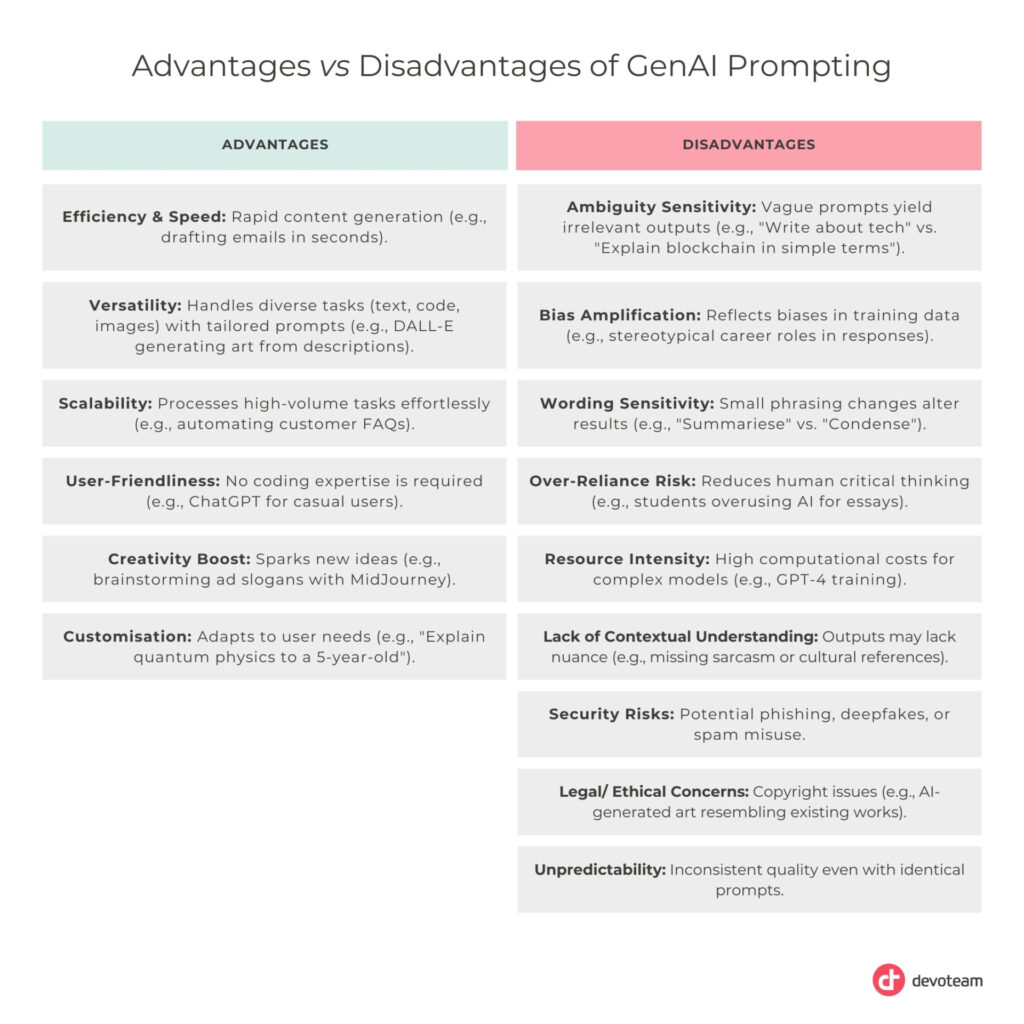
Here’s a comparison table outlining the advantages and disadvantages of AI prompting to make it clearer:
Prompting 101: Best Practices for GenAI Prompting
After reading this article, you might feel like GenAI Prompting is more of a time consumer than a helper. Which is why we built a complete guide for you:
- Be Clear and Specific: Vague prompts lead to vague answers. Instead of “Tell me about dogs,” try “Give me a detailed description of Labrador Retrievers, including their characteristics and temperament.”
- Use Proper Formatting: Well-structured prompts yield better responses. Use bullet points, numbered lists, and proper grammar.
- Keep It Concise: Long-winded prompts can confuse AI. Stick to essential details.
- Experiment and Iterate: If the response isn’t perfect, tweak the prompt and try again. Refining is key to better outputs.
Different Types of AI Prompts
- Descriptive Prompts: These guide AI in generating content with a specific tone or detail level.
- Instruction-Based Prompts: Direct commands like “Write a 500-word blog on AI in education.”
- Creative Writing Prompts: Useful for generating stories, poetry, or brainstorming ideas.
Common Mistakes to Avoid
- Being Too Vague: AI needs specificity to generate accurate responses.
- Overloading the AI: Too many instructions can confuse AI, leading to mixed responses.
- Ignoring AI Limitations: AI isn’t perfect. It requires human oversight.
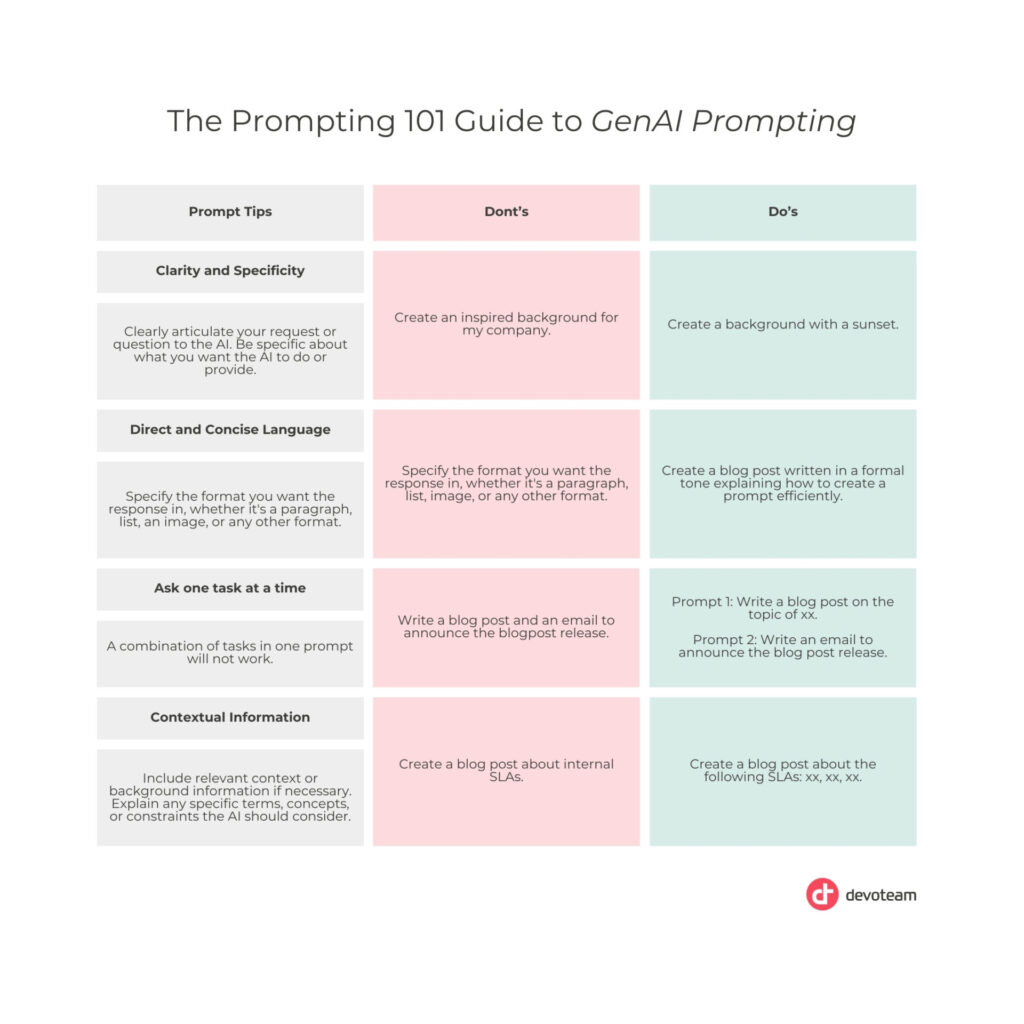
Prompting Do’s and Dont’s: The Future of GenAI Prompting
The Future of GenAI Prompting
The Future of GenAI prompting shouldn’t be about users learning to “speak AI.” Instead, it should be about AI learning to understand us. While the current challenges of prompt engineering are real, they also represent an opportunity for the IT industry to innovate and improve. By focusing on user-centric design and intuitive interfaces, we can ensure that AI lives up to its promise as a tool that works for us, not against us.
So, are we the only ones feeling like AI prompting is getting out of hand? Probably not. But the good news is, it doesn’t have to stay this way. The future of GenAI prompting is in our hands—and it’s time to improve it.
Beyond mastering prompts, discovering the vast potential of Gen AI lies in its practical applications. Explore over 100 innovative Gen AI use cases to see how these challenges are being addressed in real-world scenarios.
F.A.Q
1. What is AI prompting, and why is it important?
AI prompting is the process of structuring inputs to guide AI responses. It’s crucial because the quality of AI output depends on how well the prompt is formulated.
2. How can we reduce bias in AI-generated responses?
Reducing bias requires diverse and balanced training data, better algorithms for bias detection, and careful prompt engineering.
3. What are AI hallucinations, and how can they be prevented?
AI hallucinations occur when AI generates false information. They can be minimised by refining prompts, using fact-checking techniques, and leveraging AI models with built-in accuracy checks.
4. How does AI remember context in conversations?
Most AI models process prompts independently, but newer models use memory layers and vector databases to improve context retention.
5. What are the best practices for effective AI prompting?
Best practices include using clear and structured prompts, providing examples, refining queries based on AI responses, and leveraging advanced prompting techniques like Chain of Thought (CoT).