


Estimated reading time: 10 minutes
The idea of giving rules to intelligent machines is not new. Back in 1942, science fiction writer Isaac Asimov introduced his famous “Three Laws of Robotics”. These fictional laws were part of the stories collected in “I, Robot” and they were designed to ensure robots served humanity safely.
While coming from science fiction, Asimov’s work sparked an important thought relevant today: what rules should we give the intelligent systems we’re building? As AI takes on more tasks autonomously, it prompts us to think carefully about our own values. What decisions are we comfortable letting software make for us? This is the aim of this article – to join the discussion about the future of ethical and responsible AI from the perspective of a tech expert. If you are new to the topic, I recommend starting with my article explaining the basics of ethical AI.
The Future of Responsible AI: 5 things to consider
As an inspiration for our further exploration, let’s start with The Three Laws of Robotics, presented in the fictional “Handbook of Robotics, 56th Edition, 2058 A.D.”
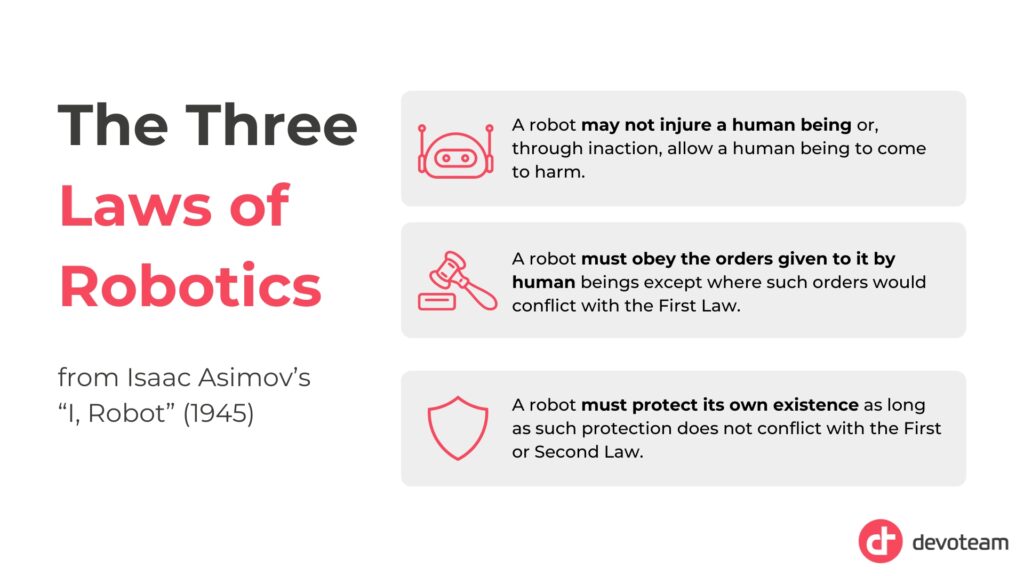
How does it translate to the foundations of ethical AI? Firstly, avoiding causing harm is at the core of ethical AI frameworks and principles. The second law corresponds with the need for AI to operate under human control and align with human intent, while acknowledging that this obedience must always be subservient to the avoidance of harm. Finally, the third law echoes discussions around accountability and the need for clear hierarchies of ethical priorities in autonomous systems.
Time to delve deeper into the 5 aspects of responsible AI for a better future.
1. The Enduring Compass: Our Core Ethics Still Point the Way
The good news is that we don’t need to invent a completely new set of morals for AI. Fundamental human ethical principles — ideas like fairness, justice, doing good, avoiding harm, being accountable, and transparency — remain incredibly relevant.
These principles, developed over centuries of human experience and thought, provide the moral compass we need. They are based on human rights and the kind of society we want to live in. AI, ultimately, is a tool created by humans, and it should serve these enduring values. At Devoteam, we believe in “Tech For People”, it is our ethics compass that has stood the test of time.

Businesses must ensure that their AI systems are fair, transparent, and accountable. They should avoid bias, use AI responsibly, protect data, and follow the rules.

Gert Jan van Halem
Chief Technology Officer at Devoteam
Real-life example: A powerful illustration of using AI in alignment with our ethics is the work of the company Zipline. It operates the world’s largest automated, on-demand delivery service for medical supplies. In countries like Rwanda and Ghana, Zipline uses autonomous drones to deliver blood, vaccines, and other critical medical products to remote hospitals and health clinics, often in a fraction of the time it would take by road.
2. The Translation Challenge: Teaching Machines Our Human Values
This is the tricky part. We humans learn ethics through experience, empathy, and understanding context, often without explicit rules. AI systems don’t have consciousness, feelings, or lived experience. So, how do we translate our complex, often subtle, human values into concrete instructions that an AI can understand and follow? How do you program “compassion” or ensure “fairness” works correctly in every unexpected situation, for example, when an algorithm helps decide on school applications or job candidates? This is one of the central questions when talking about the future of responsible AI: how to apply our human ethical framework to non-human ways of thinking.
It is not intelligence that defines humanity; it is purpose, empathy, and intention. And no machine can replicate that, only imitate and reinforce it.

Patrícia Milheiro
Strategy and Engagement, Devoteam AI Agency
Real-life example: A well-known example of the ethical challenges of AI is COMPAS, a tool that helps judges predict recidivism. However, the system was found to contain discriminatory bias, leading to unfair rulings based on race and other sensitive factors.
3. Who’s in Charge? Grey Areas in Autonomy and Accountability
AI is becoming increasingly autonomous. It can make decisions and take actions with less direct human input. This also generates ethical dilemmas: who is responsible if things go wrong? Is it the programmer, the owner, the person using the AI, or perhaps even the AI itself (which opens up big legal questions)?
When humans make difficult choices, they can be held accountable and asked to explain their reasoning, perhaps even in court. How do we build similar accountability into AI? Can we test AI in simulations beforehand to understand its choices in tough ethical situations? And if we ask AI to be able to explain everything – even what we as humans can’t – it raises the question: Are we holding AI to an even higher standard than we hold ourselves?
One answer to this challenge might be in “human-in-the-loop” systems, which combine human intelligence with machine learning capabilities. This approach involves active and continuous human participation, integrating humans into the AI process flow. The goal is to use human input to maximise AI’s potential while mitigating its risks.
Real-life example: In March 2018, a self-driving test vehicle struck and killed a pedestrian in Tempe, Arizona. The incident triggered a significant investigation and debate over accountability. The National Transportation Safety Board (NTSB) investigation revealed a complex chain of failures, raising profound legal and ethical questions about who is ultimately responsible.
4. Building Better AI: Practice, Transparency, and Working Together
Applying ethics to AI isn’t just theory; it requires practical steps. Developers and researchers are working on ways to do this, such as:
- Value Alignment: Trying to design AI goals that genuinely match human values.
- Ethics by Design: Considering ethics right from the start of AI development.
- Explainability (XAI): Creating AI systems whose decision-making processes humans can understand (though this is tough, especially with complex systems).
- Bias Detection: Actively looking for and fixing unfair biases in the data AI learns from and the algorithms themselves.
- Feedback loops and Testing: Rigorously checking how AI behaves in ethically sensitive scenarios, while also establishing continuous human feedback loops.
The human element ensures AI systems are intelligent and aligned with our values and needs, enabling more trustworthy and robust outcomes.

Cyril Maréchal
Lead Machine Learning Engineer, Google Cloud Business Unit, Devoteam
Real-life example: Trustap, a platform dedicated to secure payments, built a strong ethical base for all AI development. They wanted to ensure AI use matched their values, protected privacy, and built trust with customers and staff. For this purpose, they planned to create guidelines for responsible AI use and a robust system for managing data safely and ethically.
5. Ongoing Dialogue and Shared Responsibility
This isn’t a problem technology can solve alone, nor is it a one-time fix. As AI evolves, new ethical puzzles will appear. We need an ongoing conversation involving everyone – tech experts, ethicists, policymakers, social scientists, and the public. Defining how our timeless ethics apply to these powerful new tools requires collaboration, continuous learning, and adapting as the world changes around us.
Let’s also be mindful of how we react to mistakes – often, a single AI mistake gets far more attention than the many mistakes humans make daily. Think about self-driving cars: one accident can cause widespread alarm and debate, overshadowing the countless accidents caused daily by human drivers. Working together is key to ensuring AI develops responsibly.
The constant news headlines and tech evolution, artificial intelligence often wears the wrong mask — future dominance, cold logic, or detachment. But AI, in its essence, is not a ghost in the machine. It is an extension. A mirror. A tool. And like every tool humanity has ever created, from fire to fibre optics, it must serve us, not substitute us.
Patrícia Milheiro
Strategy and Engagement, Devoteam AI Agency
Real-life example: The Global Partnership on Artificial Intelligence (GPAI) is a real-world embodiment of this ongoing dialogue. Launched in 2020, it is a multi-stakeholder initiative that brings together leading experts from science, industry, civil society, and government to advance the responsible development and use of AI.
Conclusion
The journey into ethical AI, much like Asimov’s early imaginings, requires a continuous and collaborative effort. While fundamental human ethics provide our unchanging compass, translating these values into concrete, programmable instructions for AI systems remains a significant challenge. As AI gains more autonomy, addressing complex issues like accountability and bias becomes even more critical.
Fortunately, practical steps are being taken. From integrating “human-in-the-loop” systems and prioritising ethics by design to developing explainable AI (XAI) and robust bias detection mechanisms, the focus is on building AI that is both intelligent and aligned with human values.
Ultimately, shaping the future of responsible AI demands an ongoing dialogue among tech experts, ethicists, policymakers, and the public. As AI evolves, it becomes even more crucial to develop measures that can ensure that AI remains a powerful tool for good, augmenting human capabilities rather than compromising our core values.
Ethical AI Isn’t Optional. Get the Frameworks & Tools You Need

Confused about how to make your AI projects ethical? This playbook provides practical advice on navigating the ethical dimensions of AI. It’s based on our expertise and partnership with Google Cloud. Use it to:
- Establish clear ethical principles for your AI projects
- Ensure transparency and explainability in AI decision-making
- Implement data governance and privacy measures
- Promote sustainability and reduce the environmental impact of AI
- Explore real-world case studies (Europcar, Snowfox AI & Trustap) demonstrating ethical AI implementation