

We don’t need more intelligent AI,
we need deeper human questions
We are building AI systems that are faster, more accurate, and more autonomous.
And we’ve doing it well, technically.
But the more AI moves into the core of our society — healthcare, justice, education, work — the more obvious the gap becomes:
We’re designing AI for humans, but rarely with humans in mind.
Not deeply. Not holistically. Not beyond the “user.”
It’s not just a design flaw. It’s a strategic failure. Because when technology shapes how people decide, feel, trust, or belong, understanding those people becomes non-negotiable.
We Don’t Need Just Engineers. We Need Interpreters of Humanity.
AI doesn’t live in a vacuum. It lives inside systems:
- Inside minds, emotions, habits
- Inside institutions, biases, stress
- Inside cultures, values, contradictions
To navigate that, we need people who can read more than data, and also more than systems architecture.
- We need psychologists who understand trust, attention, and fear.
- Sociologists who know how systems include — or exclude.
- Neurologists who know how humans perceive, overload, and adapt.
- Ethicists who don’t just flag bias, but ask better questions about impact.
- Designers who don’t just remove friction, but create meaningful interaction.
These are not support roles. These are becoming core to the architecture of AI that works and lasts.
We used to call them Renaissance polymaths. Now, we might just call them the future of AI teams.
Designing for Consequence, Not Just Output
AI is not neutral. It reflects the priorities of those who build it. What we need is a confrontation with consequence.
- What happens when systems make decisions people cannot explain?
- What happens when humans adapt themselves to machines, instead of the other way around?
- What happens when “user-friendly” becomes emotionally manipulative?
- What happens when interfaces disappear, and all that’s left is trust?
These are design decisions. And they begin with the questions we ask.
From Human-Centric to Human Expansion
I am a great believer in human-centricity. It’s not something to ignore, instead, it’s something to build on. But if we stop there, we risk designing only for the moment, forgetting, the potential.
The purpose of AI is not to mimic us. It’s to expand us.
We must design AI that augments our cognition, our care, our creativity, not just our output.
That does not only mean more automation. It also means more awareness.
AI should:
- Help doctors see what fatigue hides
- Give policymakers the foresight they have never had
- Extend our senses, our decisions, our care
- Augment intelligence, not just automate labour
This is not a sci-fi future. This is what is possible when we design with purpose and depth, not just scale.
We’re not just trying to “keep humans in the loop.” We’re trying to make the loop more human.
That doesn’t mean designing for convenience. It means designing for dignity, imagination, contradiction, the full range of what it means to be alive.
AI doesn’t need to be more like us. It needs to help us become more of who we could (and should) be.
The Role We Must Now Grow Into
Shaping AI is not only a technical act. It’s a civilizational one.
And the future of AI will not be defined only by how powerful the models become, it will be shaped by the questions we ask before we build — and the perspectives we bring into the room, especially in systems never designed for another intelligence.
So who’s your next great tech hire?
It might be someone who doesn’t write algorithms.
But who sees the human complexity those algorithms will touch.

We’ve trained the machines. Now let’s bring in the people who can teach us to ask better questions.

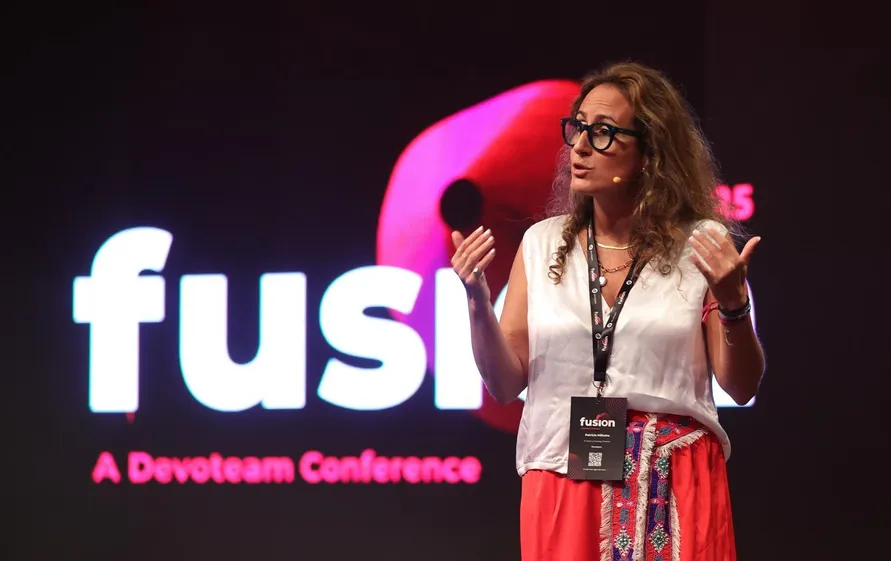
Patrícia Milheiro
AI Agency Strategy Director at Devoteam
Meet the author, Patrícia Milheiro
Patrícia Milheiro is AI Agency Strategy Director at Devoteam, where she leads AI strategy and supports organisations in adopting generative AI for business transformation. She co-authored the book “Empower Business with Generative AI,” guiding executives on the impact and best practices of AI adoption. Recognised as an AI facilitator and mentor, Patricia helps companies realise efficiency and innovation through AI solutions.