
Devoteam was present at the 2025 edition of the Dutch Cloud Native Day (DCND) as a Gold sponsor. Focusing on bringing together different enthusiasts from open source and cloud-native communities, it intrigued me to attend as well, since I consider myself part of that group of enthusiasts :D. With a special interest in Kubernetes and GitOps, I became really excited looking at the agenda of the event, seeing multiple talks about these topics. On top of that, I was hoping to connect with other enthusiasts and learn more about their experiences with GitOps.
Devoteam at the event
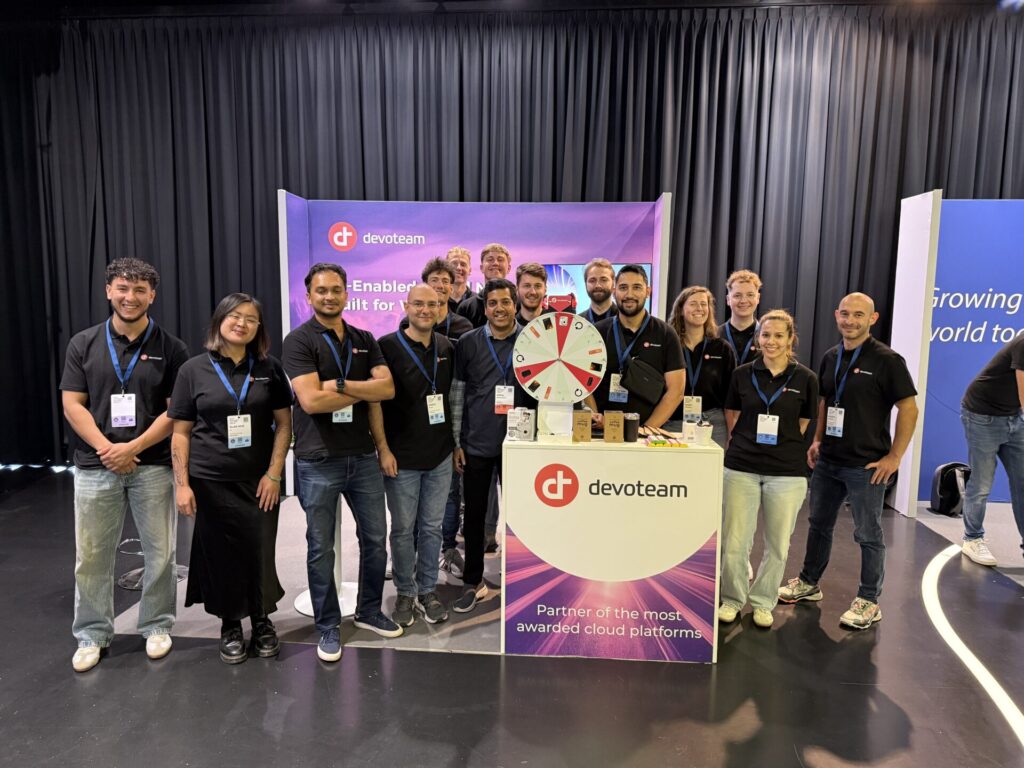
With a booth full of goodies ready to be given out, Devoteam was standing strong with around 18 people attending the DCND. We had a special Wheel of Fortune for attendees to spin and win a Polaroid camera or a very minimalistic keyboard with only the copy-paste buttons (because what more do we need nowadays with all the chatbots, right?).
The event kicked off with some croissants and coffee to wake us all up, after which the keynote and technical sessions started. Attendees could visit the sponsor booths and have meaningful conversations (read: pick up all the goodies). I was hoping to meet some Kubernetes and GitOps adopters, and I was not disappointed.
A lot of technical people from different backgrounds and companies visited our booth and immediately initiated conversations about their experiences working with Kubernetes on different cloud providers or on-premises. I also got to talk a lot about GitOps, with people using different tools like ArgoCD and FluxCD. Having worked only with ArgoCD myself, it was interesting to hear about the differences between the two tools.
Favourite technical session
The technical session that I enjoyed the most was GitOps Reinvented: Correcting Kubernetes Drift Before It Happens by Damien Dassieu.
One of the biggest downsides of using the GitOps methodology is that you can only change your manifests inside your Git repository, making the use of kubectl apply or changing things inside an OpenShift UI redundant. But for some use cases, it’s still faster to change something in the cluster itself without going through the Git routine. Unfortunately, this creates configuration drift, which is not allowed in the GitOps dictionary.
To bridge this gap, Damien created his own tool called Syngit, which can integrate with your GitOps tool to manage configuration drift the other way around. Altering something on the cluster side triggers Syngit to integrate this alteration within your Git repository — by either pushing it to the main branch or creating a pull request on a separate branch. Syngit can be found at this repository on GitHub, which I will definitely follow!
Looking back
With interesting sessions, good food & drinks, and some new LinkedIn connections in the bag, I can look back at a very successful edition of the Dutch Cloud Native Day.
Having grabbed some goodies myself at different sponsor booths, I’m good to go for another year and am looking forward to the next edition!