


“Everything was under control: state-of-the-art tools, a locked-in schedule, and rigorous monitoring. Yet, three months later, the project was behind schedule, the teams were under pressure, and the budget was slipping.”
Does this scenario sound familiar? You’re not alone. In an era where artificial intelligence promises to revolutionise project management, many project managers still see a huge gap between the technological promise and the reality on the ground.
In just a few years, so-called “generative” AI and other intelligent co-pilots have invaded management software: automated reporting, predictive planning, and real-time monitoring. On paper, it’s a dream: fewer thanless tasks, better risk anticipation, faster decisions. In practice? Tools that respond to your requests but struggle to understand how you actually work.
Why this gap? Automating a task isn’t the same as understanding it. In project management, the heart of the problem isn’t checking boxes or generating reports: it’s navigating a changing environment filled with people, tensions, and uncertainties.
This article aims to explore this blind spot. We’ll look at why current tools are at a standstill, what the real challenges (both technical and human) are in designing truly useful AI agents, and how to imagine assistants that adapt deeply to each project manager’s style, constraints, and dynamics.
Download Now: Free AI Strategy Playbook
[New 2025]
The complexity of the role of a project manager
The project manager’s job is often wrongly summarised as a matter of organisation: plan, assign, deliver. In reality, it’s a constant balancing act where every decision is made under pressure, with poorly understood risks and constantly evolving human factors.
At any given moment, the project manager juggles:
- Cross dependencies between tasks, teams and suppliers.
- Budgetary decisions under pressure.
- Inevitable scheduling conflicts.
- A vital necessity: keeping your team engaged and motivated, even when the situation becomes tense.
This complexity is not just a myth. According to the Project Management Institute, nearly 70% of projects exceed their initial deadlines or budgets. Other studies estimate that project managers spend up to 50% of their time on low-value-added tasks: reporting, coordination, and administrative follow-up.
So it’s not just a question of efficiency: it’s a matter of mental health, collective productivity, and strategic success. This is where AI could play a key role… if it can understand this complexity instead of reducing it to boxes to be ticked.
What AI already does for project managers… and its limits
In recent years, artificial intelligence has made a remarkable entrance into project management. Today, tools like ClickUp AI, Notion AI, Microsoft Copilot, and Smartsheet AI promise to assist project managers in their daily work. Their contributions focus on several key areas:
- Automation of repetitive tasks:
Generation of reports, meeting summaries, dynamic checklists, etc. These features save valuable time on tasks that were previously time-consuming. - Intelligent planning:
AI suggests tailored timelines, identifies critical dependencies, and adjusts priorities based on project progress. - Risk anticipation:
By analysing project history and trends, some tools can predict delays or issue risk alerts. - Conversational interaction:
Built-in co-pilots allow you to ask simple questions (“Show me the overdue tasks”, “Write the meeting minutes”), making the tool more intuitive.
On paper, these advances seem revolutionary. But in reality, they remain largely reactive: AI performs what it’s asked to do, often based on limited data, without understanding the deeper context in which these actions take place.
An example? You can ask your co-pilot to identify critical tasks, but they won’t anticipate that your team is showing signs of fatigue, that your client is under stress, or that a latent risk could explode in two weeks. Simply put, AI processes tasks; it doesn’t read dynamics.
Technical challenges: creating adaptive agents
Designing an AI agent that goes beyond simple automation and truly adapts to project managers presents considerable technical challenges. Contrary to a simplistic vision of simply “adding a little AI” to an existing tool, several fundamental problems must be addressed.
Understand the context in depth
A project is not just a series of tasks; it is a network of human interactions, strategic decisions, and unforeseen events. The agent must be able to understand the dynamics of the project in real time: changing priorities, internal tensions, weak signals of disengagement, etc.
Managing workflow diversity
Every project manager has their own way of working, and every company has its own project culture. It is therefore imperative to develop agnostic but adjustable models capable of continuously learning from individual behavior to refine their recommendations.
Ensure interoperability
Today, a project rarely lives in a single tool: Jira, Slack, Trello, Excel, emails… To be relevant, the agent must be able to integrate seamlessly into this disparate ecosystem, capture relevant data and detect cross-functional trends.
Building adaptive learning
This is not a one-shot: the agent must learn gradually, capturing implicit feedback (how the PM responds, adjusts or rejects suggestions) to refine its interventions.
These challenges are far from being resolved today. Most current tools remain task-centric, as it is technically much simpler to automate reporting than to understand the psychology of a team or the implicit dynamics of a complex project.
Human and sociological challenges
Beyond technical hurdles, there’s another major—and often underestimated—barrier to the adoption of AI agents: the human and cultural dimension. Developing an intelligent tool is one thing; getting it accepted, adopted, and fully utilised is another.
Mistrust and misunderstanding
Many project managers express a natural reluctance toward these new tools. The “black box” effect is real: when AI proposes a decision or suggests a schedule change without the user understanding the underlying reasoning, trust erodes. Project management remains, above all, a matter of responsibility: who is at fault in the event of an error? The machine or the human?
The weight of habit
Another obstacle is purely cultural. Project managers—often experienced ones—have spent years building their own methods, mental shortcuts, and in-house organisational systems. Asking them to completely switch to a new agent, however promising, amounts to questioning deeply rooted practices.
Delicate positioning
Finally, the question of decision-making power remains crucial: should an agent only assist, or can they go so far as to impose an action? In some cases, tools have been rejected because they were perceived as too intrusive, upsetting the delicate balance of a team, or generating additional tensions.
In short, the adoption of AI agents in project management will not only be a question of technical performance. Above all, it will be a matter of social acceptability, pedagogy, and finesse in the way these agents integrate into existing human ecosystems.
What a truly adaptive agent might look like
Let’s imagine for a moment: an AI agent that no longer just performs tasks, but actively learns from the project manager and their environment to become a true strategic co-pilot.
Personalised learning
The agent continuously observes the PM’s working style: do they prefer concise or detailed responses? Do they anticipate or react at the last minute? Do they tolerate a certain margin of risk or favour absolute caution? Within a few weeks of use, the agent adjusts its way of interacting and its suggestions based on these parameters.
Reading weak signals
Beyond the visible data, the agent picks up more subtle signals: an increase in deliverable delays, a drop in engagement on Slack or Google Chats, a harsher tone in emails, etc. These are all clues that can alert the PM before the crisis becomes visible.
Controlled proactivity
Far from intrusive, this agent knows when to intervene—and especially when to remain silent. They suggest schedule adjustments, recommend organizing a scoping meeting, or draw attention to a latent risk, but they always leave the final word to the human.
AI for Project Managers: A real-life scenario
You’re mid-project. Your team is starting to experience minor delays. The agent detects a trend: the average response time to Slack messages has doubled over two weeks, and some colleagues are reducing their login frequency. It discreetly notifies you:
“Signs of demotivation detected in the Backend team. I’m recommending an informal resynchronisation meeting this week. Automatic preparation is underway.”
That’s what a truly adaptive agent is: an assistant that not only automates, but understands, anticipates, and adjusts to your driving style.
The business case: why it’s profitable
Given the scale of the technical and human challenges, one might ask: is it really profitable to invest in the development of these adaptive agents? The answer is clear: yes, provided the impact is well targeted.
Saving time on low-value tasks is already a first lever. According to a recent study [1], project managers spend up to 50% of their time producing reports, managing follow-ups or coordinating administrative tasks. Automating these tasks would save the equivalent of several hours per week per project manager.
But the real added value lies elsewhere: in the agent’s ability to reduce the risk of project slippage and improve project predictability. A better-planned project means fewer delays, lower cost overruns, and, above all, less stress for the team. Even a marginal improvement—say, a 10% reduction in delays—can represent significant savings on complex projects.
Added to this is a benefit that’s harder to quantify but just as crucial: the satisfaction of project managers and their teams. An environment where AI lightens the mental load, clarifies risk areas, and offers concrete solutions directly contributes to talent retention and collective performance.
In short, investing in adaptive AI agents isn’t just a technological luxury. It’s a strategic lever for making project management more fluid, human, and ultimately profitable.
Conclusion
We’re living in an era where artificial intelligence promises to revolutionise the way we work. In project management, the first results are evident: automation, forecasting, co-pilots, etc. But these tools still too often remain passive assistants, incapable of grasping the full human and dynamic complexity of real-world projects.
To take a step forward, we must go further: design truly adaptive agents capable not only of executing tasks but also of understanding, learning, and anticipating based on the unique context of each project and each project manager.
This revolution will be achieved not only through technology but also through teaching and better integration into existing workflows.
Over 80% of AI projects fail. Yours don’t have to.
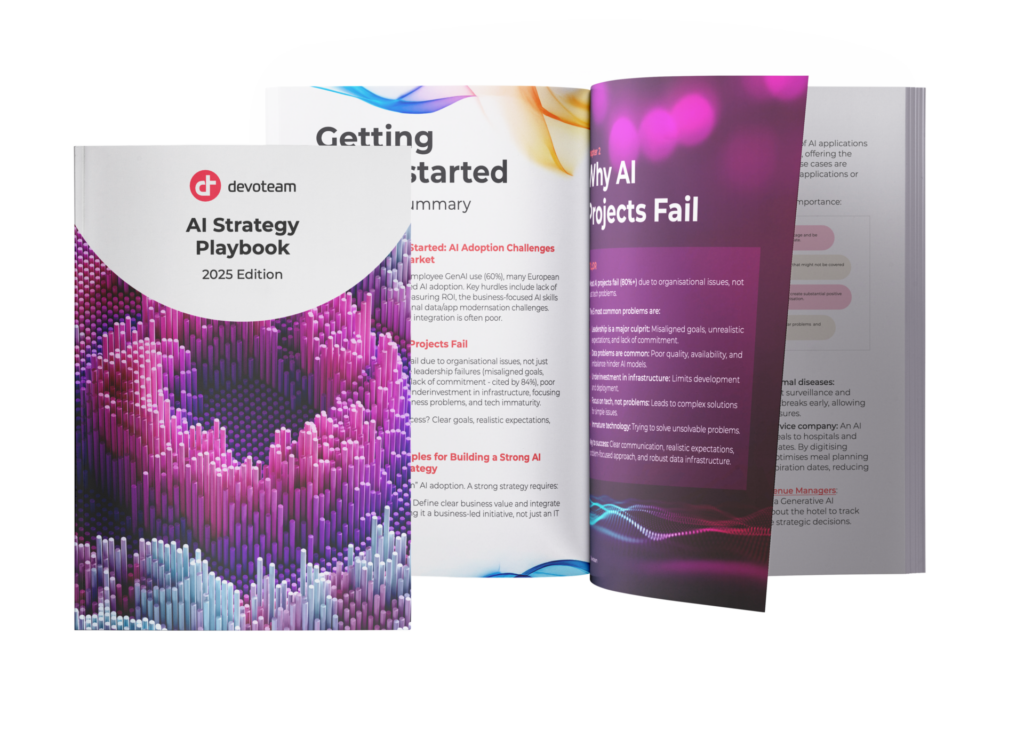
Download our AI Strategy Playbook:
- Learn why AI projects often fail (and how to avoid it).
- Follow 10 clear steps for a strong AI plan.
- Focus on solving business problems (not just using AI).
- Find the best AI uses for your business (includes 100+ examples).
- Learn how to measure AI results (GenAI projects average ~3.7x return).
- Get your tech foundations ready (Cloud, Data, and AI Security).
- Help your team adapt to AI (and see how we train our staff).
- Use AI responsibly (covering fairness, bias, and environmental thoughts).
References:
[1] PMI, Pulse of the Profession 2020: Ahead of the Curve – Forging a Future-Focused Culture , Project Management Institute, 2020.