



Estimated reading time: 19 minutes
How do you make sense of your data? Without a clear roadmap, businesses risk being overwhelmed by a data deluge, unable to extract meaningful insights or leverage its power. This is where a well-defined Data Strategy comes into play, acting as a compass to guide your organisation towards data maturity.
This guide will walk you through the steps of building a data strategy and show the added value it brings to businesses across all industries. By adopting a strategic approach to your data, you can move beyond simply collecting information to actively using it to drive better decisions, enhance efficiency, foster innovation, and ultimately gain a competitive edge.
In this guide, you’ll read:
- Why a Data Strategy is Your Competitive Advantage
- The Essential Data Strategy Components
- Data Strategy Roadmap
- Key Enablers for Successful Data Strategy
- The Added Value: Tangible Business Outcomes of a Data Strategy
- Working with a Data Strategy Consulting
- Conclusion: Embracing Data with a Strategic Approach
- Ready to transform your data into a strategic asset?
Why a Data Strategy is Your Competitive Advantage
What is a data strategy?
Often, your organisation’s data is a vast, untapped resource. A data strategy provides the framework to explore, refine, and utilise this resource effectively. It’s not just about the technology you implement; it’s about aligning your data initiatives with your overarching business goals.
Here’s why a well-articulated data strategy is crucial for sustained success:
- Making Informed Decisions: Without a data strategy, decisions are often based on intuition or limited, siloed information. A data strategy ensures that your organisation can leverage comprehensive data insights to make evidence-based decisions across all levels, leading to more effective outcomes and reduced risks.
- Improving Operational Efficiency and Reducing Costs: By analysing data related to your operations, you can identify bottlenecks, optimise processes, automate tasks, and ultimately reduce costs. A data strategy helps pinpoint areas where data-driven insights can streamline workflows and improve overall productivity.
- Driving Innovation and Identifying New Opportunities: A strategic approach to data encourages exploration and analysis, which can uncover hidden patterns, emerging trends, and unmet customer needs. This, in turn, can fuel innovation, lead to the development of new products and services, and open up new revenue streams.
- Enhancing Customer Experience and Personalisation: Understanding your customers through data is paramount in today’s customer-centric environment. A data strategy facilitates the collection and analysis of customer data, enabling you to personalise experiences, improve engagement, build stronger relationships, and ultimately increase customer satisfaction and loyalty.
- Understanding Market Trends and Competitive Positioning: By analysing market data and competitor activities, you can gain valuable insights into industry trends, identify opportunities, and refine your competitive strategy. A data strategy ensures you are leveraging data to stay ahead of the curve.
- Achieving Strategic Goals: Ultimately, a data strategy is a crucial enabler for achieving your organisation’s broader strategic objectives. By aligning data initiatives with your key performance indicators (KPIs) and business goals, you ensure that your data assets are actively contributing to your overall success.
The Essential Data Strategy Components
A data strategy encompasses several crucial components that work together to create a cohesive and effective framework:
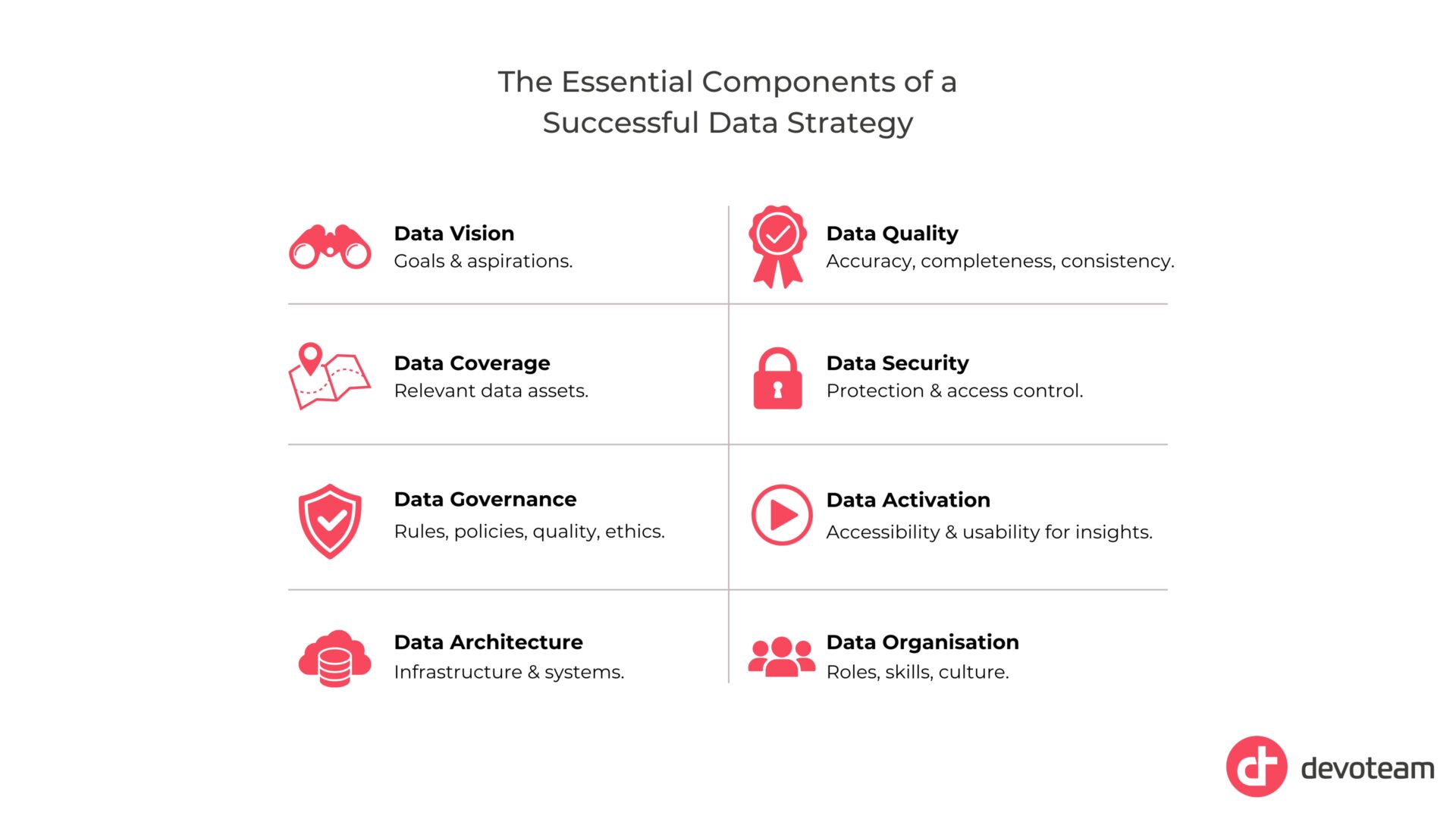
Let’s dive deeper into the data strategy components:
- Data Vision: This defines the overarching goals and aspirations for data within your organisation, aligning with your core business objectives and outlining how data will be used to achieve them.
- Data Coverage: This component focuses on identifying the specific data assets that are relevant and necessary to support your business objectives and use cases, considering both current and future needs.
- Data Governance: This establishes the rules, policies, procedures, and responsibilities for managing your data effectively. It encompasses data quality, security, compliance, and ethical considerations.
- Data Architecture: This outlines the infrastructure, systems, and technologies required to store, process, integrate, and access your data. It defines how data flows through your organisation.
- Data Quality: This ensures that your data is accurate, complete, consistent, and fit for its intended purpose. It involves implementing processes for data validation, cleansing, and monitoring.
- Data Security: This focuses on protecting your data from unauthorised access, breaches, and cyber threats. It involves implementing security measures, access controls, and data encryption techniques.
- Data Activation: This describes how data will be made accessible and usable for various purposes, including reporting, analysis, business intelligence, and data-driven applications.
- Data Organisation: This defines the roles, responsibilities, skills, and structures needed within your organisation to manage and leverage data effectively, fostering a data-driven culture.
Data Strategy Roadmap
Developing a robust data strategy is a journey that requires careful planning and execution. Here’s a step-by-step data strategy roadmap that will guide you through the process:
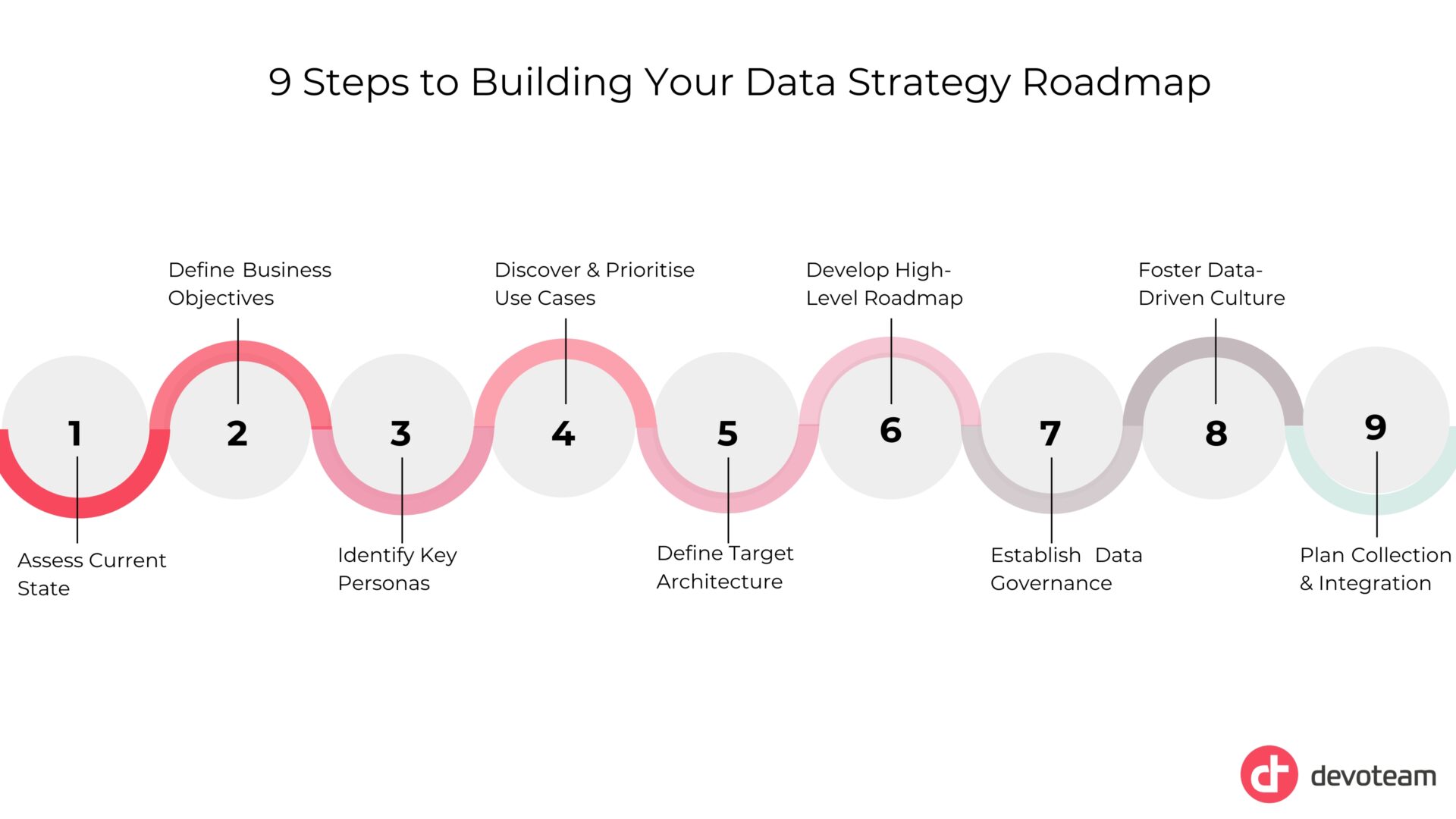
1. Assess Your Current Data State
Begin by understanding your existing data landscape. Evaluate your current data infrastructure, data sources, data quality, data management practices, and your teams’ skills and capabilities. Identify your current strengths, weaknesses, and any existing challenges related to data access, quality, or governance.
- Practical Tips & Tricks:
- Review existing documentation: Gather any existing data strategies, data governance policies, architecture diagrams, and reports.
- Conduct stakeholder interviews: Speak to individuals across departments to understand their current data usage and challenges.
- Utilise a Data Maturity Assessment: Employ a structured framework to evaluate your current capabilities across vision, coverage, governance, architecture, quality, security, activation, and organisation.
- Perform a current technology scan: Understand the existing data tools, data platforms, and infrastructure.
Questions to Ask Yourself:
- What data sources do we currently have?
- Where is our data stored and how is it managed?
- What is the quality of our data? Are there known issues with accuracy or completeness?
- How do different departments currently access and use data?
- What data governance processes are in place (if any)?
- What are our current data analytics capabilities and skills?
- What are the biggest challenges we face regarding our data?
- Do we have data dictionaries and business glossaries?
Want to know how mature you are with data? Ask yourself these questions:
- Do they have a clear plan for data?
- Do they have all the data they need?
- Are there rules for managing data?
- Is their data system well set up?
- Is their data good quality?
- Is their data safe?
- Can people easily use the data?
- Is everyone in the company good at using data?
2. Define Your Business Objectives and Needs
Clearly articulate your organisation’s key business goals and identify how data can contribute to achieving them. Engage with stakeholders across different departments to understand their specific data needs and the business questions they need to answer.
Practical Tips & Tricks:
- Align with the strategic plan: Understand the overarching business strategy and how data can support it.
- Focus on key business priorities: Identify the most critical objectives for the organisation.
- Engage with business stakeholders: Conduct workshops and discussions to understand their specific needs and desired outcomes.
- Identify potential value drivers: Explore how data can increase revenue, reduce costs, improve efficiency, or enhance customer experience.
- Consider medium to long-term objectives: Think beyond immediate needs and anticipate future data requirements.
Questions to Ask Yourself:
- What are our organisation’s top strategic priorities for the next 1-3 years?
- How can data directly contribute to achieving these objectives?
- What business questions do we need data to answer?
- What are the key performance indicators (KPIs) that the CEO and other leaders care about?
- What are the current challenges in executing our business strategy?
- In which business domains do we expect data + AI to deliver the most value?
- Do our internal stakeholders feel that our data operations are delivering real value?
3. Identify Key Data Personas and Their Pain Points
Understand who the key data users are within your organisation and what their specific needs and challenges are related to accessing and using data. This will help tailor your data strategy to meet the requirements of different user groups.
Practical Tips & Tricks:
- Map key roles: Identify individuals or teams who regularly interact with or rely on data (e.g., Sales Managers, Marketing Analysts, Operations Leads).
- Understand their objectives: What are their primary goals and how does data support them?
- Document their current processes: How do they currently access, analyse, and use data in their daily work?
- Identify their challenges: What are their frustrations and pain points related to data access, quality, tools, or skills?
- Consider missing capabilities: What data-related functionalities or insights are they currently lacking?
Questions to Ask Yourself:
- Who are the main consumers of data within our organisation?
- What are their specific roles and responsibilities?
- What types of data do they need access to?
- What are their current frustrations or inefficiencies related to data?
- What tools and capabilities would help them work more effectively with data?
- Are they able to easily perform self-service analytics?
- What kind of reporting or analysis do they currently perform?
4. Discover and Prioritise Data Use Cases
Brainstorm potential data applications that can deliver tangible business value. Consider how data analytics, artificial intelligence (AI), and machine learning (ML) can address your business challenges and opportunities. Prioritise these use cases based on their potential impact and feasibility, focusing on those that align most closely with your business objectives.
Practical Tips & Tricks:
- Brainstorm across business domains: Consider potential data applications in marketing, sales, operations, finance, product development, etc..
- Focus on value creation: Identify use cases that can deliver significant business impact and align with strategic objectives.
- Consider quick wins: Look for use cases that are feasible to implement and can demonstrate early value.
- Use ideation workshops: Conduct sessions with stakeholders to generate and discuss potential use cases.
- Leverage brainstorming techniques: Use prompts and frameworks to stimulate creative thinking (e.g., asking how data can improve existing offerings or create new ones).
- Consider different types of data: Explore opportunities using first-party, zero-party, and public/open data.
- Evaluate feasibility and impact: Assess the technical complexity, data availability, and potential business benefits of each use case.
Questions to Ask Yourself:
- Where could data and AI deliver the most value for us in the short to medium term?
- How can data improve our current products or services?
- Can data help us reach more customers or markets?
- Are there opportunities to automate processes or personalise customer experiences using data?
- What new products or business models could be enabled by data?
- What specific decisions could be improved with better data insights?
- What are some potential “quick win” use cases that can demonstrate value early on?
Selecting and Prioritising Use Cases
Once you have a range of potential use cases, you will define which ones are most valuable and feasible for your organisation. Here are some things to consider:
- Whether you are already addressing similar areas and the results you are seeing.
- Which use cases align best with your key business objectives and offer the most potential value.
- Whether the necessary data is currently available or can be obtained.
Defining the Key Elements of a Use Case
For each use case that sparks your interest, delve deeper to understand the specifics. This involves defining:
- The desired outcome or result you expect to achieve.
- How the use case will add value to your organisation and help meet your objectives.
- The data that would be needed and its current availability.
- How the use case fits with your overall company and department objectives.
- The potential impact and feasibility of implementing the use case.
Examples of Potential Data Use Cases
Here are some examples of data-driven use cases that could bring value to your organisation:
- Personalising Customer Experiences: Using data to tailor communications, offers, and content to individual customer preferences, potentially through email, web, or apps.
- Recommending Relevant Content and Products: Building systems that suggest the most interesting or suitable content, events, or products to each customer or prospect.
- Predicting Future Trends and Behaviours: Analysing historical data to forecast future customer behaviour, market trends, or potential issues like customer churn.
- Improving Marketing Effectiveness: Optimising marketing campaigns by identifying the most effective channels, targeting the right audiences, and personalising messages.
- Enhancing Operational Efficiency: Using data to optimise processes, predict demand, improve resource allocation, and automate tasks.
- Gaining Deeper Customer Understanding: Creating a holistic view of your customers by combining data from various sources to gain richer insights into their needs and behaviours.
5. Define Your Target Data Architecture
Design the future state of your data infrastructure based on your identified use cases and business needs. Consider factors such as data storage, processing capabilities, data integration requirements, and the need for scalability and flexibility. Explore modern data platforms and technologies that can support your ambitions.
Practical Tips & Tricks:
- Align with prioritised use cases: Ensure the architecture can support the data requirements of the key use cases.
- Consider scalability and performance: Design an architecture that can handle future data growth and provide timely insights.
- Evaluate data integration needs: Determine how data from various sources will be brought together.
- Explore modern cloud-based platforms: Consider the benefits of solutions like BigQuery for data storage, processing, and analytics.
- Incorporate data governance and security: Plan for how data will be managed, secured, and made accessible in a controlled manner.
- Think about BI and AI capabilities: Ensure the architecture can support advanced analytics and machine learning initiatives.
- Focus on creating “Solid Data Foundations”: Aim for a central data platform with enforced data governance.
Questions to Ask Yourself:
- What are the data storage and processing requirements for our priority use cases?
- How will data be ingested from our various source systems?
- Do we need a data warehouse, data lake, or a lakehouse architecture?
- How will we ensure data quality and consistency across the architecture?
- What security measures need to be in place to protect sensitive data?
- What tools and technologies will best support our analytics and AI ambitions?
- How will different user groups access and interact with the data in the new architecture?
- Do we have a scalable and cost-effective solution in place that fits our future needs?
6. Develop a High-Level Roadmap
Outline a phased approach for implementing your data strategy. Prioritise initiatives and define a logical sequence of activities, considering dependencies and resource availability. This roadmap should provide a clear timeline and milestones for achieving your data vision.
- Practical Tips & Tricks:
- Phase your approach: Break down the data strategy into manageable stages (e.g., Assess, Ideate, Plan).
- Prioritise based on value and feasibility: Focus on use cases that offer high business impact and are achievable with available resources.
- Consider dependencies: Identify initiatives that need to be completed before others can start.
- Define clear milestones: Set specific, measurable, achievable, relevant, and time-bound (SMART) goals for each phase.
- Visualise the roadmap: Use a timeline or visual representation to communicate the plan effectively.
- Start with foundational elements: Consider addressing data foundations and governance early on.
- Incorporate quick wins: Identify early successes to build momentum and demonstrate value.
Questions to Ask Yourself:
- What is the logical sequence of initiatives required to achieve our data vision?
- Which use cases should we prioritise for initial implementation?
- What are the key dependencies between different initiatives?
- What resources (people, budget, technology) will be required for each phase?
- What are realistic timelines for achieving key milestones?
- How will we measure progress against our roadmap?
- Do we have a clear understanding of the “Now, Soon, Someday” for our data initiatives?
7. Establish Data Governance Framework:
Define the policies, roles, responsibilities, and processes for managing your data assets throughout their lifecycle. This includes establishing data quality standards, ensuring data security and privacy, and defining data access and usage guidelines.
- Practical Tips & Tricks:
- Define data ownership and responsibilities: Clearly assign accountability for data assets.
- Establish data quality standards: Define metrics and processes to ensure data accuracy, completeness, and consistency.
- Implement data security and privacy policies: Adhere to relevant regulations and protect sensitive information.
- Define data access and usage guidelines: Specify who can access what data and for what purposes.
- Create a data catalogue and business glossary: Document data assets, their definitions, and their lineage.
- Establish processes for data definition, lineage, retention, and disposal.
- Regularly review and update governance policies.
Questions to Ask Yourself:
- Who is responsible for the quality and security of our key data assets?
- What policies and procedures do we have in place for data access and usage?
- How do we ensure compliance with data privacy regulations?
- Do we have a consistent vocabulary and understanding of our key data concepts?
- How do we track the origin and flow of our data (data lineage)?
- What are our data quality standards and how do we measure them?
- Do we have a process for defining and classifying our data assets?
8. Foster a Data-Driven Culture
Building a data-driven culture is essential for the long-term success of your data strategy. This involves promoting data literacy across the organisation, encouraging collaboration and knowledge sharing, and empowering employees to use data in their decision-making processes. Change management strategies are often necessary to facilitate this cultural shift. Read this full guide on change management in data-driven transformations.
Practical Tips & Tricks:
- Promote data literacy: Provide training and resources to help employees understand and use data effectively.
- Encourage collaboration: Facilitate communication and knowledge sharing between data and business teams.
- Empower self-service analytics: Provide users with tools and access to explore data and generate their own insights.
- Lead by example: Encourage leadership to use data in their decision-making.
- Communicate the value of data: Highlight how data insights are driving positive business outcomes.
- Celebrate data successes: Recognise and reward employees who effectively use data.
- Implement more change management tactics: Address resistance and support the adoption of data-driven practices.
Questions to Ask Yourself:
- How data literate is our organisation across different departments?
- Do our employees understand the value of data in their roles?
- Are data and business teams collaborating effectively?
- Do our employees have the tools and skills to perform self-service analytics?
- Is data actively used in decision-making processes at all levels?
- How are we communicating the importance and impact of our data initiatives?
- What steps are we taking to address potential resistance to a data-driven culture?
9. Plan for Data Collection and Integration
Determine how you will collect data from various sources, including internal and external sources. Define the processes for data integration, transformation, and loading to ensure data consistency and accessibility.
Practical Tips & Tricks:
- Identify all relevant data sources: Include internal systems, external partners, and third-party data.
- Define data collection methods: Determine how data will be captured (e.g., APIs, manual entry, sensors).
- Establish data integration processes: Plan how data from different sources will be combined and transformed.
- Consider data quality during collection and integration: Implement checks and validation rules.
- Choose appropriate data storage solutions: Select platforms that can handle the volume, velocity, and variety of your data.
- Prioritise collection of data needed for key use cases.
- Explore using “2nd & 3rd party” data to enrich your data strategy.
Questions to Ask Yourself:
- What are our key data sources, both internal and external?
- Are we collecting the right data to deliver our strategic objectives?
- How will we ensure the quality and consistency of data from different sources?
- What are our data integration requirements and how will we address them?
- Do we have a scalable and efficient data ingestion process?
- How will we handle different data formats and structures?
- Are we capturing all the “zero party” data we could be?
Key Enablers for Successful Data Strategy
Several key elements need to be in place to ensure your data initiatives deliver lasting value. Ready to let data contribute to your overall success?
- Executive Sponsorship: Strong support from leadership within your organisation, ideally at the C-level (e.g., CDO, CFO), is critical. This sponsorship provides the necessary prioritisation, resources, and strategic direction for data initiatives to succeed. It also helps ensure that the data strategy is aligned with the overall business objectives.
- Alignment with Business Goals: Your data strategy should not exist in isolation. It must be directly linked to your organisation’s overarching strategic objectives and the goals of key departments like Marketing, Sales, Operations, and Finance. When data activities deliver real value to internal stakeholders and contribute to tangible business outcomes, the impact of your data strategy is amplified.
- Data Governance Framework: Establishing clear guidelines, responsibilities, policies, and processes for managing your data is essential. This framework ensures data quality, security, compliance, and a consistent understanding of your data across the organisation. Implementing a data catalogue and a consistent data vocabulary are important aspects of data governance.
- Data Culture and Change Management: Fostering a mindset where data is valued and used in decision-making across all levels of your organisation is vital. Becoming a data-driven organisation is a significant change, and managing this change effectively through communication, training, and showcasing the value of data is crucial for adoption and success.
- Technology and Architecture: A reliable and scalable data foundation or data platform forms the backbone of your data strategy. This involves selecting the right technologies for data storage, processing, and analysis. Solutions like AWS, Microsoft Azure, Google Cloud, Databricks and Snowflake offer powerful capabilities for building a modern data architecture that supports your current and future needs. This architecture should enable you to bring data from various sources together, model it effectively, and generate valuable insights.
- Data Literacy and Skills: It is fundamental to ensure that your teams have the necessary skills and understanding to work with data. This includes the ability to access, interpret, analyse, and utilise data effectively in their respective roles. Investing in training and development programs can help build data literacy across your organisation.
The Added Value: Tangible Business Outcomes of a Data Strategy
A well-executed data strategy translates into significant added value for your business, leading to tangible and measurable outcomes:
- Improved Decision Making: Access to timely, accurate, and comprehensive data insights empowers your teams to make more informed and strategic decisions, leading to better business outcomes.
- Enhanced Efficiency and Productivity: By leveraging data to optimise processes, automate tasks, and identify inefficiencies, your organisation can achieve significant productivity gains and reduce operational costs.
- Deeper Customer Understanding: Data-driven insights into customer behaviour, preferences, and needs enable you to personalise interactions, tailor offerings, and build stronger, more profitable customer relationships.
- New Revenue Streams and Innovation: A strategic focus on data can uncover opportunities for data monetisation, the development of new data-driven products and services, and the creation of innovative business models.
- Stronger Competitive Advantage: Organisations that effectively leverage their data assets gain a significant competitive edge by making smarter decisions, responding faster to market changes, and delivering superior value to their customers.
- Better Risk Management and Compliance: Implementing a robust data governance framework helps mitigate data-related risks, ensure compliance with relevant regulations, and protect sensitive information.
Working with a Data Strategy Consulting
As shown above, data strategy brings significant advantages to businesses. However, you can meet several roadblocks while building the strategy. Businesses often struggle with defining clear objectives and understanding how they can achieve them with data. Even grasping the current data situation and setting out future requirements is not always straightforward. Organisations find it difficult to pinpoint key data users and worthwhile use cases, as well as an effective technical architecture and implementation plan. Moreover, establishing a robust data governance framework and cultivating a data-driven culture are crucial obstacles, alongside the practical challenges of data collection and integration. A lot of these potential roadblocks can be addressed by working with data strategy consulting, which can help you both build and execute your data strategy.
Devoteam offers comprehensive support in building a data strategy by addressing various critical aspects, from defining the business-driven approach and ensuring data quality and governance to establishing an efficient operating model and fostering a data-centric culture. And it’s not just about the strategy. After your data strategy is defined, you can count on Devoteam for data governance, platform implementation, advanced analytics, and AI integration. Over 1,000+ data consultants, certified across leading cloud platforms like AWS, Google Cloud, Microsoft Azure, Snowflake and Databricks, ensure that projects are executed with the highest level of technical proficiency.
Build a future-proof data strategy with Devoteam, the #1 Data Consulting Partner in EMEA.

Leverage our 1,000+ certified experts

Proven end-to-end capabilities across strategy, governance, and modern cloud platforms (AWS, Azure, GCP, Snowflake, Databricks)

Our relentless focus on turning data insights into measurable business impact
Get in touch with Devoteam’s data experts today to start your journey from data beginner to data thriver.
Conclusion: Embracing Data with a Strategic Approach
Whether you decide to build your data strategy on your own or choose to partner with a consulting company, by following a structured approach your organisation can unlock the immense potential of its data assets. This will lead to improved decision-making, enhanced efficiency, greater innovation, stronger customer relationships, and ultimately, a significant competitive advantage.

Ready to transform your data into a strategic asset?
Build a future-proof data strategy with Devoteam, the #1 Data Consulting Partner in EMEA.