



Written as part of our AI Upskilling Program
This article was created as part of the Global Devoteam AI Upskilling Program, where employees share their knowledge to accelerate their learning. The program’s key objective is to provide a foundation in AI for every employee and apply these new skills in our work. Do you want to work with us? Check out our career opportunities.
The complexity of weather prediction
Weather is the outcome of a vast and chaotic interaction between solar radiation, air masses, ocean currents, and atmospheric pressure systems. These interactions occur at multiple scales — from global patterns like jet streams to local phenomena such as thunderstorms — making precise prediction a formidable scientific challenge. And yet, despite all this complexity, weather forecasting has existed for decades. So how does it actually work?
How weather forecasting works: model types
Weather forecasting has traditionally been based on Numerical Weather Prediction (NWP). These models simulate the behaviour of the atmosphere using equations that describe physical processes such as thermodynamics, fluid dynamics, and radiation. To run effectively, they rely on a constant flow of observational data from satellites, weather stations, radar, and balloons.
The most commonly used models are deterministic models, which produce a single forecast based on the best available snapshot of current atmospheric conditions. They are highly detailed and useful for short-term forecasts but are very sensitive to errors in the initial data, which can lead to significant inaccuracies beyond a few days.
To address this uncertainty, meteorologists also use ensemble models. These run multiple simulations with slightly varied initial conditions, generating a range of possible outcomes. This helps estimate the likelihood of specific scenarios and improves risk-based decision-making.
In addition, statistical models based on historical weather trends and reanalysis datasets — which combine past observations with model output — are used for climate analysis and, increasingly, to train AI forecasting systems.
Comparison of Major Weather Forecasting Models
| Model | Use | Temporal Reliability | Resolution | Organisation |
|---|---|---|---|---|
| ECMWF (IFS) | Global weather forecasting | Up to 10 days | 9km (global) | European Centre for Medium-Range Weather Forecasts |
| GFS | Global forecasting | Up to 5-7 days | 22-25km (global) | NOAA (USA) |
| AROME | Short-range local forecasting | Up to 48 hours | 1.3km (in France) | Météo-France |
| ICON | Global and regional forecasts | Up to 5 days | 2km (in Germany)7km (global) | Deutscher Wetterdienst |
| UKMO | Global and local prediction | Up to 7 days | 15km (global) | UK Met Office |
Despite advances in forecasting models, predicting highly localised phenomena like sudden thunderstorms or microbursts remains challenging. These events develop quickly and at very small scales, often below the resolution of current models. This limitation affects sectors such as agriculture, aviation, and emergency response, where precise, timely information is crucial for safety and planning.
Nowadays uses of AI in weather forecasting
Training AI Models on Reanalysis Datasets for 10 days forecasts
Recent advances in artificial intelligence have introduced powerful new ways to forecast the weather. A key approach involves training AI models on reanalysis datasets — comprehensive reconstructions of past atmospheric conditions created by blending observations with model outputs. For example, GraphCast by DeepMind has been trained on over four decades of such data. It can generate global forecasts up to 10 days ahead with a level of accuracy comparable to leading numerical models, while using far fewer computing resources. However, these models still struggle with rare or extreme events, and their opaque decision-making process limits their use in high-risk applications.
Nowcasting to anticipate forecasts in the next 1-3 Hours
While AI shines in long-range forecasting, it also excels at the opposite end of the timescale: nowcasting, or very short-term predictions. Models like Google’s MetNet and Microsoft’s AI radar systems use high-resolution radar and satellite imagery to anticipate changes in precipitation within the next 1–3 hours. This allows for fast, location-specific forecasts — especially valuable in urban areas and during fast-developing storms. Though highly effective in densely monitored regions, performance tends to drop in data-sparse areas and beyond the short-term window. Still, AI-driven nowcasting is already transforming transport management, event planning, and emergency services.
AI in Sector specific applications like wind energy
Beyond general weather prediction, AI is increasingly used in sector-specific applications, such as forecasting wind power for renewable energy management. Tools like IBM’s Renewables Forecasting integrate machine learning with real-time turbine data and local weather observations to predict short-term wind variability. This helps grid operators balance energy supply and demand more efficiently. These models perform best with dense sensor networks and for short lead times, but can struggle in areas with complex terrain or limited data. As the share of wind energy grows, AI offers a crucial advantage in stabilising power systems and improving energy reliability.
The Next Frontier: AI-Augmented Weather Forecasting
Hybrid models are a promising new direction in weather forecasting
One of the most promising directions in weather forecasting lies in the development of hybrid models that combine traditional physics-based simulations with the efficiency and flexibility of machine learning. Institutions like the ECMWF and Google DeepMind are exploring models that use AI to correct systematic errors in physical models, such as biases in temperature or precipitation estimates. This approach preserves the scientific interpretability of numerical models while using AI to improve resolution, reduce uncertainty, and shorten computation time. Early results show that hybrid systems can outperform standalone models in specific contexts, especially when trained on vast historical datasets. However, they face significant hurdles, such as the difficulty of integrating AI outputs into complex weather systems, the risk of overfitting, and the lack of transparency in decision-making processes. Building trust in these models will require rigorous testing and collaboration between meteorologists, climate scientists, and AI researchers.
AI accelerates the integration of new weather observations.
Another area of innovation is AI-assisted data assimilation — the process of integrating new weather observations into forecasting models. Traditionally, this step is time-consuming and computationally intensive, especially when handling large volumes of satellite, radar, and in-situ measurements. AI offers a way to dramatically accelerate this process by automating error detection, quality control, and gap-filling in near real time. Agencies like the UK Met Office, NOAA, and Météo-France are experimenting with neural networks and decision trees to streamline data ingestion and provide faster model updates. This is particularly valuable for tracking fast-moving phenomena like hurricanes or flash floods, where delays can undermine forecast usefulness. Yet, several challenges remain: ensuring data consistency across different sources, avoiding propagation of faulty data, and maintaining long-term stability of the system. While promising, AI-based assimilation must be implemented cautiously to avoid introducing new sources of error.
AI is increasingly optimising forecasting models.
Beyond improving forecasts themselves, AI is increasingly used to optimise the way forecasting models are built and run. This includes automating the selection of parameters such as grid resolution, time step size, or model physics schemes. For instance, the German Weather Service (DWD) has integrated machine learning into its ICON model development pipeline to test and validate model configurations more efficiently. AI can also help design models that adapt dynamically to the situation — using high resolution in regions of interest while conserving resources elsewhere. This type of adaptive modelling could significantly improve forecast performance without overwhelming computing infrastructure. However, challenges remain in generalising these optimisations across different climates and geographies, and in ensuring that changes made by AI are physically consistent and scientifically sound. Used wisely, these tools could help weather services deliver more accurate and efficient forecasts at scale.
Wrapping up: AI is bring new levels of precision
Artificial intelligence is rapidly transforming weather forecasting — not by replacing traditional models, but by making them faster, smarter, and more adaptable. From short-term nowcasting to hybrid systems and real-time data processing, AI is unlocking new levels of precision. Yet, challenges remain in terms of transparency, validation, and integration. The future of forecasting will depend on how well human expertise and machine learning can work together.
Over 80% of AI projects fail. Yours don’t have to.
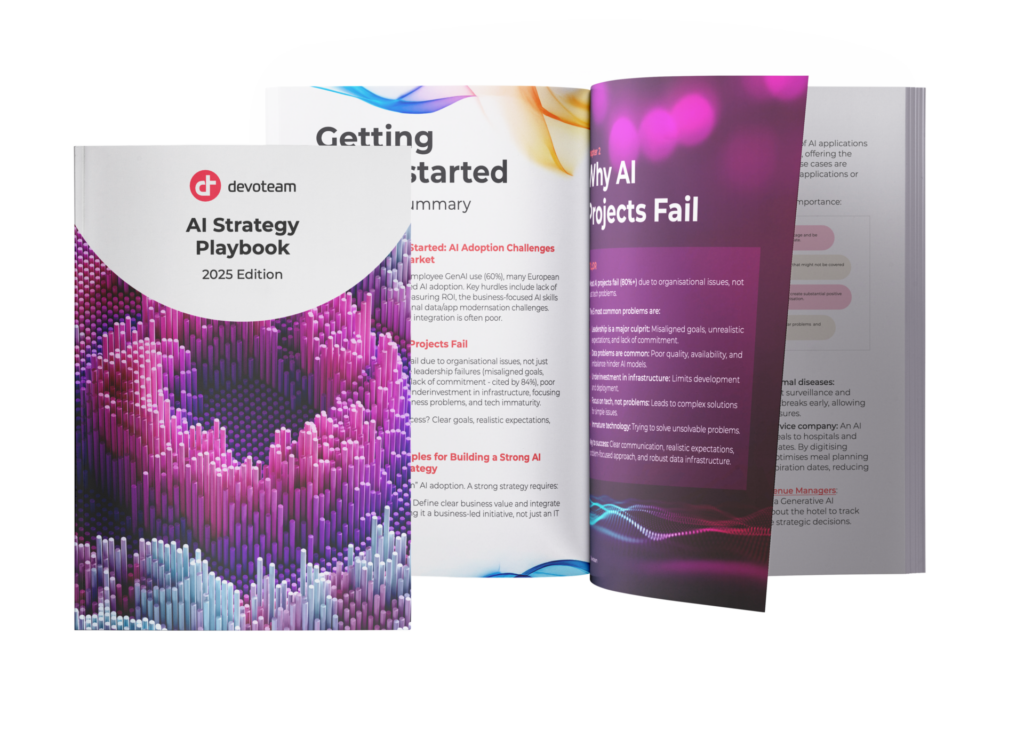
Download our AI Strategy Playbook:
- Learn why AI projects often fail (and how to avoid it).
- Follow 10 clear steps for a strong AI plan.
- Focus on solving business problems (not just using AI).
- Find the best AI uses for your business (includes 100+ examples).
- Learn how to measure AI results (GenAI projects average ~3.7x return).
- Get your tech foundations ready (Cloud, Data, and AI Security).
- Help your team adapt to AI (and see how we train our staff).
- Use AI responsibly (covering fairness, bias, and environmental thoughts).