

According to MarketsandMarkets™, the global Artificial Intelligence market is projected to grow from $371.71 billion in 2025 to a staggering $2,407.02 billion by 2032, at a CAGR of 30.6%. This growth shows that adopting AI is no longer optional. Databricks AI, a unified data & AI platform, leads this change, helping organisations use all their data to make smart decisions and innovate. This article will explore the core features of Databricks for AI and Machine Learning (ML). And its capabilities for building AI agents, and practical applications that are driving impact.
Core Concepts and Components: The Databricks AI and ML Ecosystem
Databricks AI offers features that simplify and accelerate the entire ML lifecycle, from data preparation to model deployment and monitoring. Built on the Lakehouse architecture, it provides a single, open, and unified foundation for all data, analytics, and AI workloads. This ensures data reliability, security, and performance.
Key features of Databricks AI and ML include:
- Unified Platform: Databricks consolidates data engineering, data analysis, data science, and machine learning within a single environment. This eliminates data silos and streamlines collaboration across teams, fostering a more agile and efficient development process. Expect UI for business users coming soon.
- MLflow Integration: MLflow is an open-source platform for managing the end-to-end machine learning lifecycle. Databricks natively integrates with MLflow, allowing users to track experiments, manage models, and reproduce results with ease. This is crucial for maintaining governance and ensuring the explainability of Databricks AI models.
- Automated Machine Learning (AutoML): Databricks offers AutoML capabilities that automate the most time-consuming aspects of ML, such as hyperparameter tuning. This allows data scientists to accelerate their development cycles and get results faster, regardless of the scale of their data.
- Feature Store: The Databricks Feature Store acts as a centralised repository for managing and discovering features, promoting their reuse and consistency across different models. This enhances model accuracy and reduces development time.
- Scalability and Performance: Leveraging Apache Spark™, Databricks can process massive datasets and scale effortlessly from small to big data. This ensures that your Databricks AI and ML initiatives are not limited by computational constraints.
- Real-time Capabilities: Databricks supports capturing and processing real-time data streams, enabling instant insights and actions for applications requiring low-latency decision-making.
How Databricks AI Helps to Build AI Agents, Including Databricks Generative AI
The emergence of generative AI is transforming how businesses interact with data and automate tasks. Databricks’ generative AI capabilities empower organisations to build AI agents. These agents can perform tasks beyond traditional language generation, including data retrieval, code execution, and workflow automation.
Databricks provides multiple ways for creating Databricks AI agents:
- AI Builder (No-Code): AI Builder helps business users. It offers a simple, no-code way to build AI agent systems. Citizen data scientists can also optimise these systems. They can create domain-specific solutions. This includes customer service automation. Moreover, it also covers internal knowledge management. Finally, it helps with data analysis and reporting.
- Mosaic AI Agent Framework and MLflow (Code-Based): Allows data scientists and developers to build enterprise-ready agents in Python. Databricks supports integration with popular third-party agent authoring libraries like LangGraph/LangChain and LlamaIndex for building Databricks AI solutions.
- AI Playground: This interactive environment allows users to prototype tool-calling agents with a low-code UI. They can select from various Large Language Models (LLMs), and quickly add tools to test their responses before exporting them to code for deployment as Databricks generative AI agents.
- Unity Catalog for Agent Tools: Databricks leverages Unity Catalog to manage and register AI agent tools. This ensures centralised governance, discoverability, and reuse of functions. These functions enable Databricks AI agents to interact with structured and unstructured data. They can also call external APIs and execute custom code.
Organisations can build intelligent customer service agents. They can also create internal tools that automate financial reporting and content generation. Databricks generative AI powers all these features.
7 Practical Applications and Use Cases
You can use Databricks AI and Databricks generative AI in many ways across different industries.
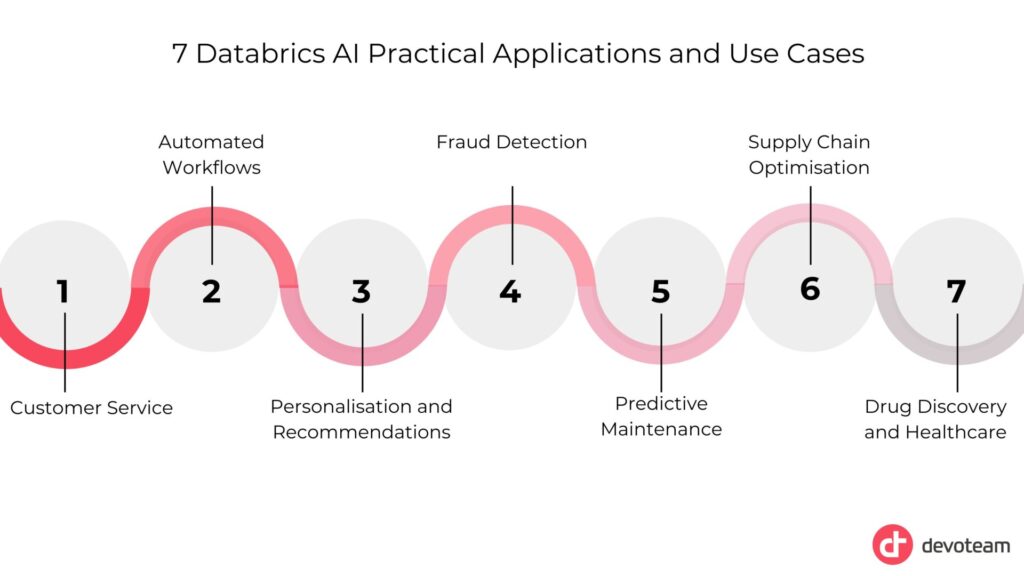
- Customer Service: Deploy AI-powered chatbots capable of resolving complex customer inquiries, leading to higher operational efficiency and improved customer satisfaction.
- Automated Workflows: Streamline and automate complex business processes, from document generation and data entry to advanced data analysis and report creation.
- Personalisation and Recommendations: Build sophisticated recommendation engines for e-commerce, content streaming, and other platforms, delivering highly personalised user experiences.
- Fraud Detection: Leverage ML models to identify and prevent fraudulent activities in real-time, protecting financial institutions and their customers.
- Predictive Maintenance: Analyse sensor data to predict equipment failures, enabling proactive maintenance and minimising costly downtime in manufacturing and energy sectors.
- Supply Chain Optimisation: Optimise logistics, inventory management, and demand forecasting through data-driven insights, leading to more resilient and efficient supply chains.
- Drug Discovery and Healthcare: Accelerate drug discovery processes, analyse patient data for more accurate diagnoses, and streamline administrative tasks in the healthcare industry.
Leading companies like Asics, Philips, and Shell are already leveraging Databricks to drive innovation and achieve significant business outcomes, showcasing the platform’s transformative potential for Databricks AI.
Partner with Devoteam for Databricks AI-Driven Innovation
AI is a driver of business growth, and the ability to leverage data effectively for intelligent solutions is essential. Databricks AI offers an open and secure unified platform that allows you to build, deploy, and manage AI/ML apps, including Databricks’ generative AI.
At Devoteam, as an Elite Databricks Consulting Partner, we understand the complexities of executing and scaling Databricks AI initiatives. With EMEA-wide coverage and over 1,000 data experts, including 10 Databricks Champions and 200+ Databricks certifications, we bring deep expertise and a business-first approach to accelerate your data and AI journey. From initial strategy and data architecture to cloud-native platform implementation, data migration, and ongoing optimisation, Devoteam provides an end-to-end experience designed to turn your data into a tangible business impact. We don’t just implement; we accelerate.
Drive innovation with Databricks AI and ML today. Contact our experts to discuss your specific needs and find the right solution for your business.
Explore our status as a Databricks Elite Partner for more detailed insights into why Databricks is a leading platform.

Ready to transform your data into a strategic asset for analytics, AI, and sustained business success?
Build a future-proof data foundation with Devoteam, the #1 Data Consulting Partner in EMEA.
- Leverage our 1,000+ certified experts,
- proven end-to-end capabilities across strategy, governance, and modern cloud platforms (AWS, Azure, GCP, Snowflake, Databricks), and
- our relentless focus on turning data insights into measurable business impact