


Estimated reading time: 7 minutes
The question facing technology leaders in 2025 is no longer if they should adopt AI. It is how to realise its true organisational value. While adoption is now almost universal, many are finding that initial productivity gains are failing to translate into systemic, bottom-line impact.
The latest DORA Report, The 2025 State of AI-assisted Software Development, provides a data-backed explanation for this challenge. In parallel, Google’s announcement of Gemini Enterprise offers a strategic platform designed to solve the systemic problems DORA identifies. Together, these developments provide a clear-eyed view of the AI landscape and a path forward.
While it’s important to note that the DORA research group is part of Google Cloud, its findings are the result of rigorous, independent analysis. This year’s report draws on survey responses from nearly 5,000 global technology professionals. It delivers a critical, industry-wide reality check on AI adoption.
This article synthesises these insights, offering a roadmap for leaders aiming to move beyond isolated experiments by connecting DORA’s research to the architectural solutions offered by Google’s launch of Gemini Enterprise.
DORA 2025 Report Findings
Let’s start with an overview of the key findings from the DORA 2025 report, before we look deeper into each conclusion.
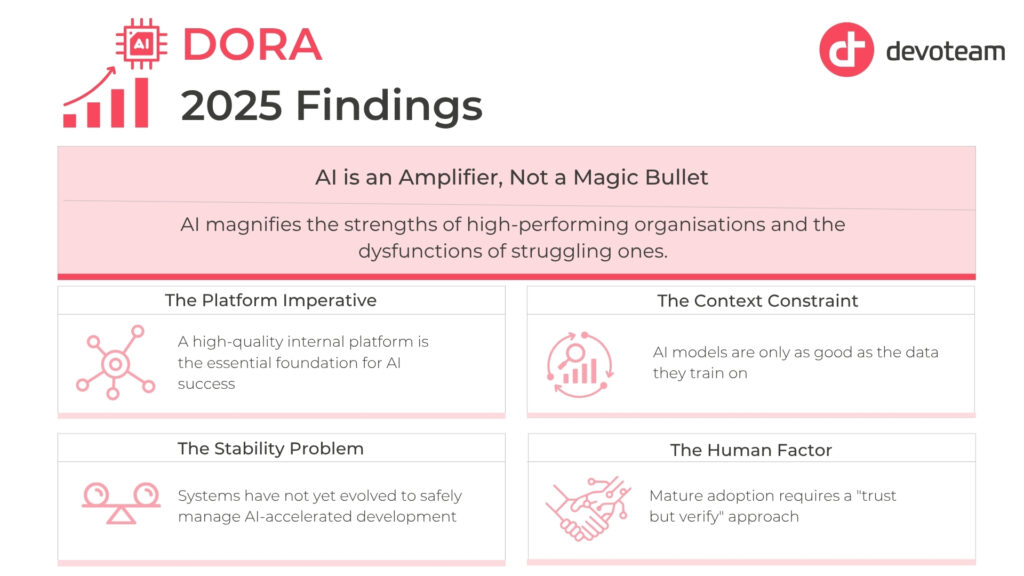
1. AI is an Amplifier, Not a Magic Bullet
The key conclusion from the 2025 DORA report is a simple but profound statement: AI’s primary role in software development is that of an amplifier. It magnifies the strengths of high-performing organisations and the dysfunctions of struggling ones.
The report firmly asserts that successful AI adoption is a systems problem, not a tools problem. Without a strong organisational foundation, AI risks creating “localised pockets of productivity that are often lost to downstream chaos.” The greatest returns, therefore, come not from the tools themselves, but from a strategic focus on the underlying system. These include the quality of the internal platform, the clarity of workflows, and the alignment of teams.
2. The Systemic Challenges: Why AI Fails to Scale
The DORA findings reveal why many organisations’ AI ambitions are stalling. While 90% of respondents report using AI at work—with 40% using it daily—the benefits are often contained. The report identifies several foundational prerequisites that are essential for scaling AI successfully.
- The Platform Imperative: While platform engineering adoption is now near-universal (90%), DORA stresses that a high-quality internal platform is the “essential foundation for AI success.” A poor developer experience and fragmented tooling will invariably hamper the impact of an AI strategy. In fact, the report finds that organisations with high-quality platforms are 2.1 times more likely to achieve high organisational performance. When platform quality is low, AI adoption has a negligible effect.
- The Context Constraint: AI’s effectiveness is critically amplified when its models are grounded in an organisation’s unique knowledge base. DORA finds that the positive influence of AI on effectiveness and code quality multiplies when tools have access to internal data sources. As the conventional wisdom states: “AI models are only as good as the data they train on.”
- The Stability Problem: Crucially, DORA research reveals that not all AI-driven activity is productive. While AI adoption improves software delivery throughput, it still increases delivery instability. This creates a scenario of “unproductive productivity,” where teams ship code faster, but that code is more likely to cause failures, requiring rollbacks and fixes. This suggests underlying systems “have not yet evolved to safely manage AI-accelerated development”—a significant risk for any enterprise.
- The Human Factor: Technology is only half the story. A significant trust gap remains, with 30% of developers reporting little to no trust in AI-generated code. However, the report also shows that AI is successfully shifting developer time toward higher-value work. AI adoption is associated with developers being 13% more likely to spend more time on system design and 22% more likely to spend more time on user research. Mature adoption requires a “trust but verify” approach, demanding new skills in critical evaluation and validation.
Gemini Enterprise: A Complete Platform for Systemic Transformation
Google’s response to these fundamental challenges is Gemini Enterprise, positioned not merely as a set of AI models, but as “the new front door for AI in the workplace.” As Google Cloud CEO Thomas Kurian notes, true AI value requires moving “beyond simple chatbots” to a platform that connects to your context, workflows, and your people.
Kurian’s critique of a piecemeal approach directly echoes DORA’s findings: “Some companies offer AI models and toolkits, but they are handing you the pieces, not the platform… You cannot piece together a transformation.”
Gemini Enterprise is designed to be the unified AI fabric that addresses DORA’s findings head-on by unifying six core components: Google’s most advanced Gemini models, a no-code workbench for custom agents, a taskforce of pre-built Google agents, secure data connectors, a central governance framework, and an open ecosystem of partners.
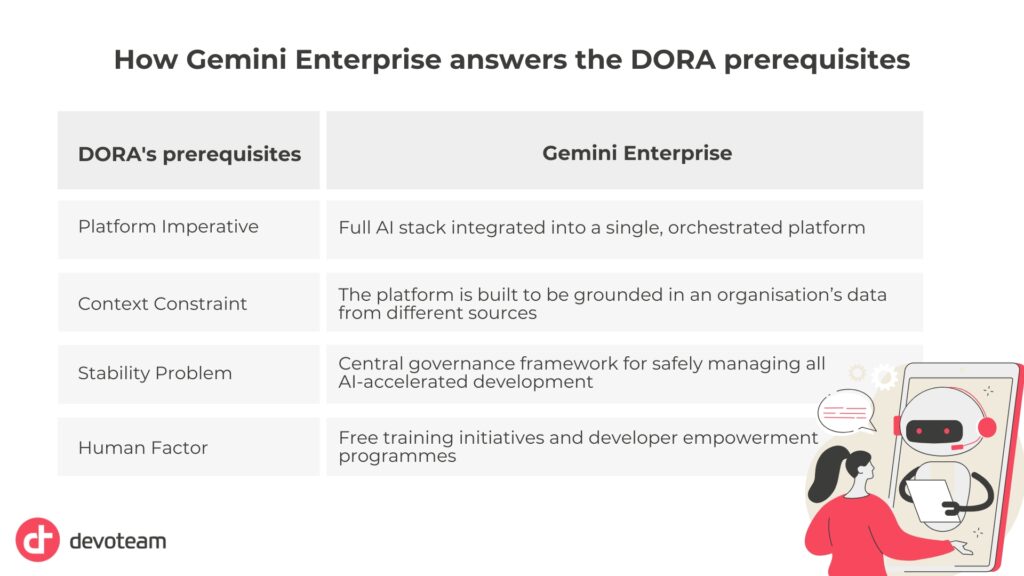
Let’s investigate how Gemini Enterprise helps companies to overcome challenges identified by DORA 2025:
- Fulfilling the Platform Imperative: It delivers the high-quality, AI-optimised system DORA identifies as essential. By integrating the full AI stack—from purpose-built infrastructure (TPUs) to world-class Gemini models—into a single, orchestrated platform, it provides the “distribution and governance layer” needed to scale individual gains into systemic improvements.
- Solving the Context Constraint: The platform is built to be grounded in an organisation’s specific information. It securely connects to a vast array of enterprise data sources—including Google Workspace, Microsoft 365, Salesforce, and SAP—wherever they reside. To further improve data health, the new Data Science Agent automates data wrangling and ingestion, helping to streamline model development and remove friction. This allows agents to be grounded with internal context, delivering more relevant, accurate, and trustworthy results.
- Managing the Stability Problem: The platform provides a central governance framework that is essential for safely managing AI-accelerated development. This allows organisations to set policies, manage agent access, and audit all agents from one place, providing the stability needed to scale AI without introducing unacceptable risk.
- Enabling the Human Factor: Google is addressing the need for upskilling with initiatives like Google Skills, a free training platform, and the Gemini Enterprise Agent Ready (GEAR) program, which aims to empower one million developers to build and deploy agents. This aligns directly with DORA’s call to develop “trust but verify” skills and empower developers to focus on high-value work.
Conclusion: A Platform for Realising Systemic AI Value
The convergence of the DORA 2025 research and the Gemini Enterprise announcement presents a compelling thesis for the future of enterprise AI. To surface a new form of organisational value, leaders must shift focus from simply adopting tools to redesigning the systems that surround them.
DORA establishes that organisational transformation is an essential prerequisite for success. Gemini Enterprise provides the comprehensive architectural answer to this research-backed roadmap. By providing a complete, AI-optimised platform, it offers the stability, context, and governance required to amplify AI’s benefits safely and at scale. Ultimately, the lesson for technology leaders is that the full potential of AI cannot be realised in a vacuum. As DORA concludes, the future value of AI hinges not on the technology itself, but on “reimagining the system of work it inhabits.” Gemini Enterprise is the integrated mechanism built to facilitate that necessary reimagining.

Ready to Move from AI Experiments to Enterprise Transformation?
Contact our experts and see how you can overcome the AI challenges identified in DORA report with Gemini Enterprise.