

Written as part of our AI Upskilling Program
This article was created as part of the Global Devoteam AI Upskilling Program, where employees share their knowledge to accelerate their learning. The program’s key objective is to provide a foundation in AI for every employee and apply these new skills in our work. Do you want to work with us? Check out our career opportunities.
As AI advances from conversational chatbots to more autonomous agents, a standardised framework is essential to govern how these systems interact with external tools and data. Acting as a ‘virtual operating system’ for AI, Model Context Protocol (MCP) gives models a clear map of available tools and the rules for using them. It transforms passive models that only talk into capable agents that can perform real-world tasks. For businesses, this protocol provides the essential control, safety, and scalability to deploy intelligent systems that don’t just answer questions, but get things done.
What you’ll read in this article:
- 1. AI Agents & the Agentic Gap
- 2. What is Model Context Protocol (MCP)?
- 3. How Model Context Protocol (MCP ) Works: A Technical Look
- 4. MCP in the Ecosystem: Comparisons and Trade-offs
- 5. The Enterprise Advantage: Why a Protocol Matters
- Agentic AI Needs a Standard – Will that be Model Context Protocol (MCP)?
1. AI Agents & the Agentic Gap
Imagine an AI that doesn’t just talk, but thinks, plans, and acts. This is the promise of AI agents. They are systems that move beyond generating text to actually getting things done. Whether it’s scheduling a meeting, analysing sales data, or coordinating logistics, an agent operates by receiving a goal, reasoning about the necessary steps, and taking action by interacting with its environment—calling external services, querying databases, or triggering automated workflows.
An agent typically:
- Receives input (e.g., from users, sensors, APIs)
- Processes the input using reasoning or learned models
- Acts on its environment (e.g., sending a message, calling an API, controlling a device)
It is also good to note that AI Agents differ from traditional software. Traditional software follows a fixed script. AI Agents are goal-driven, often adaptive, and may interact with their environment in real time. It is exactly this capability to act that creates a challenge we can call the Agentic Gap.
The Large Language Models (LLMs) at the core of these agents are brilliant reasoners, but they are isolated by design. They are text-in, text-out systems operating in a “black box,” with no innate knowledge of which tools are available, what specific APIs to call, or what permissions they have.
Connecting a model directly to company systems without a strict protocol is both unreliable and insecure. The model might hallucinate a command for a tool that doesn’t exist or misuse one that does. This gap between a model’s powerful reasoning and its lack of controlled, real-world context is the single biggest barrier to deploying autonomous AI safely and effectively in enterprise environments.
2. What is Model Context Protocol (MCP)?
To solve the Agentic Gap, AI systems require a consistent and secure protocol to interact with the outside world. This is the purpose of the Model Context Protocol (MCP). The most effective way to understand it is to think of MCP as the Operating System (OS) for agentic AI. Just as a computer’s OS manages how applications access hardware like printers and storage, MCP aims to standardise how AI models (especially LLMs) accesses and uses external tools, APIs, and data sources.
Example: MCP would let an AI agent plug into databases, APIs, or knowledge bases consistently, giving the model the context it needs to respond accurately and perform tasks.
Designed by Anthropic, MCP is a protocol that aims to standardise these interactions. It provides the model with a structured, real-time context—a clear “map” of its environment. This context explicitly tells the model:
- What tools are available (e.g., APIs, databases).
- What actions it is permitted to perform.
- What information it has access to.
- How to execute those actions in a controlled way.

Model Context Protocol is a framework that allows AI models to understand and interact with the tools, data, and environment around them.

Mohamed Elrokh
Data & Integration Consultant
By providing this structured knowledge, MCP acts as the crucial interface layer that bridges the gap between an LLM’s isolated reasoning and the complexity of the real world. It solves the “isolation problem” by giving a powerful but context-blind model the awareness it needs to become a capable, reliable agent. As AI agents grow in complexity, this OS-like framework is what turns them from clever responders into true collaborators.
3. How Model Context Protocol (MCP) Works: A Technical Look
Conceptually, MCP acts as an OS. Technically, it operates through a defined data structure and a clear workflow. To understand how MCP enables an agent to act, we need to look at two core components: the structure of the context provided to the model, and the operational flow that uses this context to execute tasks.
At the heart of MCP is a machine-readable “context” document, typically formatted in JSON. This payload is sent along with the user’s prompt to the LLM. It is a dynamic instruction manual that tells the model what its capabilities and limitations are for a specific request.
This structure allows the LLM to reason accurately about whether it can and should fulfill the user’s request and exactly how to construct the necessary function call.
The operational workflow
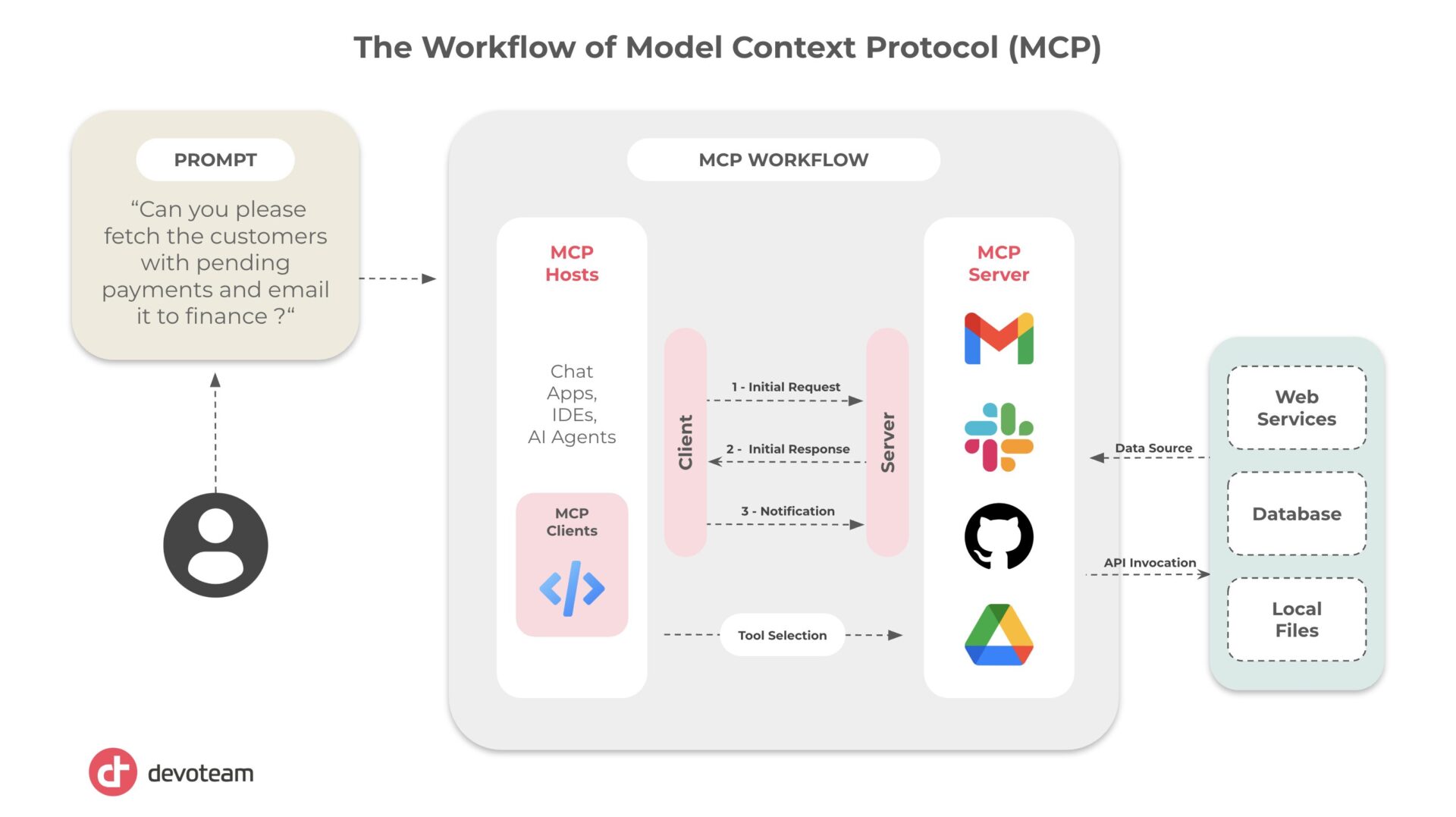
- Prompt: A user makes a request or asks a question in natural language.
- Intent Analysis (Agent Understanding): The AI agent analyses the prompt to understand the user’s underlying intent. This is where the MCP context payload is prepared.
- MCP Hosts & Clients (Request Submission): The request, now bundled with the MCP context, is submitted by an MCP Client (e.g., a chat app, IDE, or the agent itself).
- Transfer Layer (Request Routing): The Transfer Layer intelligently routes the request to the correct Data Source (e.g., Web Services, Database, Local Files) or initiates an API Invocation to relevant external Tools.
- Tool Orchestration (Action Execution): The MCP Server performs Tool Selection based on its understanding of available Capabilities (which include Tools, Resources, and Prompts) and executes the required actions.
- Response & Notification Delivery: As actions are completed, the MCP Server sends an Initial Response back through the Transfer Layer to the Client. If subsequent actions or notifications are required (e.g., for a sent email), the server also sends a Notification. The Client, in turn, handles these user-facing notifications and any final orchestration needed to present the outcome to the user.
4. MCP in the Ecosystem: Comparisons and Trade-offs
MCP does not exist in a vacuum. The agentic AI space is already populated with powerful tools, and for an engineer, understanding how MCP compares to the established players is crucial for making sound architectural decisions. MCP’s primary value is its vision of standardisation, which sets it apart from existing API features and development frameworks.
MCP vs. OpenAI Function Calling
Both tools solve a similar problem; their approach and scope differ fundamentally.
- OpenAI Function Calling is a feature tightly integrated into its API. It is a pragmatic, direct way to make OpenAI’s models use tools. You define your functions within the API call itself, and the model returns a structured JSON object if it decides a function should be called. It is powerful and easy to use, but it is specific to OpenAI’s ecosystem.
- Model Context Protocol (MCP) aims to be a model-agnostic protocol. Instead of a feature on a specific API, it is envisioned as a universal standard that any model from any provider (Anthropic, Microsoft, Google Cloud, open-source models) could adopt. Its context payload is also more comprehensive, explicitly including permissions and other constraints beyond just the function definition.
MCP vs. Agentic Frameworks (e.g., LangChain)
It’s a common misconception to see MCP and frameworks like LangChain as direct competitors. In reality, they operate at different layers of the stack.
- LangChain is a development framework, or a toolkit. It provides the “glue” for building AI applications. It offers extensive libraries, pre-built components (Chains, Agents), memory modules, and integrations to help a developer construct the logic of an agent.
- MCP is a communication protocol. It does not provide the code to build an agent’s reasoning loop; it defines the standardised rules of communication for how that agent interacts with its tools once the reasoning is complete.
Challenges and Limitations
Despite its powerful vision, adopting MCP comes with practical trade-offs and challenges that any engineering team must consider.
- Implementation Overhead: A comprehensive protocol is inherently more complex to set up than a simple API feature. Implementing MCP-compliant hosts, clients, and servers requires more initial engineering effort compared to using an existing framework’s out-of-the-box tool integration.
- Risk of Rigidity: The key strength of a standard—its stability—can also be a weakness. In a rapidly evolving field like AI, a rigid protocol might struggle to keep up with new techniques and agent architectures, potentially stifling innovation if it is too prescriptive.
- Nascent Adoption: As of mid-2025, this is the most significant challenge. MCP remains more of a conceptual framework proposed by Anthropic than a widely adopted industry standard. Today, due to their widespread use, OpenAI’s function calling and the architecture of LangChain are the de facto standards. The ultimate success of MCP hinges on broad, industry-wide adoption, which is not yet guaranteed.
5. The Enterprise Advantage: Why a Protocol Matters
Moving AI from experimental chatbots to mission-critical autonomous agents requires an industrial-grade framework built on security, scalability, and trust. While agentic frameworks prove what is possible, a standardised protocol like MCP addresses how to make it operational and safe within a corporate environment. For businesses where decisions have real-world consequences, this distinction is everything.
Security and Governance
In an enterprise, AI actions can impact financial records, customer data, and brand reputation. Uncontrolled AI is an unacceptable risk. MCP is designed with governance at its core.
- Explicit Permissions: Unlike open-ended systems, MCP requires that an agent’s permissions be explicitly defined within the context payload for each task. The model can only perform actions it is expressly allowed to, dramatically reducing the risk of unauthorised operations.
- Separation of Concerns: The protocol separates the AI’s “reasoning” from the system’s “execution.” The model can suggest an action (e.g., “call the
update_databasetool”), but a separate, auditable server component is responsible for actually executing it. This allows for final validation, logging, and control before any action is taken. - Enhanced Auditability: Because all requests and actions flow through a standardized structure, they can be logged with precision. This creates a clear audit trail essential for compliance, security reviews, and incident response.
Interoperability and Scalability
Enterprise architectures are complex and must evolve without constant, costly refactoring. Tightly coupling an agent’s logic to a single LLM or tool creates vendor lock-in and makes the system brittle.
- Model-Agnostic Design: A key advantage of a protocol is that it is model-agnostic. An organization can design its agentic workflows around MCP and then swap the underlying LLM—from OpenAI to Anthropic to an open-source model—without rebuilding the entire tool-interaction framework. This future-proofs the investment.
- Tool Abstraction: MCP abstracts tool definitions away from the core logic. As long as a tool (e.g., an internal API for a CRM) is described in the standard MCP format, the agent can use it. This makes it far easier to add, update, or replace tools and to scale the agent’s capabilities over time.
Reliability and Predictability
Systems built on complex, ad-hoc prompts to guide a model are often fragile. A minor update to the LLM or a slight variation in user phrasing can break the logic, leading to unpredictable failures. Enterprises require systems that are robust and dependable.
- Structured Communication: MCP replaces brittle prompt engineering with explicit, machine-readable instructions. The model is not being “tricked” into generating a function call; it is being formally instructed with a clear definition of the tool, its parameters, and its purpose. This leads to far more consistent behaviour.
- Predictable Failure Modes: When an action in an MCP-based system fails, it does so predictably (e.g., “permission denied,” “invalid parameters”). This is a stark contrast to a prompt-based chain that might fail silently or by generating a plausible-sounding but incorrect text response. This predictability makes the entire system easier to debug, monitor, and maintain.
Agentic AI Needs a Standard – Will that be Model Context Protocol (MCP)?
Proving that AI agents can work is no longer necessary. Now, they must work safely and reliably at an enterprise scale. This requires moving beyond development frameworks to a true communication protocol.
The Model Context Protocol (MCP) provides this essential layer of governance, offering the security, interoperability, and predictability that businesses demand. By standardising how agents interact with tools, MCP lays the foundation for a future where AI is not just a clever experiment, but a trusted and indispensable part of the enterprise technology stack. Just as cloud computing unlocked distributed apps, MCP unlocks distributed intelligence — turning models into collaborators, not just responders.
Once you understand the protocol, learn the next steps in our guide on how to deploy a secure MCP server.
Over 80% of AI projects fail. Yours don’t have to.
Download our AI Strategy Playbook:
- Learn why AI projects often fail (and how to avoid it).
- Follow 10 clear steps for a strong AI plan.
- Focus on solving business problems (not just using AI).
- Find the best AI uses for your business (includes 100+ examples).
- Learn how to measure AI results (GenAI projects average ~3.7x return).
- Get your tech foundations ready (Cloud, Data, and AI Security).
- Help your team adapt to AI (and see how we train our staff).
- Use AI responsibly (covering fairness, bias, and environmental thoughts).