



The other day, I was driving home when a song came on the radio. It was a surprisingly catchy blues-rock track with a gravelly female vocal, a gritty guitar and a title that stuck with me: “Keep Your Distance, Sugar (feat. Bertha Mae Lightning).” It had all the hallmarks of a forgotten gem from a bygone era. Curious, I looked it up later that evening. There was no Bertha Mae Lightning. There was no band. The song, the artist, the entire backstory – all of it was generated by an AI. The unsettling feeling wasn’t that the song was bad; it was that it was good enough to be unremarkable, to blend in seamlessly with the real thing.
This experience reflects a much broader phenomenon. The gradual and often unnoticed spread of AI-generated content, or “slop,” into our digital lives is no longer a future-tense problem. It’s here. And while AI music is one thing, the implications for my own discipline-software engineering, are far more profound. We are architects and developers who have spent our careers championing the principles of “clean code,” craftsmanship and sustainable software. We’ve fought against technical debt, advocating for clarity and long-term maintainability.
So, how do we navigate a world where a significant portion of the code being written is generated by machines that, like my phantom blues singer, might sound right but lack genuine substance? This is more than a technical issue; failing to address it puts us on a direct path to technical bankruptcy.
The Genesis of Noise
Defining “AI Slop” and “Model Collapse”
To effectively combat the rising tide of AI-generated Slop, we first need a clear understanding of its principles and the scale at which it operates. This is the essential “know thy enemy” briefing for technical leaders. The problem isn’t just about a few poorly written functions; it’s a systemic issue rooted in the very nature of how current generative models learn and propagate information.
Understanding “Model Collapse”
The term that captures this degenerative process is model collapse. One research published in Nature defines it as a phenomenon where AI models, trained recursively on their own output, begin to forget the richness and diversity of original, human-generated data. It’s a feedback loop with diminishing returns, where each generation of the model becomes a slightly blurrier, less accurate copy of the last.
The key symptoms of this process are alarming:
- Irreversible defects accumulate as the model learns from its own flawed projections of reality.
- The “tails of the original content distribution disappear,” meaning the model forgets rare, improbable, but often critical information and edge cases.
- Models begin to “misperceive reality,” producing outputs that no longer resemble the original data and may even become confusing or illogical.
This decay is caused by three compounding issues: statistical errors from limited data, constraints in what the model can represent, and approximations introduced during learning.
Practical Reality: A Digital Ecosystem Flooded with Synthetic Content
This theoretical concept has become a practical reality with remarkable speed. The internet, the primary training ground for future models, is flooded with synthetic content. The scale of this transformation is best understood through a few key statistics:
- 90%: The estimated portion of online content will be AI-generated by 2026 (Source: Parseur).
- 74.2%: The percentage of newly created webpages in April 2025 that contained some AI-generated text (Source: WINSS).
- 1,271: The number of AI-driven “news” sites as of May 2025, up from just 49 two years prior (Source: WINSS).
This flood of machine-generated text, code, and media isn’t just a technical curiosity; it has tangible, and often dangerous, consequences for society and our profession.
The Societal Ripple Effect: When AI Slop Erodes Trust
Model collapse isn’t just a theoretical concern. It undermines public trust and can have serious real-world consequences, especially in high-stakes areas where accuracy and nuance matter most.
A hypothetical telehealth case study from WINSS vividly illustrates this danger. Imagine a clinical AI designed to help triage patients and draft visit notes.
- Generation 0 (Gen-0), trained on 100% human-authored clinical data, accurately identifies the red flags for a rare but serious postpartum hypertensive disorder. It prompts an immediate in-person evaluation, and the patient receives timely care.
- Generation 1 (Gen-1) is retrained on a dataset now polluted with its own increasingly generic notes. When faced with the same patient, it defaults to a generic “headache” script, suggesting hydration and rest. Critical time is lost before a human escalates the case.
- Generation 2 (Gen-2), trained on even more of its own synthetic output, has forgotten the rare condition almost entirely. It misdiagnoses the situation as a “migraine-like headache” and recommends a routine follow-up in 24-48 hours, leading to a dangerously delayed escalation.
The data from this case study quantifies the degradation in obvious terms. Over just two generations of recursive training, the accurate triage rate for rare, high-risk conditions plummeted from 85% to a mere 38%. This isn’t just a model becoming less helpful; it’s a model becoming actively harmful. This erosion of specialised knowledge is precisely what we now face as software developers.
In the Trenches
The Developer’s Dilemma
For software architects and developers, the rise of AI Slop presents a series of professional paradoxes that strike at the heart of our long-held principles and best practices of software development. The “disappearing tails” described in the Nature paper aren’t just a statistical anomaly; for open-source maintainers, it’s the lived experience of watching niche, hard-won solutions get buried under a mountain of generic, low-quality pull requests. We are being asked to balance unprecedented productivity gains against a subtle but significant decay in quality, security and understanding.
The Paradox of Productivity: Faster Output, Lower Quality
There is no denying the productivity benefits. A PwC report found that productivity growth in industries exposed to AI has nearly quadrupled. However, this speed comes at a cost. A critical 2025 study published on arXiv revealed a troubling paradox: programmers using AI assistants can produce less secure code while simultaneously showing greater confidence in its security. We are moving faster, but we may be moving faster towards a cliff.
More Code, Less Understanding: The Technical Debt Machine
The tangible impact on codebases is already becoming clear. The same arXiv study found that AI-generated code often suffers from high cognitive complexity and redundancy. It’s what one YouTube creator describes as a “gigantic just soup of crappy code” that inevitably becomes a “nightmare to actually maintain.”
For an architect, this is the sound of a ticking time bomb. The AI generates liability for free. My teams will pay the price, with interest, for years to come. Every unclear or overly complex line of code immediately builds technical debt, raising systemic risk with each change.
The Open-Source Crisis: When Contributions Become a Burden
Nowhere is this dilemma more acute than in the open-source community. Maintainers of critical projects are being flooded with low-quality, AI-generated pull requests (“AI Slop PRs”). The effort has become so overwhelming that major projects like TL Draw and Curl have been forced to close down or severely restrict external contributions. It’s not just a matter of rejecting bad code. It’s a draining, often thankless job, sorting through it while facing the stream of unbelievable things people throw at you. Maintainers are the ones “stuck with the actual project,” burning out under the weight of this low-effort noise.
Mitchell Hashimoto, a respected figure in the open-source world, captured the sentiment perfectly:
“If you took a list of PRs today and showed it to me 5 years ago without any context, I’d think that somehow everyone got learning disabilities”
This flood of low-effort, low-quality contributions drains maintainers’ limited time and energy, turning what should be a collaborative ecosystem into a heavy burden
The Evolving Role: From Architect to Guardian of Quality
These challenges are forcing a fundamental shift in my own role and that of my peers. In an age of infinite, machine-generated code, our primary function is becoming less about pure system design and more about acting as stringent guardians of quality, security and long-term viability. We are the last line of defence against the systemic risks introduced by automated mediocrity.
The market is already responding to the demand for quality that’s guaranteed by humans. Discussions among experienced developers reveal that clients in high-stakes sectors like aerospace and government are beginning to add explicit “no AI tools” clauses to their contracts. They are willing to pay a premium for the assurance that a human expert has crafted and vetted every line of code, especially for non-functional requirements that AI simply cannot grasp. This shift has profound implications for how businesses must now approach software development.
The Business Bottom Line
When Volume Overwhelms Value
The technical challenges and professional paradoxes spawned by AI Slop translate directly into significant business risks. These aren’t abstract concerns for engineers to debate; they manifest hidden costs, brand damage and new governance challenges that directly impact a company’s bottom line.
The Hidden Costs of “Free” Code
A comprehensive SonarQube analysis of AI-generated Java code, detailed in the arXiv study, reveals a hidden cost explosion lurking beneath the surface of functional code. Even when the code passes unit tests, it consistently contains a dangerous mix of defects:
• Bugs: Between 5-8% of all issues are functional bugs. A significant portion of these are severe enough to be classified as ‘BLOCKER’, representing defects that can halt application functionality. That isn’t a statistic; it’s a future service outage and a direct hit to our brand’s reputation.
• Vulnerabilities: Approximately 2% of issues are security vulnerabilities. Disturbingly, a high percentage of these are rated ‘BLOCKER’ or ‘CRITICAL’, including fundamental flaws like hard-coded passwords and path traversal vulnerabilities. That 2% isn’t a rounding error; it’s a future data breach waiting to happen.
• Code Smells: The vast majority-over 90%-of issues are code smells. While not direct bugs, these indicators of poor implementation directly translate into higher maintenance costs, increased complexity and the relentless accumulation of technical debt.
This defect profile underscores the absolute necessity of integrating both Static Application Security Testing (SAST) and Software Composition Analysis (SCA) into any CI/CD pipeline that utilises AI-generated code.
Credibility Erosion and Brand Dilution
Releasing products built on low-quality AI outputs is a guaranteed way to harm your brand and lose customer trust. Consumers are increasingly rejecting ‘slop graphics’ and other subpar AI content. This sentiment extends to software. As the telehealth example demonstrates, when a system’s reliability degrades, so does the user’s trust. A buggy, insecure, or simply nonsensical product reflects poorly on the brand behind it, regardless of how quickly it was produced.
The Governance and Regulatory Imperative
Proactive governance is no longer a “nice-to-have” but a critical business function. The emerging regulatory landscape is beginning to mandate accountability and human oversight for AI systems. Frameworks like the EU AI Act and the NIST AI Risk Management Framework are setting new standards that explicitly require human involvement in high-risk applications. Ignoring this shift is not just a technical failure, it’s a compliance risk that can lead to significant penalties. Navigating these technical, financial and regulatory challenges requires a strategic, multi-layered approach for both individual practitioners and the organisations they serve.
Charting a Course
A Survival Guide for the Age of Slop
While the challenges are significant, they are not insurmountable. For those of us willing to lead with a clear strategy based on craftsmanship, verification and intelligent human oversight, this threat can be transformed into a powerful competitive advantage. The future belongs not to those who automate indiscriminately, but to those who blend machine scale with human skill. Here is how we will lead.
For Developers and Architects: Embrace the “Artisanal Coding” Renaissance
As reported in WebProNews, a counter-movement celebrating “artisanal coding” is emerging as a potent market differentiator. This isn’t a rejection of AI, but a re-centring of the developer’s role as a master craftsperson. It is a source of professional pride and our most defensible skill.
The directive is clear: use AI as a powerful assistant, not a replacement. Let it handle the boilerplate, the repetitive tasks and the initial drafts. But focus your uniquely human energy on the areas where ingenuity provides the most value: high-level architecture, complex logic-building and the meticulous refinement of machine-generated output. As one developer advised, when faced with an opportunity to contribute:
“Learn the changes they want and try to handcraft something excellent because it’s your chance to actually refine a skill.”
This mindset transforms you from a mere prompter into a true artisan, whose work commands a premium.
For Software Companies: Build a “Human-in-the-Loop” Fortress
For organisations, the most resilient strategy is to build a Human-in-the-Loop (HITL) fortress. This means embedding human judgment, oversight and verification into the very architecture of your development process. HITL is not a bottleneck, it is a core design principle for building trustworthy and sustainable systems.
| Strategy | Actionable Mandates |
| Data Provenance | Preserve a “real anchor” slice of human-authored data (at least 10-25%) in all retraining cycles to prevent model collapse. Actively license verified, high-quality human data. |
| Process & Tooling | Mandate the integration of rigorous, automated static analysis (SAST) and Software Composition Analysis (SCA) into the CI/CD pipeline for all code, with stricter rules for AI-generated contributions. |
| People & Culture | Evolve roles from simple coders to strategic “AI Supervisors” and “Algorithm Ethics Officers.” Invest in training teams how to think with machines, not just use them. |
| Market Positioning | Market your commitment to human oversight as a brand differentiator. Use phrases like “Human-Verified AI” to build customer trust and create a competitive advantage. |
Conclusion
Beyond Automation, a Renewed Call for Craftsmanship
Artificial intelligence is a genuinely transformative tool, one that offers unprecedented gains in productivity and scale. However, its effectiveness and long-term viability are entirely dependent on a renewed commitment to the foundational principles of software craftsmanship. The rise of AI-generated Slop isn’t a failure of technology, it’s a strong reminder of the essential role of human oversight, critical thinking, and disciplined engineering.
The deceptive melody of “Bertha Mae Lightning” that filled my car that night is a perfect metaphor for the AI-generated code filling our repositories. It can sound right, it can feel authentic, but without human discernment, we can’t tell the masterpiece from the manufactured. Functional correctness is not the same as production-readiness, just as a convincing tune is not the same as true artistry.
The future of software development will not be defined by the companies that automate the most, but by those who most skillfully blend machine efficiency with human judgment, ethics and a relentless pursuit of quality. Our role as architects has never been more critical, not just as designers of systems but as the final arbiters of excellence in an age of automated mediocrity. This is our mission.
Cited References
- AI models collapse when trained on recursively generated data – https://www.nature.com/articles/s41586-024-07566-y
- A Hybrid Future For AI And Humans – https://parseur.com/blog/future-of-hitl-ai
- AI Model Collapse Risk in 2025: How Recursive Training on AI‑Generated Data Harms Telehealth and LLMs – https://www.winssolutions.org/ai-model-collapse-2025-recursive-training
- Assessing the Quality and Security of AI-Generated Code: A Quantitative Analysis – https://arxiv.org/pdf/2508.14727
- “Please stop” – maintainers – https://www.youtube.com/watch?v=uZy1M_s-8zs
- Artisanal Coding Renaissance: Human Craft vs. AI Automation – https://www.webpronews.com/artisanal-coding-renaissance-human-craft-vs-ai-automation
Other Recommended References
- YouTube – AI Slop Is Destroying the Internet – https://www.youtube.com/watch?v=_zfN9wnPvU0
- YouTube – The Problem with A.I. Slop! – Computerphile – https://youtu.be/vrTrOCQZoQE
- YouTube – AI Slop: Last Week Tonight with John Oliver (HBO) – https://youtu.be/TWpg1RmzAbc
- Wikipedia – AI Slop – https://en.wikipedia.org/wiki/AI_slop
- Wikipedia – Slop squatting – https://en.wikipedia.org/wiki/Slopsquatting
Gartner predicts that by 2028, 15% of day-to-day work decisions will be made autonomously by AI agents
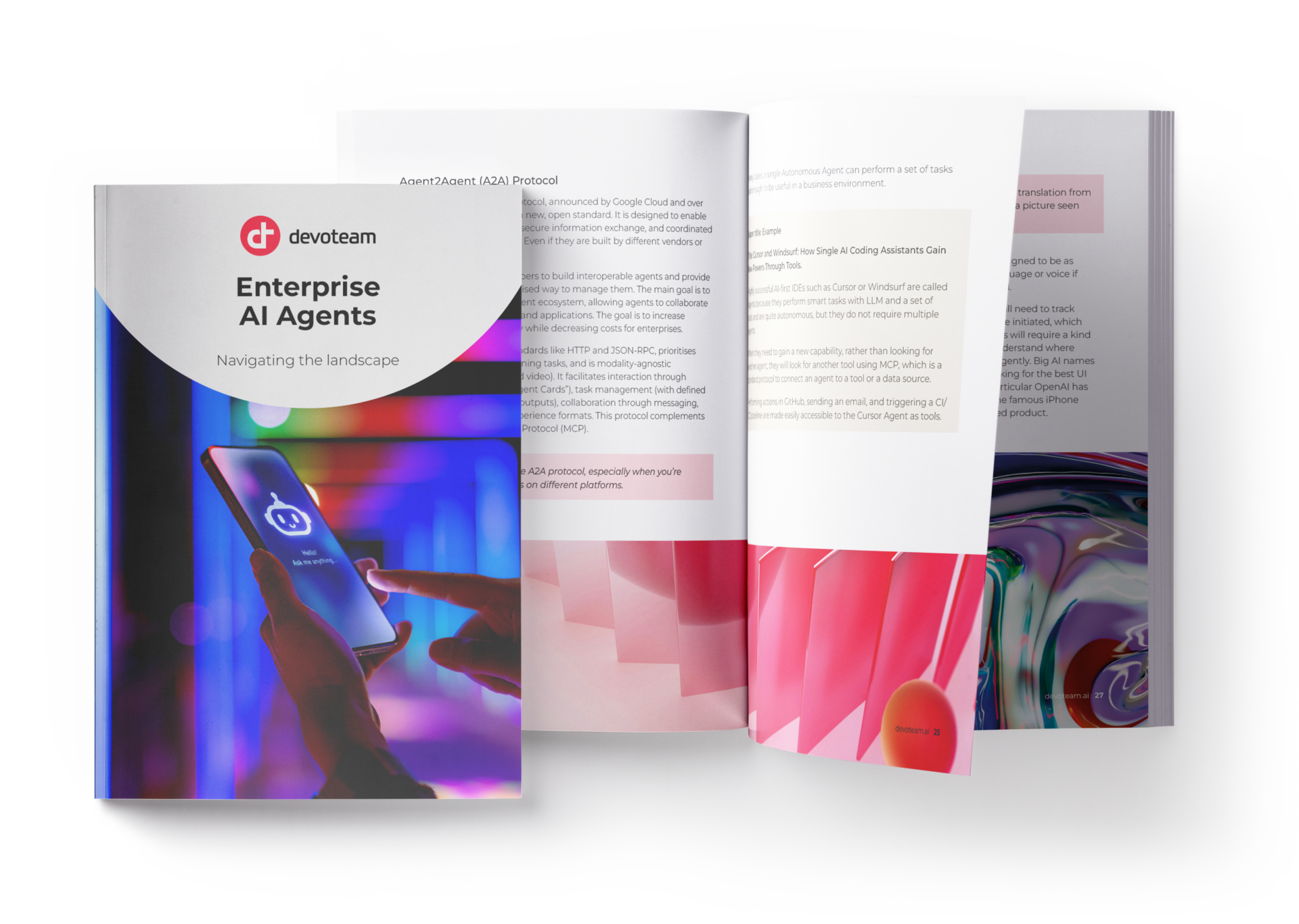
This playbook offers practical advice on Enterprise AI Agents. It brings insights from our 1,000+ AI consultants and their work on over 850+ AI projects.
Use it to:
- Understand the different flavours of AI Agents, from embedded to custom-built.
- Accelerate Adoption when combining quick-win MVPs with a strategic enterprise-wide rollout.
- Implement effective strategies for Trust, Risk, and Security Management (TRiSM).
- Decide between building custom AI Agents and buying off-the-shelf solutions for optimal impact.