


Estimated reading time: 4 minutes
Written as part of our AI Upskilling Program
This article was created as part of the Global Devoteam AI Upskilling Program, where employees share their knowledge to accelerate their learning. The program’s key objective is to provide a foundation in AI for every employee and apply these new skills in our work. Do you want to work with us? Check out our career opportunities.
Why “Fake” Data is Becoming More Real Than Ever
You’ve heard about AI writing essays, creating images, and even composing music. But what if AI could create data? Not just any data, but entirely new, artificial datasets that look and behave just like real-world information, without revealing a single true secret. Welcome to the world of AI-Powered Synthetic Data Generation (SDG), a powerful, yet still somewhat niche, technology that’s quietly revolutionising how we train AI, protect privacy, and accelerate innovation.
What Exactly is Synthetic Data?
Imagine you have a huge spreadsheet of customer transactions: names, addresses, purchase history, and credit card details. This is incredibly valuable for training AI models (e.g., to detect fraud or predict buying patterns). But it’s also a privacy nightmare.
Synthetic data is the clever solution. Instead of using those real, sensitive records, an AI model studies their patterns and relationships. It learns how credit card numbers typically relate to spending habits, or how specific demographics tend to purchase certain items. Then, it uses this learned “knowledge” to generate entirely new, artificial customer records that follow the same rules, but are completely fabricated.
Think of it this way: An artist studies numerous portraits, learning about human anatomy, lighting, and expressions. Then, they paint a new portrait of a person who doesn’t actually exist. The painting is “fake,” but it looks incredibly real and embodies all the characteristics of a genuine portrait.
How Does AI Create This “Fake” Data?
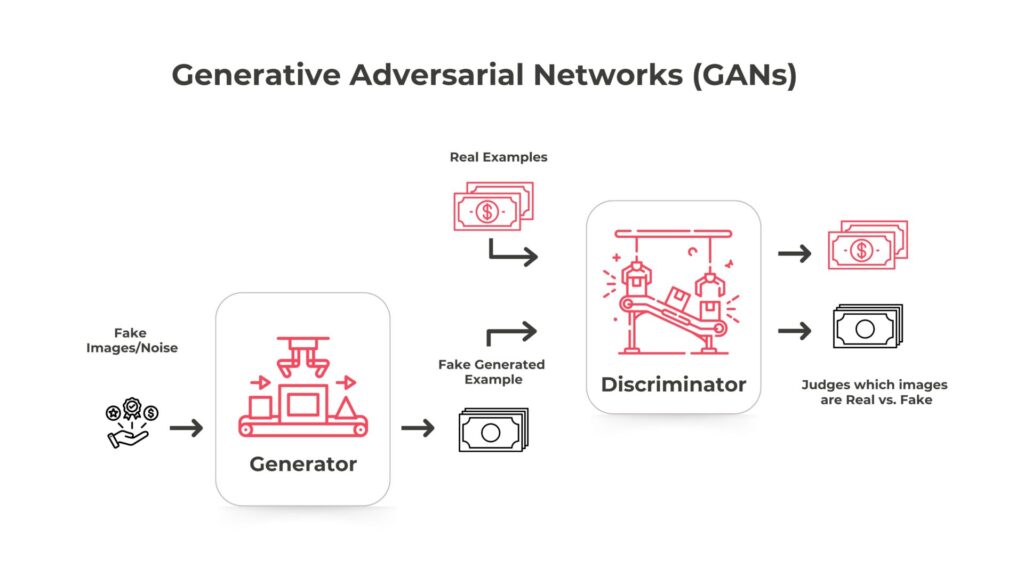
The magic often happens with advanced AI architectures like Generative Adversarial Networks (GANs).
Here’s a simplified look:
- The Artist (Generator): One AI model (the “generator”) tries to create new, convincing synthetic data.
- The Critic (Discriminator): Another AI model (the “discriminator”) acts as a detective. It displays both real data and the generator’s fake data, and its job is to distinguish between the two.
- The Game: The generator continually attempts to deceive the discriminator, improving its ability to create increasingly realistic fake data. The discriminator, in turn, gets better at spotting the fakes. This “adversarial” game continues until the generator is so good that the discriminator can no longer distinguish between the real and fake data.
The result? A synthetic dataset that mirrors the statistical properties and complexities of the original, but is entirely anonymous and safe to use.
Where is Synthetic Data Making a Real Impact?
While not yet a household term, SDG is proving incredibly valuable in specific, high-stakes areas:
- Healthcare: Train AI to diagnose diseases or predict patient outcomes using synthetic patient records, eliminating concerns about HIPAA or patient confidentiality.
- Finance: Develop fraud detection systems or credit scoring models with synthetic transaction data, sidestepping strict GDPR or CCPA regulations. This is a game-changer for secure data sharing and innovation.
Fighting Bias in AI:
Real-world historical data often contains biases (e.g., in hiring, lending, or law enforcement). Synthetic data can be generated in a balanced way, removing these historical biases to train fairer AI models from the start.
Supercharging Data for Rare Events:
Imagine training an AI to spot very rare, critical equipment failures. There might only be a handful of real examples. SDG can create thousands of realistic “fake” failure scenarios, making the AI much more robust without waiting years for more real data.
Accelerating Development and Testing:
Software developers can test new features or entire systems using realistic synthetic data, simulating real-world usage patterns without risking sensitive production data or needing complex, slow data masking.
Real Solutions from Artificial Sources
In conclusion, Synthetic Data Generation resolves the conflict between the need for more information and the demand for better privacy. From securing patient records to reducing bias, it proves that we don’t always need sensitive, real-world data to build accurate systems. As technology matures, synthetic data presents a safer approach, demonstrating that artificial inputs can still yield genuine, practical results.

Devoteam helps you lead the (gen)AI revolution
Partner with Devoteam to access experienced AI consultants and the best AI technologies for tailored solutions that maximise your return on investment. With over 1,000 certified AI Consultants and over 300 successful AI projects, we have the expertise to meet your unique needs.