



Estimated reading time: 1 minute
Frameworks and principles are the backbone of ethical AI innovations, but their true value lies in their active implementation. Without practical application, even the most well-intentioned guidelines remain just that—guidelines. In this article, I focus on real-life examples of ethical AI innovation implemented by Devoteam’s experts. Join me to explore the responsible AI journeys of Europcar, Snowfox AI, and Trustap. Additionally, to make it even more actionable, I prepared a checklist for the ethical usage of AI in any industry.
Want to start with the basics? In the first article of this series, I explain ethical AI and why we need it.
IV. Case Studies: Ethical AI Examples
Case Study 1 – Europcar Drives Ethical AI in the Car Rental Industry
The snapshot:
1
Europcar sought to overcome information retrieval challenges for its employees to enhance customer service and operational efficiency.
2
The company aimed to develop a natural language processing chatbot, providing quick and accurate answers from existing data.
3
Europcar adopted an ethically-driven, collaborative, and agile development approach, involving end-users and business operations to ensure a responsible AI solution.
Europcar, a global car rental company, faced the challenge of employees struggling to quickly find information within vast document repositories to answer customer queries. This inefficiency impacted both employee workload and customer service quality.
Seeking a competitive advantage through technology, Europcar decided to use AI. They aimed to build a chatbot capable of understanding natural language. This chatbot would provide employees with quick, accurate answers from existing data, consequently improving both efficiency and service. Crucially, this goal was intertwined with a commitment to responsible AI adoption, ensuring the solution would be accessible, benefit users, respect human rights, and actively minimise bias.
Europcar and Devoteam built a chatbot, focusing on ethics throughout the process:
- The chatbot uses Europcar’s documents to automatically answer questions.
- Development wasn’t just technical; we collaborated closely with business operations and centred the design on end-user needs.
- Staff were actively involved through a pilot phase and advisory groups. This ensured diverse perspectives and hands-on feedback were used to make the AI effective and fair.
- This inclusive approach, coupled with flexible (Agile) methods, allowed for continuous ethical reviews to proactively spot and fix potential biases or negative impacts, aligning the AI with Europcar’s standards.
Although the chatbot is still in testing, Europcar expects various benefits, including:
- Faster Staff: Employees should save time when finding internal information, making their jobs easier.
- Better Customer Service: Quicker information access means faster, more consistent help for customers.
- Smoother Workflows: Testing and applying user feedback will contribute to an accurate and reliable chatbot.
Eventually, once the chatbot is fully launched, Europcar will measure results like faster query times.
Case Study 2 – Trustap built a strong ethical foundation for all AI development and deployment
The snapshot:
1
Trustap, a platform dedicated to secure payments, recognised the growing need to address potential ethical issues as their use of AI expanded.
2
The company sought to establish a robust ethical framework for all AI development, ensuring alignment with their values, data privacy, and trust with customers and staff.
3
Trustap implemented an AI Ethics Charter, review processes, data governance, human-centred design principles, and targeted training to embed responsible AI practices throughout their organisation.
Trustap is a platform focused on making online and face-to-face payments safer by preventing fraud. Serving major online marketplaces globally, their mission is to improve both customer experiences and business operations responsibly.
As Trustap used more Artificial Intelligence (AI) across business processes, they recognised potential ethical issues. They needed to use the power of AI for innovation without compromising data privacy, fairness, or the trust they aimed to build by stopping fraud. Without clear ethical rules, their AI systems could clash with company values.
Trustap aimed to build a strong ethical base for all AI development. They wanted to ensure AI use matched their values, protected privacy, and built trust with customers and staff. For this purpose, they planned to create guidelines for responsible AI use and a robust system for managing data safely and ethically.
Trustap took a proactive approach with these solutions:
- AI Ethics Charter: They created clear rules outlining ethical AI principles, linked to their core values, for all staff involved in using AI.
- Sharing the Charter: The rules were shared with all employees as a guide for using AI tools.
- Review Process: They set up checks in order to ensure AI projects followed the ethical rules.
- Data Governance: They prioritised safe and ethical data management as the foundation for responsible AI.
- Human-Centred Design: They involved customers and staff across the early stages of each AI project to understand their needs and concerns.
- Training: They planned different training levels to help employees work effectively with AI.
While ongoing, Trustap’s efforts have increased staff awareness of AI ethics. Their focus on data governance is building a foundation for responsible data use. By involving people in designing AI use cases, like their customer support bot, they ensure the technology aims to be beneficial and addresses potential worries from the start.
Case Study 3 – Empowering Through Ethical AI Education
The snapshot:
1
As part of the 69th Session of the Commission on the Status of Women at the United Nations General Assembly, Devoteam experts proposed training programmes targeting cyber safety education for all women and girls.
2
Recognising the increasing sophistication of AI-powered cyber threats, the workshop highlighted the critical need for robust cyber safety education.
3
The workshop underscored the importance of a collaborative and strategic plan involving diverse stakeholders to effectively develop, implement, and monitor these essential cyber safety training initiatives.
AI-powered cyber threats are becoming increasingly sophisticated and personalised, making robust cyber safety education more critical than ever to protect individuals from novel and evolving attacks. These concerns heighten the need for educational training on data privacy and safety.
A great example of how we think about educating people on the ethical use of AI is the case of interactive workshop ‘AI: A Transformative Force for All Women & Girls‘, which was held by Tristan Van Thielen, AI & ML Expert at Devoteam, and Simon Ruszala, Group Learning Director at Devoteam. The workshop took place as a side event at the 69th Session of the Commission on the Status of Women (CSW69) at the United Nations General Assembly in New York.
The workshop revealed that ethical considerations from the outset can guide the development of AI solutions that are empowering, ethical, and secure. In alignment with Devoteam’s ethos “Tech for People”, as well as the ITU’s platform (the UN agency for digital technologies) “AI for Good”, the workshop focused on how AI can help with quality education and training for all women and girls.

I endorse the Devoteam group for their exceptional Harnessing AI for Good workshop and toolkit. They made complex AI accessible and practical through engaging methods. The comprehensive, user-friendly toolkit empowers responsible AI implementation, setting a benchmark in AI education. Highly recommended for enhancing AI capabilities.
Berthe De Vos-Neven
Representative to the United Nations in Geneva, Vice President NGO CSW Geneva
This workshop recognised that cyber safety education is really needed for all women and girls. To help with this, Devoteam’s experts suggested creating tiered training programs, in other words different levels of training for different needs.
To make these training programs work well, a clear plan is needed. Here are the steps:
- Bring together a team: With a clear objective and strategy, involve diverse stakeholders from: government, civil society, schools, and tech companies to meet everyone’s needs.
- Create a detailed plan: Define objectives, timelines, costs, responsibilities, as well as monitoring mechanisms.
- Develop learning materials: Produce appropriate training resources that are accessible both culturally and linguistically.
- Try out the programs first: Pilot the training in various communities to gather feedback and make improvements.
- Tell people about it: Launch awareness campaigns and provide training to equip all women and girls with online safety skills.
- Ask for changes in rules: Advocate for policies that support cyber safety education.
- Keep an eye on progress: Monitor the programs’ impact and effectiveness using KPI’s or OKR’s.
This example shows how thinking about ethics from the start can help create AI solutions that empower people and keep them safe. Ultimately, by collaborating and working towards a common objective with a robust strategy and actionable plan, we can use AI for good in education and beyond.
Case Study 4 – Lessons on Ethical AI from Snowfox AI
The snapshot:
1
Snowfox AI automates purchase invoice processing and leverages data for ESG reporting, noting their AI falls into the “no risk” category under the EU AI Act due to the inherently low ethical risks of their specific application.
2
A key ethical concern for customers, and a focus for Snowfox AI, is the potential impact on employment for workers whose tasks can be automated.
3
Snowfox AI champions transparency, robust data governance and proactive change management with employee upskilling to ensure ethical AI implementation and address workforce concerns effectively.
Snowfox AI focuses on automating purchase invoice processing, helping businesses streamline their financial operations. They also help organisations leverage data for purposes like ESG reporting.
Interestingly, Snowfox AI notes that ethical concerns are usually not the primary discussion point with their customers regarding their core technology. Having assessed their operations against the EU Artificial Intelligence (AI) Act, they fall into the “no risk” category. This suggests that the inherent ethical risks in their specific AI application for invoice processing are perceived as low. Instead, Snowfox AI believes that ethical considerations are more relevant to how their customers use the technology and its outputs.
A key ethical aspect from Snowfox AI’s customers is the potential impact on employment. However, Snowfox AI’s research indicates that over half of their customers find more valuable work for employees whose tasks are automated. This underscores the importance of implementing an effective change management program and subsequent employee upskilling.
For Snowfox AI, transparency, data governance, and change management are crucial:
- Transparency is a core ethical principle. It ensures customers understand how their AI solution operates and arrives at conclusions.
- Robust data governance is a cornerstone of Snowfox AI’s ethical approach. They maintain strict data security, holding ISO 27001 certification and adhering to GDPR guidelines.
- Implementing AI ethically requires careful change management and addressing employee concerns. Snowfox AI emphasises the need for openness and transparency to foster buy-in for AI initiatives. They also recognise the importance of training and upskilling staff to work effectively with AI systems.
Snowfox AI demonstrated their commitment to data ethics when they immediately stopped processing inappropriate personal data mistakenly provided by a customer, informed the customer of the error, and deleted the data from their systems. This proactive handling, despite the error originating from the customer, reflects their dedication to responsible data management.
So, how can you keep track of your AI implementation? Beyond technical metrics like cost and time savings, Snowfox AI observes that some customers use internal surveys to gauge employee satisfaction as an indicator of positive ethical implementation. While directly measuring the social and ethical impact remains challenging, increased employee satisfaction following the automation of routine tasks suggests a positive outcome.
Snowfox AI believes that empowering employees with a general understanding of AI is crucial. This knowledge enables individuals to consider ethical implications within their specific business contexts. For Snowfox AI, customer responsibility, robust data governance, proactive change management, and continuous learning are essential pillars for ensuring ethical AI implementation and usage.
Download Now: Your Free 2025 Ethical AI Playbook
Ethical AI Usage Checklist (Applicable For All Industries)
Do you feel inspired by Europcar, Trustap, Snowfox AI, or Devoteam’s workshops at the UN? It’s time to start your own journey! The checklist below will help you regardless of your industry and the type of AI innovations you are planning to develop or implement.
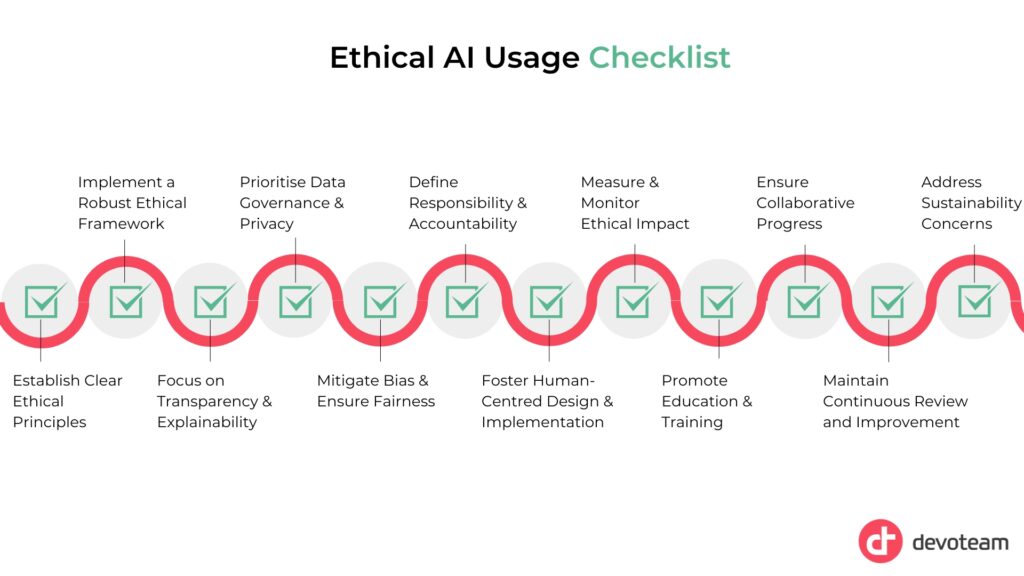
Establish Clear Ethical Principles:
- Develop and document your organisation’s AI ethical principles.
- Ensure these principles align with your core company values.
- Make these principles accessible to all employees.
- Consider fundamental principles such as responsibility, transparency, and fairness.
- Commit to developing AI in a way that respects human rights.
Implement a Robust Ethical Framework:
- Develop clear processes and policies related to ethical AI.
- Consider creating an AI ethics charter outlining your principles and usage guidelines.
- Embed ethical considerations into your (agile) development process.
Focus on Transparency and Explainability:
- Ensure AI systems are explainable and not opaque “black boxes”.
- Consider using tools and techniques in order to achieve explainability.
Prioritise Data Governance and Privacy:
- Establish a strong data governance framework as the backbone of responsible AI.
- Ensure data is accurate, secure, and used ethically.
- Define clear data handling policies.
- Invest in appropriate tools for data storage, tracking, and compliance.
- Check for biases and inconsistencies in your training data.
- Prioritise privacy protection and security of user data.
- Adhere to relevant regulations and standards.
- Obtain informed consent for data collection and use.
- Implement practices like anonymisation and data minimisation.
Mitigate Bias and Ensure Fairness:
- Carefully curate and diversify your training data in order to minimise bias.
- Actively identify and address potential biases in training data and algorithms.
- Monitor AI outcomes for diversity and fairness.
- Design AI applications to avoid unethical practices.
Define Responsibility and Accountability
- Establish clear lines of responsibility for AI systems and their outputs.
- Consider designated human oversight roles.
- Implement mechanisms for auditing AI decisions.
Foster Human-Centred Design and Implementation
- Design and implement AI projects with a focus on the needs and well-being of people.
- Involve stakeholders early in the AI project lifecycle (employees, customers, community).
- Design AI systems to complement rather than replace human work.
- Maintain a continuous user feedback loop.
- Actively listen to and address employee concerns.
Measure and Monitor Ethical Impact:
- Implement an ongoing audit process in order to assess ethical compliance.
- Go beyond technical metrics to assess the social and ethical impact.
- Gather employee and customer feedback on fairness and usefulness.
- Conduct fairness audits and monitor diversity in AI outcomes.
- Establish open channels for complaints if users feel unfairly treated.
Promote Education and Training:
- Provide tiered training programs in order to equip the workforce with the necessary AI skills.
- Offer training on both the fundamentals of AI and ethical use.
- Address employee fears and uncertainties about AI through education.
- Encourage a culture of innovation and continuous learning in AI.
Ensure Collaborative Progress:
- Collaborate with a broad range of partners on AI development.
- Share learnings about both AI safety and security with the ecosystem.
- Consider input from external experts on ethical considerations.
Maintain Continuous Review and Improvement:
- Establish a review process for continuous improvement of ethical practices.
- Continuously adapt to the evolving regulatory landscape.
- Stay updated on new regulations and best practices.
- Regularly revise and modify your ethical framework based on both learning and feedback.
Address Sustainability Concerns (Where Applicable):
- Explore the environmental impact of AI.
- Promote sustainable IT practices and responsible development to minimise resource consumption.
- Consider using AI to optimise energy and resource usage for sustainability goals.
Conclusion
To sum up, building ethical AI innovations isn’t just theory. As we’ve seen with Europcar, Trustap, and Snowfox AI, and through Devoteam’s educational efforts, principles truly come alive when implemented. From designing user-friendly chatbots to establishing ethical charters and ensuring fair employment with automation, responsible AI is clearly beneficial.
By prioritising the elements outlined in our checklist, your business can ensure its AI usage is not only advanced but also ethically sound.
For a deeper dive into the ethical concerns surrounding cutting-edge technology, read our expert view on the specific ethics of Generative AI.
Ethical AI Isn’t Optional. Get the Frameworks & Tools You Need

Confused about how to make your AI projects ethical? This playbook provides practical advice on navigating the ethical dimensions of AI. It’s based on our expertise and partnership with Google Cloud. Use it to:
- Establish clear ethical principles for your AI projects
- Ensure transparency and explainability in AI decision-making
- Implement data governance and privacy measures
- Promote sustainability and reduce the environmental impact of AI
- Explore real-world case studies (Europcar, Snowfox AI & Trustap) demonstrating ethical AI implementation