


Written as part of our AI Upskilling Program
This article was created as part of the Global Devoteam AI Upskilling Program, where employees share their knowledge to accelerate their learning. The program’s key objective is to provide a foundation in AI for every employee and apply these new skills in our work. Do you want to work with us? Check out our career opportunities.
Remember how it was, only months ago? “Just Google it” was the universal answer to almost any question. We’d dive into search results, skim headlines, click through to promising articles, and often, quite deliciously, tumble down a rabbit hole of related topics. It was a journey of discovery, a quest for context, a genuine act of research.
Fast forward to today. For many, that meticulous process has been replaced by a single, confident query to an AI. A concise summary pops up, perfectly phrased, often bullet-pointed. Instant answer. Job done. Or is it?
This rapid shift marks a profound learning twist – a fundamental change in how we acquire knowledge.

While AI is a phenomenal tool, a personal assistant at our fingertips, it begs a crucial question: are we truly learning, or just consuming bite-sized information?

Teodora Vučković
Assistant Professor at Faculty of Technical Sciences, University of Novi Sad | Lead Technical PM at Devoteam Serbia
The “Before” – The Era of the Deep Dive
Cast your mind back. When you set out to understand a complex topic, let’s say, “the economic impact of 9/11,” a Google search would yield a deluge. You’d encounter articles from the BBC, The Economist, academic papers, think tanks, and dissenting opinions. You’d probably spend a good twenty minutes, or even an hour, reading through a few pieces, cross-referencing facts, understanding different perspectives, and piecing together the broader picture.
This wasn’t just about finding facts; it was about the process. It was about:
- Contextual Understanding: Seeing how different elements interconnected.
- Critical Evaluation: Weighing evidence, identifying bias, forming your own informed opinion.
- Information Synthesis: Weaving together disparate pieces of information into a coherent understanding.
- The Unintentional Discovery: Stumbling upon related concepts or experts you hadn’t even thought to search for.
It was, in essence, building your own mental map of the knowledge terrain.
The “Now” – The Age of AI Summaries & Quick Learning
Today, that same query about 9/11 economic impact might go straight to your favourite AI chatbot. Within seconds, you’ll have a pithy summary: “Key impacts include trade barriers, supply chain disruptions, and new regulatory frameworks.” It’s incredibly efficient. It’s concise. It’s often perfectly articulate.
And herein lies the learning twist.
We live in a world where time is a precious commodity. Everyone’s busy, perpetually short on hours. This has fuelled a collective hunger for “quick facts” and “quick learning.” We skim, we scan, we diagonally read. The patience required for a truly deep dive feels increasingly like a luxury few can afford. AI, with its instant, distilled answers, perfectly caters to this modern impatience.
The problem, however, is that takeaways, when solely generated as an AI summary, aren’t always good enough. They’re often just the tip of our Knowledge Iceberg.
Unpacking the Knowledge Iceberg: What We’re Missing
Imagine knowledge as a vast iceberg. What AI often gives us is the visible 10% above the waterline: the headline facts, the key bullet points, the immediate answer. It’s helpful, it’s digestible, and it feels like learning.

But below the waterline, the other 90% is submerged:
- The Nuance: The subtle distinctions, the “it depends” caveats, the different interpretations.
- The Why and How: The underlying mechanisms, the historical progression, the causal chains that led to the “fact.”
- The Contradictions & Debates: The opposing theories, the unsolved problems, the areas of active research and disagreement.
- The Source Credibility: Understanding who said what, when, and why it matters.
- The Mental Modelling: The act of building connections, forming hypotheses, and truly integrating new information into your existing understanding.
When we rely solely on AI summaries, we bypass the critical process of navigating that submerged 90%. We might walk away with a quick answer, but without the context, the connections, or the critical scrutiny, that answer can be fragile, incomplete, or even misleading. Our critical thinking muscles, once honed by rigorous research, risk atrophy.
The Crucial Question: What’s Your Learning Goal?
This brings us to the core of navigating the AI learning twist: Know your learning goal.
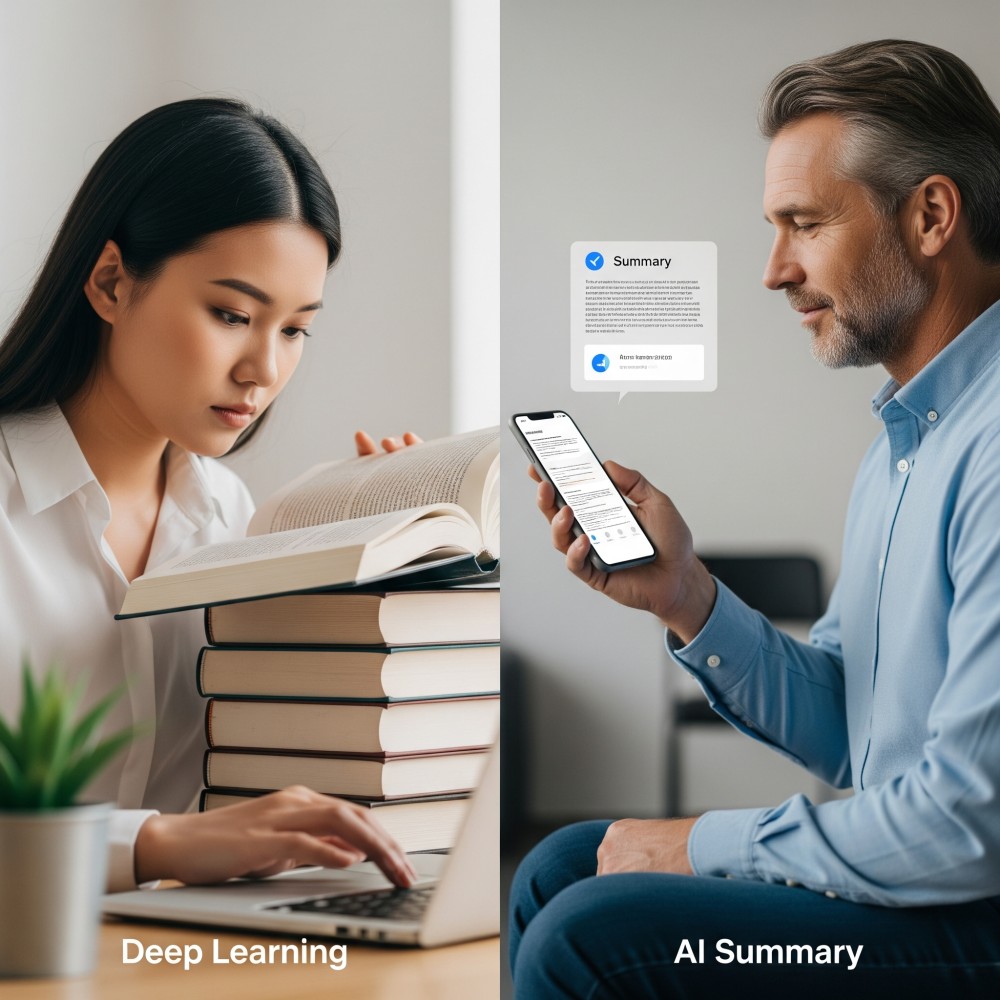
Are you simply searching for a fast insight on a topic to quickly grasp a concept for a fleeting conversation? Or do you genuinely need to knowledge yourself on a certain topic – to truly understand it, integrate it, and perhaps even apply it in complex situations?
- For a quick insight: AI is your best mate. Need to know the capital of Madagascar? AI’s got you. What’s the general idea of quantum entanglement? AI can provide a digestible overview. This is where AI excels as a rapid information retrieval tool.
- For deep knowledge: This is when you need to Learn More! This is when AI becomes your starting point, not your destination. It’s the prompt that sends you diving into the iceberg’s depths. You’ll then use it to find relevant sources, summarise complex papers, or even brainstorm counter-arguments to what you’ve read.
AI: Your Ally, Not Your Crutch
It’s vital to stress: AI is a fantastic hand, an unparalleled personal assistant anytime. I, too, love using it. The point isn’t to demonise AI, but to understand how we learn from it and, crucially, do we develop our critical thinking by doing it?
The answer is, only if we choose to.
AI’s Impact on Learning; Studies suggest AI offers benefits like personalized learning, but also raises concerns about over-reliance and diminished critical thinking. (Source: MDPI, Frontiers)
To harness AI for deeper learning, consider these approaches:
- Use AI as a Research Assistant: Ask it for summaries of long articles, to identify key arguments in a paper, or to generate a list of credible sources on a topic. Then, go read those sources yourself.
- Prompt for Nuance: Instead of “Tell me about X,” try “Tell me about X, including its main criticisms and alternative viewpoints,” or “What are the historical controversies surrounding X?”
- Verify and Cross-Reference: Never take an AI’s answer as gospel. Always use it as a starting point to verify facts with independent, reputable sources.
- Engage in Dialogue: Treat AI as a conversational partner. Ask follow-up questions, challenge its assertions, and ask it to explain its reasoning.
- Actively Process: Read AI-generated content with the intent to summarise it in your own words, explain it to someone else, or apply it to a hypothetical scenario. This active engagement is key to retention and understanding.
The Future of Work and The Indispensable Human Element
The future of work won’t be about who can recall the most facts – AI already wins that contest. Instead, it will be about who can think most critically, solve complex problems innovatively, and adapt to rapidly changing information landscapes.
Employers will increasingly value individuals who can:
- Navigate complexity: Understand the full 90% of the Knowledge Iceberg, not just the tip.
- Discern truth from fiction: Especially vital when AI can “hallucinate” information.
- Synthesise diverse data: Pull insights from various sources, AI-generated or traditional.
- Ask the right questions: AI can give answers, but humans must formulate the intelligent questions.
AI is transforming our tools, but it doesn’t have to diminish our minds. The learning twist is an invitation to be more intentional about how we acquire knowledge.
Critical Thinking in the Workplace; 99.2% of employers consider critical thinking essential for new hires. (Source: NACE) However, a significant percentage of graduates lack these skills.
Striking the Balance: Becoming an AI-Empowered Deep Learner
So, do you still Google? Perhaps not in the same way. But the spirit of curiosity, critical inquiry, and the desire for true, contextual understanding remains more vital than ever.
The future of learning isn’t about choosing between AI and traditional methods. It’s about intelligently integrating both. It’s about leveraging AI’s incredible speed for efficiency, while consciously choosing to dive deep when your learning goal demands it. It’s about knowing when to skim the surface, and when to plunge beneath the waves to explore the vast, rich depths of the Knowledge Iceberg. Your future learning depends on it.
Looking for a place that not only equips you with emerging tech knowledge and the latest learning methods but also shows you how to leverage AI assistance in an ethical and most impactful way, alongside established and innovative learning approaches? Devoteam is that place for you.
Over 80% of AI projects fail. Yours don’t have to.
Download our AI Strategy Playbook:
- Learn why AI projects often fail (and how to avoid it).
- Follow 10 clear steps for a strong AI plan.
- Focus on solving business problems (not just using AI).
- Find the best AI uses for your business (includes 100+ examples).
- Learn how to measure AI results (GenAI projects average ~3.7x return).
- Get your tech foundations ready (Cloud, Data, and AI Security).
- Help your team adapt to AI (and see how we train our staff).
- Use AI responsibly (covering fairness, bias, and environmental thoughts).