

Meet the author, Patrícia Milheiro

Patrícia Milheiro is AI Services Director at Devoteam, where she leads AI strategy and supports organisations in adopting generative AI for business transformation. She co-authored the book “Empower Business with Generative AI,” guiding executives on the impact and best practices of AI adoption. Recognised as an AI facilitator and mentor, Patricia helps companies realise efficiency and innovation through AI solutions.
The promise of AI is that it is a “loyal servant to augmenting human purpose, not being its master.” To be honest, this is not always the case. Think of an AI agent designed to optimise hiring, but that inherits our worst biases. Or an algorithm built for security, but erodes our privacy. So we have to ask: Who is AI truly serving?
Many organisations view AI as a mystical oracle, like a black box full of magic stuff. Processes are designed around the tool rather than the things that count. What counts? Meaningful outcomes, ethical clarity, and human needs.
AI should not dictate. It should assist. And more importantly, it should anticipate. Whether it’s running in code or moving through the physical world, AI must always stay in service of human purpose.
Let’s Be Clear: AI Is Smart, But Not Wise
AI does not have context. It does not know what matters. It does not know whether a prediction causes harm or good. It just follows the rules we give it. That’s our job.
That’s why we must design AI systems with intent and keep humans in the loop at critical steps and for approval. We must not forget that we might risk automating the very things we should be questioning.
Consider digital twins, for example. These AI-powered virtual replicas are helping engineers and planners simulate the future before it happens.
Today, in governmental services, these models are being applied to simulate housing policy, refugee movement, or education access, giving decision-makers the tools to test societal outcomes before they unfold in the real world.
Some EU-funded projects are using digital twins to predict how rising temperatures or air pollution will affect specific neighbourhoods, informing more equitable climate adaptation strategies.
That’s not just smart — That’s AI at its best: proactive, predictive, and human-led, it is deeply human-centric and working proactively for us.
Digital twins can be societal tools, helping us rehearse policy, rethink services, and ultimately, make more human decisions at scale.
It’s AI helping us care more, not just calculate faster. It is about giving us foresight, not just hindsight.
Physical AI: Making the Invisible Tangible
AI is not just living in the cloud; it’s moving in the world.
In physical AI, robotics and smart systems help us on the ground, on the factory floor, and even in hospitals’ operating rooms.
Exoskeletons powered by AI are helping workers reduce strain and injury in industrial settings. In hospitals, autonomous robots deliver medicine, monitor patients, and free up valuable time for nurses and doctors to focus on human care.
Logistics companies are using AI-guided drones and robots in their warehouses to improve safety and efficiency, but crucially, humans stay in control. These systems augment, not automate blindly.
When we design AI with empathy and guardrails, it becomes a collaborator — not a competitor.
Speed Without Direction = Disaster in Fast-Forward
These tools are only powerful if we ask the right questions first:
- What are we trying to improve?
- Who does this benefit — and who might it harm?
- Are we solving the right problem, or just making the wrong one faster?
The danger is not the AI itself. It is our silence. Our abdication.
We cannot automate ethics. We cannot outsource responsibility.
Speed without direction? That’s not innovation — it is just disorganised acceleration.
The Future Is Designed, Not Predicted
Let’s stop treating AI as a destination and start treating it as a design decision.
Because the question is not whether AI will shape the future. It is who will shape the AI. We ought to embed it with purpose, strategy, and governance. Because when you design AI around human insight, real impact follows. Read more about why your next tech hire should be a psychologist.
AI is here. It’s powerful. It’s physical and digital.
AI will become what it was originally intended to be if we continue to be deliberate and continue to be the creators of the reasoning rather than merely the recipients of the results: a tool, a helper, a silent power at our service, improving human lives in the background.
But it’s not autonomous in purpose.
We are the purpose.
Let’s keep it that way.
Over 80% of AI projects fail. Yours don’t have to.
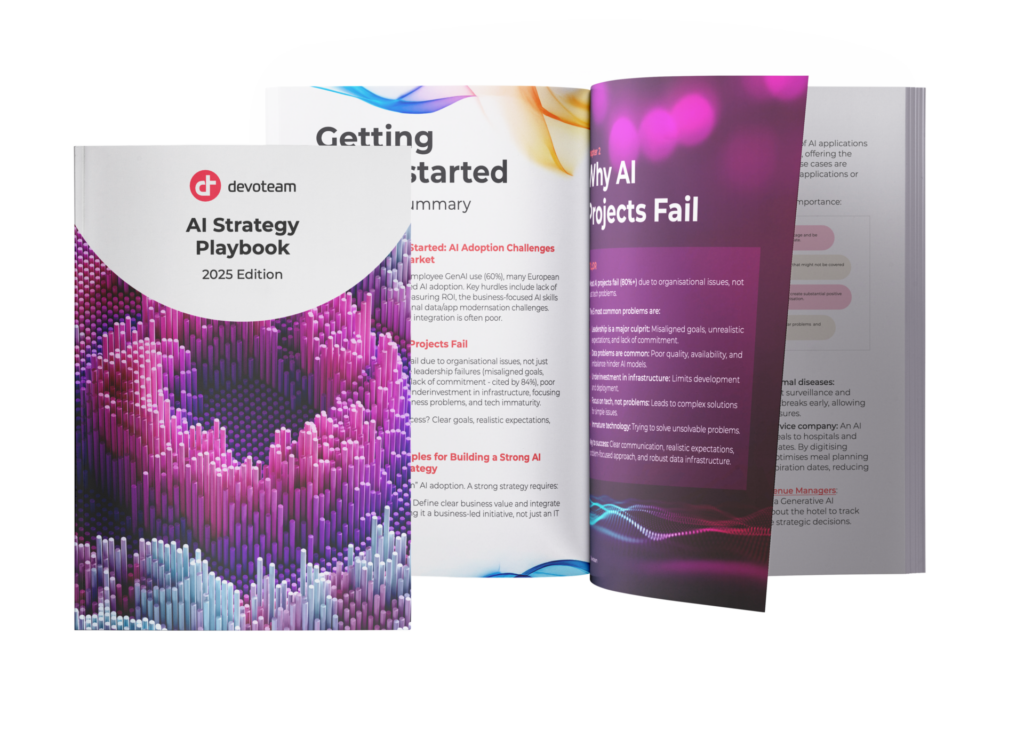
Download our AI Strategy Playbook:
- Learn why AI projects often fail (and how to avoid it).
- Follow 10 clear steps for a strong AI plan.
- Focus on solving business problems (not just using AI).
- Find the best AI uses for your business (includes 100+ examples).
- Learn how to measure AI results (GenAI projects average ~3.7x return).
- Get your tech foundations ready (Cloud, Data, and AI Security).
- Help your team adapt to AI (and see how we train our staff).
- Use AI responsibly (covering fairness, bias, and environmental thoughts).