





Introduction
Imagine that half of your customers are ready to leave after just one negative experience. For the telecommunications industry, that’s not a hypothetical scenario. Despite investing $1.3 trillion in new 5G networks, telcos are struggling with some of the lowest customer satisfaction scores of any sector. They are caught between the huge cost of upgrading their infrastructure and the demand from customers for perfect, uninterrupted service.
But it’s not all doom and gloom! Telco’s challenges can be resolved with powerful new Agentic AI technology. This article dives into the solutions offered by AI Agents – smart assistants that can take autonomous action. Focusing on Google Cloud’s Gemini Enterprise (formerly ‘Google Agentspace’), we’ll show how Telcos can get ahead of problems by predicting network outages, streamlining customer support, and improving internal efficiency.
Current Challenges in The Telco Industry
Before we dive into technology, we should look into the current challenges of the telecommunications industry. Telcos are under immense pressure to remain competitive while meeting ever-increasing customer expectations. These pressures span several key areas, including customer experience, financial investment, and the pursuit of revenue growth. Let’s shine some light on these pain points:

1. Heightened Customer Expectations and Dissatisfaction
Customer satisfaction has always been a big challenge in the telecommunication industry. It consistently reports low Net Promoter Scores (NPS), typically between 20 and 30, placing it among the poorest-performing sectors for customer loyalty. And this dissatisfaction can be quite costly, as research indicates that 55% of customers will cancel their service following a single bad experience. In such a competitive environment, retaining customers and reducing churn is a primary challenge for operators.

2. The Financial Strain of 5G Investment
Telco companies face capital expenditure (CapEx) as they invest heavily in building and expanding their 5G networks. The scale of this investment is massive – between 2023 and 2030, 90% of the over $1.3 trillion+ CapEx investment globally is expected to be allocated to 5G. This follows approximately $600 billion spent by operators on their networks between 2022 and 2025 alone.

3. Rising Network Demands and the Need for Differentiation
This industry must manage rapid growth in network demand, particularly in data traffic. By 2029, 5G is expected to account for 76% of all mobile data traffic. If they want to stand out, operators must also adopt the latest advances in AI and technology to deliver highly personalised experiences to their customers at scale.

4. The Search for New Revenue Streams
Operators are constantly exploring ways to diversify their sources of income and increase the average revenue per user. This has led 65% of telecommunications companies to collaborate with ecosystem partners to create new monetisation models and fresh revenue streams.
The Opportunity: AI Agents with Gemini Enterprise
While the Telco industry faces significant challenges, technological advancements are creating opportunities across the entire value chain.
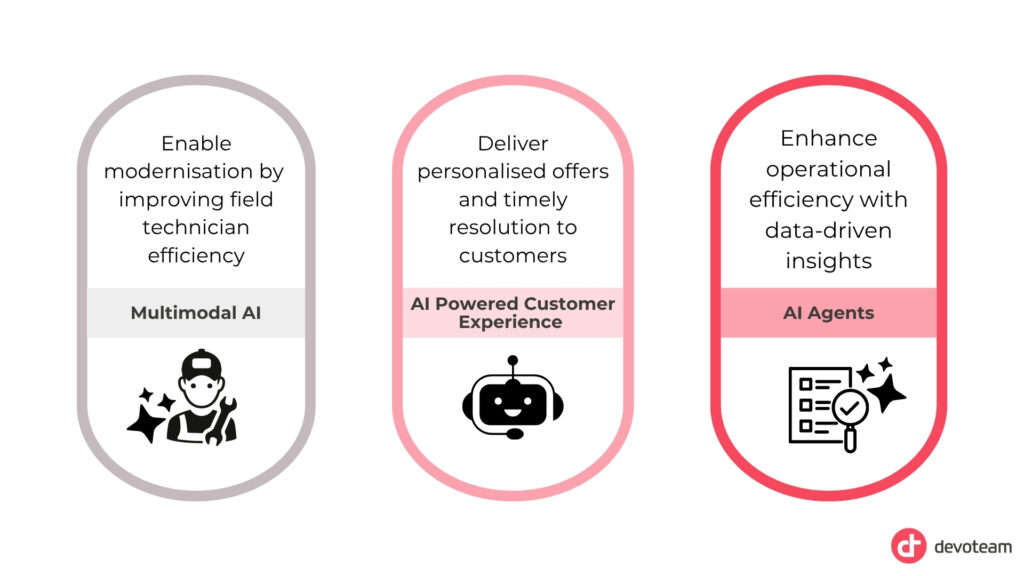
AI agents are evolving beyond traditional chatbots, becoming sophisticated AI assistants capable of taking autonomous action and completing specialised tasks. This allows them to solve fundamental problems within the telecommunications industry, from enhancing the customer experience and optimising network operations to improving internal efficiency.
In this article, we focus on Gemini Enterprise from Google Cloud, an Agentic AI solution that provides a single, secure platform that can help enterprises achieve their goals. It allows users to choose Out-of-the-Box (OOTB) connectors for data discovery and conversational assistance with supported systems (like Jira and Confluence) while also empowering the development of highly specialised, autonomous agents using the Agent Development Kit (ADK) and no-code agent builder. In the following section, we will demonstrate how Gemini Enterprise addresses specific challenges faced by the Telco industry.
Applying Gemini Enterprise to Telco Challenges
1. Enhancing Operational Efficiency and Meeting Network Demands
Custom-built AI agents, developed using the Agent Development Kit (ADK), enable a shift from a reactive approach (responding to problems as they occur) to a proactive one (preventing them from happening in the first place).
| Challenge Addressed | AI Agent Solution |
| Reactive Incident Management (relying on user searches and queries) | Autonomous Background Operation: ADK-built agents run continuously and independently, removing the need for constant user prompting. They can proactively predict when an incident is about to occur and notify relevant staff on platforms like Slack or Microsoft Teams. |
| Network Outages and Data Traffic Growth (managing rising network demands) | Proactive Outage Prediction: By continuously monitoring network telemetry data with specific tools, agents can analyse anomalous patterns to predict and prevent potential outages. |
| Complex Incident Correlation (moving from Mean Time to Resolution to Mean Time to Prevention) | Advanced Logic and Decision-Making: Agents can correlate unusual network patterns with historical incident data to identify if a similar pattern has previously caused a major issue. Based on its core logic, the agent can then decide on the next step, such as creating a pre-populated incident ticket or alerting an on-call engineer, and then complete this task. |
| Data Silos and Legacy Systems | Custom Integrations: The ADK allows agents to connect to custom or unsupported APIs. This is vital for monitoring unique network telemetry data that may not be accessible through standard connectors. |
2. Improving Customer Experience and Reducing Churn
AI agents can simplify complex customer interactions and provide tailored, immediate support.
| Challenge Addressed | AI Agent Solution |
| Fragmented Information Access | Unified View and Context-Aware Assistance: Agentspace functions as a “connective AI,” integrating data from various internal sources (e.g. Jira, Confluence, Mail, Drive) and external APIs. This allows an agent to provide the correct information instantly within a single chat interface, while respecting user access permissions. |
| Slow Incident Response and Resolution | Automated Workflows and Actions: Agents can perform complex, multi-step tasks without leaving the chat interface. For instance, if a customer is experiencing a problem with their router, the agent can summarise the router’s manual, generate a video demonstrating the router’s features, and propose steps for the customer to take to resolve the issue. Further, for an on-site issue, the agent is able to draft and send emails to site managers, or create high-priority Jira tickets with likely causes and failure summaries. |
| Handling Complex Tasks and Negotiations | Advanced Task Management: Agents can manage intricate processes such as coordinating network outage responses or handling customer payment arrangements. |
3. Streamlining Internal Processes and Improving Efficiency
AI agents can help telecommunication companies manage internal pressures and optimise the performance of their workforce.
| Challenge Addressed | AI Agent Solution |
| Engineer Onboarding and Knowledge Transfer | Deep Research Capabilities: Agents can perform deep research grounded in a company’s internal knowledge bases, wikis, and user manuals. This provides new technical staff with essential, company-specific information (such as router network fundamentals) and can even generate an audio summary on demand. |
| Inconsistent and Repetitive Workflows | Process Automation and Standardisation: Agents can expand a team’s expertise by automating repetitive workflows that are often inconsistent and drain productivity. Users can build custom agents to automate specific processes, such as the entire incident response flow, improving efficiency by proceeding directly to alerting the site manager. |
See it in action: watch the demo showing how to use Gemini Enterprise for Telco:
How to Implement AI Agents in Telco
Understanding the potential of Gemini Enterprise is the first step. The next phase is putting it into practice. Let’s look at how you can move from potential to solving your challenges.
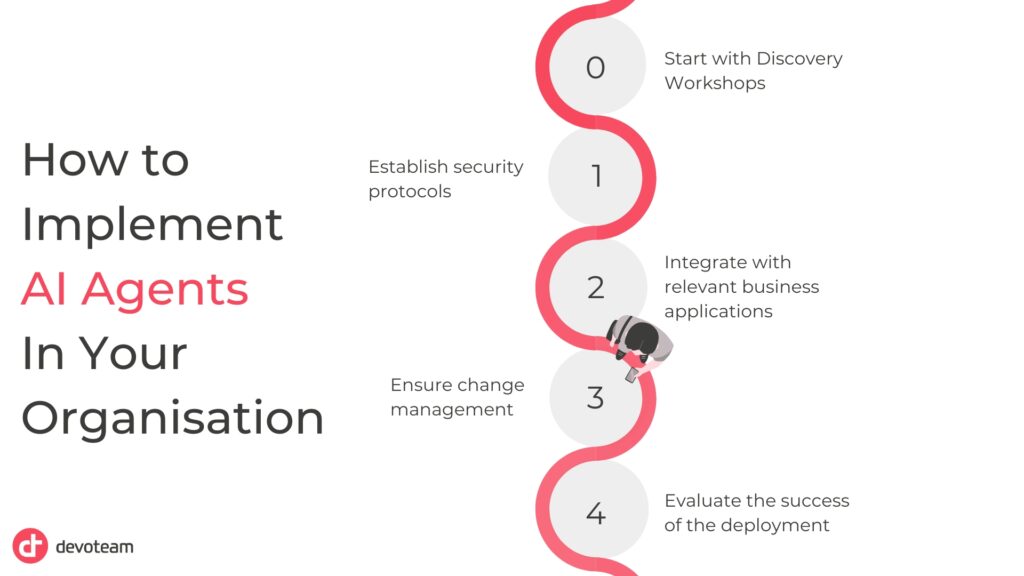
1. Engage in a Discovery Workshop
You can begin the process by taking part in Devoteam’s ‘Gemini Enterprise Use Case Discovery Workshop’. The workshop aims to discuss how Gemini Enterprise could be tailored to your company’s specific needs and use cases. If you are interested in this session, contact us.
2. Follow a Strategic Adoption Approach
After the initial discovery phase, the strategic adoption of Gemini Enterprise follows a structured approach. This process is designed to ensure successful implementation across four main phases:
I. Security: The process begins with a firm focus on security and compliance. AI and machine learning experts start the project by establishing robust security protocols. This phase ensures that effective privacy, governance, and compliance controls are in place from the outset.
II. Integrations: This phase involves the technical setup and configuration for the end-users. User personas are defined, and the necessary integrations with relevant business applications (such as Jira, Confluence, and Mail) are configured.
III. Adoption: Effective change management is critical to maximising the return on investment. Specialist change management teams conduct role-specific onboarding workshops and training sessions. This process empowers different user groups for success, addresses potential resistance to change, and ensures that staff can leverage the solution to its full potential.
IV. Embed (Post-Implementation) The final phase focuses on evaluating the success and impact of the deployment. An impact assessment is conducted to demonstrate the ROI. This provides a data-driven understanding of the productivity improvements resulting from Gemini Enterprise. For example, the time employees spent researching information before and after implementation can be compared to quantify the benefits.
Conclusion
The telecommunications industry stands between the pressure of rising customer expectations and the rising cost of network evolution. Continuing with a reactive, traditional operational model is no longer sustainable. As we demonstrated in the article, proactive AI agents offer a transformative path forward, allowing a shift from managing problems to preventing them entirely. Using platforms like Gemini Enterprise, telco providers are able to enhance network efficiency, deliver superior customer experiences, and drive new value for their internal teams. The operators who embrace this intelligent, automated approach will overcome today’s challenges and build the agility for the future.

Your journey towards a smarter, more resilient network starts here
Contact us to book your free Use Case Discovery Workshop and start solving your biggest challenges.