



Champions now quest for sporting excellence as much in laboratories as on the pitch, with AI and data emerging as their new essential allies. How are these technologies transforming training, analysis, and decision-making in elite sport?
On April 3, Devoteam brought together top athletes and sports journalists for an event exploring this silent revolution that is transforming the global sporting landscape.
Between demos, testimonials from high-level athletes, and innovative use cases, this morning allowed us to lift the veil on the behind-the-scenes of a profound change: how data analysis and AI algorithms are redefining training, strategy, and even the fan experience.
From fencing to the Vendée Globe, from professional basketball to sports journalism, prestigious speakers – including sabre fencer Margaux Rifkiss, skipper Fabrice Amedeo and the general director of the Levallois Sports Club Henry de Grissac – shared their vision of a sport augmented by technology, where data becomes the essential complement to talent and intuition.
Let’s dive into the heart of a match shaping the sport of tomorrow, where the power of artificial intelligence can optimise every millisecond, every decision, and every movement.
Data makes performance more understandable
The morning began with a presentation by Erwan Benech, head of the SportTech offering at Devoteam and himself a four-time French champion in the 800m and 1500m. As an athlete and consultant, he presented Devoteam’s vision for supporting sports stakeholders through data and artificial intelligence.
As Erwan explained:
“Our goal is to explore on a daily basis the variables that make and break victories .”
This approach is based on two main axes: supporting coaches and athletes in their decision-making through data analysis and transforming the fan experience by making sports performance more accessible and understandable to the general public.
L’Équipe: When AI Accelerates Sports Journalism
The first use case presented involved collaborating with the media outlet L’Équipe to revolutionise Olympic Games coverage. Faced with the deluge of information generated by the global sporting event, Devoteam developed an intelligent system for analysing and prioritising content.
This innovative system relies on a complex mechanism: massive data collection, analysis of journalists’ work, and establishment of a scoring system. Journalists assign specific scoring rules to each Olympic event, which automatically determine the highlights and athletes to feature in the two-minute editions.
This algorithmic approach saves valuable time in processing information and offers spectators a richer and more relevant experience without missing any key moments of the competitions.
The result? The “2 min chrono ” podcast is based on a model that collects, prioritises, and summarises the highlights of the Paris 2024 Olympic Games before producing an audio news flash in line with L’Équipe’s editorial policy. Commentary, recap of the previous day, podium chances, medal table—all the essential information in this 2-minute digest.
Levallois Metropolitans Basketball Club: sporting excellence enhanced by technology
Henry de Grissac, General Manager of the Levallois Sporting Club (LSC), then presented the collaboration initiated with Devoteam several years ago. This partnership with France’s largest sports club, founded in 1983 and offering more than 150 sports disciplines, revolves around two main axes.
First, Devoteam has become the sponsor of the LSC’s high-performance center, which brings together around thirty elite athletes. ” To attract and retain these champions, we need not only financial resources, but also sporting and extra-sporting support comparable to what INSEP offers,” emphasised Henry de Grissac.
The second part concerns the project with Levallois Metropolitans Basketball Club, where the culture of statistics is particularly rooted. ” Data does not replace humans,” insisted Henry de Grissac, ” but it helps the coach to sort information, prioritise it, and better understand the compatibility between different positions .” Artificial intelligence thus makes it possible to optimise existing processes, making them faster and more precise.
For example, opponent scouting can save professional teams considerable time. With an average of two matches per week, teams have little time to analyse competitor videos. Automated AI analysis can quickly identify opponents’ strengths and weaknesses.
Physical training and injury prevention are other promising areas, particularly in transitioning from amateur to professional levels. The speakers noted, “There is still much room for improvement in the use of data in physical training .”
The LSC CEO also shared his vision for the future, hoping that less high-profile sports, such as women’s and disabled sports, could benefit from the same technological advances as the major disciplines. He also discussed the potential of AI to improve refereeing, offering more neutral and less pressure-based decisions.
The presentation concluded with a demonstration of the application developed specifically for the Metropolitans, illustrating how technology is now integrated into the daily life of professional sports teams.

Roundtable: Do AI and performance go hand in hand?
The highlight of the morning was the round-table discussion led by Léandre Caupenne. It brought together the sabre fencer Margaux Rifkiss, the skipper Fabrice Amedeo, and Henry de Grissac around a central question: Will AI make a difference in sports performance or is it just another new tool among others?
Uses already anchored in high-level practices
For Margaux Rifkiss, AI is now an integral part of the fencing landscape and is even becoming a requirement. ” Physical tests are tracked via applications within the French team, as are fatigue levels and sleep monitoring, ” she explained. However, she adds, ” For now, it’s a significant tool that hasn’t yet proven itself in all areas. We have a lot of data, but we don’t yet know how to use it all .”
Fabrice Amedeo’s experience in the last Vendée Globe was unusual, having had to sail “in adventure mode” after losing his boat two years before the race. On an older, less technologically advanced boat, the use of data was limited. But the skipper emphasises the usual omnipresence of data in modern sailing: “The boat’s performance data, target speeds depending on whether you’re solo or crewed, in the bay or offshore, are essential. We collect data throughout the year to have target speeds and find the right settings. “
He also mentions optimising the transition from one veil to another among the eight available and, personally, sleep management through tests to identify the best times to reach deep sleep.
A competitiveness challenge for the future
Henry de Grissac observes that club directors know that data management will become a major competitive issue: “Data is everywhere, the question is which club will exploit it best. “
Erwan Benech shared a personal reflection on what technology could have brought him during his running career. While he acknowledges the instinctive dimension of the 800m, which he describes as a ” hunter’s race,” he would have appreciated an approach based on biomechanics:
“Running well isn’t instinctive. I wish I had an AI to analyse how my competitors run, their ground time, and their suspension. What makes this athlete faster than me? Is it the movement? The stride? “
Beyond the results: valuing the progress made
Margaux Rifkiss mentioned an unexpected use of data: enriching the notion of a prize list. “I would like to bring other data into my prize list, not to define myself solely by the result, but also by the path taken, ” she confided.
According to her, this approach allows us to highlight everything necessary to reach the highest level – the time spent, the number of movements performed, particularly for young people, to show them the effort required and “give them instructions ”. However, she questions the management of this data: “Can the data become negative, for example, when it indicates that I am not in optimal shape?
The promises and challenges of AI in sport
For Fabrice Amedeo, even if AI is not yet authorised in certain sailing competitions, it will revolutionise sailing sports, particularly weather forecasting— “which is today less and less reliable because of climate change.”
The roundtable concluded with questions for the future: How can athletes who are individually better thanks to AI become more successful collectively? The speakers emphasised that there is still considerable room for improvement regarding the relevance of AI’s results.
Towards a democratisation of uses
The debate also addressed the issue of support for the use of AI tools in sport. While the National Sports Agency offers training, it is not yet widespread. Clubs have dedicated tools for coaches and physical trainers, but athletes’ knowledge of their work could be improved. Speakers also noted that many fears about AI are not always well-founded, emphasising the importance of awareness and training.
AI, training partner for the sport of tomorrow
At the end of this morning, rich in discussions and demonstrations, one certainty emerged: artificial intelligence and data analysis are profoundly transforming the world of sport, from training to performance, including fan experience and sports journalism.
Far from replacing humans, these technologies are positioned as valuable allies in optimising athletes’ potential, enabling more informed decision-making and providing a more in-depth understanding of performance mechanisms. While some challenges remain, particularly regarding training and the adoption of these tools, this morning demonstrates a development that is already well underway and will permanently reshape the global sports landscape.
In this race for innovation, the advantage will go not to those who have the most advanced technologies, but to those who know how to integrate them into their practice best to make them a real lever for performance, while preserving the very essence of sport: surpassing oneself and the expression of human talent.
Over 80% of AI projects fail. Yours don’t have to.
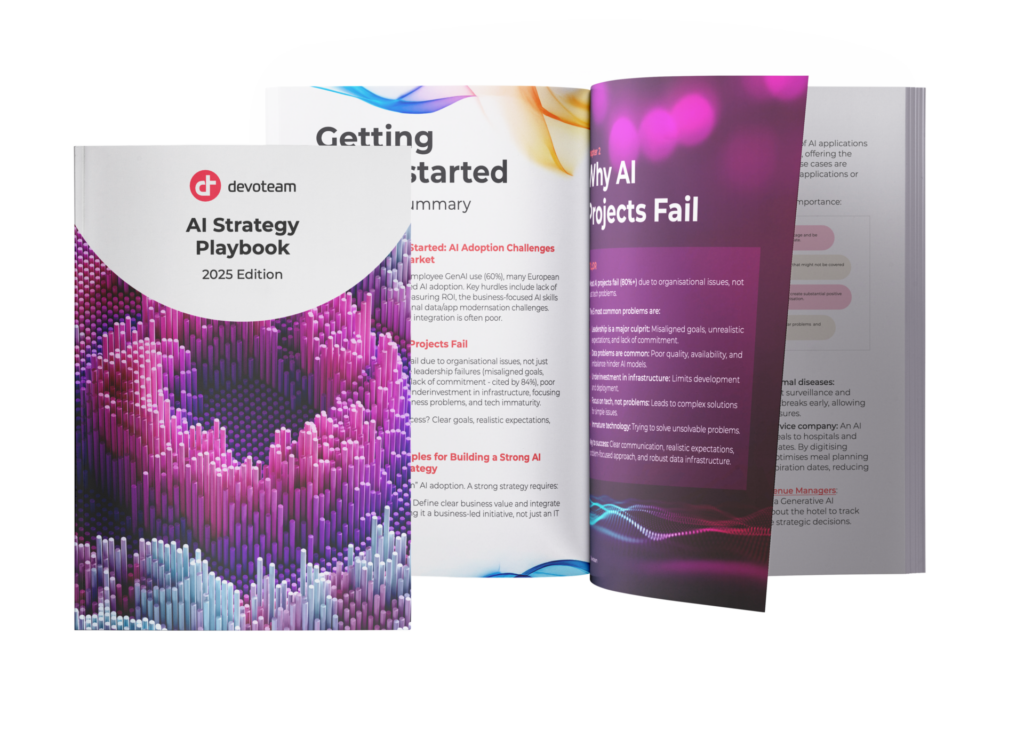
Download our AI Strategy Playbook:
- Learn why AI projects often fail (and how to avoid it).
- Follow 10 clear steps for a strong AI plan.
- Focus on solving business problems (not just using AI).
- Find the best AI uses for your business (includes 100+ examples).
- Learn how to measure AI results (GenAI projects average ~3.7x return).
- Get your tech foundations ready (Cloud, Data, and AI Security).
- Help your team adapt to AI (and see how we train our staff).
- Use AI responsibly (covering fairness, bias, and environmental thoughts).