


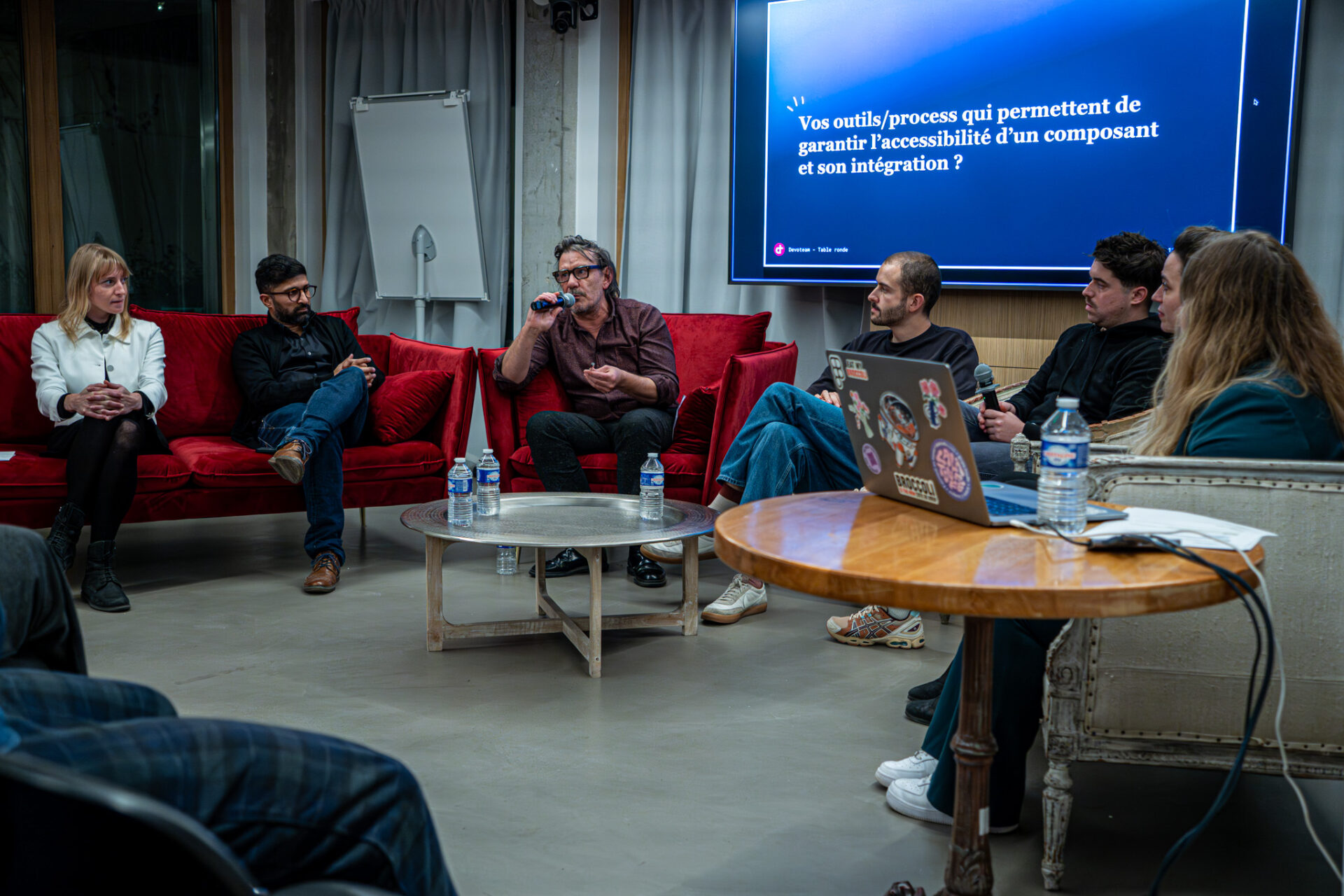
Since the implementation last June of the new European directive ensuring access to certain services and products for people with disabilities, digital accessibility can no longer be treated as an isolated topic, whether technical or design-related. It requires a systemic approach, and the design system has become the structural tool for deploying it at scale. This was the shared observation of speakers at our roundtable bringing together experts from Carrefour, Radio France, Ipedis, and the banking sector, moderated by Sarah Guenkine (Lead Digital Accessibility at Devoteam) and Adeline Pessard (Lead Design System at Devoteam).
Antoine Dehoux (Lead DS Manager at Carrefour), Moïse Akbaraly (co-founder of Ipedis), Joshua Grade (DS Designer at Radio France), Ivan Tozzi (Design System Manager at a banking company), and Loraine Duclaux (Product Ops at Devoteam) shared their experiences, covering regulatory constraints, organisational challenges, and concrete successes. A look back at the practices and lessons learned from these organisations at various levels of maturity.
Design Systems at Different Stages of Maturity
The speakers presented design systems of comparable scale but with different priorities. Carrefour and the banking company demonstrate high maturity in design systems, while Ipedis stands out for its advanced accessibility expertise. Radio France, meanwhile, positions itself at an intermediate level on both dimensions.
At Carrefour, acceleration occurred post-COVID with 70 components deployed across 5 technologies for 100 active users. Ivan Tozzi’s design system also features 70 components in 4 themes (clients, businesses, private banking, branch employees), used by 250 applications and 150 developers across 6 application domains.
Radio France currently manages 3 design systems trending toward unification, with a stated goal of simplification. Ipedis has designed its own design system as an educational tool, with 24 components intended to support around thirty clients in implementing accessibility.
Triggers: Between Legal Constraint and Technical Necessity
While last April’s legal constraint played a role, it wasn’t the only driver. At Carrefour, “everything starts with tech—it provides a foundation,” explains Antoine Dehoux.
For Ivan Tozzi, the initiative began in 2019, facing a pragmatic reality: each project developed its own solutions, making site redesigns extremely complex. Standardisation through best practices naturally led to the design system.
For Radio France, accessibility became a priority just a year ago. With 100% audio content, the organisation has many visually impaired users, which motivated major work on the mobile app, the most used in its ecosystem.
At Ipedis, the goal was to accelerate remediation processes for their clients.
The First Building Blocks of Accessibility
Initial approaches vary by organisation. At Radio France, the first app redesign focused on visually impaired users before extending to the website.
Carrefour focused on semantics, locking in best practices at the Figma stage, notably by limiting colour palettes. Awareness documentation accompanied this approach.
For Ivan Tozzi, the 2019 regulatory constraint provided the impetus, followed by project support and awareness efforts. The team developed accessibility expertise, wrote guidelines for designers and developers, and then created components. For him, “accessibility can only be implemented through the use of a design system. It’s not just a technical or design issue.”
Ipedis adopted a pragmatic approach by prioritising the most problematic components identified during audits, then defining test models with scenarios for each component in given situations.

Who Is Responsible for Accessibility?
The question of responsibility generates consensus. The design system is a supplier that delivers all necessary building blocks. However, it cannot guarantee final production implementation, which it doesn’t control.
For Ivan Tozzi, an implementation layer on the interface remains with projects and developers. Hence, the establishment of guidelines and training to enable Product Owners and developers to test autonomously.
Radio France adopts a similar philosophy: provide guidelines that prevent 90% of problems, give a good foundation, and support teams to help them.
The Role of Product Ops in Accessibility Integration
Loraine Duclaux provided the Product Ops perspective on this issue. Her mission: optimise workflow throughout the product cycle and provide a robust, scalable framework. The design system consists of libraries, but also guidelines.
A certain number of criteria are natively handled by technology, such as colors. On training, “ideally we train everyone, but it’s complex and costly,” she acknowledges. Hence, integrating accessibility fromthe design system onboarding.
For the framework to be effective, it must align closely with team practices. Design system conformity reviews offered to teams can be a good lever for providing accessibility support. This facilitates awareness and communication, as accessibility is often perceived as a constraint.
“Accessibility is a product quality criterion, and therefore concerns the entire team.”
Ensuring smooth interfaces is a concern for everyone, and in this context, the design system can become a true change management tool. The more teams adopt this approach, the more they develop the reflexes necessary for creating accessible components.
At Carrefour, awareness comes through all channels: training designers, creating documentation even if not always read, developing plugins with the goal of delivering the most perfect version possible. The posture is that of a facilitator, even offering GPT tools for image creation.
For Ivan Tozzi, the design system enabled progress on historically difficult ground: co-creation between design and technical teams. For a given need, the team now knows all display contexts and can take the component further than the initial need.
How to Measure Impact?
Indicators vary by organisation. Radio France doesn’t really measure impact yet, except for the number of components created.
At Carrefour, each component has a score with a 100% target. Currently, it’s manual control that must eventually be automated.
Ivan Tozzi hasn’t implemented component scoring but relies on audits, both on components themselves and supported projects. The accessibility rate exceeds 80% on completed audits.
Next Steps
Future ambitions reflect each organisation’s specificities.
Carrefour focuses on automating time-consuming tasks to check everything automatically. In the e-commerce ecosystem with its numerous use cases, automatic reporting becomes crucial. AI integration to automate certain processes is under study.
Ivan Tozzi wants to go further by defining complete patterns: what is a journey? What is a bank transfer? The goal is to increasingly simplify feature usage. On AI, Ivan Tozzi observes that audits can’t be automated, but it helps implement unit tests. “In terms of disability, AI is heavily used. Without accessibility, we can’t respond to AI used by visually impaired clients. AI isn’t just a production mode—it’s also becoming a ‘client.’”
Ipedis is working on mobile components and plans to translate its design system, currently in English, into French.
Difficulties and Successes
The obstacles encountered are multiple. At Carrefour, despite great success with all types of users, ages, and audiences, the main difficulty remains those who consider accessibility optional.
For Ivan Tozzi, top management adoption and budget were challenges. Managing accessibility technical emergencies for large clients can be challenging. But success is achieved: over 250 projects use the design system, facilitating delivery and establishing lasting trust. “Today it’s part of the Bank’s DNA, though adoption was complicated,” Ivan Tozzi notes.
Radio France faces process and implementation difficulties, with fixed and strict deadlines keeping the team in catch-up mode. Nevertheless, success with visually impaired users helps champion the topic with management.
Ipedis learned an important lesson: having designed 100% accessible components isn’t enough, as behaviours change from one screen reader to another. “Hence the importance of user testing. The score isn’t an end in itself; we must include user tests and feedback in the process. We can check all boxes, and sometimes it doesn’t work,” emphasises Moïse Akbaraly. Success is measured by reduced remediation time between audit reports and corrections, and practice harmonisation.
What Would They Do Differently?
For Carrefour, the design system ROI is obvious and has avoided many penalties. However, it would have been better not to wait for legislative constraints, particularly to preserve the brand image.
For Ivan Tozzi, adoption came through perseverance. Showing it’s an innovation and product quality issue, providing clients the simplest product to use, took time. However, the team wouldn’t necessarily do things differently.
Radio France still lacks perspective but believes that integrating more people, faster and earlier, would have avoided many friction points.
Ipedis would have started creating a design system much earlier.
Design System and Accessibility: Advice for Teams
Drawing from these contrasting experiences, speakers share recommendations for teams embarking on accessibility integration. The first pillar remains training involved teams from the start. This awareness must be accompanied by systematic practice. Test early and test often to identify problems quickly, rather than discovering malfunctions at the cycle’s end.
This approach only works if accessibility is integrated as mandatory, not optional. Communication is essential to change perceptions and create a common culture within organisations. It’s also about documenting, centralising, and supporting teams to facilitate adoption by all, while constantly keeping usage and users at the centre of concerns.
Operationally, it’s crucial to think about accessibility from conception rather than correcting afterwards—an approach that avoids both costs and frustrations. This means avoiding imbalance between tech and design by fostering true collaboration, notably through design/accessibility pairs for each component. This comprehensive approach ensures consistent quality.
Facing potential resistance, speakers advise proving value quickly when possible to convince decision-makers and maintain momentum. Finally, for internationally-focused organisations, anticipating multilingual and multicultural dimensions from the start avoids costly backtracking.
These experiences show that integrating accessibility into design systems is a demanding but valuable journey, both for users and organisations themselves. Between regulatory constraints and conviction, between technical obstacles and measurable gains, the path to universal accessibility is built step by step, component by component.