


The insurance industry is facing a defining moment. For decades, traditional carriers set the pace, defined the rules, and shaped the customer experience. Today, that dynamic has flipped. Agile Insurtechs, built natively on cloud, automation, and behavioural intelligence, are rewriting expectations at a speed the industry has rarely seen.
This is more than technological disruption, it’s a shift in mindset, culture, and customer behaviour. And it demands a fundamental reinvention of insurers’ digital ecosystems, not just at the surface, but deep inside their operating models.

“What I see most often is not a lack of ambition, but ecosystems held together by legacy systems, fragmented data, and operating models designed for stability, not speed. That’s where transformation becomes truly hard.”

Pedro Campos
Executive Director and Head of Management Consulting at Devoteam
The Insurtech Advantage: Built for Speed, Trust, and Customer Obsession
Insurtech companies like Lemonade are not simply “more digital.” They operate on entirely different operating principles:
- AI-driven underwriting and instant claims settlement
- Digital-native customer journeys designed around transparency and simplicity
- Cloud platforms with near-zero marginal costs and unlimited scalability
- Data-driven pricing and behavioural models that continuously learn and adapt
Insurtech companies don’t optimise legacy processes. They eliminate them.
They don’t design journeys for compliance. They design for trust, speed, and frictionless interactions.
As Lemonade’s model demonstrates, innovation in insurance is not about technology alone, it’s about using technology to reshape the experience, the economics, and the relationship carriers have with customers. Check the Devoteam expert view on this link.
That said, the Insurtech story is not without its challenges. Speed and simplicity come at a cost, and not every Insurtech manages to turn innovation into sustainable profitability.
Many struggle with rising customer acquisition costs, regulatory pressure, thin margins, and the complexity of scaling trust-based products in highly regulated markets. Others discover that removing friction is easier than building long-term loyalty or underwriting discipline.
In my personal opinion:
“Insurtechs are brilliant at reimagining the front-end of insurance. The real test comes when they need to scale trust, profitability, and risk management at the same time, and not all of them pass that test.”
Pedro Campos
Executive Director and Head of Management Consulting at Devoteam
The Real Pressure: Customers Have Already Moved On
Today’s customers expect insurance to work with the simplicity of their favourite banking app or e-commerce platform: instant decisions, transparent pricing, mobile-first interactions, proactive communication, zero paperwork and personalised options.
This expectation shift did not originate within the insurance market, but it is now firmly embedded within it. Customers no longer compare insurers with insurers. They compare insurers with the last great digital experience they had.
The question for incumbents is no longer: “Should we modernise?”
It is: “How fast can we close the experience gap?”
Modernisation Is Not Cosmetic – It’s Structural
Despite clear roadmaps and strong intentions, many insurance transformation programmes fail to deliver their expected outcomes. Not because the technology is wrong, but because the organisation isn’t ready.
“In my experience, transformation fails less because of technology and more because of internal politics, accumulated technical debt, and the fear of disrupting existing revenue streams. Modernisation challenges the status quo, and that’s where resistance emerges.”
“Without leadership alignment and the courage to simplify, even the best architectures end up reinforcing old ways of working.”
Pedro Campos
Executive Director and Head of Management Consulting at Devoteam
Many insurers respond to disruption by building apps, launching portals, or rebranding services as “digital.” But true modernisation requires structural reinvention across four critical layers:
Modernisation requires structural reinvention across four layers:
1. Cloud-Native Foundations
Moving beyond infrastructure migration to build scalable, elastic, modular architectures that accelerate delivery and reduce operational complexity.
2. Data & AI as Core Business Engines
Not isolated innovation labs, but end-to-end decision intelligence powering underwriting, pricing, fraud detection, claims automation, and personalised experiences.
3. API-Based Ecosystems & Partnerships
Future insurance models depend on integration with mobility, health, smart home, banking, cybersecurity, and more. Insurers must evolve from closed systems into platform players.
4. Product and Process Simplification
Technology cannot compensate for unnecessary complexity. Simplification unlocks speed, reduces cost, and enables real-time customer experiences.
This is where insurers either scale or stall.
The Leadership Imperative: Reinvention Starts With Purpose and Clarity
Technology alone will not close the gap between incumbents and Insurtechs. Leadership will.
Insurers must embrace a mindset shift:
- from risk-avoidance to controlled experimentation
- from siloed operations to integrated ecosystems
- from internal efficiency to customer-centric value
- from “technology projects” to business transformation powered by technology
In my experience leading digital and cultural transformations across industries, success always comes down to the same question:
Does leadership have clarity of purpose, and the courage, to act on it?
The insurers that thrive will be those that align strategy, technology, and culture around a shared mission: delivering transparent, simple, meaningful protection in a world that expects instant value.
The Devoteam Perspective: Technology as a Catalyst for Reinvention
Across Europe, we see insurers accelerating cloud adoption, modernising core systems, and operationalising AI at scale.
At Devoteam, we support this journey by combining digital transformation consulting with:
- cloud expertise (AWS, Azure, Google Cloud)
- data & AI architecture
- process automation and intelligent decisioning
- digital strategy and operating model design
- cultural transformation and change leadership
But the real differentiator is understanding that technology is not the destination, it’s the enabler. Reinventing digital ecosystems requires not just tools, but clarity, leadership, and a holistic view of the business. In this expert view, Devoteam’s CTO explains why you need a strategy over shiny tools.
Insurtechs have proven what is possible. But incumbents have something equally powerful: scale, trust, and a deep societal role.
When these strengths are combined with modern platforms and customer-centric innovation, the potential for transformation is extraordinary.
The Wake-Up Call: The Moment to Reinvent Is Now
Insurance sits at the crossroads of risk, society, and life events. They come in when people need confidence and clarity the most. The industry has the opportunity to redefine itself, not as a slow-moving necessity, but as a proactive, intelligent, and human-centred partner.
The opportunity is clear: combine the scale of incumbents with the speed of Insurtechs.
The carriers who act now will lead the next decade. The ones who wait will inherit systems, mindsets, and expectations they can no longer control.
The wake-up call has already sounded. Now is the moment to reinvent, boldly, intentionally, and with purpose.
Over 80% of AI projects fail. Yours don’t have to.
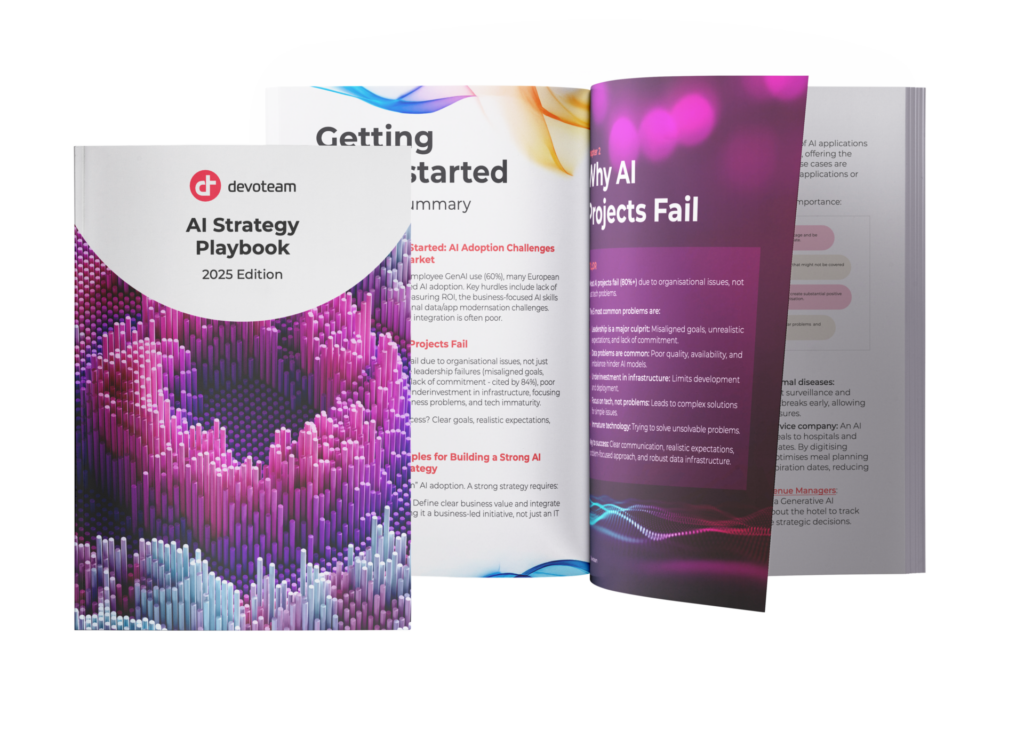
Download our AI Strategy Playbook:
- Learn why AI projects often fail (and how to avoid it).
- Follow 10 clear steps for a strong AI plan.
- Focus on solving business problems (not just using AI).
- Find the best AI uses for your business (includes 100+ examples).
- Learn how to measure AI results (GenAI projects average ~3.7x return).
- Get your tech foundations ready (Cloud, Data, and AI Security).
- Help your team adapt to AI (and see how we train our staff).
- Use AI responsibly (covering fairness, bias, and environmental thoughts).