
Estimated reading time: 9 minutes
What you’ll read in this article:
The Stakeholder Paradox
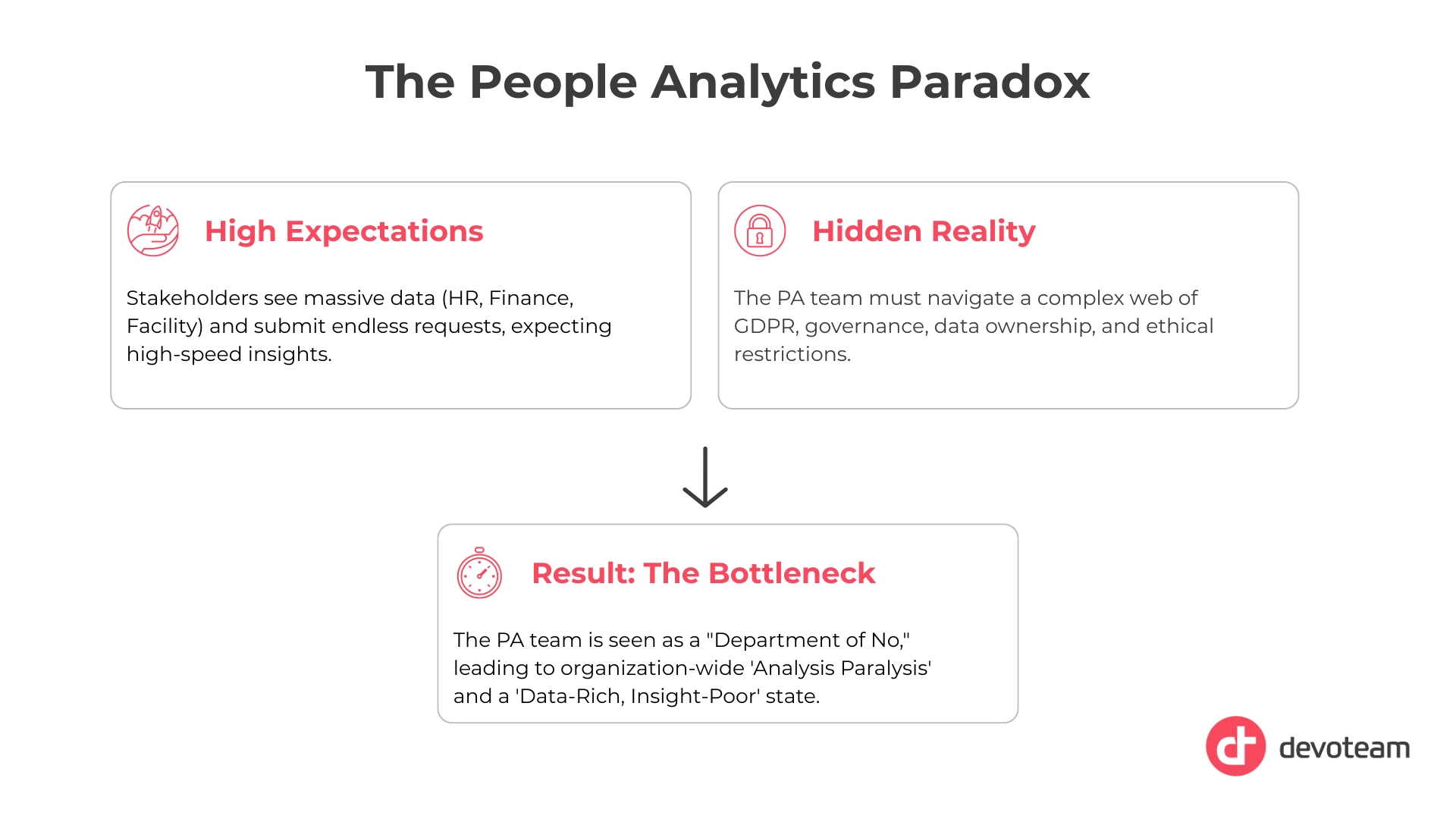
The modern, centralised People Analytics function is facing a central paradox: stakeholders see massive amounts of data across the HR, finance, facility, and many more, envisioning its potential, and are submitting an increasing volume of requests. This creates rising expectations for specialised people analytics departments to combine base employee data and history with survey answers, time registration, and physical workplace. Yet, underneath this apparent data availability lies a complex web of unseen legal, governance, and business restrictions.
Before an analysis can proceed, teams must navigate GDPR compliance, track down data owners, and consider the ethical implications of invasiveness. This dynamic inevitably creates a high-friction environment where the People Analytics team is trapped in an impossible position. It’s a challenging pattern we at Devoteam observe regularly in enterprise-scale organisations. Stakeholders, often unaware of these compliance layers, perceive the team as a ‘department of no,’ while in reality, they are simultaneously expected to serve the business with agility and act as the primary guardian against significant legal, ethical, and brand-related risks.

“Stakeholders, often unaware of data compliance layers, perceive the analytics team as a ‘department of no,‘ while in reality, they are trapped… expected to serve the business with agility and act as the primary guardian against significant legal, ethical, and brand-related risks.”

Oliver Fredborg Smietana
Consultant at Devoteam
The Cost of ‘Analysis Paralysis’
The result isn’t just frustration; it’s a crippling ‘analysis paralysis’ for the entire organisation. The immense business value that stakeholders are right to envision remains locked away. It leaves the company stuck in a ‘data-rich but insight-poor’ state. Any attempt to bypass this gridlock and move faster without a proper framework increases the risk of data breaches, employee trust violations, and costly non-compliance penalties. This paradox, therefore, isn’t just an inconvenience. This paradox is the single biggest barrier preventing the company from scaling its analytics capabilities and becoming a truly data-driven organisation.
Competing Truths Erode Trust
This paralysis is compounded by a second problem: the loss of a single source of truth. When the central PA team’s slow time to market for insights turns them into a bottleneck, stakeholders develop their own solutions. This results in multiple, conflicting analyses on the same topic. Finance, for example, may calculate ‘headcount’ using one set of rules, while HR uses another. The CEO-office might pull a ‘turnover’ report for their quarterly reporting, which directly contradicts the official numbers. The consequence is confusion and an erosion of trust in the data. Instead of making data-driven decisions, leaders are stuck in meetings debating ‘whose number is right?’ The relevant conversations, like ‘what should we do about our attrition problem?’ are postponed in favour of conversations about ‘which number is correct’. This lack of a ‘true’ number effectively diminishes the impact of the data, and hinders meaningful changes in the business.
The Premature Leap to AI
To complicate matters further, stakeholders are no longer satisfied with historical reports. They are now asking for the future: predictive insights, AI, and machine learning. The business wants to know ‘which high-performers are at risk of leaving?’, not just ‘what was our turnover rate?’ The People Analytics team, already overwhelmed by governance bottlenecks and battling data trust issues, is now expected to leapfrog into advanced data science. They are being asked to build complex predictive models on a data foundation that is fragmented, untrusted, and fundamentally not ready.
A Practical Plan for Building an Effective People Analytics Function
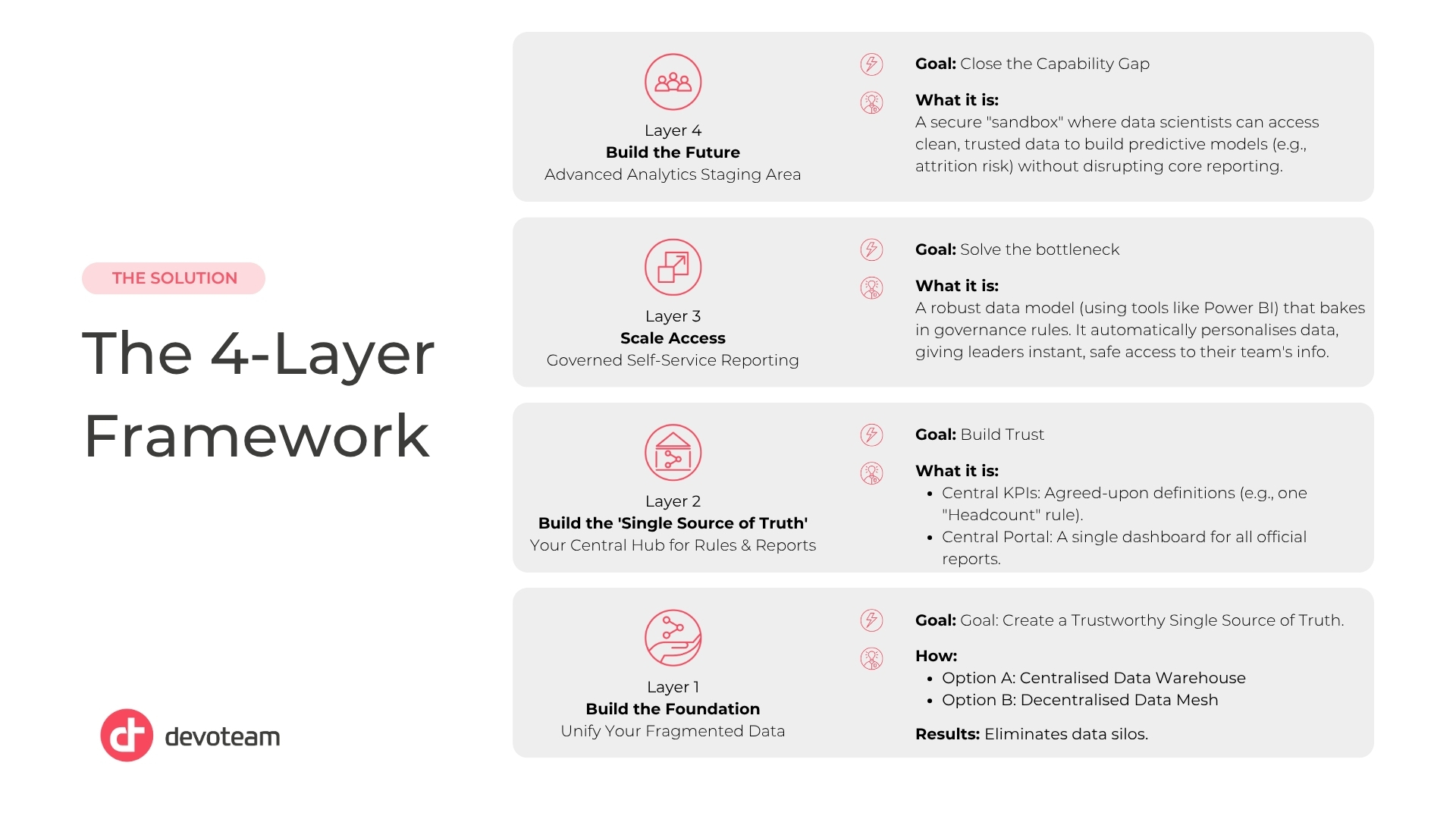
The problems of analysis paralysis, eroded trust, and the predictive capability gap are symptoms of a broken data foundation. It’s better to not ignore the question ‘“How’s Your Data Team Organised?’ and have a discussion on your data operating model. Based on our experience at Devoteam, we recommend a four-layer framework. This framework enables the People Analytics team to transition from a reactive bottleneck to a strategic enabler. It consists of four key layers:
Build the Foundation: Unify Your Fragmented Data
In our experience helping clients, establishing the right data foundation to solve the fragmented data problem is the critical first step. The fundamental goal is to create a trustworthy single source of truth, eliminating the data silos that cause conflicting reports. How you achieve this depends on your organisation’s scale and structure.

Option A: The Centralised Data Warehouse
For most organisations, the most direct path is building a centralised data warehouse. This system automatically ingests and integrates data from all disparate sources (HRIS, ATS, engagement tools). This unification creates a powerful, single view of all people data, forming the bedrock for all subsequent analytics. Although centralising sensitive people data requires care, this option is highly secure when implemented with modern controls. Features like row-level security, role-based access, and data masking are designed to solve this exact challenge, making it a powerful choice for many.
Option B: The Decentralised Data Mesh
However, in larger, more complex, or highly federated companies, a centralised-only approach can create its own bottlenecks. A more modern alternative is the Data Mesh. This is a decentralised architecture where data is treated as a product. In this model, individual domains (like your People Analytics team) take full ownership of cleaning, integrating, and serving their specific data (e.g., Attrition, Headcount) as a reliable, discoverable product for the rest of the business to consume.
Both approaches can address the “fragmented data” problem. They establish a single source of truth, which is essential for building trust. Choosing the right foundation, or often a hybrid of the two, is the critical first step in scaling your analytics capabilities. Read our complete guide on building Data Foundations with Cloud Data Platforms.
Build the ‘Single Source of Truth’: Your Central Hub for Rules and Reports
A data warehouse alone doesn’t build trust; trusted information does. This requires two key components: clear, agreed-upon definitions and a single, reliable place to access the data. The first step is developing and documenting central KPIs, which forces consensus on critical terms like Headcount or “Attrition Rate.” These rules are then built directly into the data models.
The second, crucial step is creating a single, promotable access point, such as a central analytics portal or dashboard suite. This hub becomes the one place where stakeholders can find both the official reports and the aligned documentation that defines them. This combination is what finally silences the ‘my number vs. your number’ debate, giving the entire organisation one unified source for clearly defined people information.
Scale Access: Enable Governed Self-Service Reporting
With a trusted single source of truth, you can solve the bottleneck problem through robust data modelling. This model is the crucial layer between the data warehouse and your BI tools (like Power BI or Tableau). It translates raw, complex data into clear business logic and, most importantly, bakes in your governance rules. The end result is a set of reliable, governed assets, such as Power BI’s certified datasets or Tableau’s published data sources, that your entire company can trust.
This is what empowers leaders to get instant, accurate answers, slashing the time-to-market for data from weeks to seconds. Getting this security and personalisation layer exactly right is incredibly challenging, as it means modelling the complex “hierarchy data” (like dotted-line reporting) and not just the simpler “people data” (like hire dates or demographics). When built correctly, the data model itself enforces security, automatically personalising reports and dashboards. It scopes each leader’s view only to their direct reports or function. This is what truly liberates the PA team from endless ad-hoc requests and gives stakeholders data without creating compliance risks.
When built correctly, the data model itself enforces security, automatically personalising reports and dashboards.

Gustav Anholm
Lead Data & Analytics Consultant at Devoteam
Build the Future: A Staging Area for Advanced Analytics
Finally, to close the “capability gap,” you must build on this stable foundation. A dedicated staging area for advanced analytics provides a secure sandbox where data scientists can access clean, trusted data. This allows them to build the predictive models stakeholders are asking for (like “who is at risk of leaving?”) without disrupting core business reporting.
Are You Ready to Scale?
The challenges facing People Analytics place organisations at a critical crossroads. You can either continue in the high-friction “analysis paralysis” state or build the scalable, governed foundation required for a data-driven future.
Proven Frameworks: Case Examples
Building this framework delivers real, tangible results. With our clients, we’ve seen the power of solving these challenges firsthand:
- End-to-end analytics setup covering People data in a large pharma company, covering pipelines and data flow in the back-end to self-service enablement, landing pages, reporting, and governance.
- Built a central hub with access to all data analytics assets for a large-scale Danish IT company.
- Talent Acquisition for a large pharma company, combining data from various systems to analyse the entire talent acquisition funnel from job posting to final hire.
- For a financial sector client, we consolidated dispersed, on-premise legacy systems into a unified cloud environment. This new foundation resolved critical performance and GDPR challenges using tokenisation, enabling governed, self-service analytics across the organisation
- We implemented a scalable, hybrid, self-service data & analytics platform for a pharma company, empowering data users with a solution their own teams could take over and maintain.
- And many more! Discover all our data success stories.
From Data Bottleneck to Enabler
This is precisely where our expertise lies. At Devoteam, we help organisations build the data products and platforms that transform People Analytics from a bottleneck into a strategic business enabler. No matter your maturity level. If you’re ready to move to the next stage of your people analytics journey, get in touch.