


Legacy systems are expensive anchors. They consume up to 30% of your development capacity on maintenance, leaving little room for innovation. Yet simply migrating to AWS without rethinking architecture only moves the problem to the cloud.
Real modernisation means asking the right questions first: What business outcomes do we need? Where are the hidden dependencies in our systems? Should we rebuild or construct in parallel?
This strategic approach, prioritising business understanding over technical decisions, is what distinguishes successful transformations from costly migrations.
In this article, you’ll read:
The Modernisation Imperative
Businesses face pressure to innovate, but legacy systems hinder their ability to respond to market changes. These outdated applications have monolithic structures and manual processes that resist change.
Simply moving legacy systems to AWS through “lift-and-shift” migration doesn’t solve the core problems. While it may reduce infrastructure costs, it transfers the same inefficiencies to the cloud. A monolith remains a monolith, with the same scaling issues, tight coupling, and deployment risks.
Real modernisation means leveraging AWS services to rethink how applications are built and managed. This includes using containerization with Amazon ECS or EKS, serverless computing with AWS Lambda, and managed databases like Amazon RDS or DynamoDB. It means treating IT as a strategic asset for growth, not just a cost centre.
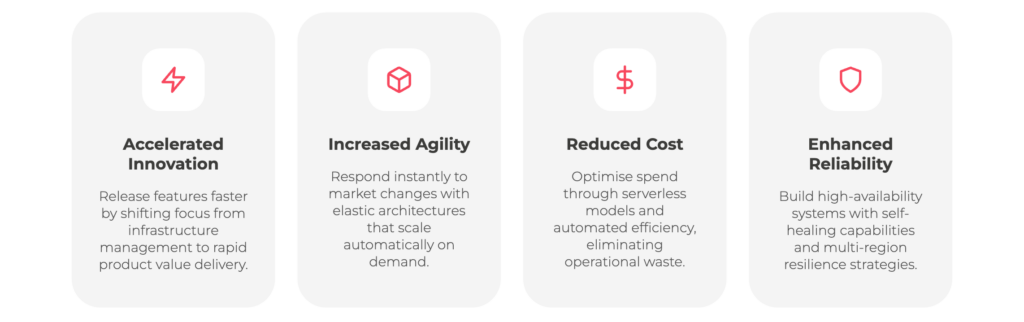
Modernisation on AWS is a strategic fusion of business objectives and technical execution. By transforming legacy environments into agile, elastic, and highly available systems, organisations directly drive four key outcomes:
- Accelerated innovation
- Increased agility
- Reduced cost
- Enhanced reliability
This article examines these business drivers, connects them to core technical strategies such as refactoring, serverless computing, and agent-based AI, and outlines the metrics necessary to measure and sustain long-term success.
The Devoteam Approach: Beyond Technical Migration
As an AWS Premier Consulting Partner, Devoteam stands out through a strong conviction: modernisation isn’t just about replacing technology components with cloud services. This vision forms the foundation of a consulting approach that places business understanding at the heart of transformation.
End-to-End Expertise on the MAP Program
Devoteam supports its clients throughout the entire AWS modernisation cycle, leveraging the MAP (Migration Acceleration Program):
- Assess: workload identification and migration strategy definition
- Mobilise: organisational and technical migration preparation
- Migrate: actual application migration to AWS
- Modernise: modular transformation and continuous optimisation
- MSP: post-migration operational maintenance
This coverage ensures consistency throughout the project and avoids the gaps often seen when multiple providers work sequentially on different phases.
From Technical to Product: A Paradigm Shift
As Nicolas LU emphasises: “DevOps is often reduced to an automation profile, when it’s primarily a philosophy that enables effective dialogue between different business units and builds shared understanding.”
This philosophy permeates Devoteam’s entire approach. Rather than starting from a purely infrastructure-based view, teams adopt a product-oriented methodology that prioritises business needs and functional vision over technical choices. This reversal of traditional logic builds architectures that truly serve business objectives, rather than infrastructures to which needs are later adapted.
The use of collaborative workshops illustrates this commitment to creating a common language between business teams, developers, and infrastructure teams. This convergence of understanding is the true success driver for modernisation projects, far beyond technical considerations alone.

Each team brings its own expertise: developers master the code, business teams carry the functional vision, and ops ensure stability. The challenge is not individual but collective: creating a common language that enables these three worlds to understand each other and converge toward a shared objective.
Nicolas Lu
AWS Solution Architect at Devoteam
Customer usecase: Discover Mondaq’s AWS Migration & Modernisation Success
Creating Business Value with AWS Modernisation
The decision to modernise must be rooted in business value. Technical upgrades performed in a vacuum often fail to secure the necessary funding or organisational buy-in. Leaders must frame modernisation around four primary pillars: innovation, agility, reliability, and cost optimisation.
Accelerate Innovation: From Idea to Market in Record Time
In a legacy environment, the challenge is rarely a lack of good ideas; it is a “speed to market” problem. The friction involved in provisioning infrastructure, configuring security, and navigating manual deployment pipelines means that even simple prototypes can take months to reach users. To gain a competitive edge, businesses need to rapidly prototype and test applications tied to specific business cases.
AWS enablers enable teams to utilise advanced technology without requiring expertise in infrastructure. For example, the introduction of the Amazon Nova model family, including Nova 2 Sonic for conversational AI and Nova 2 Lite for cost-effective reasoning, provides developers with frontier-level AI capabilities that can be integrated via simple API calls.
Managed services like Amazon SageMaker AI with serverless MLflow allow data science teams to experiment with zero-infrastructure setup, cutting prototyping time from weeks to minutes. By offloading the “undifferentiated heavy lifting” of infrastructure to AWS, organisations can focus their most talented resources on building features that differentiate the business in the eyes of the customer.
Become More Agile: Scaling & Evolving with Business Needs
Business agility is the ability to scale resources for peak demand,such as a product launch or a seasonal spike,and to evolve systems so that small changes can be made safely and quickly. In a legacy monolith, scaling is binary and expensive; you must scale the entire application, even if only one component is experiencing high load.
AWS enables agility through elasticity and the principle of loose coupling. Services like Amazon SQS and SNS enable microservices to communicate asynchronously, meaning that a failure or change in one service does not necessitate a system-wide outage or redeployment. This architectural style, combined with Auto Scaling Groups, ensures that the system grows and shrinks automatically based on real-time demand. Furthermore, the rise of agentic AI, such as the Kuro Autonomous Agent, enables development teams to scale their output by delegating routine tasks, like bug fixing and backlog management, to autonomous “AI teammates” that maintain context across workflows.
Customer usecase: Discover how Mercado migrated to AWS and improved scalability and reliability
Increase Quality, Reliability & Security: The Foundation of Trust
Downtime is more than just lost revenue; it is an erosion of customer trust that can take years to rebuild. Modernisation shifts the operational burden of maintaining high availability to AWS. Managed services like Amazon RDS and Amazon Aurora provide automated patching, backups, and high availability across multiple Availability Zones (AZs) by default.
The security landscape is also transformed through modernisation. Traditional security models often rely on a “perimeter” approach that is easily bypassed once an attacker gains entry. Modernised applications on AWS use the “Security-by-Design” approach.
The new AWS Security Agent, for instance, proactively reviews design documents and scans code for vulnerabilities during the development process, identifying risks before they ever reach production. By utilising services like Amazon GuardDuty for extended threat detection across both EC2 and ECS (containers), organisations can achieve a unified security posture that is resilient to complex, multi-stage attacks.
Reduce & Optimise Costs: From CapEx to OpEx Precision
Modernisation requires a strategic trade-off based on an economic equation: is it better to deconstruct and rebuild the existing system, or build new modules in parallel before switching over?
Nicolas Lu
AWS Solution Architect at Devoteam
Legacy IT procurement is characterised by “CapEx”, where organisations overprovision expensive hardware to handle hypothetical peak loads. Modernisation turns this fixed capital expense into a variable operational expense (OpEx) where the business pays only for what it uses.
AWS Cost Explorer and the newly introduced AWS Cost Efficiency Score provide precise, real-time insight into cost drivers. This transparency allows FinOps teams to identify idle resources and rightsize instances with surgical precision. The launch of Database Savings Plans in 2025 further enhances this by offering up to 35% savings for a one-year commitment to a consistent amount of usage across all database services, including serverless and provisioned instances.
This flexibility is critical for organisations in the middle of a modernisation journey, as they can switch database engines (e.g., from RDS SQL Server to Aurora PostgreSQL) while still receiving the discounted rate.
| Cost Driver | Legacy Impact | Modernised Impact (AWS) |
| Provisioning | Overprovisioned for peaks | Auto-scaling and “scale-to-zero”. |
| Licensing | Expensive proprietary licenses | Move to open-source (Aurora, Graviton). |
| Maintenance | Manual patching and updates | Automated managed services. |
| Hardware | Fixed 3-5 year depreciation | Pay-as-you-go / Savings Plans. |
Core Technical Strategies for AWS Modernisation
Achieving the business benefits outlined above requires a deliberate technical strategy. The path is often non-linear, beginning with stabilisation and moving toward full cloud-native optimisation.
Replatforming & Refactoring Applications
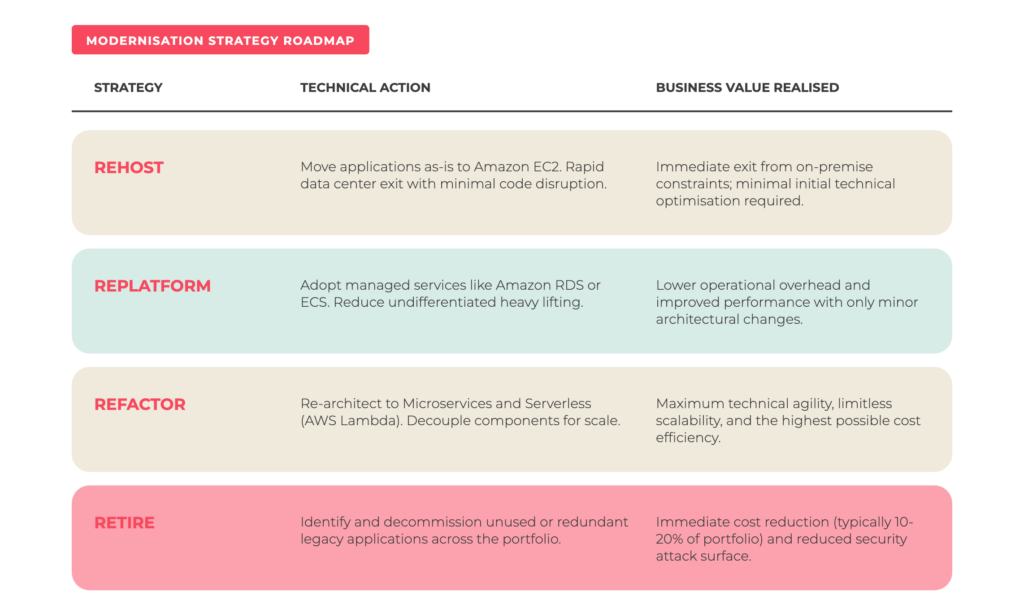
The technical deep dive begins with the “7 Rs” of migration, with Replatforming and Refactoring being the primary vehicles for true modernisation. Replatforming, often referred to as “lift-and-tinker,” involves making minimal changes to achieve a tangible benefit, such as migrating an on-premises PostgreSQL database to Amazon RDS for PostgreSQL to eliminate database administration overhead.
Refactoring, or “re-architecting,” is a more profound transformation. It involves breaking a large, monolithic application into smaller, independent microservices. This is driven by a strong business demand to scale or to accelerate the release of new features. A link between business and technology is evident here: you cannot achieve the agility or innovation required for modern digital business with a monolith. Refactoring is the foundational work required to enable small, autonomous teams to deploy features independently and rapidly without waiting for a massive, coordinated release cycle.
Modernising with Containers, Serverless & DevOps
If refactoring is the goal, containers and serverless are the engines. Containerisation (via EKS or ECS) allows applications to run consistently across any environment, making it the perfect home for refactored microservices. Serverless (via Lambda or Fargate) represents the next evolution, where there are no servers to manage, and developers focus purely on code.
The cultural and automation “glue” for this engine is DevOps. Creating CI/CD (Continuous Integration/Continuous Deployment) pipelines using AWS CodePipeline and CodeBuild allows for the automated testing and deployment of code. The business-tech link is clear: serverless enables cost reduction by only running when needed, while a mature DevOps pipeline is the literal engine of innovation, allowing code to be deployed multiple times per day rather than once per quarter. New 2025 announcements, such as AWS Lambda Managed Instances, allow organisations to combine the simplicity of Lambda with the flexibility and pricing models of EC2, providing a bridge for steady-state workloads that still require high performance.
API Management & Integration
As monoliths are broken into microservices, the complexity of communication between these services increases. Amazon API Gateway acts as the secure “front door”, handling authentication, throttling, and routing for dozens or even hundreds of internal services.
API Gateway is what makes a loosely coupled system manageable, providing a single point of entry for external and internal consumers. Beyond management, APIs enable new business models by allowing organisations to securely expose their services as products to partners or customers. This “API-first” approach is a primary driver of innovation, enabling third-party developers to build upon the enterprise’s core capabilities.
| Technology | Role in Modernisation | Key AWS Service |
| Containers | Portable microservice execution | Amazon EKS |
| Serverless | Event-driven, no-ops compute | AWS Lambda |
| DevOps | Automated delivery pipeline | AWS CodePipeline |
| API Mgmt | Secure service integration | Amazon API Gateway |
AWS Transform: New Announcements from re:Invent 2025
Re:Invent 2025 marked a major milestone for AWS Transform, introducing capabilities that significantly lower the barrier to large-scale modernisation.
AWS Transform enables organisations to define their own organisation-specific modernisation rules using natural language and code samples. This allows the AI agent to learn and apply a company’s unique coding standards and architectural patterns across hundreds of repositories.
Additionally, the launch of the Full-Stack Windows Modernisation Agent now automates the coordinated transformation of .NET applications and SQL Server databases into Linux-compatible Blazor and Aurora PostgreSQL, potentially reducing operating costs by up to 70%.
AWS also introduced specialised agents for DevOps and Security, which autonomously investigate incidents and review design documents to prevent vulnerabilities, effectively embedding expert-level guidance into every stage of the software development lifecycle
Measuring & Sustaining Your Success
Modernisation is not a one-time event but a continuous process. To sustain investment and prove value to stakeholders, organisations must move from basic monitoring to deep observability and use standardised performance metrics.
From Monitoring to Observability
Standard monitoring tools answer questions like “Is the server up?” or “Is CPU usage at 90%?” While necessary, these metrics are insufficient for modern, distributed systems. Observability, enabled by AWS X-Ray and Amazon CloudWatch Logs, answers deeper questions like “Why is the ‘add-to-cart’ button slow for users in a specific region?”
This shift to observability is the technical proof of quality and reliability. By tracing requests across multiple microservices, teams can find the root cause of issues before they impact a large number of customers. The 2025 introduction of AI-powered “5 Whys” analysis in CloudWatch Investigations automates this process, drawing on decades of Amazon’s internal operational discipline to guide DevOps teams through complex troubleshooting.
Delivery Performance Monitoring
To measure the success of a modernisation initiative, the C-suite should look at DORA (DevOps Research and Assessment) metrics. These metrics measure the effectiveness of the development process itself:
- Deployment Frequency: How often the organisation successfully releases to production.
- Lead Time for Changes: How long it takes for a code commit to reach production.
- Change Failure Rate: What percentage of deployments cause an issue?
- Time to Restore Service: How fast the organisation can recover from a failure.
These metrics are the direct report card for Agility (Deployment Frequency) and Innovation (Lead Time), balanced with Reliability (Change Failure Rate, Time to Restore). A high-performing modernised organisation is one that can deploy code multiple times a day with a low failure rate and a rapid recovery time.
Conclusion
Modernisation isn’t just a technical matter. It primarily aims to make the application more elastic, agile, and aligned with modern architectures. Before getting started, it’s essential to ask the right questions: why modernise, what is our level of understanding of the existing system, and how do we proceed in a controlled manner.
Nicolas Lu
AWS Solution Architect at Devoteam
Modernisation on AWS is a new operating model designed for the digital age. By moving beyond rehosting and embracing strategies like refactoring, serverless, and containerization, organisations align their technology directly with their business goals.
The transition from legacy technical debt to an agile, AI-ready architecture allows enterprises to realise tangible business outcomes in innovation, agility, cost, and reliability. Whether it is using AWS Transform to reimagine mainframe functions or adopting Database Savings Plans to optimise costs, the goal is to create a system that can evolve as fast as the market requires.
Maximise Your Cloud Benefits with AWS
Ready to migrate to AWS but unsure where to start? Learn how to avoid common migration pitfalls and achieve real business transformation.
- Plan your migration properly, focusing on business value
- Connect cloud strategy to your business goals
- Prepare your organisation for successful transformation