


Estimated reading time: 14 minutes
Data is a critical asset for many organisations. However, many find themselves struggling to leverage their data effectively. Their data is often siloed, inconsistent, difficult to access, and time-consuming to prepare for analysis. This is where the concept of a Data Platform or Data Foundation comes into play. A data platform offers a robust and streamlined approach to managing and leveraging your data assets.
This article explains why you should build a strong cloud data foundation. It explores the added value it brings to businesses across various industries.
In this article, you’ll read:
- What is a data platform or data foundation?
- Data challenges you can solve with data platforms
- 6 Benefits of Cloud Data Platforms
- The Technological Components of a Data Platform
- Step by step plan to build your data foundation
- Success Cases: Transforming Businesses with strong data platforms
- Building a Data Foundation: start to prepare your future needs now
- Ready to transform your data into a strategic asset for analytics, AI, and sustained business success?
What is a data platform or data foundation?
At its core, a cloud data foundation serves as the bedrock of your data strategy. It’s a unified and well-governed environment that integrates data from various sources. Additionally, it transforms the data into a consistent and usable format, and makes it readily accessible for analysis and decision-making.
A data foundation is the essential infrastructure that empowers your business to move beyond simply collecting data to actively leveraging it for tangible benefits.
The value proposition of a data foundation is clear. It transforms raw, often chaotic data into actionable insights that drive business advantage. By establishing a solid data foundation, your organisation can experience a multitude of benefits, including accelerated time to insights; improved data quality; enhanced agility and scalability; stronger data governance and security. It also brings you optimised resource utilisation and cost efficiency and self-service analytics.
Ultimately, a robust data foundation empowers your business to move swiftly and confidently, making data-backed decisions that lead to better outcomes, increased efficiency, and a stronger competitive position. It addresses the common data challenges that often hinder progress. Once your solid cloud data platform is established, you can evolve its capabilities to support specific AI data platforms.

Data challenges you can solve with data platforms
The digital age creates more data than ever before. Organisations have vast amounts of data originating from many sources – customer interactions, sales transactions, marketing campaigns, operational systems, IoT devices, and more.
An IDG study even claims that an average enterprise analyses over 400 data sources.
This data deluge, while holding immense potential, often presents significant challenges for organisations:
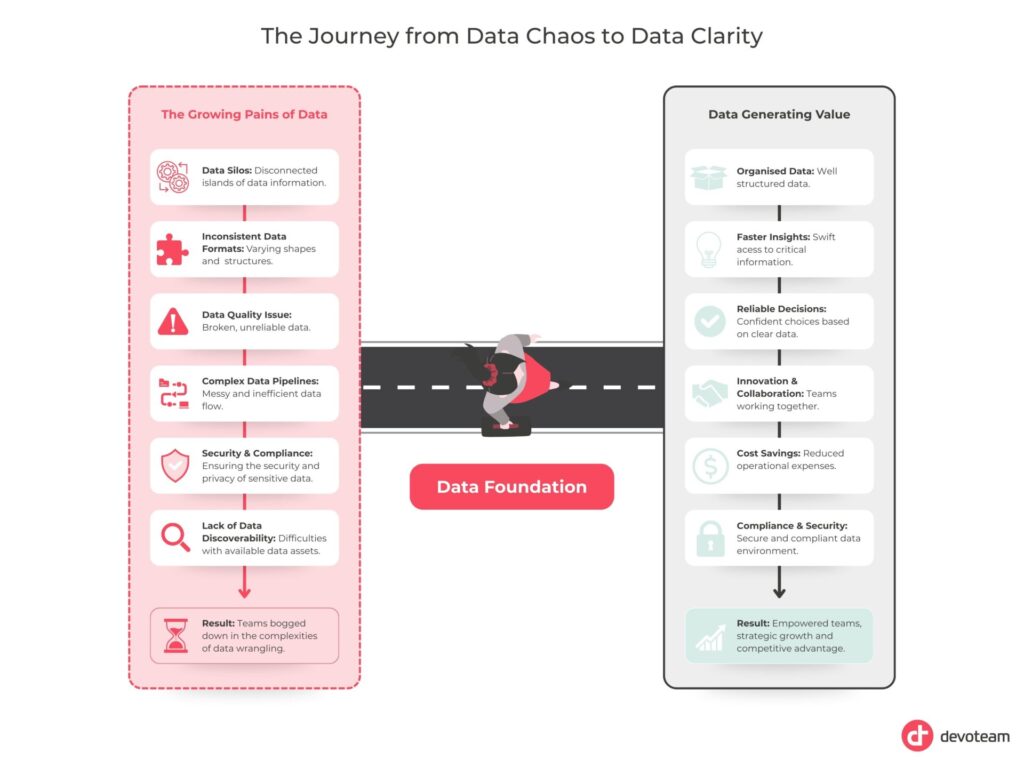
- Data Silos: Data residing in disparate systems and departments, making it difficult to gain a holistic view of the business.
- Inconsistent Data Formats: Data from different sources often comes in varying structures and formats. It requires significant effort for integration and standardisation.
- Data Quality Issues: Inaccurate, incomplete, or outdated data can lead to flawed analyses and misguided decisions.
- Complex Data Pipelines: Manual and fragmented data processing workflows prone to errors and difficult to maintain.
- Security and Compliance Concerns: Ensuring the security and privacy of sensitive data while adhering to evolving regulatory requirements.
- Lack of Data Discoverability: Difficulty in finding and understanding available data assets, leading to duplication of effort and missed opportunities.
While offering immense scalability and flexibility, a cloud-native data warehousing environment presents new challenges. Data needs to be easily discoverable and available for both technical and business users. Maintaining data security requires clear data lineage and the ability to apply fine-grained access control principles. Ensuring consistency across data and transformations becomes crucial. Moreover, new skills and expertise are required to effectively leverage cloud-native technologies, potentially increasing the time to value.
Without a well-defined data foundation, organisations often find their teams bogged down in the complexities of data wrangling. It leaves less time to focus on generating valuable business insights. The workload associated with orchestrating can easily detract from the core goal of leveraging data for strategic advantage.
6 Benefits of Cloud Data Platforms
The benefits of building a data foundation extend far beyond mere technical improvements. They translate directly into significant business advantages:
1. Time Savings and Accelerated Insights
A data foundation’s primary benefit is the reduced time required to access and prepare data for analysis. Instead of spending weeks manually integrating and cleaning data from disparate sources, a well-established foundation automates these processes. Data ingestion tools can seamlessly connect to various systems, and transformation frameworks allow for efficient and repeatable data manipulation.
Consider the scenario where business users need a report on recent sales performance across different regions.
- Without a data foundation, the data team might need to pull data from multiple CRM systems, reconcile different product codes, and manually format the data for reporting. This process can take days, if not weeks.
- With a data foundation in place, the relevant sales data is already ingested, transformed into a consistent format, and readily available in a central data warehouse. Business users can then generate their reports and dashboards in a fraction of the time, leading to faster insights and more timely decision-making. If you were to build a data foundation yourself from scratch, you would need 8 weeks – while with Devoteam’s data foundation factory, 1 week would be sufficient. Building a data foundation from scratch typically takes at least 8 weeks, whereas Devoteam’s Data Foundation Factory you can achieve this in just 1 week.
2. Ensuring Data Consistency and Quality
Data quality is paramount for reliable analysis and informed decision-making. A data foundation implements mechanisms to ensure data accuracy, completeness, and consistency. This includes enforcing naming conventions for tables and columns, standardising data descriptions, and embedding data quality tests within the transformation pipelines. Tools like Elementary can be integrated to provide data quality reports and tracking. By establishing a single version of the truth, a data foundation eliminates the confusion and errors that can arise from working with inconsistent data.
For instance, if customer data is stored in multiple systems with varying formats for addresses or contact information, it can lead to inaccurate customer segmentation and ineffective marketing campaigns.
A data foundation resolves inconsistencies, providing a unified and reliable view of customer data that enables more targeted and successful business initiatives. Pre-commit hooks can even be implemented to check the completeness of data descriptions before code is released, further ensuring data quality.
3. Empowering Agility and Scalability
Modern data foundations built on cloud platforms offer inherent agility and scalability. Infrastructure-as-code tools like Terraform enable the easy deployment and management of data foundation components across different environments, such as development, testing, and production. This allows for rapid experimentation and the quick rollout of new data pipelines and analytical capabilities.
Furthermore, cloud-native data warehouses can seamlessly scale storage and compute resources up or down based on demand, ensuring that the data foundation can handle growing data volumes and increasing analytical workloads without requiring significant upfront investment or complex infrastructure management. This scalability is particularly valuable for businesses experiencing rapid growth or dealing with seasonal data fluctuations. The flexibility to deploy data foundations in for example any Cloud Data Center region also provides adaptability based on factors like data locality and environmental considerations.
4. Strengthening Data Governance and Security
Protecting sensitive data and ensuring compliance with regulations are critical for all organisations. A data foundation provides a centralised platform for implementing and enforcing robust data governance and security policies. Read here how a data foundation helps you comply with regulations like the GDPR .
How does a Data Platform help to strengthen your data governance?
- Fine-grained access control mechanisms can be implemented to restrict data access based on user roles and responsibilities.
- Data lineage tracking provides transparency into the origin and transformations of data, aiding in compliance efforts and troubleshooting. Read how Databricks enables data lineage
- Data masking techniques can be applied to sensitive data to protect privacy while still allowing for analysis. Read how to apply dynamic data masking in BigQuery
- User access management can be streamlined through integration with cloud IAM systems.
5. Optimising Costs and Resource Allocation
While the initial investment in building a data foundation is required, it ultimately leads to significant cost savings. Even to more efficient resource allocation in the long run.
- By automating data integration and preparation tasks, organisations can reduce the manual effort and associated costs.
- Leveraging serverless cloud services for orchestration and compute ensures that resources are only consumed when needed, minimising operational overhead.
- Cost monitoring and attribution through the use of for example BigQuery job and table labels provide visibility into data processing costs. It enables easier optimisation and budget management.
- Sandbox environments allow developers to work with data without incurring the costs associated with full production datasets. This optimises development expenses.
In some cases, smaller organisations can sometimes remain within the free tiers of certain cloud services.
6. Fostering Collaboration and Innovation
A well-documented and easily accessible data foundation empowers business users to engage in self-service analytics, reducing their reliance on the data team for basic reporting and analysis. This frees up data professionals to focus on more complex analytical tasks and strategic initiatives.
By democratising access to reliable and well-governed data, a data foundation fosters a data-driven culture across the organisation. The result? More collaboration and innovation.
- Teams can readily share and reuse data assets, leading to new insights and a more informed approach to problem-solving and opportunity identification.
- The provision of developer sandboxes also facilitates experimentation and the rapid prototyping of new data products and features without impacting production environments.
The Technological Components of a Data Platform
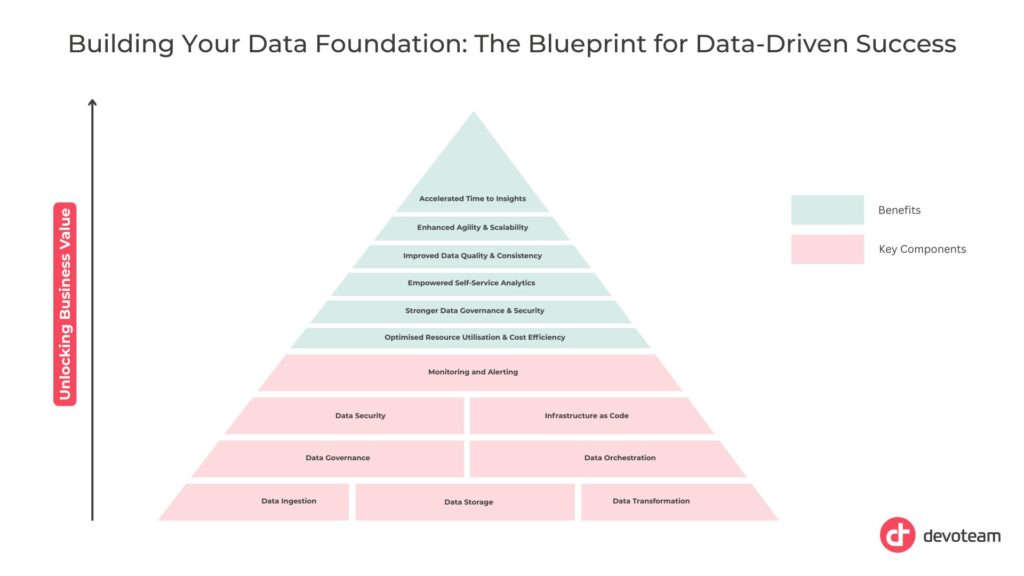
A modern data platform or foundation is more than just a data warehouse. It is a comprehensive and integrated ecosystem designed to streamline the entire data lifecycle. It encompasses various key components and principles:
- Cloud Data Platform (e.g., Snowflake, BigQuery etc.): A scalable and serverless platform for storing and analysing large datasets, this platform should be able to manage natively structured and unstructured data
- Data Ingestion Tools (e.g., Airbyte, Fivetran): Services that automate the extraction and loading of data from various source systems into the data warehouse.
- Data Transformation Frameworks (e.g., dbt, Dataform): Tools that enable code-based data transformations within the data warehouse, supporting version control, testing, and documentation.
- Orchestration Services (e.g., Cloud Workflows, Cloud Scheduler): Serverless platforms for automating and scheduling data pipelines and other tasks.
- Infrastructure as Code (IaC) Tools (e.g., Terraform): Solutions for managing and provisioning cloud infrastructure resources using code.
- Monitoring and Alerting (e.g., Cloud Monitoring): Services for tracking the health and performance of the data foundation and providing automated notifications for issues.
- Data Governance Tools (e.g., Dataplex, Data Catalog): Platforms for managing metadata, ensuring data discoverability, and enforcing data governance policies.
- Infrastructure as Code (IaC): Managing and provisioning the underlying infrastructure using code, typically with tools like Terraform. This enables consistent and repeatable deployments of data foundation components across different environments.
- CI/CD Pipelines (e.g., Cloud Build): Automated workflows for building, testing, and deploying code changes to the data foundation.
- Data Security: Implementing measures to protect data from unauthorised access, breaches, and misuse. This includes encryption, access controls, data masking, and auditing.
A well-architected data foundation provides a clear pathway for data to flow from its source systems, through necessary transformations, and into the hands of analysts and decision-makers. By integrating these key components effectively, businesses can create a robust and efficient data ecosystem that fuels their analytical capabilities.
An overview:
| Tool Type | AWS | Microsoft Azure | Google Cloud | Databricks | Snowflake |
|---|---|---|---|---|---|
| Runs on AWS/Azure/GCP | Runs on AWS/Azure/GCP | ||||
| Cloud Data Warehouse | Amazon Redshift | Microsoft Fabric (latest offering) Azure Synapse Analytics (legacy offering) | Google BigQuery | Databricks SQL | Snowflake Cloud Data Platform |
| Data Ingestion Tools | Amazon AppFlow, AWS Glue Jobs, AWS Glue Zero ETL, AWS Data Pipeline, AWS Database Migration Service (DMS), Kinesis Data Firehose | Azure Data Factory (ADF Standalone, Fabric, Synapse), Logic Apps, Azure Functions, Event Hub, Fabric Eventhouse | Cloud Data Fusion, Cloud Dataflow, Datastream, Pub/Sub, BigQuery Data Transfer Service | Auto Loader, Delta Live Tables (DLT), LakeFlow | Snowpipe, Kafka Connector, Spark Connector, Extensive Partner Network (Fivetran, Airbyte, Matillion, Informatica, etc.) Snowflake Openflow (not before June 3rd) |
| Data Transformation Tools | AWS Glue Jobs (Spark ETL), Amazon EMR, Redshift (SQL), (dbt common via adapter), Athena (SQL) | Azure Data Factory (ADF Standalone, Fabric, Synapse), dbt | dbt and Dataform | Delta Live Tables (DLT), Databricks Notebooks, dbt | Snowflake SQL, Snowpark (Python, Java, Scala), Dynamic Tables, Streams & Tasks, (dbt extremely common via adapter), Partner Tools (Matillion etc.) |
| Orchestration Services | AWS Step Functions, AWS Managed Workflows for Apache Airflow (MWAA), AWS Glue Workflows, EventBridge | Azure Data Factory (ADF Standalone, Fabric, Synapse), Astronomer | Cloud Composer (Managed Airflow), Cloud Workflows, Cloud Scheduler | Databricks Workflows | Snowflake Tasks, (Often orchestrated by external tools like Airflow, ADF, Step Functions, Prefect, Dagster), can be executed every 10 sec to foster near real time data processing |
| Infrastructure as Code (IaC) Tools | AWS CloudFormation, AWS CDK, (Terraform widely used) | Bicep, Terraform, Azure Resource Manager Templates (ARM), | Terraform | Databricks Asset Bundles (DAB), Databricks Terraform Provider, | Snowflake Terraform Provider, SQL Scripts, (Managed alongside underlying cloud’s IaC) |
| Monitoring and Alerting | Amazon CloudWatch, AWS CloudTrail, Amazon Simple Notification Service | Azure Monitor, Azure Log Analytics | Google Cloud Monitoring, Google Cloud Logging | Databricks Lakehouse Monitoring | Snowflake Resource Monitors, Query History, Task History, Snowsight Dashboards, Account Usage Views, Integration with partner tools |
| Data Governance Tools | AWS Lake Formation, AWS Glue Data Catalog, AWS Glue Data Quality, AWS DataZone, Macie (Data Security), Amazon Sagemaker Unified Studio Catalog | Microsoft Purview | Google Cloud Dataplex, Cloud DLP (Data Loss Prevention) | Unity Catalog | Snowflake Horizon (Object Tagging, Access History, Masking Policies, Row Access Policies, Column Lineage), Partner integrations |
| CI/CD Pipelines | AWS CodePipeline, AWS CodeBuild, AWS CodeDeploy (Gitlab CI and Github actions widely used) | Azure DevOps, GitHub | Google Cloud Build | Databricks Repos, Databricks Asset Bundles (DAB) | Integration via SnowSQL (CLI) Native Terraform Provider Native Github INtegration Connectors + External tools (Azure DevOps, GitHub Actions, Jenkins, GitLab CI etc.) |
| AI/ML Capabilities | Copilot Studio, AI Foundry, ML Studio, Azure AI Services | AI/BI Genie, Databricks IQ, Mosaic AI, MLFLow | Cortex ML Cortex for GenAI Cortex Analyst Cortex Agents Cortex Intelligence | ||
| Data Sharing & Monetisation Capabilities | Azure Integration Services | Delta Sharing, Marketplace, Cleanrooms | Native Data Sharing capabilities since 2017 |
Step by step plan to build your data foundation
Building a successful data foundation is not a one-time project but an ongoing journey that requires careful planning and execution. The key steps typically involve:
- Understanding Business Needs: Clearly define the business objectives and the data insights required to achieve them.
- Assessing the Current Data Landscape: Identify existing data sources, their formats, quality, and accessibility.
- Defining Data Strategy and Architecture: Develop a comprehensive data strategy that outlines the overall vision, goals, and principles for managing and leveraging data. Design a logical and physical data architecture that aligns with the business needs and technology choices.
- Selecting Technologies and Tools: Choose the appropriate cloud platform, data warehouse, integration tools, transformation frameworks, and other necessary components based on requirements and budget.
- Implementing Core Components: Build the initial data pipelines for ingestion, storage, and transformation. Set up essential data governance and security measures.
- Iterative Development: Adopt an iterative approach, gradually expanding the data foundation to incorporate more data sources and analytical capabilities based on evolving business needs.
- Continuous Monitoring and Optimisation: Regularly monitor the performance and health of the data foundation and identify areas for optimisation and improvement.
- Training and Enablement: Provide adequate training and support to data teams and business users to effectively utilise the data foundation.
Collaboration between business stakeholders and technical teams is crucial throughout the entire process to ensure that the data foundation effectively addresses business needs and delivers tangible value.
Success Cases: Transforming Businesses with strong data platforms
Numerous organisations across diverse industries have benefited from building robust data foundations. Check out our customer success stories or take a look at these anonymised examples:
A global non-profit organisation aimed to standardise data practices across its international offices to gain better insights into their operations and facilitate data sharing. By deploying a data foundation, they could integrate data from various sources, establish consistent reporting, and empower local branches with self-service analytics, ultimately improving their efficiency and impact.
An e-commerce marketing agency faced performance issues with its client dashboards due to complex data blending within the BI tool. They implemented a data foundation with defined data layers and automated transformations. The result? Improved dashboard performance and reduced maintenance overhead. They also freed up their data experts to focus on enhancing their core platform.
Companies in various sectors, struggling with slow data preparation times and inconsistent data, have adopted data foundation approaches to accelerate their analytics initiatives, improve the reliability of their insights, and enable faster, data-driven decision-making across different business functions.
Building a Data Foundation: start to prepare your future needs now
Building a strong data foundation is no longer a luxury. It provides the essential infrastructure for turning raw data into actionable insights. It fosters agility, ensures data quality and governance, optimises costs, and empowers a data-driven culture. Building a data foundation using modern cloud-native technologies and a clear strategy is essential for organisations preparing for Artificial Intelligence (AI) and machine learning.
Once you have a robust foundation, explore how to evolve your data platform to specifically drive innovation in Artificial Intelligence.

Ready to transform your data into a strategic asset for analytics, AI, and sustained business success?
Build a future-proof data foundation with Devoteam, the #1 Data Consulting Partner in EMEA.
- Leverage our 1,000+ certified experts,
- proven end-to-end capabilities across strategy, governance, and modern cloud platforms (AWS, Azure, GCP, Snowflake, Databricks), and
- our relentless focus on turning data insights into measurable business impact