


The Transformation in Information Retrieval
In recent years, information-seeking behaviour has evolved at a fast pace. The ascent of Large Language Models (LLMs) has introduced a new digital paradigm: users have moved beyond simply searching for links; they now demand direct, actionable, and conversational answers.
In an era where traditional search engines are no longer the only starting point, the challenge for brands is clear: how can visibility and relevance be ensured in a landscape where responses are synthesised by artificial intelligence? In a landscape where traditional SEO is no longer sufficient, it becomes essential to adopt a new approach. This is where Generative Engine Optimisation (GEO) comes in.

GEO does not replace what came before, but invites us to embrace the evolution of how content is discovered, understood, and recommended.

Viviane Portela Gama
SEO/GEO Specialist
From Traditional Search (SEO) to Response Generation
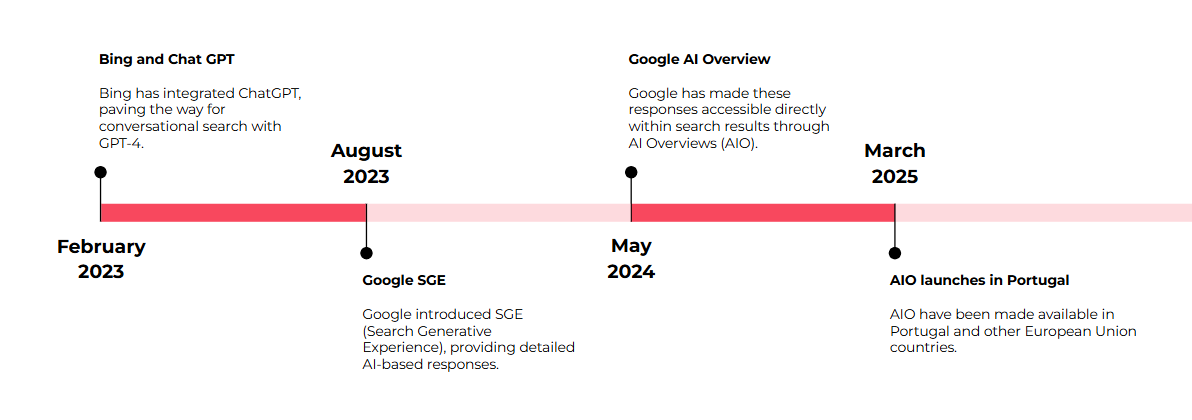
The market has witnessed a significant transformation: search is no longer merely about the presentation of results, but rather the synthesis of information. We are experiencing a clear transition: from the traditional search model to an ecosystem where responses are crafted by generative models – not based on what brands say, but on what is said about them.
The surge in LLMs adoption
The adoption of LLM-based tools is growing exponentially. Projections suggest that by 2031, the global user base could increase by 239%, reflecting a fundamental shift in search habits: users now prioritise speed, conciseness, and a clear orientation towards utility.
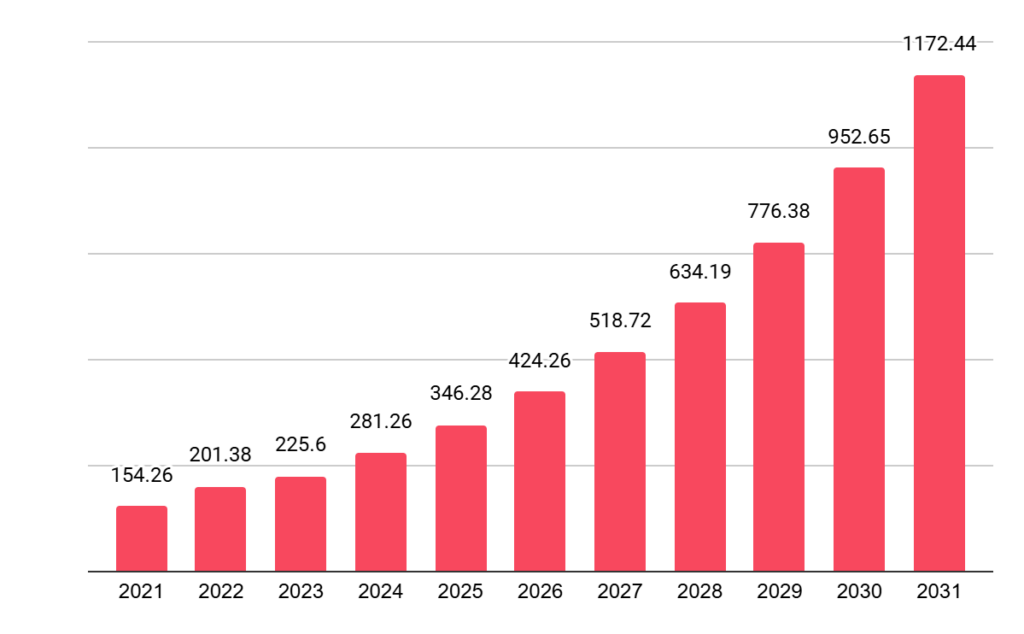
Source: Statista. (March 2025). Number of AI tool users worldwide from 2021 to 2031 (in millions).
Whilst LLMs are gaining significant traction, traditional search engines continue to lead in traffic volume. In October 2025, Google exceeded 84 billion visits, accounting for approximately 86% of the total share among major engines and platforms. Bing, Yahoo, and DuckDuckGo collectively recorded roughly 5 billion visits.
ChatGPT, however, registered 6.2 billion visits (approximately 6.3% of the total), clearly outperforming other generative platforms such as Gemini, Copilot, DeepSeek, and Perplexity – and even surpassing the majority of traditional search engines. Concurrently, LLM-generated traffic is growing monthly; according to SEMRush, it could represent 17% of total website traffic by 2026.
These figures reinforce the need for a comprehensive, hybrid strategy: ensuring a presence across both traditional search engines and AI-powered platforms.
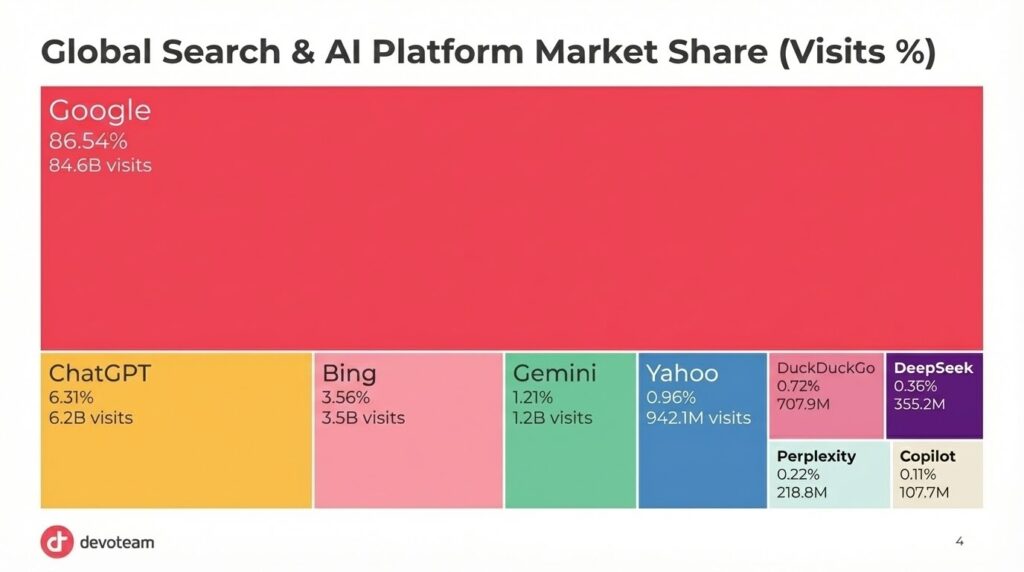
Source: Similarweb. (Junho 2025). Website visits.
The Imperative for Immediate Action
LLMs synthesise responses and summaries based on specific sources. Throughout this process, many brands find themselves either omitted or misrepresented, simply because the models do not perceive them as relevant.
Furthermore, the trend towards ‘zero-click’ searches is rising: in March 2025, 26.1% of searches resulted in no clicks at all (an 11% increase compared to 2024), and all indicators suggest this figure will continue to grow.
Consequently, the objective has shifted beyond merely generating organic clicks. The focus has pivoted towards enhancing visibility, credibility, and authority to attract truly qualified traffic: users who purposefully choose to click because they have a genuine interest in the product or service.
The Strategy for GEO
Implementing a GEO strategy is a structured, ongoing process, vital for securing a brand’s footprint within the ecosystem of Large Language Models (LLMs) and answer engines.
Moving beyond the traditional focus on visibility inherent in SEO, brands must now aim to educate users and guide AI response engines to be more efficient and accurate in the responses they share in their conversations and content.
The process unfolds across four complementary phases:
I. Audit and Diagnosis
A technical website analysis, digital reputation, and overall brand presence. This stage is critical for mapping the data sources of generative models and diagnosing how the sector and competitors are currently represented within LLMs. It concludes by identifying strengths and significant gaps in existing content.
II. GEO Positioning Strategy
Defining the key topics, entities, and concepts that must be uniquely associated with the brand by generative models. This involves the rigorous analysis of prompts and linguistic patterns to establish a controlled narrative for the brand within the AI landscape.
III. Optimisation and Implementation
This stage is dedicated to refining content based on the core criteria of clarity, authority, and relevance for LLMs. It includes developing long-form Q&A content, thematic pages, and a strategic digital PR and backlink acquisition plan to bolster the brand’s referential credibility.
IV. Continuous Monitoring and Maintenance
Establishing a cycle of continuous optimisation, which involves regular monitoring of responses from leading models to assess the brand’s presence. This phase generates performance reports to adjust the strategy based on the evolution of generative models and the dynamics of user behaviour.
GEO vs. SEO
GEO does not replace SEO; rather, it represents its evolution. Both methodologies share a core emphasis on content quality, technical integrity, and alignment with search intent. However, the transition from search engines to answer engines requires that brand visibility is secured through referencing by systems built on consolidated knowledge. It has become imperative to ensure that AI classifies a brand as relevant, credible, and worthy of citation.
GEO occupies a more transversal position in the definition of brand content strategy. It serves as an accelerator for SEO, driving a more structural and comprehensive shift.
Sources:
Statista Research Department (2025). Number of AI tool users worldwide 2020-2031. https://www.statista.com/forecasts/1449844/ai-tool-users-worldwide
Goodwin, D. (2025, June). Zero-click searches rise, organic clicks dip: Report. Search Engine Land. https://searchengineland.com/zero-click-searches-up-organic-clicks-down-456660
Handley, R. (2025, July). We Studied the Impact of AI Search on SEO Traffic. Here’s What We Learned. SEMRush. https://www.semrush.com/blog/ai-search-seo-traffic-study/
Cardillo, A. (2025, November). Future of Search: Why LLMs Will Drive 75% of Revenue by 2028. Exploding Topics. https://explodingtopics.com/blog/llm-search