



Securing cloud infrastructure requires a fundamental shift from traditional IT security approaches. AWS operates on a shared responsibility model for security. AWS secures cloud infrastructure while you secure your data, applications, and configurations.
This guide covers the critical security foundations every AWS user must understand: identity management, data protection, threat detection, and compliance. These practices and services form the backbone of robust AWS security. They apply whether you’re migrating to cloud or optimizing existing deployments.
The key to AWS security is not just knowing what tools are available, but understanding how to implement them systematically across your entire cloud environment.
In this article you’ll read:
Introduction to AWS Cloud Security
Cloud adoption fundamentally transforms an organisation’s security landscape, shifting traditional responsibilities and introducing new paradigms. Robust AWS security requires understanding foundational concepts and following recommended practices. It also demands strategic use of dedicated security services.
AWS Shared Responsibility Model
The AWS Shared Responsibility Model delineates the division of security and compliance duties between AWS and its customers. This concept is essential, as it directly influences the scope of customer-managed security controls.
Under this model, AWS is responsible for “Security of the Cloud.” This covers protecting AWS’s global infrastructure underpinning all services. It includes physical facilities, hardware, software, networking, and underlying virtualization infrastructure. For example, AWS ensures the physical security of its data centers and manages access control to these foundational resources.
Customer’s responsibility
The customer bears the responsibility for “Security in the Cloud.” The precise scope of this responsibility is dynamic, determined by the specific AWS Cloud services chosen. For IaaS offerings like Amazon EC2, customers control and manage guest operating systems. They’re responsible for updates, patches, applications, and configuring AWS-provided security groups.
In contrast, for more abstracted services like Amazon S3 or Amazon DynamoDB (Platform as a Service or Software as a Service), AWS manages the infrastructure layer, operating system, and platforms. In these scenarios, customers primarily focus on :
- managing their data, including encryption options,
- classifying their assets,
- and applying appropriate permissions using AWS Identity and Access Management (IAM) tools.
This customer responsibility also extends to user access control and data management practices. It necessitates regular audits of customer permissions as part of IAM best practices.
Customer responsibility adapts based on the AWS service’s abstraction level. This requires a highly adaptive and service-aware security strategy. A static, one-size-fits-all security approach is insufficient. Security professionals must understand each AWS service’s operational model (IaaS, PaaS, SaaS). This enables accurate identification and implementation of necessary customer-side controls.
This inherent complexity necessitates the automation of security configuration and validation processes. Manual methods would quickly become overwhelmed by the varying responsibilities across a diverse portfolio of cloud services.
Cloud Security Posture Management (CSPM) in AWS
Cloud Security Posture Management (CSPM) tools are indispensable for continually enhancing cloud security. They perform ongoing compliance checks and identify security risks associated with cloud workloads. Thus, they ensure that configurations align with established best practices and regulatory standards.
CSPM solutions continuously evaluate cloud configurations against recognised security benchmarks, such as CIS Benchmarks and the AWS Well-Architected Framework. Upon detection of any deviations or misconfigurations, these tools are capable of automatically initiating corrective actions.
AWS Security Hub functions as a central CSPM tool within the AWS ecosystem. It conducts security best practice checks and aggregates security findings from various AWS security services and integrated partner solutions. This consolidation provides a unified view of an organisation’s security posture. Security Hub includes the AWS Foundational Security Best Practices standard. It is a continuously updated set of security guidelines vetted by AWS security experts, which offers automated, continuous monitoring. Furthermore, Security Hub supports adherence to major regulatory and industry compliance frameworks. This includes PCI DSS, CIS AWS Foundations Benchmark, and NIST standards, through continuous, automated security checks.
“AWS Security Hub provides a continuous 360-degree view of an AWS Organization/Landing Zone’s security posture. Through centralised findings consolidation and scoring mechanisms, we give our clients the means to adopt a proactive security culture. This enables organisations to systematically identify and remediate vulnerabilities at their origin, rather than adopting a reactive approach to security incidents.”
Reyan Leifa, AWS Solution Architect, Devoteam
Key features of AWS Security Hub CSPM
- Automated and Continuous Monitoring: Security Hub provides event-based continuous monitoring or scheduled periodic checks. Severity ratings aid to prioritise the findings.
- Customizable Controls: The service allows for fine-tuning CSPM controls to align with specific organisational security guidelines. This includes modifying parameters for password policies, thresholds for unused resources, or lists of high-risk ports. You can centrally configure these settings across multiple accounts.
- Security Score and Visualisation: Security Hub presents a straightforward 0-100 security score for each standard and account. It also features customizable dashboards that offer powerful data visualisations for identifying patterns, vulnerabilities, and threats, leading to faster responses.
- Findings Aggregation: It centralises security findings from various AWS security services. For example: Amazon GuardDuty, Amazon Inspector, Amazon Macie and integrated partner solutions. All findings are in a standard format, simplifying searching and action across diverse sources.
- Automation and Response: Security Hub supports automated updates or suppression of findings through automation rules. It also enables custom automated workflows via integration with Amazon EventBridge. This allows for remediation and enrichment actions using AWS Lambda functions or AWS Systems Manager Automation runbooks.
- Multi-account Support: The service facilitates centralised deployment and management across AWS Organisations. This enables an administrator account to view correlated security findings across all member accounts.
Addressing the misconfiguration challenge
The dynamic and API-driven nature of cloud environments, coupled with the shared responsibility model, means that misconfigurations are a primary vector for cloud security incidents. CSPM, particularly AWS Security Hub, directly addresses this challenge by automating continuous configuration assessment. This shifts security from a reactive, periodic audit to a proactive, continuous posture management discipline. It significantly reduces reliance on manual checks. Manual checks are inherently prone to human error. They are unable to keep pace with the rapid rate of change in cloud deployments. Fine-tuning and central configuration enables unified, policy-driven governance at scale, replacing siloed security efforts.
Furthermore, CSPM plays a pivotal role in enabling DevSecOps methodologies. Automated security checks in CI/CD pipelines identify misconfigurations and compliance issues early. This enables remediation before production deployment, improving overall security posture. This “shift left” approach substantially reduces the cost and complexity associated with fixing security issues discovered later. It cultivates a culture where developers are more directly accountable for security. The continuous feedback loop provided by CSPM tools is indispensable for maintaining agility while bolstering security in modern development practices.
AWS Security Best Practices
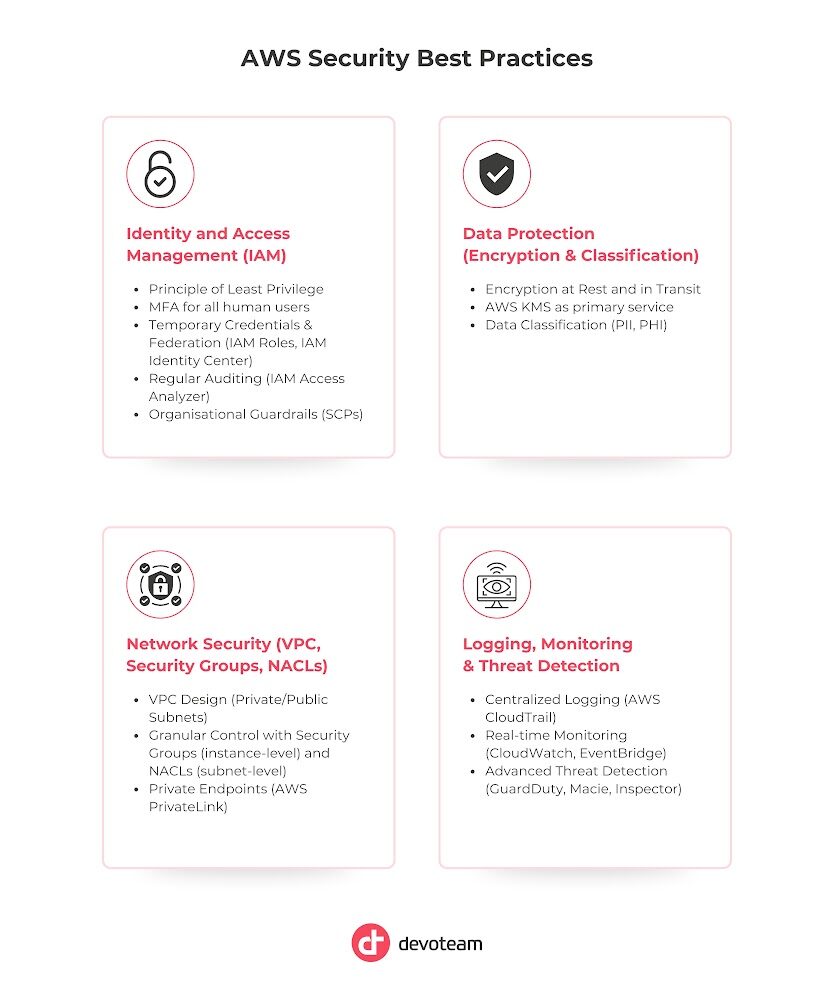
AWS’s recommended security practices span identity management, data protection, network security, and continuous monitoring.
Identity and Access Management (IAM) Best Practices
AWS Identity and Access Management (IAM) is the fundamental service for securely controlling access to AWS resources. Implementing IAM best practices is critical for the overall security of an AWS environment.
Least Privilege
The Principle of Least Privilege dictates granting only the minimum permissions necessary for users and workloads to perform their specific tasks. This involves precisely defining actions on specific resources under specific conditions. While an initial broader permission set might be useful for exploratory phases, the objective should always be to refine these permissions to the least privilege as the use case matures.
Multi-Factor Authentication
Multi-Factor Authentication (MFA) enforcement is a crucial security measure. MFA should be a mandatory requirement for all human users, especially the root user of the AWS account and any IAM users with console access. This adds an essential layer of security, significantly reducing the risk of unauthorised access even if primary credentials are compromised.
Temporary Credentials
We strongly advise the use of Temporary Credentials and Federation over long-term static credentials. Human users, including administrators and developers, should access AWS by federating with an identity provider, such as AWS IAM Identity Center, and assuming roles that provide temporary credentials. This practice eliminates the security risks associated with persistent IAM user credentials.
AWS IAM Identity Center is specifically recommended for centralised access management, streamlining the process of granting and managing user access across multiple AWS accounts and applications. Similarly, workloads (applications and backend processes) should utilise temporary credentials via IAM roles when interacting with AWS services. For workloads running on AWS compute services like Amazon EC2 or AWS Lambda, AWS automatically delivers temporary credentials to the compute resource. For workloads residing outside AWS (e.g., on-premises), methods like IAM Roles Anywhere or AWS Security Token Service (STS) APIs can be employed to deliver temporary credentials.
Just-in-Time (JIT) access
This strong emphasis on temporary credentials, Just-in-Time (JIT) access, and federation signifies a profound evolution in cloud identity management. Static, long-lived credentials are inherently more vulnerable due to their persistence. The adoption of temporary credentials and JIT access significantly reduces the window of opportunity for attackers and simplifies credential rotation, moving towards a more dynamic and context-aware authorisation model. This approach is indispensable for large, agile cloud environments where users and workloads require varying permissions for limited durations.
Removing unused IAM users, roles, permissions, policies
Regular Auditing and Credential Management are ongoing requirements. It is a best practice to frequently review and remove any unused IAM users, roles, permissions, policies, and credentials by leveraging IAM’s “last accessed information”. This practice directly reduces the potential attack surface. For specific use cases that genuinely necessitate long-term credentials (e.g., certain third-party integrations), access keys must be regularly updated. Passwords and access keys should be safeguarded diligently, never embedded in publicly accessible code, and frequently rotated. AWS IAM Access Analyzer is a valuable tool for generating least-privilege policies based on AWS CloudTrail access activity and for validating policies to ensure they are both secure and functional. It also helps verify public and cross-account access to resources.
Organisational design and Guardrails are crucial for scaling security. Leveraging AWS Organizations allows for the centralised management of resources and access across multiple AWS accounts, enabling granular access controls and clear separation of duties. Service Control Policies (SCPs) and Resource Control Policies (RCPs) within AWS Organizations are instrumental in establishing permission guardrails across the entire enterprise, preventing unintended actions or configurations. Furthermore, permission boundaries can be utilised to safely delegate permissions management within an account while setting the maximum permissions that can be granted.
The integration of IAM with AWS Organizations represents a shift from securing individual accounts to implementing enterprise-wide governance. This enables consistent enforcement of security policies and compliance standards across a complex, multi-account landscape. This approach prevents accidental misconfigurations or unauthorised actions across the entire AWS footprint, ensuring that security scales with the organisation’s cloud adoption. The hierarchical nature of SCPs allows for fine-grained control at different organisational levels, striking a balance between central oversight and delegated operational autonomy.
Data Protection Best Practices (Encryption, Data Classification)
Data protection is a paramount concern in cloud security, encompassing both data at rest (stored) and data in transit (moving across networks).
A fundamental best practice is to implement encryption for data both at rest and in transit. AWS provides robust encryption capabilities natively integrated across almost all of its services, offering flexible key management options. AWS Key Management Service (KMS) is the primary service recommended for managing these encryption keys. This widespread availability of encryption means that in a mature cloud security posture, encryption should be considered a default setting for all sensitive data, rather than an optional add-on. The ease with which encryption can be enabled via AWS services, often with seamless KMS integration, removes traditional barriers of complexity and performance overhead. This shifts the focus from whether to encrypt to how to effectively manage encryption keys and policies at scale.
Data Classification is a prerequisite for effective data protection. Organisations must thoroughly understand and classify their data types based on sensitivity, regulatory requirements, and business criticality. Based on this classification, appropriate responsibilities must be assigned for the secure processing and storage of all data. Sensitive or regulated data, such as Personally Identifiable Information (PII) or Protected Health Information (PHI), must be stored in highly controlled environments with stringent access control measures in place. This classification directly informs the level of encryption and key management required, for instance, determining whether to use customer-managed keys in KMS for highly sensitive data or relying on AWS-managed keys for less critical information.
Network Security Best Practices (VPC, Security Groups, Network ACLs)
Securing the network perimeter and internal communication paths is a vital component of cloud security, ensuring that only authorised traffic can access resources.
VPC Design: Virtual Private Clouds (VPCs) should be designed with a clear separation of private and public subnets. Sensitive resources, such as databases and application servers, should be isolated within private subnets, while public-facing resources like load balancers or web servers reside in public subnets.
Security Groups and Network Access Control Lists (NACLs) are critical for granular network control. Security Groups act as stateful firewalls at the instance level, controlling inbound and outbound traffic to and from individual EC2 instances or network interfaces. NACLs, conversely, function as stateless firewalls at the subnet level, providing an additional layer of defence. It is a best practice to restrict both inbound and outbound access to only the absolutely necessary ports and IP ranges, adhering to the principle of least privilege for network connectivity.
The use of Private Endpoints via AWS PrivateLink is highly recommended for securely accessing AWS services. PrivateLink establishes private connections between VPCs and AWS services, ensuring that network traffic remains entirely within the AWS network and does not traverse the public internet. This significantly reduces the attack surface and enhances data confidentiality.
The emphasis on granular controls signals a significant evolution from traditional perimeter-centric network security to a more “zero-trust” model. In a dynamic cloud environment, relying solely on a hardened external perimeter is insufficient. This approach advocates for authenticating and authorising every connection, regardless of its origin (internal or external), by assuming no inherent trust.
Logging, Monitoring, and Incident Response
Robust logging and continuous monitoring are indispensable for effective security operations. They enable the timely detection of security events and facilitate efficient incident response.
Centralised logging
AWS CloudTrail records all user activity and API calls across AWS services as events, providing an immutable audit trail that answers critical questions such as “who did what, where, and when?”. CloudTrail logs can be delivered to Amazon S3 for long-term storage (encrypted by default, with an option for AWS KMS encryption), and optionally to Amazon CloudWatch Logs and Amazon EventBridge for real-time processing. This centralised log provides a comprehensive historical record for auditing and forensic analysis.
For Real-time Monitoring, integrating these logs with Amazon CloudWatch and Amazon EventBridge allows for the creation of alarms and automated responses to security events. This enables security teams to react swiftly to detected anomalies or potential threats.
Advanced Threat Detection
- Amazon GuardDuty: A fully managed, AI/ML-powered threat detection service that continuously monitors AWS accounts and workloads for malicious activity and unauthorised behaviour. It leverages anomaly detection, machine learning, and threat intelligence to identify various threats, including reconnaissance, instance compromise, account compromise, bucket compromise, and malware. GuardDuty provides continuous monitoring across multiple accounts without adding operational complexity and integrates seamlessly with AWS Security Hub.
- Amazon Macie: A data security and privacy service that uses machine learning and pattern matching to discover, classify, and protect sensitive data stored in Amazon S3. It offers ongoing evaluation of S3 security posture, targeted sensitive data discovery, and detailed security findings, helping organisations meet compliance requirements such as GDPR, PCI DSS, and HIPAA.
- Amazon Inspector: An automated vulnerability management service that continuously scans compute workloads (Amazon EC2, AWS Lambda, containers) and code repositories for software vulnerabilities and unintended network exposure. It provides a contextualised risk score for findings, aiding in the prioritisation of remediation efforts. Inspector offers simplified onboarding and integrates with AWS Organisations.
The volume and velocity of data generated in cloud environments make manual threat detection impractical. AWS’s significant investment in AI/ML-driven security services underscores the inadequacy of traditional, reactive, signature-based security models. These services enable organisations to proactively identify behavioural anomalies and sophisticated threats that might bypass conventional controls, facilitating earlier detection in the attack kill chain, minimising dwell time, and automating responses. The seamless integration of these services into AWS Security Hub further supports the establishment of a unified, intelligent security operations center (SOC) in the cloud.
Finally, Incident Response Planning is crucial. Organisations must develop and regularly test their incident response plans to ensure preparedness for security incidents. Services like AWS CloudTrail provide data for forensic analysis during and after an incident, helping to reconstruct events and determine root causes.
To see how these AWS security principles are applied in a real-world scenario, discover how Marketing Delivery strengthened its platform security with our help.
Continuous Learning and Well-Architected Framework
The dynamic nature of the cloud security landscape, characterised by evolving threats and new services, necessitates a commitment to continuous education and adherence to architectural best practices.
Fostering Continuous Learning within security and development teams is paramount. Regular participation in AWS security webinars, workshops, and training programs is crucial to staying abreast of the latest threat vectors, security protocols, and service capabilities. An informed and well-trained team serves as the primary line of defence against potential security breaches, making ongoing education an invaluable investment.
The AWS Well-Architected Framework is a resource for designing and operating secure, high-performing, resilient, and efficient cloud workloads. The AWS Well-Architected Tool allows organisations to review their workloads against the framework’s pillars, including the Security Pillar. This systematic review helps anticipate potential vulnerabilities and proactively neutralise threats rather than merely reacting to them.
Cloud security is not a static project with a defined end date, but rather an ongoing, iterative process. The emphasis on continuous learning and the Well-Architected Framework signifies a necessary cultural transformation within organisations. Security awareness and responsibility must be embedded across all teams, fostering a DevSecOps mindset where security is an inherent part of daily tasks and development cycles. This continuous improvement model integrates security from design through operations. It requires dedicated time and resources for training and architectural reviews.
AWS Dedicated Security Services
AWS offers an extensive portfolio of specialised security services, each designed to address specific security domains.
Identity and Access Management (IAM)
Identity and Access Management forms the bedrock of security in AWS, controlling access to all resources.
- AWS IAM: This service allows administrators to securely manage access to AWS services and resources. It facilitates the creation of users, groups, and roles with granular permissions, rigorously enforcing the principle of least privilege.
- AWS IAM Identity Center (formerly AWS SSO): This cloud-based identity management service centralises access to multiple AWS accounts and integrated business applications from a single point. It offers single sign-on (SSO), supports temporary access, enables multi-factor authentication (MFA), and integrates with external identity providers like Microsoft Entra ID or Okta. IAM Identity Center significantly unifies access control across accounts, thereby reducing the administrative overhead associated with managing individual credentials.
- AWS Resource Access Manager (RAM): This service enables the secure and simplified sharing of AWS resources across multiple AWS accounts or within an AWS Organisation. It is particularly useful for sharing foundational infrastructure like VPC subnets or private certificate authorities, reducing operational overhead by avoiding resource duplication and improving security through fine-grained access controls for shared resources.
Threat Detection and Monitoring
Proactive threat detection and continuous monitoring are critical for identifying and responding to security incidents in real-time.
- Amazon GuardDuty: A fully managed threat detection service that continuously monitors AWS accounts and workloads for malicious activity and unauthorised behaviour. It leverages artificial intelligence, machine learning, anomaly detection, and threat intelligence to identify various threats, including reconnaissance attempts, instance compromises, account compromises, suspicious S3 bucket activity, and malware. GuardDuty provides continuous monitoring across accounts without adding operational complexity and seamlessly integrates its findings with AWS Security Hub.
- Amazon Macie: A data security and privacy service that employs machine learning and pattern matching to discover, classify, and protect sensitive data stored in Amazon S3. It offers ongoing evaluation of S3 security posture, targeted sensitive data discovery, and detailed security findings. Macie assists organisations in meeting stringent compliance requirements such as GDPR, PCI DSS, and HIPAA.
- Amazon Inspector: An automated vulnerability management service designed for compute workloads (Amazon EC2, AWS Lambda, containers) and code repositories. It continuously scans for software vulnerabilities and unintended network exposure, generating a contextualised risk score for findings to help prioritise remediation efforts. Inspector offers simplified onboarding and integrates with AWS Organizations for multi-account management.
The aggregation of findings from these services into AWS Security Hub further consolidates security data. It facilitates a unified and intelligent security operations platform.
Network and Application Protection
Protecting network perimeters and securing applications from common exploits and denial-of-service attacks is fundamental.
- AWS WAF (Web Application Firewall): This service helps protect web applications from common web exploits that could compromise availability, security, or consume excessive resources. It enables users to create rules to filter web traffic based on conditions such as IP addresses, HTTP headers and body, or custom URIs. AWS WAF effectively blocks common exploits like SQL injection and cross-site scripting. It also offers preconfigured protection packs and advanced bot control features.
- AWS Shield: A managed DDoS protection service that automatically safeguards applications running on AWS. AWS Shield Advanced provides enhanced DDoS mitigation capabilities for network (Layer 3), transport (Layer 4), and application (Layer 7) layer attacks. It also offers cost protection against scaling charges incurred during DDoS events and provides access to the AWS DDoS Response Team (DRT) for expert assistance.
- AWS Firewall Manager: A security management service that centrally configures and manages firewall rules across an organisation’s AWS accounts and applications within AWS Organizations. It can automatically deploy and audit AWS WAF rules, AWS Shield Advanced protections, AWS Network Firewall rules, and Amazon VPC security groups. This ensures consistent application of security policies and helps identify non-compliant resources across the entire organisation.
Data Protection and Encryption
Data protection relies on robust encryption and secure key management.
AWS Key Management Service (KMS)
A managed service that simplifies the creation and control of encryption keys used to encrypt data. KMS keys and their functionality are extensively utilised by other AWS services and can be integrated into customer applications. It provides a highly available and secure environment for key management, with FIPS 140-2 Level 3 validated hardware, giving customers control over key generation and usage.
AWS Secrets Manager
This service assists in managing access to applications, services, and IT resources by securely storing, encrypting, and automatically rotating secrets such as database credentials, API keys, and other sensitive information. Secrets Manager encrypts secrets at rest using encryption keys provided by AWS KMS. It also supports automatic replication of secrets to multiple AWS Regions for disaster recovery and cross-regional redundancy.
AWS Certificate Manager (ACM)
A service that streamlines the handling of SSL/TLS certificates within AWS environments. It provisions, deploys, and automatically renews both public and private certificates, ensuring secure access to websites and applications. ACM seamlessly integrates with services like Elastic Load Balancers (ELBs), Amazon CloudFront, and Amazon API Gateway to enable HTTPS communication.
AWS CloudHSM
A cloud-based hardware security module (HSM) service that allows customers to generate and use cryptographic keys on dedicated, FIPS 140-2 Level 3 validated hardware instances within their own Virtual Private Cloud (VPC). CloudHSM provides a higher level of security assurance and control for cryptographic operations, helping organisations meet stringent regulatory compliance requirements.
Compliance and Governance
Maintaining compliance and strong governance is crucial for regulated industries and for demonstrating adherence to security standards.
- AWS Config: This service continuously monitors and records AWS resource configurations and changes, providing a detailed inventory and configuration history. It helps assess compliance against predefined AWS managed rules or custom rules defined using AWS Lambda functions and tracks resource relationships. AWS Config provides historical change records for governance and compliance auditing. It’s essential for facilitating security incident response processes.
- AWS CloudTrail: As previously discussed, CloudTrail records user activity and API calls across AWS services as events, providing an immutable audit trail of actions. It is crucial for security auditing, incident response, compliance verification, and operational troubleshooting. CloudTrail logs can be encrypted with KMS and delivered to Amazon S3 for long-term, immutable storage.
- AWS Artifact: A self-service portal that provides on-demand access to AWS’s security and compliance documentation and agreements. This includes AWS Artifact Agreements (e.g., Data Processing Agreements for GDPR) and AWS Artifact Reports. Artifact helps organisations verify AWS’s compliance with global security frameworks and supports vendor risk management processes.
Centralised Security Management
Managing security effectively in large, dynamic AWS environments requires centralised control and visibility.
- AWS Security Hub: (Refer to Section I.B for detailed features). Security Hub acts as the central Cloud Security Posture Management (CSPM) tool. It aggregates security findings, performs best practice checks, and provides a security score across accounts and regions. It integrates seamlessly with numerous other AWS security services, consolidating their outputs for a unified view.
- AWS Organizations: This service enables centralised management of multiple AWS accounts. It facilitates consolidated billing, resource allocation, and consistent policy application for governance. It is indispensable for implementing security guardrails across the entire enterprise using Service Control Policies (SCPs) and Resource Control Policies (RCPs), ensuring uniform security standards.
- AWS Resource Access Manager (RAM): RAM facilitates the secure and simplified sharing of resources across multi-account environments. It reduces duplication and improving security by enabling fine-grained access controls for shared resources.
The emphasis on “centralised management,” “multi-account support,” and “cross-account protection policies” across services like Security Hub, Organizations, and Firewall Manager highlights the imperative of centralised security management in hyper-scale cloud environments. As organisations expand their AWS footprint, managing security across potentially hundreds or thousands of accounts becomes unmanageable without such centralised tools. These services specifically address the “governance at scale” challenge, allowing security teams to define, enforce, and monitor policies consistently across the entire organisation from a single pane of glass.
Deep Dive into Encryption and Secret Management
This section covers AWS’s key encryption and secret storage services, explaining their distinct yet complementary roles.
AWS Key Management Service (KMS)
AWS Key Management Service (KMS) is a highly available and scalable managed service for creating and controlling encryption keys. It forms a critical component of data protection across the AWS Cloud.
KMS allows users to generate, store, and manage cryptographic keys that are used to encrypt and decrypt data across various AWS services and within their own custom applications. KMS integrates natively with most other AWS services. Beyond data at rest, KMS keys can also be used to protect private keys for issuing Certificate Authorities (CAs) and for Transparent Data Encryption (TDE) in supported Oracle databases.
KMS supports various types of keys, including customer-managed keys (CMKs). They provide full control over the key lifecycle, and AWS-managed keys, where AWS handles the key management. Customers can define granular key policies using IAM to control who can use and manage these keys. KMS also facilitates automated key rotation and provides comprehensive auditing of all key usage and management operations through AWS CloudTrail.
KMS is not merely an encryption service. It functions as the central, highly secure, and auditable foundation for cryptographic operations across the entire AWS ecosystem. Its deep integration with numerous other AWS services means that the confidentiality and integrity of data at rest, and often in transit, fundamentally depend on the proper management and security of KMS keys.
KMS is a critical security control. Its configuration—key policies, rotation schedules, and access controls—is essential for cloud security. Compromising KMS keys would severely impact an organisation’s encrypted data, highlighting its role as a cryptographic trust anchor.
AWS Secrets Manager
AWS Secrets Manager is a dedicated service designed to centrally manage the lifecycle of secrets. Such as database credentials, API keys, OAuth tokens, and other sensitive configuration information.
Secret Storage
A primary feature of Secrets Manager is its secure secrets storage. It encrypts secrets at rest using encryption keys that are owned and managed within AWS KMS. When a secret is retrieved, Secrets Manager decrypts it and securely transmits it over TLS to the requesting application or environment. Access to secrets is rigorously controlled through fine-grained IAM policies and resource-based policies.
Automatic secrets rotation
The service can rotate secrets on a predefined schedule or on demand, crucially, without disrupting active applications. It offers native support for rotating credentials for databases hosted on Amazon RDS, Amazon DocumentDB, and Amazon Redshift, and its functionality can be extended to rotate secrets for other AWS or third-party services by leveraging AWS Lambda functions. This automation is a game-changer for mitigating the risks associated with long-lived, static credentials.
Automatic Replication
Secrets Manager also provides automatic replication of secrets to multiple AWS Regions. This feature is vital for meeting disaster recovery and cross-regional redundancy requirements, as Secrets Manager securely creates regional read replicas and keeps them synchronised with the primary secret.
For programmatic retrieval, Secrets Manager offers APIs and SDKs in common programming languages, allowing applications to fetch credentials at runtime. This eliminates the insecure practice of hardcoding sensitive information. It supports retrieving single secrets by name or ARN, or groups of secrets using filter criteria. Furthermore, configuring Amazon Virtual Private Cloud (VPC) endpoints ensures that traffic between a VPC and Secrets Manager remains entirely within the AWS network, enhancing security. Client-side caching libraries are also available to improve availability and reduce retrieval latency.
For audit and monitoring, Secrets Manager integrates with AWS CloudTrail and Amazon CloudWatch. This integration enables auditing of secret creation and rotation events, monitoring of secret usage, and configuration of notifications for events such as secrets remaining unused for a period. The service also helps organisations meet various compliance requirements, by ensuring secrets are configured and managed securely.
Automation Capabilities
The most impactful aspect of AWS Secrets Manager is its automation capability, particularly for secret rotation. Manual rotation of secrets is an operationally complex task that is frequently neglected, leading to the proliferation of long-lived, potentially compromised credentials. By automating this critical process, Secrets Manager fundamentally reduces the attack surface associated with static credentials and enforces robust security hygiene at scale. This automation is indispensable for improving an organisation’s security posture, especially in dynamic cloud environments characterised by numerous microservices and databases. It shifts the operational burden from development and operations teams to a managed service, allowing them to focus on core application logic rather than the tedious and error-prone task of credential management. This also encourages a “just-in-time” approach for secrets, where applications retrieve fresh credentials as needed, further enhancing security.
AWS KMS and AWS Secrets Manager comparison
While both AWS Key Management Service (KMS) and AWS Secrets Manager are integral to data protection in AWS, they serve distinct yet complementary purposes. Understanding their individual roles and how they interact is crucial for designing a security architecture.
Table comparison
| AWS Key Management Service (KMS) | AWS Secrets Manager | |
| Primary Purpose | Manages cryptographic keys for encryption and decryption operations. It is the core service for controlling encryption keys. | Stores, manages, and automatically rotates secrets (e.g., database credentials, API keys, OAuth tokens). |
| Core Functionality | Key generation, storage, usage, deletion, policy management, and cryptographic operations (encrypt, decrypt, sign, verify). | Secure storage, automatic rotation, replication, programmatic retrieval, auditing, and monitoring of secrets. |
| Encryption At Rest | Provides the encryption keys (Customer Master Keys – CMKs) that are used by other AWS services and applications to encrypt data. It encrypts the keys themselves. | Encrypts the secrets at rest using encryption keys provided by AWS KMS. |
| Integration | Integrated with almost all AWS services for data encryption (e.g., S3, EBS, RDS, DynamoDB, CloudTrail). | Integrates with various databases (Amazon RDS, DocumentDB, Redshift) for native rotation, and with AWS services for credential management. |
| Auditability | Logs all key usage and management operations via AWS CloudTrail, showing when a key was used for cryptographic operations. | Logs secret access, creation, and rotation events via AWS CloudTrail and Amazon CloudWatch, showing when and who accessed/modified a secret. |
| Cost Model | Primarily based on the number of stored CMKs and the volume of cryptographic API requests. | Primarily based on the number of secrets stored and the frequency of their rotation. |
| Role in Security | A foundational encryption primitive that secures the underlying data. It provides the cryptographic building blocks. | Solves the challenge of managing, distributing, and rotating application credentials and other sensitive configuration values, improving secret hygiene. |
The complementary purposes of KMS and Secret Manager
KMS provides the underlying cryptographic engine with secure keys. Secrets Manager handles application-level secrets and leverages KMS for its own encryption. This distinction is crucial for architects and security engineers to design robust and compliant solutions, ensuring that both the data itself and the credentials accessing it are adequately protected.
This specialisation and integration of services exemplify a core design principle within AWS security: providing specialised services that integrate seamlessly to offer a layered defence.
Instead of a monolithic security solution, AWS offers granular services that excel in specific domains (e.g., key management versus secret management). This specialisation allows for optimised security controls tailored to each type of asset, while their inherent integration ensures a cohesive and robust security posture. This approach provides both depth and breadth in security, allowing organisations to select and combine services based on their specific needs while benefiting from the underlying secure cryptographic primitives.
Conclusion
Implementing robust AWS security requires a global approach that spans identity management, data protection, threat detection, and continuous compliance monitoring. The shared responsibility model fundamentally shifts security paradigms, demanding that organisations understand their specific responsibilities while leveraging AWS’s extensive security service portfolio.
AWS security implementation depends on three critical pillars:
- Automated security posture management through tools like AWS Security Hub,
- Adoption of least-privilege access principles with temporary credentials and federated identity management,
- Proactive threat detection using AI/ML-powered services such as GuardDuty, Macie, and Inspector.
The evolution toward DevSecOps methodologies, supported by continuous monitoring and automated remediation, represents a fundamental shift from reactive to proactive security management. This transformation is essential for maintaining agility while strengthening security in dynamic cloud environments.
As an AWS Premier Consulting Partner and AWS Security Competency Partner, Devoteam brings deep expertise in implementing these security frameworks at enterprise scale. Our certified security specialists help organizations navigate the complexity of multi-account environments, design resilient security architectures, and establish governance frameworks that align with regulatory requirements. Through our proven methodologies and AWS partnership, we enable organizations to accelerate their secure cloud transformation while maintaining the highest security standards.
Maximise Your Cloud Benefits with AWS

Ready to migrate to AWS but unsure where to start? Learn how to avoid common migration pitfalls and achieve real business transformation.
- Plan your migration properly, focusing on business value
- Connect cloud strategy to your business goals
- Prepare your organisation for successful transformation