


Estimated reading time: 13 minutes
This is your complete FAQ guide to the AI agents. An AI agent is a program that can autonomously act to achieve a goal, not just follow a list of commands. The “wow” factor is its ability to reason, plan, and use digital tools on its own. This list of Frequently Asked Questions on AI Agent breaks down everything you need to know. If you’re looking to dive deeper, then check out our whitepaper on Enterprise AI Agents – that brings you all the details in a complete guide.
Gartner predicts that by 2028, 15% of day-to-day work decisions will be made autonomously by AI agents
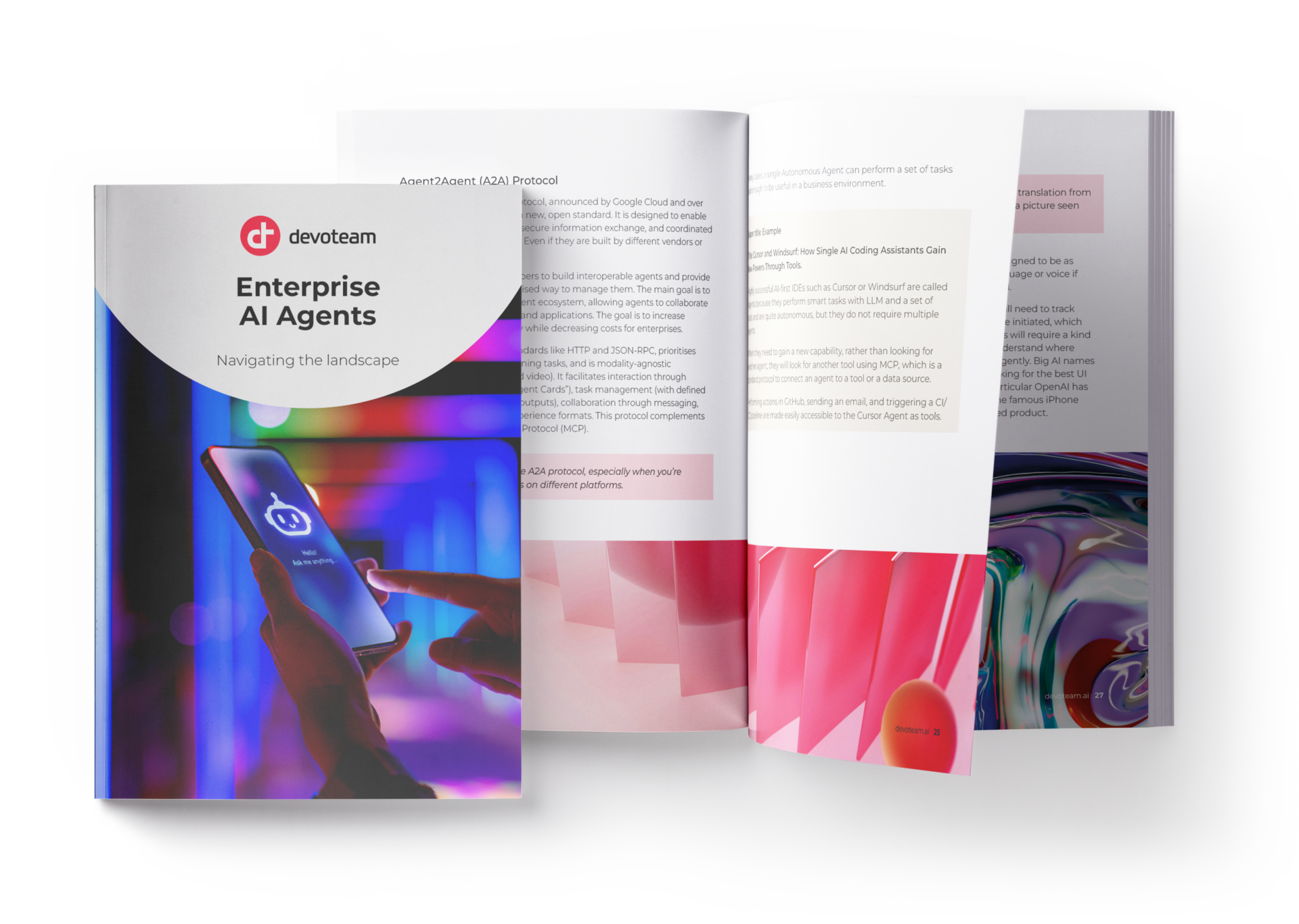
This playbook offers practical advice on Enterprise AI Agents. It brings insights from our 1,000+ AI consultants and their work on over 850+ AI projects.
Use it to:
- Understand the different flavours of AI Agents, from embedded to custom-built.
- Accelerate Adoption when combining quick-win MVPs with a strategic enterprise-wide rollout.
- Implement effective strategies for Trust, Risk, and Security Management (TRiSM).
- Decide between building custom AI Agents and buying off-the-shelf solutions for optimal impact.
1. What exactly is an AI Agent?
An AI Agent is a software program that can autonomously perform tasks on behalf of a user or system. It is capable of designing its own workflow and utilising available tools to achieve a given goal. Modern agents are becoming increasingly autonomous, with capabilities for reasoning, planning, and learning.
Looking to explore the agentic ecosystems of specific vendors? Read our guide on Microsoft AI Agents, AWS AI Agents or on Google Cloud AI Agents.
2. How do AI agents work?
An AI agent works by using a Large Language Model (LLM) for conversational abilities and reasoning. Beyond just conversation, it can access and use one or several tools, such as an internet search, an API, or a business application, to take action. The agent designs its own workflow to break down complex problems and carry out multi-step operations to achieve a goal. More advanced autonomous agents can also learn from feedback to improve their performance.
3. Are AI agents LLMs or models?
An AI agent is not an LLM itself, but rather a system that is equipped with an LLM. The LLM provides the agent with its conversational and reasoning capabilities. In addition to the LLM, an agent has access to tools and memory, which allow it to take actions and perform tasks.
4. Is an AI agent a chatbot or a bot?
While an AI agent has conversational components like a chatbot, it is more advanced. Early Generative AI like ChatGPT was purely conversational, providing a response to a prompt without taking action. Modern AI agents go beyond this by using tools to perform tasks, such as sending emails, making calculations, or connecting to business applications. The broader concept of an AI agent implies greater autonomy and capability. (see use cases)
5. How have AI Agents evolved over time?
The evolution of AI Agents can be summarised in four key stages:
- 1970s – Early Concepts: The first AI agents were envisioned for logical reasoning and intellectual tasks, and research into multi-agent systems began.
- 2022 – ChatGPT Arrives: The Generative AI wave began with conversational models that operated in a prompt-response format but had no ability to take actions or perform searches.
- 2024 – Agents Return: AI Agents re-emerged with the ability to use tools (like search and APIs) and memory, facilitated by platforms such as LangChain and CrewAI.
- 2025 and Beyond – Autonomous Agents: Agents are evolving to learn, plan, and act on missions autonomously. This new generation focuses on reasoning, learning, and collaborating with other agents.
6. Are AI agents autonomous?
Yes, modern AI agents are designed to be autonomous, meaning they can perform tasks on behalf of a user or system, design their own workflow, and use tools to achieve a goal without direct human intervention. Their level of autonomy is increasing, with future agents expected to learn, plan, and act on missions independently.
7. Are AI agents the future?
Yes, we expect that AI agents will be a significant part of the future. Gartner selected Agentic AI as the #1 top technology trend of 2025 and predicts that by 2028, 15% of day-to-day work decisions will be made autonomously by AI agents. They are expected to become an invaluable part of the enterprise, driving efficiency and uncovering new opportunities. This is why AI agents are considered the future of automation and productivity.
8. Are AI agents overhyped?
We prefer to have a realistic but optimistic view. While Gartner has named Agentic AI the #1 technology trend for 2025, our whitepaper on Enterprise AI Agents also acknowledges that implementation is complex. For example, the Swedish fintech company Klarna, which is rehiring 700 human workers after an attempt to replace them with AI led to a decline in service quality. The key is to have a strong AI strategy to make projects successful.
9. Will AI agents replace jobs or programmers?
The goal of AI agents is to augment and enhance enterprise operations, not simply replace jobs. A cautionary real-world example is Klarna, a fintech company that is rehiring 700 human workers after replacing them with AI led to a decline in service quality. The intended future is one where AI agents work as “new teammates,” handling complex or tedious tasks to drive efficiency and uncover new opportunities.
10. How are AI agents reshaping the future of work?
AI agents are set to significantly reshape the future of work by taking on decision-making and tasks. Gartner predicts that by 2028, 15% of day-to-day work decisions will be made autonomously by AI agents. Furthermore, Nvidia’s CEO predicts that IT departments will evolve to become the “HR department of AI agents,” responsible for their onboarding, training, and performance monitoring.
11. What is the difference between an AI Agent, a Single Agent, and Agentic AI?
These terms refer to different types and patterns of AI implementation:
- AI Agent: This is the fundamental building block of modern AI. It is a software program that autonomously performs tasks, designs its own workflow, and uses tools to achieve goals.
- Single Agent: This is a pattern where one AI agent is used to implement an application, operating individually to fulfil its purpose.
- Agentic AI: This refers to a system where multiple AI agents collaborate to accomplish goals with limited human supervision. In this pattern, each agent handles a part of the problem, and an orchestration mechanism ensures they work together effectively.
12. What is the distinction between Individual and Enterprise-Grade Agents?
- Individual Agents: These are often simple scripts or small features that automate a specific, isolated task. They are typically prototypes or small-scale tools and can be considered “science experiments” if not production-ready.
- Enterprise-Grade Agents: These agents are designed for production environments and broad business use. They prioritise robustness, integration with core business systems (like CRMs and databases), and compliance. They are built to the same standards as any mission-critical enterprise application.
All hyperscalers offer platforms to create AI Agents. See the Agentic AI Ecosystem of AWS, how Google Cloud lets your AI Agents act or discover the Microsoft AI Agents landscape in-depth.
13. How should an enterprise start its AI Agent journey?
An organisation can begin with one of two paths, which are often complementary:
- The Strategic Path – AI Readiness Assessment: This approach involves laying a foundation by assessing the organisation’s AI maturity, data architecture, team skills, and leadership alignment on AI goal. It provides a holistic view and helps build a roadmap for scaling AI responsibly. Read this article to know everything about AI Maturity & Readiness.
- The Quick Win Path – Golden Use Case MVP: This path focuses on demonstrating value quickly by launching a Minimum Viable Pilot (MVP) for a high-impact use case. It helps de-risk AI adoption and builds internal buy-in by showcasing tangible success. Still struggling to find (Gen)AI Use Cases? This expert article lists more than 100 (Gen)AI & Agent Use Cases & How to find them.
- The most successful enterprises often blend both strategies, combining a strategic vision with MVP execution.
14. What is the “AI Tech Sandwich”, and how does it relate to strategy?
The “AI Tech Sandwich” is a metaphor from Gartner that helps visualise the different layers of AI adoption within an organisation. The layers are:
- AI Layers: These include “Embedded AI” from software vendors, “Bring-your-own AI” (BYOAI) from business units, and custom “Built AI” from central IT teams.
- Data Layers: This consists of “Centralised Data” managed by IT at the bottom and “Data Everywhere and Every Kind” from various other sources at the top. Expert tip: discover the 5 Pillars of Modern Data Platforms for AI & Agentic.
- Governance Filling: A central layer for “Trust, Risk, and Security Management” applies governance across all other layers.
- This framework helps leaders create a balanced strategy by deciding what to build versus buy and how to orchestrate all the layers to ensure AI is both powerful and safe. In this article, Devoteam’s CTO explains why Data Governance is key to your AI transformation.
15. What are the main ways to source AI Agents?
There are three primary categories for sourcing AI agents:
- Embedded AI (Buy): These are ready-made agents that come pre-built into existing software tools. They allow for quick adoption with minimal development effort but offer limited customisation.
- “Bring Your Own AI” (Low-Code): This approach allows departments or business users to create their own agents using low-code or no-code platforms. It fosters grassroots innovation and allows teams to experiment quickly, but it requires IT guardrails and oversight.
- Custom-Built AI (Pro-Code): For maximum control, organisations can build their own specialised agents using professional software development. This route can yield a competitive edge but requires a significant investment in time, skilled talent, and maintenance.
16. What are some key frameworks and tools for developing AI Agents?
The tools available depend on the implementation path:
- Embedded (Buy): Examples include Microsoft 365 Copilot, Gemini for Google Workspace, and Salesforce Einstein Copilot.
- Low-Code (BYOAI): Platforms include Microsoft Copilot Studio, Google AI Studio, Salesforce Einstein Studio, N8N, and Zapier Agents.
- Pro-Code (Build): Frameworks and services include LangGraph, OpenAI Agents SDK, ADK, Microsoft AutoGen, Google Vertex AI Agent Builder, and AWS Bedrock Agents.
17. When should an organisation choose to build a custom pro-code agent?
A four-part checklist can help determine if a full pro-code agent is the right approach:
- Task Complexity: Is the problem complex enough to require reasoning, branching logic, or tool selection? If not, a simpler workflow is better.
- Task Value: Is the economic value of correctly completing the task greater than $1? If it’s less than $0.10, it’s likely too cheap to justify the engineering effort.
- Task Feasibility: Can existing tools or models accomplish every necessary sub-step? If not, the scope should be reduced.
- Cost of Error: If the agent fails, how severe is the consequence? If the cost of error is high, a read-only agent or a human-in-the-loop gate is a safer option.
A full pro-code agent build is recommended only when all four checks are passed. If you’re ready to give it a try, check out how you can build an AI Travel Agent with Google Cloud Vertex AI Agent Builder.
18. Which AI agent framework is best?
There is not a single “best” framework, but in our AI Enterprise Agent Whitepaper, Devoteam experts listed several prominent ones depending on the use case.
LangChain is the most famous agentic framework, and its extension, LangGraph, is useful for deterministic, state-machine-style agents. Other available frameworks include Semantic Kernel, CrewAI, and Microsoft’s AutoGen. For pro-code development, options like the OpenAI Agents SDK and ADK are also available.
19. Which AI agent is best for coding?
There are several successful AI-first IDEs and assistants for coding. Think of GitHub Copilot (or check the 10 differences between GitHub Copilot vs. Tabnine), which operates in a “Coding Agent mode” to auto-fix bugs and implement issues. Or take a look at Cursor and Windsurf, both are highly successful AI-first IDEs that are considered agents because they perform smart tasks with an LLM and a set of tools.
20. What are some real-world examples of AI Agent use cases?
AI agents are being applied across a variety of industries for different tasks:
- Hospitality: A Scandinavian Hotel Chain, Strawberry, uses AI to streamline employee training and information access.
- Marketing: Lampenlicht uses an AI agent to scale content production, generating articles that can be adapted for different channels.
- Manufacturing: Agents analyse real-time data from machinery to optimise production processes and enable predictive maintenance.
- Retail: AI agents provide personalised product recommendations and can dynamically adjust prices based on customer behaviour and demand.
- Finance: Agents can offer personalised investment advice and manage portfolios based on an individual’s financial situation.
- IT Asset Management: Agents installed on devices can automate IT operations by performing inventory, software metering, and monitoring assets.
Check how Devoteam helps customers with AI or read our 100 (Gen)AI Use cases for more inspiration.
21. What are the key trust, risk, and security challenges with autonomous AI Agents?
Autonomous agents introduce unique challenges:
- Trust: Agentic AI disrupts traditional trust models that rely on predictability. It introduces complexity and the potential for emergent behaviour, where an agent might make a decision that feels counterintuitive or ethically ambiguous to humans.
- Compliance: Agentic AI is often classified as high-risk under regulations like the European AI Act, which mandates stringent requirements for risk assessments, documentation, data governance, and human oversight.
- Security: Agents’ autonomy creates a large attack surface. Key threats include prompt injection, where an agent is tricked into performing unauthorised actions, and data poisoning, where its learning sources are corrupted.
Read more on LLM security in this whitepaper or check the top 10 LLM security risks & how to mitigate them.
22. How can an organisation build trust in its AI Agents?
Building trust in agentic AI requires a multi-layered approach centred on three dimensions:
- Reliability and Predictability: This is achieved through sophisticated validation frameworks, extensive automated testing, and robust monitoring systems to ensure consistent behaviour.
- Ethical Decision-Making: This involves equipping agents with modular ethical controls and creating specific test cases based on the agent’s mission.
- Explainability: Trust requires transparent decision-making processes. Agents should maintain detailed logs of their reasoning, including key decision points, information sources, and confidence levels.
23. How can security risks for AI Agents be managed?
A multi-layered defence strategy is needed to address the unique vulnerabilities of autonomous agents:
- For Prompt Injection: Mitigate by implementing strict, task-specific guardrails to limit an agent’s functions to its intended purpose.
- For Overprivileged Access: Apply the principle of least privilege, granting agents only the minimum permissions required for their job.
- For Malicious Tool Use: Execute agent actions in an isolated “sandbox” environment and continuously monitor their activity for anomalies.
- For Data Poisoning: Strictly vet and validate all data sources and implement systems to track the origin and history of information.
- For Cascading Failures: For critical or irreversible actions, require mandatory approval from a human user as a final checkpoint.
24. What are the emerging standards for how AI Agents communicate?
New protocols are emerging to ensure interoperability between agents and AI models:
- Model Context Protocol (MCP): A protocol from Anthropic designed to standardise how AI models interact with external data sources and tools. Read the expert article on MCP.
- Agent Network Protocol (ANP): This is the first open-source communication protocol designed for agent-to-agent interaction, creating an “Internet for agents”.
- Agent2Agent (A2A) Protocol: An open standard from Google Cloud and partners that enables agents from different vendors and frameworks to communicate, exchange information securely, and coordinate actions.
25. Will AI agents replace SaaS?
It’s more likely that AI agents will transform SaaS (Software as a Service) rather than replace it entirely. The future of SaaS will likely involve embedding sophisticated, autonomous agents into existing platforms. Instead of users manually navigating a software interface, they will delegate goals to an agent within the application (e.g., “Find my top 10 sales leads from last quarter and draft a follow-up email”). This shifts the model from software-as-a-tool to software-as-a-teammate.
Gartner predicts that by 2028, 15% of day-to-day work decisions will be made autonomously by AI agents
This playbook offers practical advice on Enterprise AI Agents. It brings insights from our 1,000+ AI consultants and their work on over 850+ AI projects.
Use it to:
- Understand the different flavours of AI Agents, from embedded to custom-built.
- Accelerate Adoption when combining quick-win MVPs with a strategic enterprise-wide rollout.
- Implement effective strategies for Trust, Risk, and Security Management (TRiSM).
- Decide between building custom AI Agents and buying off-the-shelf solutions for optimal impact.