



Estimated reading time: 12 minutes
Introduction
According to Google’s report, more than 90% of enterprises are interested in incorporating agentic AI in the next 3 years. Furthermore, Gartner predicts that by 2028, 33% of enterprise software applications will include AI agents. Why the strong interest if Generative AI was all the hype just a minute ago?
While nearly every organisation is experimenting with Gen AI, many are struggling to see a tangible return on investment. The gap between potential and profit often lies in one key difference: action. This is where Agentic AI steps in, transforming AI from generating content to getting the job done.
From this guide, you will learn how to enter the Agentic AI world with Google Cloud Platform. Discover the essential products for developing and deploying AI agents, explore inspiring use cases across key industries, and get a clear roadmap to begin your journey with Agentic AI on GCP.
Download Now: The AI Agent Handbook by Google Cloud
Generative AI vs Agentic AI
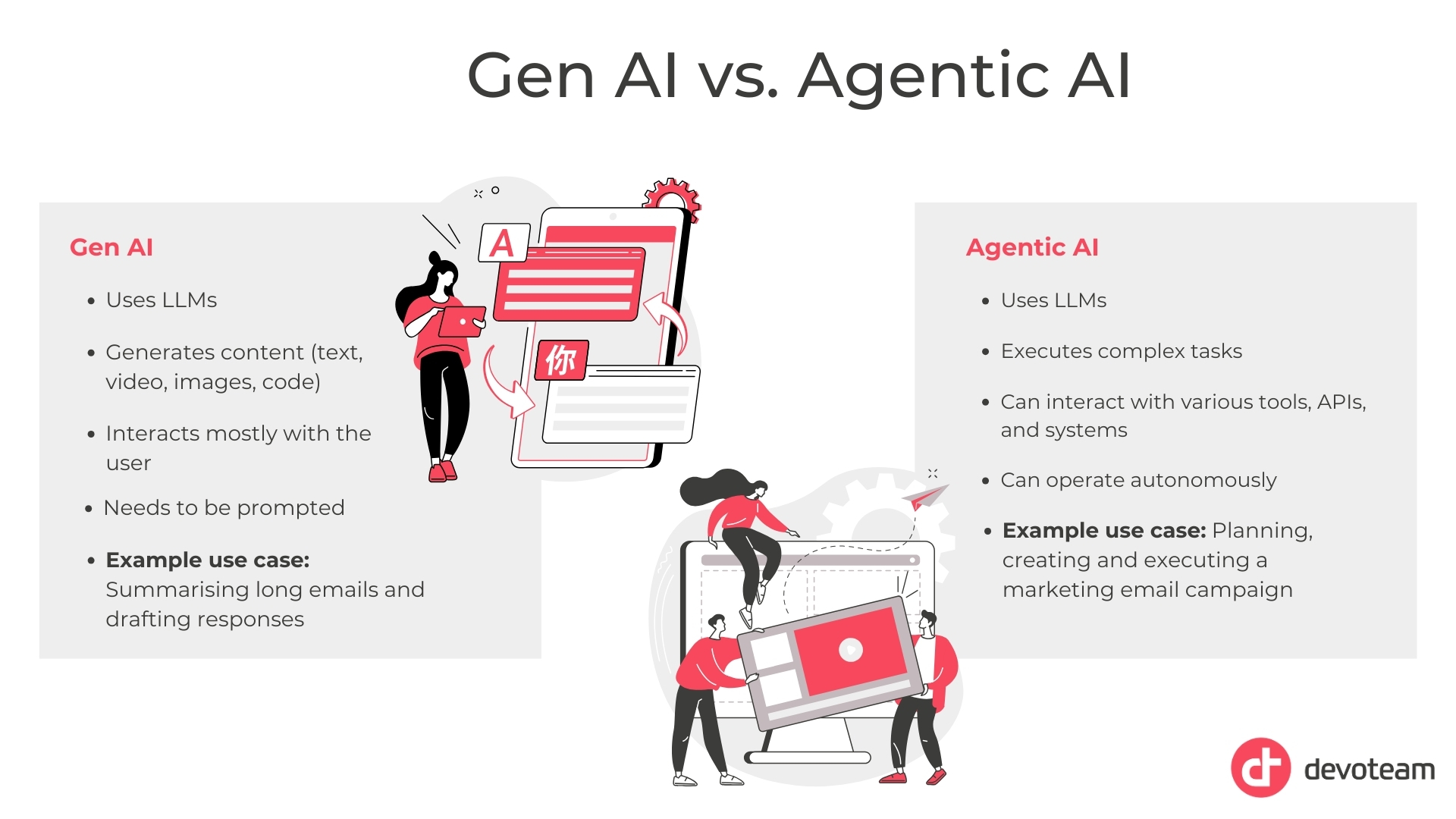
Firstly, the basics – both Gen AI and Agentic AI use large language models (LLMs) to automate tasks and speed up processes. Although they are related concepts, their capabilities and operating methods are different.
The differences between Generative AI and Agentic AI become clearer when you look at the names. Generative AI uses LLMs to generate new content like text, images, or code. Agentic AI, on the other hand, acts like an agent, orchestrating and executing tasks using LLMs and different tools. Think also about the concept of “agency” – it refers to the ability to act independently. And that’s precisely what AI Agents can do – act autonomously to perform complex tasks. “Agency” also means an organisation that provides a service, so you can imagine Agentic AI as your own personal, digital agency that you contact when you need to get a complex job done. And Generative AI can be “hired” as part of that agency, but it only does what it is prompted to do.
Agents are not autonomous in the sense that they have a mind of their own and can suddenly make a bank transfer or order food. They don’t have a consciousness and can only act within the scope of what we defined.
Where does this shift from Gen AI to Agentic AI come from? According to Google Cloud’s 2025 State of AI Infrastructure report, 98% of organisations are using or experimenting with Gen AI. We are definitely past the experimenting stage. However, many businesses find it challenging to translate generative AI’s potential into tangible ROI. Agentic AI bridges this gap by combining the reasoning power of generative models with the agentic ability to take action in business systems.
Agentic AI or AI agents?
These terms are sometimes used interchangeably, but they describe different elements of the same concept. In essence, AI agents are the components, while agentic AI is the system that coordinates these components to accomplish complex tasks.
Google AI Agent Products and Frameworks
Now that we have clarified the definitions, how can you develop, deploy, and manage AI agents and agentic AI systems on Google Cloud? Google offers a suite of products and services designed to be flexible, scalable, and secure. Their solutions cater to both developers and enterprises.
Gemini Enterprise

What is it?
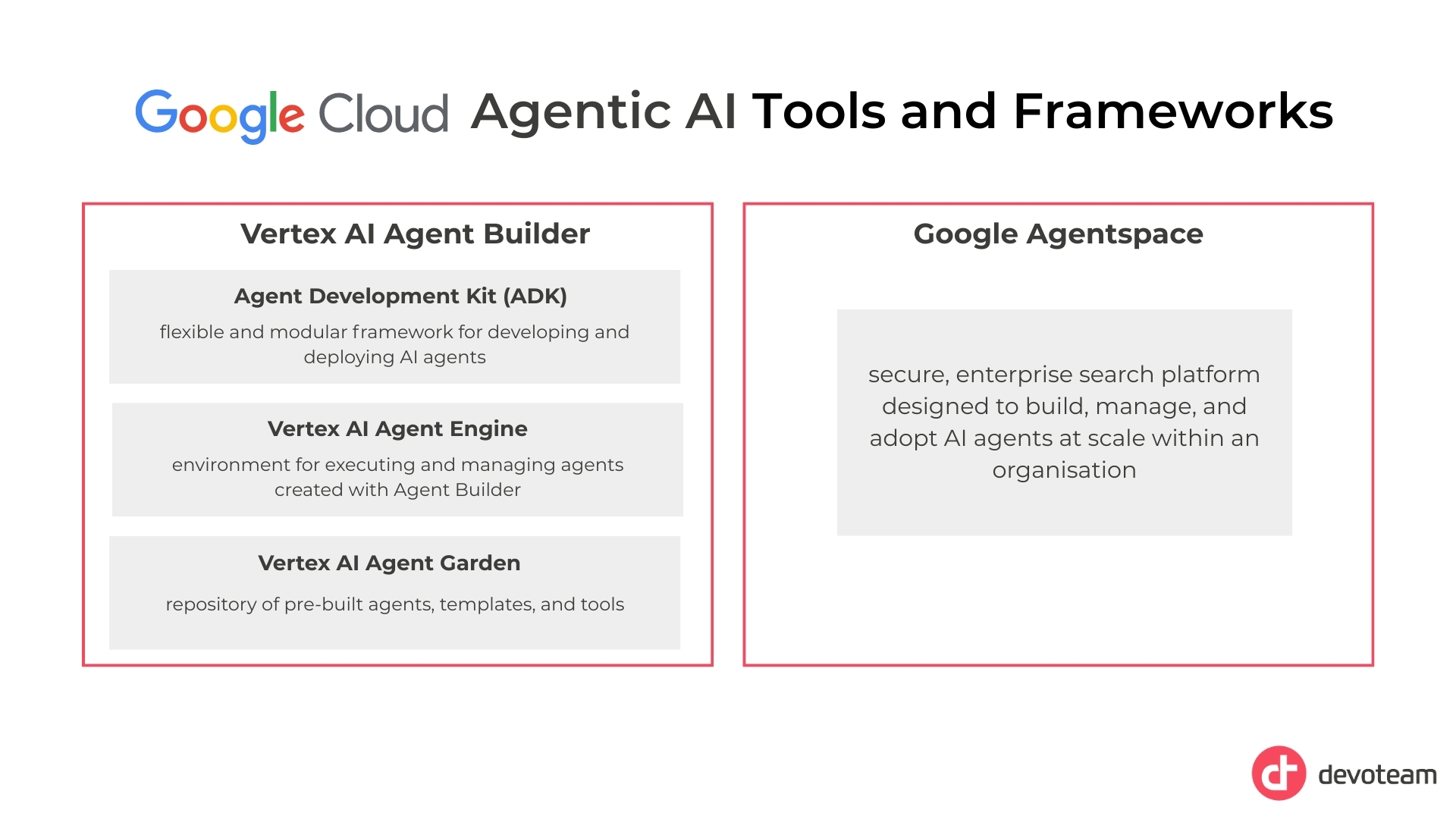
Gemini Enterprise is a secure, enterprise search platform designed to build, manage, and adopt AI agents at scale within an organisation. It breaks the data silos, combining all your connected data, different applications and knowledge available on the Internet.

What is it for?
Creating a secure, unified workspace for searching internal data and automating multi-step workflows for enterprises.

Key elements:
- Pre-built Google Agents: Offers ready-to-use expert agents like the Deep Research agent for comprehensive reports.
- Agent Gallery: This is where users can access the pre-built Google Agents and any custom agents they built and deployed on Gemini Enterprise.
- Multi-Agent Ecosystem Support: This allows building an ecosystem of custom agents that support open protocols like Agent2Agent. It ensures interoperability between agents from different vendors and frameworks.
- Extensive Connectivity: It integrates with critical enterprise systems and applications (e.g. SharePoint, Google Drive, Outlook, Confluence, Jira, ServiceNow), eliminating information silos.
- Agent Governance and Orchestration: You can manage and scale enterprise-wide agent adoption, including user access, agent provisioning, and multi-agent coordination, ensuring centralised governance and monitoring.
- Enterprise-Grade Security: Built on Google Cloud’s secure-by-design infrastructure, offering robust security measures like encryption, data residency guarantees.
Vertex AI Agent Builder
Read the full guide on Vertex AI here.
What is it?
A suite of tools offered by Google Cloud for creating and deploying sophisticated, enterprise-grade AI agents with minimal to no coding.
What is it for?
Creating conversational AI agents, chatbots, and generative AI applications that need to be grounded in specific data sources and quickly deployed in an enterprise environment.
Key elements:
- Agent Garden: a library full of ready-made sample assistants and tools to give you a head start. Instead of building from scratch, you can browse the ‘garden’ to find examples you can adapt, helping you get your project up and running much faster.
- Agent Development Kit (ADK): a framework for developing and deploying AI agents. It’s flexible and modular, and it aims to make agent development similar to traditional software development. It simplifies the creation and orchestration of agentic architectures, from simple tasks to complex workflows.
- Vertex AI Agent Engine: Environment for executing and managing agents created with Agent Builder. It includes services to run the assistant, check its performance, remember past conversations, and store key information.
- Agent Tools: These are the special abilities and connections you can give your assistants to make them truly useful. They can be equipped with:
- Built-in Tools: Use Google Search, Vertex AI Search, and the RAG Engine to provide factual answers grounded in data. Also includes Code Execution to perform tasks.
- Google Cloud Connectors: Link to your company’s own software (Apigee), over 100 common business apps (Integration Connectors), or build bespoke connections (Application Integration).
- Ecosystem and Other Tools: Add more capabilities using popular toolkits like LangChain and CrewAI, along with specialised tools (MCP) for better context.
Do you want to know how to build AI Agents with Vertex AI Agent Builder? My colleague did a great job preparing a step-by-step guide to building your first agent!
Use Cases
We established what Agentic AI is and what tools can help you implement it in your business. Now, it’s time to dive into what problems it can solve.
1. Telco
| AI Agents for: | Problem | Agentic AI Solution |
| Network Operations | Reactive, manual network management leads to slow issue resolution and significant network downtime. | Agents proactively monitor network telemetry data to autonomously detect anomalies, pinpoint root causes, and trigger resolution workflows, reducing downtime. |
| Financial Strategy | Static pricing models that fail to capitalise on fluctuations in real-time demand and network usage. | Agents enable dynamic pricing by using models that automatically adapt to real-time demand and usage patterns, optimising revenue. |
| Revenue Assurance | Revenue is lost due to undetected billing discrepancies and manual, slow recovery processes. | Agents prevent revenue leakage by automatically identifying billing errors and discrepancies, and then initiating recovery actions without human intervention. |
2. Financial Services & Insurance
| AI Agents for: | Problem | Agentic AI Solution |
| Insurance | Slow, manual underwriting and quote generation processes. | Agents streamline underwriting by synthesising applicant and risk data to create individualised risk profiles, flag edge cases for human review, and accelerate the process. |
| Wealth Management | Time-consuming creation of personalised investment plans and continuous manual portfolio monitoring. | AI agents support advisors by creating personalised investment plans, monitoring portfolio performance and recommending adjustments. |
| Banking | High-friction, manual Know Your Customer (KYC) and client onboarding workflows, which can lead to delays and compliance risks. | Agents automate the entire KYC process by gathering and validating identity documents, screening applicants and completing onboarding tasks to reduce client friction and enhance compliance. |
3. Healthcare
| AI Agents for: | Problem | Agentic AI Solution |
| Healthcare Providers | Manual and fragmented patient journey coordination, leading to administrative overhead and delays. | Agents enhance care coordination by automating the entire patient journey, from initial intake to appointment scheduling, freeing up staff and improving efficiency. |
| Payers (Insurers) | Complex and slow revenue cycle management, resulting in errors, fraud, and delayed reimbursements. | Agents orchestrate the claims process by managing coverage verification, fraud detection, and payment, which improves accuracy and accelerates reimbursement cycles. |
| Research Firms | Lengthy and resource-intensive timelines for drug discovery and clinical trials, slowing the development of new therapies. | AI agents accelerate research and development by assisting with drug discovery and automating clinical trial operations like site activation and patient monitoring. |
4. Retail
| AI Agents for: | Problem | Agentic AI Solution |
| Customer-Facing Operations | Impersonal shopping experiences and slow, manual post-purchase support for inquiries and returns. | Agents personalise the customer journey by offering tailored product recommendations, handling service questions and processing returns. |
| Backend Operations | Inefficient inventory management, leading to stockouts or overstocking, and manual supplier reordering processes. | Agents automate stock replenishment by analysing real-time demand signals. Procurement agents can also manage supplier reordering automatically to prevent stockouts and reduce costs. |
Getting Started with AI Agents on Google Cloud
Feel inspired to start with Agentic AI? Before you jump in, ask yourself some questions:
1. What do I need?
It seems obvious, but start by asking yourself if you need an AI Agent. Identify problems caused by repetitive and time-consuming manual tasks. These are often excellent candidates for AI automation. If the solution requires the AI to perform actions, then an Agentic AI is the way to go!
Example: You need an AI recommender that can improve customers’ shopping experience.
2. What does it need to do?
Identify the specific actions the agent must be able to perform. Once you know that, it’ll be easier to identify the data the agent will need, the APIs it will need to connect to, and the Google Cloud tools you could use.
Example: Your AI recommender needs to be able to suggest products to clients based on their previous purchases and their similarity to other users.
3. What does it need to know?
Consider what context or knowledge the agent requires to solve the problems you identified. Based on that, you will identify additional tools your agent will need. For example, BigQuery will allow it to analyse structured data and store general information. For advanced Retrieval Augmented Generation (RAG) systems, use a vector database like AlloyDB or Vertex AI Vector Search. This would allow the agent to search based on meaning and context, not just keywords.
Example: Your shopping recommender needs to access and analyse data about users and their shopping history.
4. Do I need to start from scratch?
There’s no point in reinventing the wheel! Explore available pre-built agents with accessible code from Vertex AI Agent Garden or ready-to-use agents in Gemini Enterprise. Consider the limitations of what’s available and compare your answer to questions 2 and 3.
Example: Your AI recommender can be used with pre-built agents, but you will be limited in your ability to control how data is processed or indexed.
The questions above should be a good starting point. They will also ensure that you take the problem-first approach, which helps you avoid unnecessary investments in technology that don’t address your challenges.
Conclusion
While generating content is powerful, the true return on investment lies in autonomous action. Agentic AI is the next evolution, bridging the gap between an AI that can generate and an agent that can execute.
Google Cloud provides a flexible ecosystem to bring this vision to life. Whether you are a developer building complex, custom workflows or a business leader deploying enterprise solutions, the platform is designed to support your organisation in intelligent automation.
But to successfully implement Agentic AI, you need both the right tools and expert guidance. That’s where our team can support you! Contact our Google Cloud AI experts to get started!
Discover what the AI Agent Trends
mean for your business
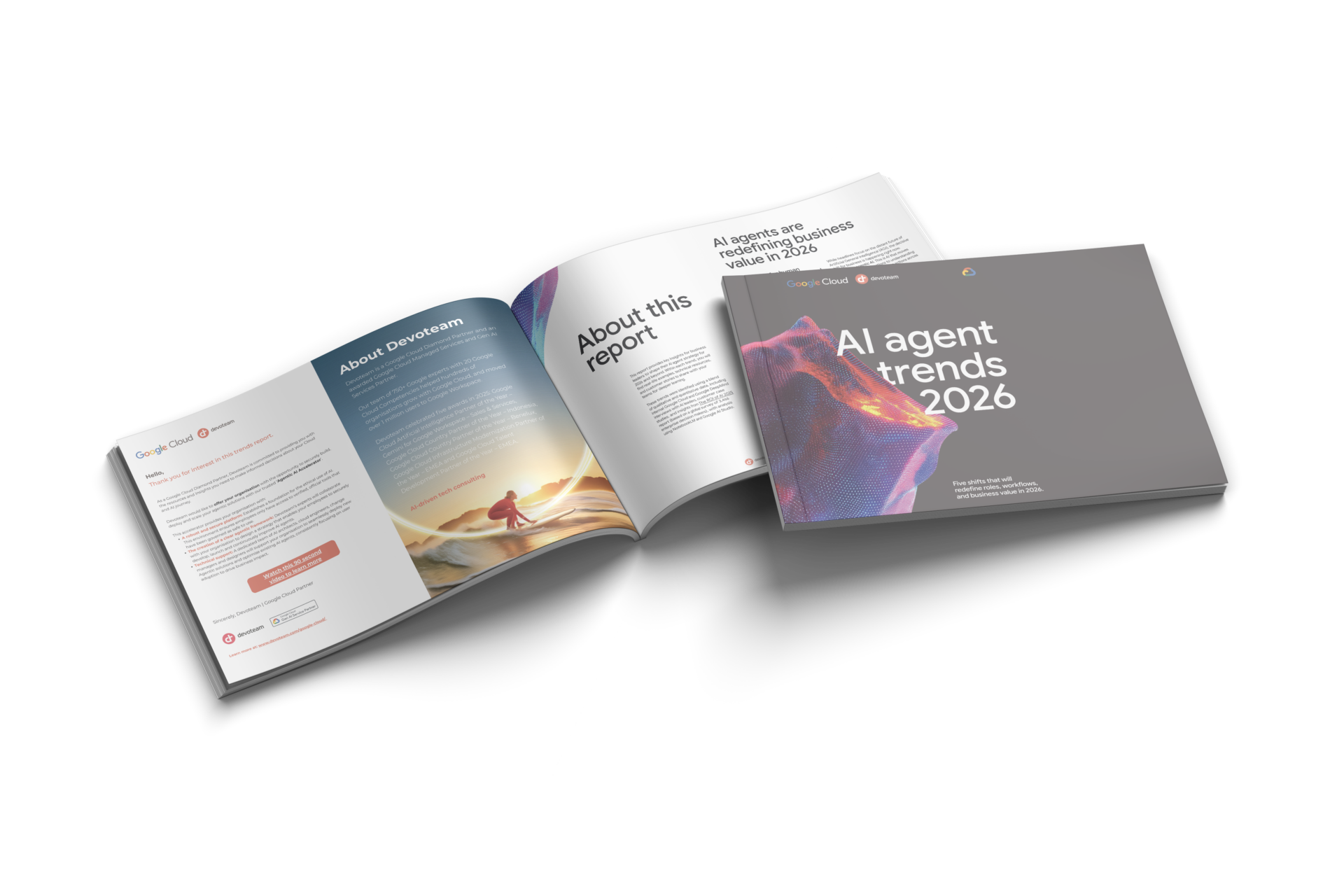
Download the report to find out:
- How the 2026 trends can shape your organisation’s agentic AI strategy.
- Practical examples on how to deploy agents across your enterprise.
- A series of adoption techniques to empower staff to use agentic AI.