

The “Portugal Digital Summit 2025”, held at the Lisbon Congress Centre on 22 and 23 October, established itself as a crucial event for the Portuguese digital economy. With the motto ‘Reinventing Business in the Age of Artificial Intelligence,’ the meeting served as a stage for leaders and experts to discuss the transformative influence of AI on organisations and society.
The event stood out for its rich and diverse content, featuring a structure of 10 themed stages. These stages addressed crucial challenges that mark the present and the future, focusing on topics such as: Future of Money, Future of Energy & Sustainability, Future of Digital Trust and Cybersecurity, among others. The debate was promoted through diverse formats, including Keynotes, Discussion Panels and Case Studies. The presence of several renowned speakers, such as astronaut Sara Sabry and researcher Nils Olaya Fonstad from MIT CISR, further enriched the quality of the programme.
Devoteam played a central role, appearing as a Stage Partner on the ‘Future of Leadership and Work Stage | New Paradigm Management in the AI Era’. This stage, entirely dedicated to management and cultural adaptation of work in the face of AI disruption, solidified Devoteam’s position as a thought leader in the areas of strategy, technology, and human capital.
Future of Leadership and Work Stage: A summary of the programme
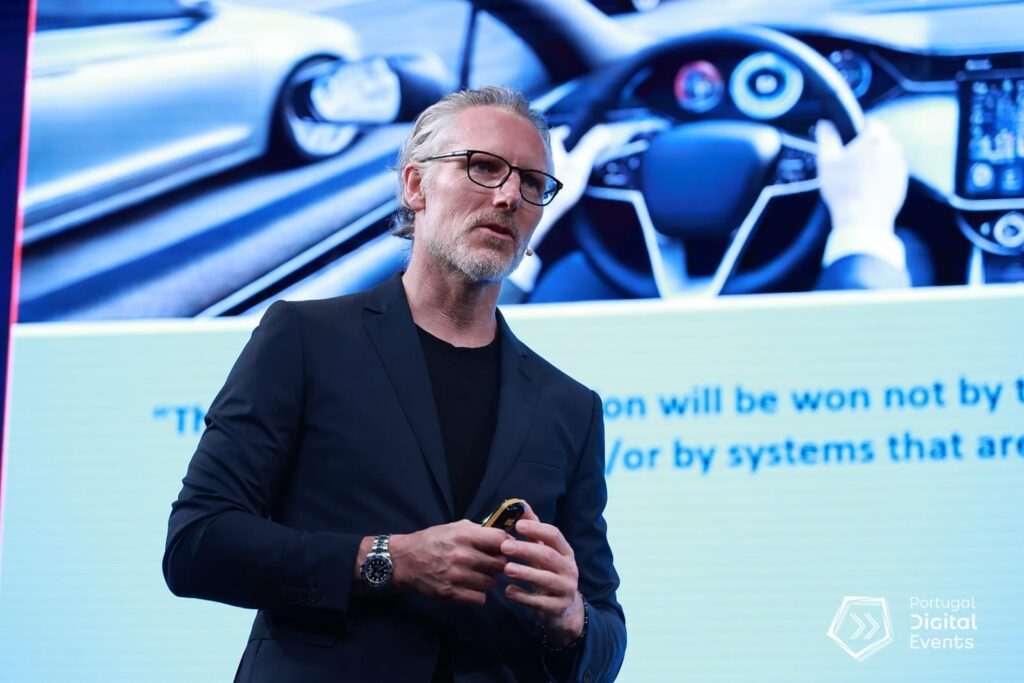

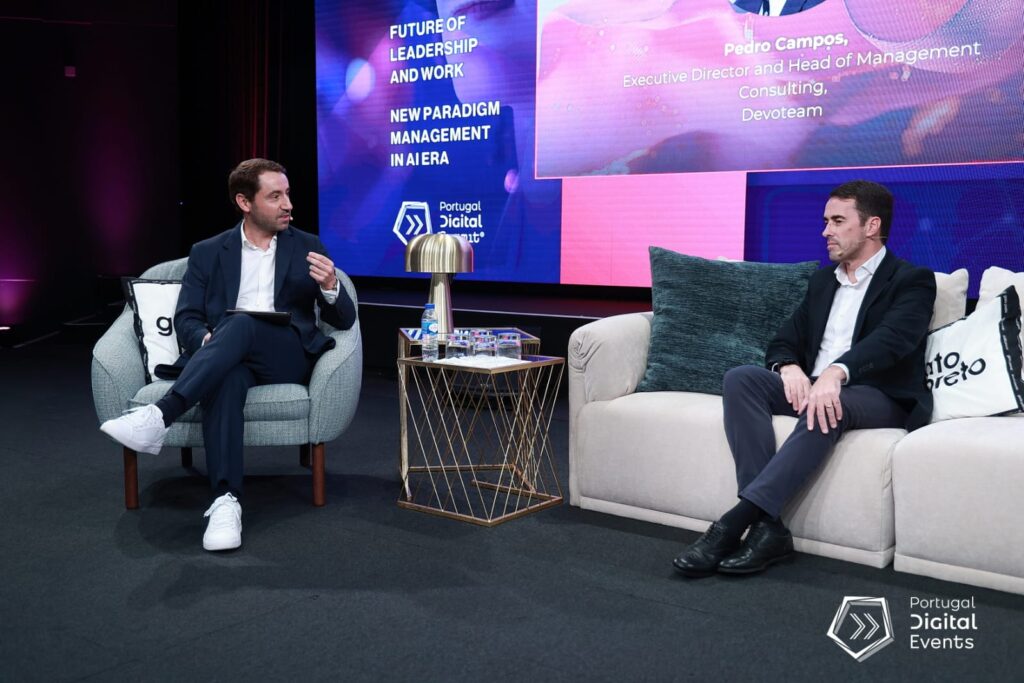

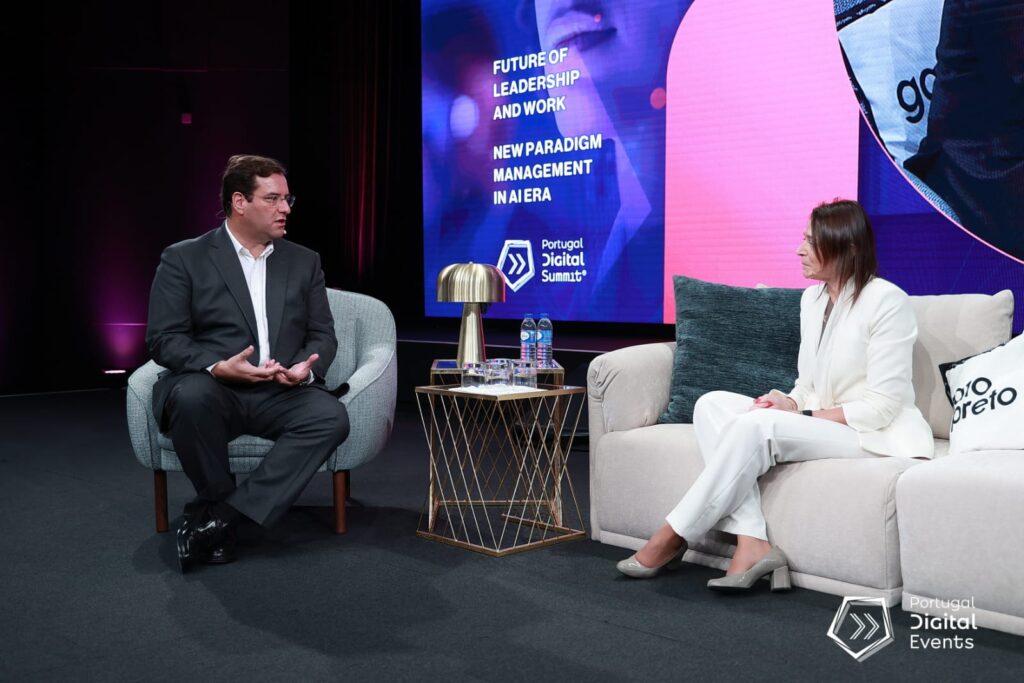
On the morning of 22 October, the ‘Future of Leadership and Work Stage | New Paradigm Management in the AI Era’ hosted a programme that integrated strategic vision, data analysis and operational application.
The programme began with the keynote speech ‘Towards the Agentic Enterprise’, presented by Jesper Schleimann, Head of Business AI at SAP EMEA One. His message focused on the transition to the next level of enterprise AI, highlighting the concept of ‘Agentic Mesh’.
The highlight of the programme was the Discussion Panel ‘Strategic Decision-Making in the AI Era: From Data to Action’, which featured Bruno Mota, CEO of Devoteam Portugal, Hélder Dias Ribeiro, CDO of Sonae MC, and João Nascimento, CIO of EDP. The panel was moderated by João Guedes Vaz, Board Member, Managing Partner, Global Head of Leadership Consulting at Boyden.
This was followed by the presentation of the case study ‘Rewriting the Operations Playbook: How Mota-Engil’s transformation path has included AI for End-to-End Innovation?’, in which Pedro Campos, Executive Director and Head of Management Consulting at Devoteam, and Filipe Morla, CEO of Mota-Engil Global, explored Mota-Engil’s strategic vision and digital transformation journey.
There was also time for a demonstration on the topic ‘AI Tools that Augment Management and Strategy’ led by Francisco Morais, SDR Manager at Factorial.
And finally, a Fireside Chat between Adolfo Martinho, General Manager of DXC Portugal, and Catarina Ceitil, CIO of Galp, providing a 360º perspective on culture, strategy and management tools in the new era of AI.
The future of decision-making: Highlights from the panel discussion
The panel discussion ‘Strategic Decision-Making in the AI Era: From Data to Action’ addressed a crucial challenge in the digital age: how to convert data into real and sustainable value for organisations.
This moment brought together Bruno Mota, Hélder Dias Ribeiro, and João Nascimento, leaders who, in their daily roles, are at the forefront of the evolution of decision-making models, promoting the use of data, algorithms, and increased collaboration for more agile, reliable, and value-generating decision-making, with the discussion focusing on three major themes:
Data governance: The critical factor for AI scalability
One of the points of discussion focused on the challenge of Artificial Intelligence scalability. Despite vast investment in infrastructure, the transition from proofs of concept (PoCs) and MVPs to large-scale implementation is often interrupted. The main barrier identified is not technological, but rather organisational in nature.
The need for robust and non-negotiable data governance was the central point of consensus among all speakers, considered essential for the successful implementation and scalability of Artificial Intelligence. João Nascimento emphasised the importance of having ‘good foundations’, warning that ‘bad data generates bad outputs’. As an example, he mentioned EDP’s investment in cataloguing more than 80% of its data domains. Bruno Mota added to this, warning that many companies that consider themselves data-ready end up failing due to the absence of an adequate governance structure.
Enablement at scale
The transition from experimentation to actual business transformation requires a significant effort in large-scale training and a clear demonstration of Return on Investment (ROI).
This point was highlighted by Hélder Dias Ribeiro, who presented Sonae MC’s ‘AI Accelerate’ programme, structured around three essential pillars: People (focus on digital literacy and skill set development); Process Transformation (avoiding the application of AI to obsolete processes); and AI-enabled Products. Sonae MC’s CDO also emphasised that ‘value measurement’ is the key factor in unlocking potential in organisations.
Along the same lines, João Nascimento highlighted EDP’s investment in training thousands of employees, adapted to different levels of maturity in AI.
In conclusion, Bruno Mota summarised that the biggest challenge lies precisely in validating ROI and ensuring that AI projects evolve from mere experiments into robust solutions capable of effectively transforming organisational processes and workflows.
Human-in-the-loop
The panel discussion emphasised that the future lies in optimised collaboration between humans and machines, rather than an exclusive choice. Hélder Dias Ribeiro illustrated this synergy by sharing the use of quasi-autonomous agents in cybersecurity. In addition, Bruno Mota highlighted the importance of human intervention, estimating that ‘90% of agents would benefit from having a human-in-the-loop component’ for greater assertiveness and confidence in decision-making. João Nascimento reinforced that the human factor represents, above all, a strategic and differentiating issue in the market.
In summary, it was concluded that, although automation is ideal for technical and back-office processes, crucial customer-oriented decisions still require human oversight.
In this context, competitive advantage will not be determined by algorithms, which are widely accessible (democratised), but rather by how technology is specifically applied to the business, by leadership vision, by valuing talent, and by speed of implementation.
The Operational Playbook: Mota-Engil’s digital transformation
The conversation, entitled ‘Rewriting the Operations Playbook: How Mota-Engil’s transformation path has included AI for End-to-End Innovation?’, focused on how Artificial Intelligence can drive operational efficiency.
Pedro Campos, Executive Director and Head of Management Consulting at Devoteam, and Filipe Morla, CEO of Mota-Engil Global, began the session by addressing the challenge of innovating in a traditional sector such as construction and exploring the factor that triggered the integration of technology into their daily lives.
Focus areas for innovation and productivity
Filipe Morla explained that Mota-Engil’s digital transformation journey arose from the need to add value, break down silos and structure a programme focused on three areas: Efficiency (automation and robotics), Customisation (adapting system output to users) and Data (real-time delivery capability).
Pedro Campos then introduced the topic of productivity, classifying it into two areas: individual (related to the workplace) and corporate (focused on operations and the work front). When questioning the effectiveness of current results and the state of play, Filipe Morla revealed that the group is already using Artificial Intelligence combined with ERP (SAP) to optimise processes in the supply chain and construction logistics, in a project that has ‘just come out of the laboratory’. The main aim is to free employees from administrative tasks, allowing them to focus on timely, high-quality delivery.
Global scale and governance
Faced with the challenge of scaling innovation across the 20 countries where Mota-Engil operates, Pedro Campos questioned how to bring together these different geographical realities. Filipe Morla pointed out that scalability requires a broad programme involving all geographical areas, which is essential for defining rules and priority needs. The crucial lesson learned from this process is the need for continuous sponsorship and ‘very strong sponsorship from the Executive Committee’.
From debate to action: The imperatives of the AI era
The ‘Portugal Digital Summit 2025’ outlined a clear path for organisational transformation. The event emphasised that the evolution of Artificial Intelligence requires, as a priority, rigorous data governance, substantial investment in skills training, and the integration of the human element as a fundamental strategic axis.
In this context, Devoteam reaffirms its role as a catalyst for this transformation. Its commitment is clear: to support its partners in converting the complexity of digital evolution into concrete, value-adding solutions, with a focus on sustainability and the human factor.