

Estimated reading time: 11 minutes
ROI has been our comfort metric for decades.
It gave leaders a shared language, boards a sense of control, and investment committees a clear equation: return minus investment, divided by investment, multiplied by 100. It works well when cause and effect are stable, when benefits can be isolated, and when timelines are predictable.
So let me be very clear: ROI is not dead.
However, when it comes to AI, ROI is no longer the primary measurement, or at least not initially. Not because financial discipline is optional, but because the shape and timing of value has changed.
AI is not a classic project investment. It is a capability, capacity and a mindset shift. And those shifts do not behave like quarterly-deliverable programs.
What you’ll read in this article
- Why Traditional ROI Becomes Fragile in AI
- VOI Is Not a Replacement for ROI – It is the Bridge to It
- The Golden Eggs Problem: Leaders Still Invest Like Time Is Abundant
- Value No Longer Comes from Optimisation Alone
- The Present Is Too Fast for “Wait and See”
- The Devoteam AI Investment Framework: A Useful Reality Check
- Literacy Is the Ultimate Value Multiplier
- AI Transformation Is Not a Digital Project With People Involved
- From “Outside the Box” to “Without a Box”
- The Real Shift: From Measuring Returns to Creating Conditions
- In a Nutshell : The World Can No Longer be Captured on X and Y Axes
Why Traditional ROI Becomes Fragile in AI

The issue is not that ROI is wrong. The issue is that ROI assumes conditions that AI routinely breaks:
- Delayed returns: AI initiatives can take months (sometimes longer) before producing measurable business impact.
- Adoption-dependent value: AI creates value only when people trust it, use it, and know what they are doing, so enablement (or the traditional change management) becomes part of the value equation, not a side activity.
- Complex attribution: AI often improves outcomes across multiple functions and steps in the value chain, making it difficult to isolate the “one benefit” from the “one investment.”
- Intangible benefits: Many of the earliest, strongest effects of AI show up as decision quality, speed, customer experience, or workforce empowerment, those advantages that are real but do not immediately convert into revenue lines.
- Hidden variable costs: Data work, integration, training, governance, and ongoing operations are not “extras”; they are the investment. Yet they are often hard to quantify upfront.
“While 65% organisations report positive returns on generative AI investments, the broader landscape of AI ROI measurement remains complex and often stagnant.”
– Dataiku Report
Value Is Created at Inference, Not Deployment
AI also challenges ROI because value is not created at design or deployment time. Value is created when AI is actually used.
This moment, known as inference, is where:
- decisions are augmented,
- workflows change,
- and behaviour shifts.

If AI is not inferencing at scale, there is no adoption, no transformation, and ultimately no value, regardless of how advanced the technology may be.

Patrícia Milheiro
AI Agency Strategy Director at Devoteam
If you demand classic ROI certainty too early, you often get one of two outcomes:
- You kill high-potential initiatives prematurely.
- You underinvest in the enablers that would have unlocked scale.
VOI Is Not a Replacement for ROI – It is the Bridge to It
This is where VOI (Value of Investment) becomes essential.
VOI does not deny financial accountability. It reorganises it. It is the discipline of answering a better question:
- What value does this investment unlock – now, next, and later – and for whom?
VOI recognises that AI creates value in layers:
- Some value is tangible (cost savings, productivity, revenue).
- Some value is intangible but decisive (faster decisions, better service, trust, resilience, talent uplift).
ROI measures what you can cleanly count today. VOI measures what you are deliberately building so that ROI becomes inevitable tomorrow.
In a world where the present is already moving at the speed we once reserved for the future, leaders need both. But they need them in the right order.
? What is VOI?
VOI (Value of Investment) is a holistic framework that expands beyond traditional ROI to measure both tangible financial gains and intangible assets like organisational agility, decision speed, and readiness. It evaluates value across multiple time horizons: now, next, and later. VOI acts as a bridge that justifies investing in capabilities today to ensure financial returns tomorrow.
The Golden Eggs Problem: Leaders Still Invest Like Time Is Abundant
Every leader faces the same fundamental question:
Where do I put my golden eggs?
Traditionally, the answer leaned toward predictability:
- Proven business lines
- Clear efficiency gains
- Short-cycle returns
But AI does not reward the typical safe allocation. AI rewards strategic concentration.
Many organisations spread their AI budgets thin, a pilot here, a tool there, a small experiment everywhere. And they call it progress. In reality, it is diffusion.
Patrícia Milheiro
AI Agency Strategy Director at Devoteam
Transformation requires focus because value compounds when:
- ownership is clear,
- business priorities are explicit,
- growth vision is understood,
- and successful patterns become repeatable.
This is why the “AI for all” approach often produces activity but not impact. The reality is, bluntly, a trap: organisations run many pilots without measurable impact because no one owns transformation end-to-end.
VOI forces a tougher conversation: what are the few bets that change the trajectory of the organisation?
Value No Longer Comes from Optimisation Alone
In stable environments, value comes from optimisation.
In volatile environments, value comes from optionality, which relies on agility, adaptability, strategic capacity, and resilience.
AI creates value not only by reducing costs or increasing output, but by expanding strategic capacity:
- faster sensing of signals,
- faster decision loops,
- faster reallocation of resources,
- and faster organisational learning.
This is why “preparing for the future” is no longer a visionary statement. It is a survival mechanism. Because the truth is: the present is too quick and unpredictable to rely on yesterday’s measurement models.
The Present Is Too Fast for “Wait and See”
A dangerous leadership instinct today is the illusion of optional delay:
“I’ll wait until the technology matures.”
“I’ll wait until ROI is clearer.”
“I’ll wait until others prove it works.”
By the time clarity arrives, the advantage has moved.
AI compounds in organisations that:
- learn faster,
- institutionalise what works,
- and build capability rather than collect pilots.
VOI captures this reality because it treats learning, readiness, and adoption as value, not as “nice-to-haves.”
The Devoteam AI Investment Framework: A Useful Reality Check
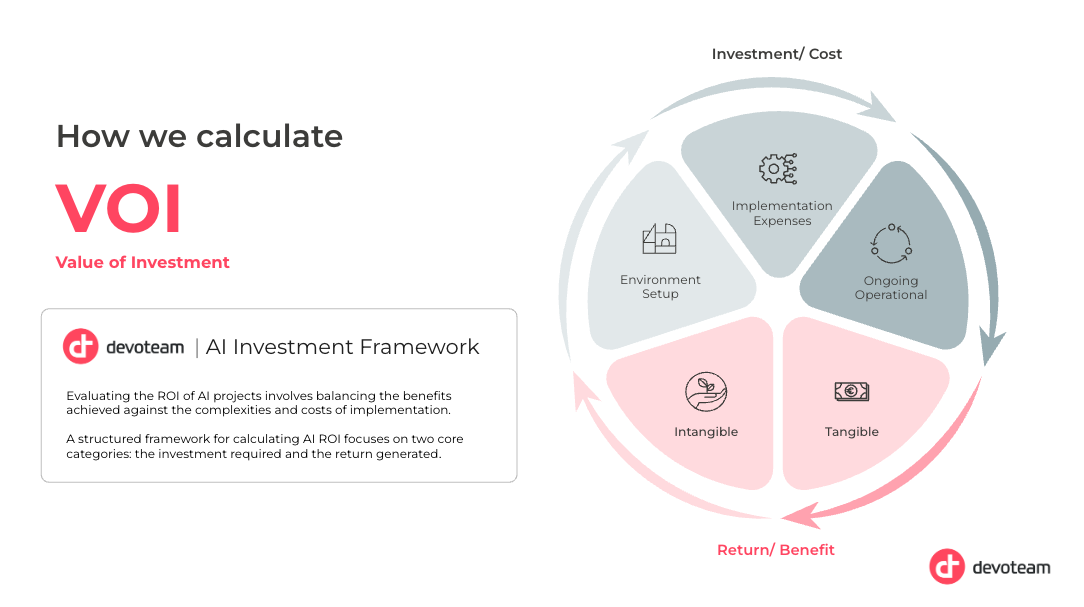
One of the most common reasons AI initiatives disappoint is simple: leaders assume AI is a technology spend. The real news is – it is not.
The Devoteam AI Investment Framework makes this explicit by structuring investment across the lifecycle into four pillars: Technology, Data, People, and Governance.
This matters because value collapses if one pillar is missing:
- Technology without data becomes a demo.
- Data without people becomes an unused asset.
- People without governance become a risk.
- Governance without real adoption becomes bureaucracy.
The Dynamic Nature of TCO
This is where Total Cost of Ownership (TCO) must be understood as dynamic, not static.
In AI, costs evolve with:
- adoption,
- inference usage,
- maturity,
- and literacy.
Rising operational costs are not always a warning sign; in many cases, they reflect real usage and embedded value. The risk is not cost growth, the risk is low usage driven by poor enablement.
In the AI ecosystem, the more you use, the more you spend, but the more value it can bring. Having said that, we should monitor it—specifically through FinOps—and identify how to optimise the solution, ensuring that usage remains high in a more cost-efficient way.
The framework also forces honesty about cost across stages: environment setup, implementation, and ongoing operations.
And it forces maturity about return: tangible and intangible, because AI returns are inherently multifaceted.
In other words: this is not an “ROI calculator.” It is an investment truth serum.
Literacy Is the Ultimate Value Multiplier
Here is what too many organisations underestimate:
The more AI-literate an organisation is, the more value it can perceive and capture.
AI value is not self-evident; it must be interpreted, trusted, and operationalised.
Without literacy, teams either:
- overtrust AI (risk), or
- undertrust AI (waste), or
- treat it as “just another tool” (missed leverage).
With literacy:
- leaders ask better questions,
- teams identify higher-value use cases,
- adoption accelerates,
- and value becomes visible sooner.
This is why literacy is not only training, it is economic enablement.
When people know what to do, how to do it, and where AI truly fits, the organisation stops debating whether value exists and starts scaling it. It goes beyond the human in the loop, to making the loop more human.
AI Transformation Is Not a Digital Project With People Involved
Let’s be clear, AI transformations are people projects enabled by technology.
AI changes:
- how work is performed,
- how decisions are made,
- what skills matter,
- how roles evolve,
- and how trust is built.
So the leadership levers shift too:
- from communication as broadcast to communication as continuous sensemaking and provide comfort to fail and redo,
- from periodic retraining to ongoing capability building,
- from top-down change plans to adaptive change leadership.
This is why change management is not a “phase.” It is a value engine. I can even risk saying that the “old”change management is just a static way of looking at this reinvention of our world. Because we do not manage change as before. We enable organisations to realise value from AI, continuously.
From “Outside the Box” to “Without a Box”
We like to tell leaders to “think outside the box.”
That advice assumes the box still exists, that the world can no longer be captured on traditional X and Y axes, this or that, binary choices with clear edges. And it does not.
The world is no longer X & Y.
AI dissolves boundaries:
- between functions,
- between strategy and execution,
- between planning and learning,
- between human judgment and machine augmentation.
The challenge now is not to think outside constraints, but to lead in a world without predefined constraints.
VOI is one of the few lenses that actually fit that reality because it does not pretend that value is always immediate, isolated, or purely financial.
Patrícia Milheiro
AI Agency Strategy Director at Devoteam
The Real Shift: From Measuring Returns to Creating Conditions
This is the leadership shift AI demands:
| From | To |
|---|---|
| Measuring outcomes after the fact | Creating conditions where outcomes become inevitable |
| Proving value once certainty exists | Investing in value ahead of certainty |
ROI still has its role, especially once solutions are stable, adopted, and scaled. But VOI is how you make the early and mid-stage decisions that determine whether ROI will ever arrive.
Because in a world where the present moves faster than our old models of planning, leaders do not win by predicting better.
They win by building organisations that are prepared for more futures than one. In other words, they win by building organisations that can adapt and perform well across different possible futures, not just one predicted scenario.
And that is what it means to lead, without a box, designing the AI journey as the path unfolds..
In a Nutshell: The World Can No Longer be Captured on X and Y Axes
- AI is not changing how we calculate value; instead it is changing what value looks like.
- ROI still matters, but it comes too late to guide the decisions that truly shape success. VOI helps leaders decide where to invest, what to prioritise, and how to prepare, in a world where change is constant and outcomes are not linear.
- Value today comes from business levers, focus, from people who understand what they are doing, and from organisations that invest in capabilities before certainty exists. It comes from literacy, trust, and the ability to adapt faster than the environment around us.
- Leadership is no longer about predicting the future, it is about building organisations that can create value across many possible futures, starting now.
The world can no longer be captured on X and Y axes. The box no longer exists.
AI demands a richer understanding of creating and managing value, and for that, we have VOI.
Patrícia Milheiro
AI Agency Strategy Director at Devoteam